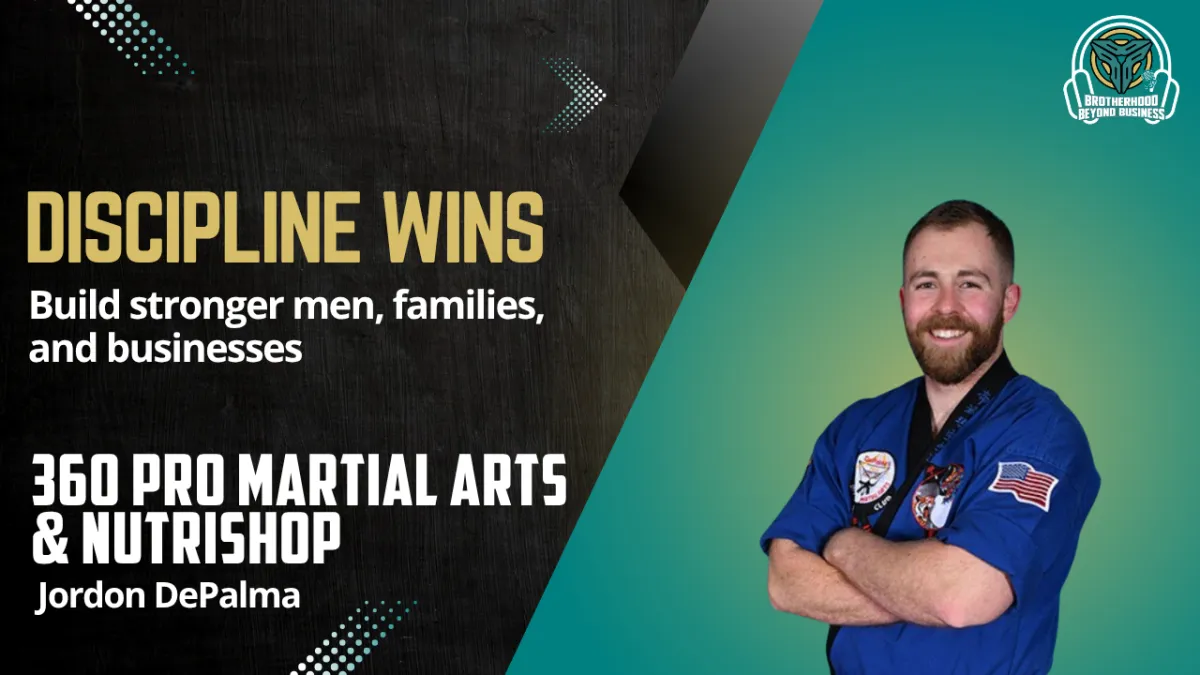
Ep 33 | Building Discipline, Family, and Business Through Martial Arts with Jordon DePalma
Episode 33 | Host: Trev Warnke | Guest: Jordon DePalma
🔥 Why This Episode Matters
Most men say they want discipline—but what they really have is motivation that comes and goes.
In business, that shows up as inconsistency. In life, it shows up as stress, lack of direction, and feeling like you’re always behind. You know what you should be doing… you just don’t do it consistently.
This conversation matters because it breaks down what real discipline actually looks like—and how it’s built through repetition, structure, and standards, not emotion.
Right now, more than ever, entrepreneurs need a foundation. Not more tactics. Not more ideas. A foundation that holds up under pressure.
🎧 Listen to the Episode
👤 Meet the Host & Guest
Trev Warnke — Instagram | Facebook | LinkedIn | Profile
Trev Warnke is an entrepreneur, coach, and co-founder of Brotherhood Beyond Business. Through the Brotherhood community, Trev works with male entrepreneurs who want to build strong businesses without sacrificing their health, faith, or family.
Jordon DePalma — Profile | Facebook
Jordon DePalma is the owner of 360 Pro Martial Arts in Prescott Valley, Arizona. He helps kids, teens, and adults build discipline, confidence, and leadership through structured martial arts training that carries over into everyday life.
About 360 Pro Martial Arts — Website | Facebook | Instagram
360 Pro Martial Arts focuses on building strong individuals through martial arts training that emphasizes discipline, respect, and consistency. Their programs are designed to help students develop confidence and leadership both on and off the mat.
📌 What You’ll Learn in This Episode
Why discipline is built through repetition—not motivation
How martial arts creates structure that carries into business
The difference between knowing what to do and actually doing it
How consistency impacts your leadership at home and work
Why standards matter more than goals
How to build confidence through small daily wins
The role of accountability in long-term growth
What most men are missing when they feel stuck
🧩 Episode Summary
Trev and Jordon dive into what discipline actually means in the real world—not the idea of it, but the daily execution of it. Jordon shares how martial arts creates an environment where structure, repetition, and accountability are non-negotiable.
The conversation moves into how those same principles apply directly to business. Most entrepreneurs aren’t lacking knowledge—they’re lacking consistency. And that gap is what holds them back from real growth.
They also discuss how discipline impacts family life. When a man lacks structure, it shows up everywhere. But when he builds it, everything around him gets stronger—his business, his leadership, and his presence at home.
This episode reinforces a core Brotherhood principle: you don’t rise to your goals—you fall to your systems. And discipline is the system that holds everything together.
🕒 Episode Timestamps
[00:00] Intro & why discipline matters
[05:10] Jordon’s journey into martial arts
[12:45] Discipline vs motivation
[20:30] Applying structure to business
[28:15] Leadership at home and family impact
[36:40] Building confidence through repetition
[45:10] Why most men stay stuck
[52:00] Final thoughts on discipline
💡 Quote Highlight
“Discipline isn’t something you turn on when you need it—it’s something you build every single day.”
🚀 Next Steps
👉 Download our Your Circle is Your Ceiling eBook
👉 Learn more about Our Method
📚 Resources & Links
Follow BBB on: Website | Instagram | YouTube | X | Facebook | Buzzsprout Podcasts
Watch the full episode on YouTube
Want to listen to future episodes: Spotify | Apple Podcasts | Buzzsprout
🚀Full Transcript
Trev Warnke (00:48)
All right guys, welcome back to another episode of brotherhood beyond business podcast today We're here with Jordan DePalma and we're gonna talk through his life We're gonna talk through his business and just get to know him better So Jordan go ahead and first give me just some feedback on why you moved to Prescott your family life and give me a little bit of base of who you are
Jordon DePalma (01:03)
Yeah, so I moved to Prescott Valley about eight years ago What brought me up here wasn't anything planned we actually opened up our karate school in Prescott Valley for somebody else who had already lived up here one of our black belts and They're like, yeah, we want to do this. So after putting them through the training they needed they quit about a month in and We said, but we just signed a five-year lease. So
Being from the Gilbert and Queen Creek area, I was running a karate school down there for I believe two years at that point. And we reached out and said, hey, what's the plan? I luckily had someone ready enough to kind of step into my school down there. And that got me the opportunity to move up here. It's kind of going back and forth a little bit, quite a bit for the first couple of months. And then started running that school full time and I left the other school to them. So that school is still running.
but with someone totally different at this point. But so yeah, that's what brought me up here. But yeah, originally from Queen Creek, had the plans of wanting to move to a small town, but didn't know it was just gonna happen so fast. Yeah, more or less.
Trev Warnke (02:05)
And so you have four kids, you said? You're married with four kids? Tell me a little bit about your wife and your kids.
Jordon DePalma (02:10)
So me and my wife have been together for dating about, since we started dating about three years, married before we just had our first year anniversary back in February. The youngest one, so our kid together, we have a three month old. So that's our, we call our band-aid of the family. Just brings all the other kids together. Then I have another daughter and she has two other kids. So the oldest one is a 12 year old girl, six, seven, sorry, 11 year old girl, seven year old boy.
three-year-old girl and then the three-month-old and they're all involved in karate too, so lots of fun.
Trev Warnke (02:43)
Yeah, you're at that age with them that's like, so 12 year olds are getting into like all the different sports that are going to be happening, right? So in terms of that, like that schedule gets busy plays and recitals and all that kind of stuff. And a little, you know, three month old, like that just like probably not as much sleep as you, you enjoy. So it's like, got a pretty busy life inside of that, along with running a karate school and then also a neutral, neutral shop as well. So that's a pretty busy life overall. So give me some information about your parents, because I your parents live here as well.
Jordon DePalma (03:04)
nutrition store. Yeah. So NutriShop.
Trev Warnke (03:11)
And people in Prescott Valley might know your parents as well.
Jordon DePalma (03:14)
Yeah, so my parents are Fred and Robin DePalma. They moved, well, they kind of live up here half of the time. When the Northern Arizona Wranglers came into town, we were already indoor football fans with the Rattlers down in Phoenix. And I called my dad and said, hey, guess what? We're getting a football team this year. And he said, cool, so we got season tickets to go up here. And then somewhere along between the first and second year, he met the original owner.
And they worked out a deal that then they were partners for the second year and then he took over for the third year and continued it. So crazy little story. I don't even know how it got started to be honest. There's pieces missing, but they run the football team. And so they are doing that. I know that's really popular up here. I know there's a lot of fans and founding fathers and you know, gets together for all those games and stuff.
But prior to that, currently, they run the martial arts school. So my dad started the, he owned his first school in 1986 in Connecticut. And then in 1990, 91, he moved here to Arizona in this tiny little town called Gilbert at the time. And he opened his first school there and just grew that school like crazy. And then in 95, met my mom.
They got married or 96, I believe at my mom, somewhere along the way. Anyway, I was born in 97, so they got married at some point and then she came in and started helping out at the schools. He didn't want her to be a part of it at first. He'll tell you that he's like, nope, let's keep working home separate, but that's not how my mom is. So she came in and worked her way up in the karate school organization, know, train, got to her black belt like normally people would. And then she actually ended up running.
one of the most successful martial arts schools within our organization even to today. And so she, no one can repeat her success with her one school yet. So we're all trying, but that's why she helps out with the schools of watching those numbers to help us grow because she lived it. She said, okay, hey, do this, this and this. This is where that success comes from. And then, so they're still involved running schools, but they're not stepping on the floor teaching all the kids. My dad only comes in now and teaches the...
the high rank black belts, the head instructor, so we can go and share that with the other students now.
Trev Warnke (05:28)
Yeah, it's funny saying Gilbert is a small town, Like there's nothing small about anything in Phoenix area. So what, how have you enjoyed living in the smaller community? So when you say small community, so I grew up in a town of 600.
Yeah, so it's like a small town. Small town. I'm from Gilbert. You're from Gilbert, right? And so for me, this is still small town because I did live in the Chicago area for about 12 years. So I definitely know what you're talking about there. But what does it feel like living? What do you enjoy about living in a small community like this instead of like something like Gilbert?
Jordon DePalma (05:57)
I think what's fun about it is just it's a closer culture. It amazes me how many people, because my wife grew up here, but how many people come into the karate school and then she knows them. I went to school with them. I like, that's funny to me. So that's something that's definitely different. Being in Gilbert, you don't get as many people when I was running that school that came in that knew each other, unless it was like an invite because it was just the mass of people.
on you know, one by one mile radius and then up here it's a little different. So everybody comes in and they know somebody and to me that makes it fun. So the culture is easy to grow to what I wanted it to because everyone's already friends with each other. You know, they grew up, they know each other and they come in and just get to have that culture continue to build and grow at the karate school. So it's definitely different in that aspect. Also it's different because there's not as much like other martial arts schools around.
And because of that, it's like you got less options to more or less pick from, you know, so which for me, that's nice because people come in, we can have a conversation, hey, are we the school for you, more or less, and you know, what are you looking for with your training? It's really easy to know for them that's like, yeah, this is a great place, it's a good culture they want to be a part of. They're not running around to a hundred different places trying to figure out, you know, what's the best martial arts school?
We all have great martial arts here in the town, which is cool, but just being a part of that community is fun, to be known as the karate guy that's in town.
Trev Warnke (07:19)
Yeah, that's one thing. running both one in Gilbert and then obviously running the one in Prescott Valley, do you see like just a higher retention rate overall because like the Gilbert they can run probably till maybe 15 or 20 different ones within a 20 minute drive, right? And so do you find yourself just having a naturally higher retention rate?
Jordon DePalma (07:36)
To be honest, it really comes down to the person in charge. Cause we have some schools down there that great retention rate and others that are still learning it. And up here is the same thing. So it's like my numbers up here when it comes to retention is about equal with the other schools. So that doesn't necessarily honestly change it when it comes to retention wise. It's just easier to know where we're at. know, that's what makes it simple.
Hey, yeah, we're that karate school. That's right there. Yeah. Okay. I see that all the time. You know, they know exactly like where to find it or what we're talking about or, or, you know, my friend went there, my cousin trained or, you know, my friend's kid or things like that. The conversation is a little shorter, more or less.
Trev Warnke (08:18)
Yeah, I mean for us, so we own a gym still out in Illinois, Chicago area. And so we can literally be a block and a half away from somebody that's lived there for 30 years. And they have no idea that we've been there 12 years and that we're right behind them. Because like, there's just so much stuff around that like, they never drive that direction. They just never see that gym. Whereas like in this area, people have asked me many times, are you going to open a gym out here, which I'm not going to, it's just not a desire of mine. But I like, I always think about that, like you can actually be
Instead of being the best kept secret when you're in big town, sometimes you're the best kept secret and nobody knows about you, which is not a good thing. And here you can actually build a reputation and people are like, oh, and they'll actually talk to other people about it. In our gym, there'll be people that have lived probably, you know, maybe half a mile from each other for, I don't know, at least 10 or 15 years and never met each other once. Here you live a half a mile from somebody, you've run into them multiple times.
in some type of event you went to in terms of like your kids going to school or something that you run into people. for me, it's just a different environment, which I love when I grew up. Like I said, small town Iowa, I grew up and we knew every single person. And so out here is kind of getting to, for me, I've only been here three years, but starting to get to that point too, where it's like, okay, I'm trying to consistently run into people I know. that's kind of.
Jordon DePalma (09:25)
Yeah, and that's actually a, I know a side story, but that's how I met my wife, more or less. She, we obviously didn't know each other prior to starting to date really, but the first time I met her, we didn't realize that one of her family friends had their kids party at the karate school, do birthday parties. And her son was at the party at the time he was two. And I remember him cause he had a cast on his leg at the time. And you know, she was there.
And I wasn't, I was already in a relationship at the moment. So I didn't think anything of it, but that was the first time we actually kind of ran into each other was that. And then after the fact, we then, you know, we go to all the Presque Valley town events, ran into her again and her kids actually won some karate classes that we gave away. And they came down and did the classes, even signed up for like a couple of weeks. They couldn't continue after that, but it at least got them, you know, in the doors and.
Then from there, was a, they started again because somebody won them free classes again. So they came back and trained for a little bit, but at that time I was single. So that kind of stemmed into me being a little hesitant because I'm like, I don't date in the dojo, you know, when I'm single, that's a rule. But I was like, well, they're not training anymore. They just did those free classes and they weren't around at the moment. So I was like, hey.
want to go out sometime and that turned into we now. So it's pretty fun. But that was just funny to me. It's like, man, we ran into each other all the time up until the time was right, more or less.
Trev Warnke (10:49)
Yeah, and like that wouldn't happen in Gilbert or would happen to where I'm in Chicago is like you just you might see someone one person one time You'll never see him again your life. Mr. Upper
Jordon DePalma (10:57)
I remember that when I was young and dating, it's like, she's cute. And then you never see them again. Even at church, it's like they would show up that one day and then they wouldn't be there again. Cause maybe they were visiting a friend or family and you didn't know that. So you're like, Hey, have you seen this girl trying to describe what she looked like? Cause you didn't say hi the first time and you missed out and then you learn, Oh, okay. I got to step up a little bit.
Trev Warnke (11:19)
That's cool thing about the small communities. We've been talking about it a little bit, just founding fathers, people like founding fathers and stuff I've heard them talking about. And I've talked to some different people about the fact that like this community here is so special, but it's an aging community and young people like you and me are the ones hopefully in the future going to be able to grow it. We've got to find a way to get more younger people to move to the area because it's just an expensive area to move to in general. But yeah, it's a really cool area overall. So let's dig a little bit into your two businesses, okay?
So let's start with the NutriShop part first, why you added that part, and then we'll go back from there into your Karate Studio. actually, we talked a little bit about your name brand change. Talk about that change between the two just in case people associate the old name with or the new name.
Jordon DePalma (12:01)
All right, cool. Yeah, so NutriShop, we just opened three, four months ago at this point, but it's been a year of development, ideas, training, communication with the franchise owners, you know. And that started just for my own personal fitness journey. I got tired of not knowing what supplements I needed or understanding the different stuff and why.
BCAs are important and which protein to take and you know, what's testosterone do for you and little things like that? so, you know doing my own research kind of gets hard because you know Google sometimes says one thing and then this person says another and You go into some places sometimes that have the supplements and depending who's working that day Still don't really have all the answers occasionally and then you go some days and that's this person does and so I wanted to have a place to where People can come in and know
that whoever they're talking to is going to give the best advice they can based on what your fitness goal of the journey is. And even if it's not something you're necessarily looking for, least you understand what that product does for you. And then we know too, if there's something that's like, what's this ingredient? My team's really good at, that's a great question. Let me write that down. I'll look it up and we'll tell you once we figure it out. Cause we want to make sure we don't give false answers too. We do that at the karate school also. We know it's like never.
or never just assume an answer, always find it. It's okay to say, let me get back to you on that when you need to, because I'd rather be confident in my answer than guessing, more or less. So that's how that started. And at the same time, because I'm getting, I know I'm not old yet, but I'm getting to that point in my life, know, with having kids and things, my goal is to set up different businesses, hopefully, and to have that extra revenue coming in for my kids.
So that way they have something to grow up into to kind of pick and choose from when it comes to hopefully them having a job or understanding how business goes. So that started just on my own personal fitness journey and wanting to do something that can have longevity. Because martial arts is great, but it's really hard sometimes to grow a good instructor. You to find the perfect person because they have to be personable. They have to be good with kids. They have to be a good teacher. They have to be good role model. And they have to know martial arts.
And there's a lot of little steps that comes to being a martial artist, but someone that can work a Nutri Shop, I can train in three months and actually get them to understand and know the product and give the recommendations and teach the scripts. You know, it's a lot less training. And so I just wanted to have an option, at least of business growth that I can go faster when I need to versus a martial arts school. Cause that takes the right person. Now, martial arts school is going to be way more successful still.
but this can be successful for a single individual who really wants to get into something that I can train quickly on. So that's where it stemmed from.
Trev Warnke (14:46)
Now that's, I love that. Like, so looking from a business owner perspective, right? So you have, are services, but one is what I'd call a product based service and one is a service, like a hand on service, right? And so hands on service are very rewarding, but our heart aren't always as scalable because of the human component, right? Finding the perfect trainers, finding the perfect coaches becomes an obstacle.
Whereas product based ones, like all we got to do is create a product database and what this product database like, so example is like creatine, like who should use creatine? Why would they use creatine? You can create a quick, simple like system. you know, somebody walks in and they have this question about, want to get stronger or I'm looking for, you know, I know creatine has been proven for Alzheimer's now, so I'm looking for brain health. Like, creatine could be a really good supplement for you. Very easy to train somebody in a very short period of time. Good trainer, especially within martial arts when you guys have a belt system too, which shows.
the proven over time, right? And so it takes a little bit longer to get people into those or find qualified individuals for the level that you want to teach at. So it's good. I love that. The perspective of creating different types of revenue streams and everything is exact. It is a hands on service based thing. Dobson becomes is you keep running in the same obstacles. Let's say, let's just throw an example. You built that, but you also over here decided, Hey, we can try to do fitness as well. So we're to build a CrossFit right next door. Well then you.
running different services in certain ways, meaning one's martial arts and one's fitness, but you run in the exact same obstacles, which is humans, people running these things. Whereas in this thing, you have complimentary businesses, people that are doing martial arts need supplements most likely, but also it's like, hey, I don't have to rely on having the exact same quality of people, or not exactly quality, but the hiring process isn't nearly as hard. So for you, as you're building businesses, it just makes it easier. Like one is quicker scalable if I need to.
and the others maybe long term, like this is a better product we can do. So I that.
Jordon DePalma (16:34)
Yep, no, definitely. yeah, and that's the fun part. And one big thing about martial arts to where, which my dad's huge on this, and so am I, and I agree, but anytime we hire, bring someone on, we actually hire people, not rank. And now sometimes rank comes first, just depending on age. I got my black belt when I was 12, and being 12 years old, I'm not really old enough yet to go teach, even though I was working my way up. But right now I have...
Five instructors and not a single one of them is a black belt because they're all good people. They're all good kids. know, two of them are adults and three of them are teenagers between 14 and 16 right now and they have a good personality and you know, because I can train somebody to become a black belt, but I can't really train someone's personality to go with it. And so we always look for that first. Now, if they are younger, then we get their black belt. Then we're trying to see if their personality goes down the right path, but
You know, that's a fun thing about martial arts too is we have that right handbook, you know, the correct lesson plans, the structure, the trainings that say, okay, hey, you're high enough rank to work with the lower ranks because you know more than what they know still. And you can help them get to two of their goals of where they need to be. And what's fun with that is two of the instructors are testing for their black belt within the next couple of months here. So they're excited, but they, you know, they're finally old enough to.
come help out and they're like, yeah, so they're pumped to get their black belts finally. But they're my newest instructors. They're the youngest ones. They're the ones that just turned 14, you know? And my older ones, the ones that have been there longer, are like the lower ranks of the group of them, but they're more mature, you know? They have better qualities when it comes to working with kids than sometimes you get certain high ranks to do. And on the martial arts side, that's important because where karate schools can...
can occasionally go wrong is they hire their high ranks that aren't good at working with kids. And then they wonder why, man, why is no one liking classes? Because it's like, well, this guy's teaching your white belts like they're black belts and kind of scaring them off. So we don't want that to happen. But still, just getting to that right personality type and the passion of martial arts, it's hard. It's a very unique profession that you have to be able to get into.
takes a lot of personal training and personal want and drive and good personality goes with it.
Trev Warnke (18:54)
Yeah, we actually found that in fitness as well. When we first started our business in the first couple of years, we tried to hire people with extra science degrees, just technicians, right? And then nobody really liked to train with them because they just didn't have the personalities, like you're saying. So then we flipped our model to being, we only hired through our clients. So we just went through our clients, like who's got the best personality, loves this and has time. And then we started, so all of our coaches now over the years have all just been internal coaches or internal clients that eventually grew into coaches.
So because what you're looking for most people would think you're looking for the best technicians and you but technique can be taught Teaching people how to be taught getting along with people and relating to people is a harder skill to teach so you guys like figure that out early on I'm sure your dad's known that for way longer and I've ever known that but the idea is like it is it's one of those things you would think you're gonna go out and hire the highest skill set out there and I think In business in general, that's not what you're looking for anymore
Jordon DePalma (19:32)
Yeah.
Trev Warnke (19:46)
Even like in sales, you're not looking for the person that has the most sales, you're looking for the person that relates to people the most, because I can teach them a script. I can teach them how to sell anything. I can teach you pretty much any skill that's like a technique-based skill, but I can't teach you how to be a good person. I can't teach you how to be a dick, you know? Like if you're just somebody that's, I just can't teach you that. And so that's the kind of stuff that I love that, especially in a very relationship-based business.
Jordon DePalma (20:06)
And it's fun because that because of that we can give opportunities to these 14 year olds. You know, they can come in and help out just a little bit. We're really hands on to the kids. And I personally like that too, because it's for the students, that's who they're more relatable to. You know, they look at me and they're like, I can't become, you know, they call me master to palm at the school. can't become master to palm. He's been doing this for 25 years and he's older than me. And it's hard to think like when you're five years old that you're going to be me one day. But if you're
lined up next to a 10 year old that's helping out, you're like, oh, I want to be like him one day. And that 10 year old's looking up to the 15 year old and the 15 year old's looking up to the 20 year old and it goes up more or less. And I like having that different ages of coming to help out for that reason too.
Trev Warnke (20:49)
It's one thing that we've lost in America is the apprenticeship program, So it used to be, know, especially in the seventies, apprenticeship for almost every industry you're in. If you wanted to become like an electrician, you go through apprenticeship program. So when they still use that in other countries in the world, we just don't use that in America anymore. It's very little apprenticeship, but the idea is like you start at a younger age and you learn these skills. College kind of replaces apprenticeship. But the problem is anybody that hires people out of colleges, they're not really trained up for the thing that you need. They're trained up maybe to
to how to learn more, but they haven't been trained up in like, this is how we do these things. I would rather bring somebody in a younger age. like, you know, there are a lot of different types of martial arts out there. It's like, hey, I've been trained up in this, but I want somebody trained up in my system. The sooner they're trained in my system, the better they'll be really good at our system. And so that's pretty much what you guys are creating there, have created, an apprenticeship type program, like over time. And maybe they find a different career after 20 years old, after they graduate from college or something like that. But it's like, hey,
They might also, at 13 or 14 years old, found their forever career too. And like how many people at that age found that career because they got a chance to actually experience the joy in it.
Jordon DePalma (21:54)
Yeah. And that's actually, so my buddy that runs a school in Gilbert, we call him she hunts tour. She owns his title, but Stevie, he, he, we, we call him the, the, you know, the last lamb of the group. Cause when he got his black belt, when he was younger, he stopped training, you know, he was a teenager back in the day. And, and then randomly we ran into his family again at a bowling alley and, he went to college. He's got multiple degrees at the moment. He was managing like a whole movie theater in charge of that.
And we actually offered his sister job interview. And so she came in for the job interview and he went with her because he wanted to just see the karate school. He was excited to see his instructor, you know. And we're like, hey, you to get back into classes. And just that conversation sparked. He got back into training. He started helping now and now he runs our largest martial arts school. So it's like he went and did all the college stuff, but then went, I really love doing this. And now he's super successful at this school. you know, and that...
happens, but like you said, that apprenticeship, giving that little opportunity, because sometimes students start and parents and everybody, don't think like martial arts is a career, and it absolutely is, but you just have to take the right steps and the right training to more or less get there. And we're pretty open too. I know you're saying that apprenticeship, but we'll actually hire from the outside if we have the right personality or if this person wasn't given an opportunity from their school. So we have a location in Mesa.
And she's not originally one of our students. She didn't go through the ranks, but she was a black belt. But we gave her an opportunity to come help out. And now she's running that location. And that location hit some speed bumps with other instructors have been there. But she's finally growing. She got it to there because she had the right personality to go with it. And now she's ranked with us and a higher rank and everything, which is cool. We're excited. But there's that right personality and opportunities for them.
Now she's growing her own people within her school too, so it's fun.
Trev Warnke (23:42)
is awesome. The cool
thing as you move up in these service based industries is when you start to be able to train people underneath you because you've seen the journey that it to get out there and that helps along that. First of all, what are the two names of your current name of your karate school and what did it used to be called?
Jordon DePalma (23:59)
So
currently we're now known as 360 Pro Martial Arts. And then if you look on social media, there's a dash and then it's our name we're transitioning out of right now, which is Team USA Martial Arts. So Team USA Martial Arts, we've been that since I can remember. So somewhere in the 90s, that name popped up and we've been that name forever, pretty much my whole life. We just transitioned to 360. A couple of reasons was one,
We believe that we're a very well-rounded martial arts school. Sometimes when you train with, there's nothing wrong with it, you're one thing focused. And at the same time, there's other martial arts schools that are a hundred things focused. we're neither of those, we're somewhere in between. So American Kenpo is our primary style when it comes to our self-defense techniques and like most of our katas. But we do have some, a little bit of Taekwondo background as well with my dad. And so...
even though we're great at self defense, we have some guys that can jump, flip, kick and spin like crazy. And I used to be able to do that stuff. I tried to dabble. And so even though they can be great at defending themselves or protecting themselves, we'll go to tournaments and win in the tournament industry too. And then we have our sparring and fight classes as well. And we just like to have that well-roundedness because you might join and...
and really like kata more, or someone else like self-defense more, someone else like sparring more, but you're gonna learn it all, because it's all important, it goes hand in hand together. We're not gonna be just focused on one thing, plus some weapon training too. So we're gonna have fun with some weapons from traditional to the more competitive style that you see nowadays also. So that's where the 360 name came from. I think we finally pulled the trigger on it, actually, because of me. I went and sat down with my dad and said, hey, I really like this name, it's super modern, it's cool.
I think the logo we developed was really neat. And I want to know, I transition into that with my school up here? I'm already two hours away from the New York school. I want to see if I can grow this and start it, at least the small baby steps into it. And he said, no. And then a couple months later pulled the trigger on it. So I think I kind of sparked the reason behind it more or less. I was like, I really like that name.
cool, you know, it's really neat to be able to say 360 pro and just go with it. So that's where that comes from, more or less, just being well rounded.
Trev Warnke (26:14)
That's perfect because your dad, said, 58, your 28, so a 30-year gap. He's been running these businesses since, what, said, 86 or 96?
Jordon DePalma (26:21)
86 is when he opened her body. Yeah
Trev Warnke (26:23)
Yeah,
so it is the same thing for my dad my dad 78 and I'm 39 and so I have to give my dad an idea from the side and let it become his idea months later still to this day that thing is like if I talk to him in the moment with it he will like no or just complete disagree and then like six six weeks later something he'll be like really been thinking about that thing he has a good idea or he'll be like or he'll say to his team like I thought of this idea and I'm I'm fully like that's fine
I don't really care whose idea it is as long as it's switched, but it's just that like been in business long enough. They need to have that little bit of time to like process the idea because it's been this way for so long and then once they process like, it's probably not that bad idea. But in the moment, it's really hard to even make that change.
Jordon DePalma (27:05)
It's their baby and they don't want to let go and they know someone else is going to eventually take over and that's where I'm starting to come up a little bit too. I can tell anytime I give something, he's a no guy. think some of the best dads are the ones that say no. And I do it with my kids all the time. Can we do this? No. And they know it's like, I'm going to think about it. Well, seven year old, doesn't know that I'm going to think about it yet. He's working on it. But he's always been just no.
But again, it gets the gears turning so you can really think it through and get it to where it goes, which I think is an important skill. How many times do unsuccessful managers or employees or business people are always yes men? And every time someone asks a question or wants a request, they say, yeah, sure, let's do it. And then they don't have time to think it through. And then later after change their answer, now that person is upset because they said yes the first time. And they're like, but you said we could. It's like, actually changed my mind. Instead, I'd rather be like, no.
and come back later. You know, yeah, let's talk this through a little bit and see what can be capital. But I think that's important for anybody to be honest. ⁓
Trev Warnke (28:05)
Yeah,
I'm a very slow to decide person, fast to act. So like, it me a little bit to make a decision on something. But like when I'm like, yes, it's like go full goal, right? With things like we're gonna if we're gonna do this, we're gonna do this. And I think for raising kids in general, it's like, just in today's society, it has just been too much like you can just have anything you want. It's like, we need to step back and be like, okay, like parents are still the boss here. And we'll decide to give us a second, we'll make a decision on this. Then we can talk about it. I think that's always just like good thing to I mean,
You know, you were raised, your dad's 58, my dad's 78, like they were raised in a different time. So we were raised by people in a different time. So if we keep those standards going forward, it's a good thing.
Jordon DePalma (28:42)
And I've learned too with my kids, they'll ask me a question, they're like, let me ask your mom. So together we are gonna have conversation, especially if it's like, can I go hang out with a friend, can I have a sleepover? Sometimes it's just little things like that, but I need to make sure our schedule works for that. don't wanna say yeah, and then mom all of sudden is like, oh no, I can't because I can't drop you, pick you up, or whatever it is, because plans or whatever. So we tie that in.
Trev Warnke (29:02)
Yeah, me and my wife don't have kids yet, but we still we'd even do that with our dog My dog will come and try to get something from from Leslie just a doodle because do do don't run your life. I'm I don't know. Let me talk to your mom first to see if you already got that treat from her It's just a little simple that communication be like already. Yeah, check it ready So your is your studio then is the only one that's currently called the 360 Pro Oh, did it for the whole like, yep
Jordon DePalma (29:24)
No, we all did the name change.
We're it for everything. And we, we made that change literally not even. It's brand new. So if you go to our Facebook pages, like you'll see it says 360 dash team USA, then the location that it's in, cause we're, we're in that transition right now. want people to look us up and still know, that's the same place. And I've had some people, cause we've even changed like how to answer the phone. Thanks for calling 360. They're like, is this the, you know, is this the diploma guy? Cause then I'm like, yes.
Trev Warnke (29:31)
Okay.
Jordon DePalma (29:53)
And they're confused, I'm like, we had a name change, like, oh yeah, and they forget. So even the students that we told and announced are forgetting too sometimes. So it's just fine, they're so used to it.
Trev Warnke (30:04)
And with name changes, it's a good year, if not two year process, because like you said, former students that were there years ago, they haven't looked you up forever, right? And all of a sudden they're like, hey, we're going to go back to that studio. And then I can't find your studio online anymore. Right. So where's the studio? part about Google itself is like your former name is going to be still listed out there forever. So then it will redirect it long term. But yeah, it is one of those things. think rebranding is an obstacle sometimes, but it's less an obstacle in today's like
social media world or Google world than it was a long time ago because now you can like switch something on certain platforms and Google just picks it up real fast and now you're able to do that through like SEO. You can really switch that stuff around pretty fast. So who is your studio for? Like is it for adults, kids? Like what's the range of like age groups?
Jordon DePalma (30:48)
We started as young as three and half and then there's no limit on age from there pretty much. Everyone is at their own training because it is an individual sport even though it's in a team setting. But we break it into three different age groups and then depending on rank sometimes we combine it a little bit more. But we have a little dragons program which to me is one of my most favorite classes to teach. They're fun. I purposely put this class first on the schedule every day because it doesn't matter how stressed or overwhelmed or whatever.
It is, this is our three and a half to six year olds. You know, we start that class and they just do and say the funnest stuff. And it puts you in a good mood. You have to be in a good mood to teach that age. You know, so I do that selfishly to be honest. and what's fun with that is my three and a half year old just started, so she's doing her first belt exam next Saturday. So it's been a whole new experience for me teaching, because now I have kid on the floor, you know, working her way through white belt too.
But that's our first age group. Next is our, we have an age group for first grade to 12. And that's our, we call just our kids class. And so a little bit more mature, of course, what we're doing, but still going over basics and self-defense techniques. Then we have a teen and adult program. So 13 on up. So broken down more by size and then maturity when it comes to the little ones, make sure they're hanging out with the proper age groups that they need to be.
Trev Warnke (32:06)
Very cool. I mean, that's the thing I always from somebody in that side perspective that like always want to get into martial arts. My wife was big into Krav Maga for years. She did Krav Maga for 10 years because she lived, when she, her dad got her into it because she was doing it. She's a teacher and she was doing inner city work and he's like, you need to know self-defense. And so he got found a Krav Maga guy and they went and did it. She trained that for like 10 years before we ever met.
And so she was really into that and so when we moved out here, she's like eventually we need to get into martial arts again You know something of that nature, right? And so we've been talking about that But the big thing is when you go to websites and stuff You just never know if people train adults because adults is like you see all the kids stuff You don't always see the adult stuff So that's good to kind of like know from that outside perspective like, you know training adults because I think a lot more adults want to do it I know like for BJJ that's become popular. Yeah, and so a lot of dogs like oh that's for adults was like some people like miss I like type
can be for that, judo can be for that. There's a lot of different sports out there than the martial arts sport wise that can be for adults. They just don't promote to adults as much.
Jordon DePalma (33:07)
Yeah. And I mean, that's just the marketing game to be honest. So when we market to adults, a lot of times I'm marketing to parents of the kids. You know, we're constantly doing things like, come train, come learn what your kids are learning. And that's a big thing that we do because we know it's sometimes hard to market to adults because usually the adults aren't the ones looking. And if they are, they don't fully get the differences of what's going on. Or they might see something to go, I don't want to train with a whole bunch of kids.
It's like, you actually have your own age group to go work out with. And then the next step, of course, for adults is just like starting anything new. It's always hard to take that first step in, you more or less. Most of the adults that come when they don't have their kids have trained before. And so somewhere. And so they understand how a dojo works. And so they come in knowing a little bit of the expectations. What's easier for them to where other ones, it's a little harder. It's scary. You know, you see those TV shows and movies and you have that picture in your head of what a karate school is going to be like.
or even the comedy skits sometimes about karate and you think that's somewhat real. And so you step in and you go, oh no, this is cool. And that's why we have those age groups, just that culture. We want the adults to hang out. I know my adults actually will do barbecues and get togethers all the time. And I'm like, sweet. So they had like a Christmas get together that I couldn't make. And they all just went and hung out. I was like, awesome. So just building that culture and that friendliness. sometimes it'll get to get.
They'll do the get togethers and they won't invite me. I'm like, what the heck? They're like, sorry, we didn't know you wanted to go. I'm like, it's fine. I'm busy anyway. But yeah, just having friends. For adults, how important that is to be able to have friends to train with or to do something with your spouse or just relieve stress a little bit, hit things really hard. That's a plus.
Trev Warnke (34:46)
Well, in our business model and the Brotherhood Beyond Business, the way we set it up is there's domains, there's pillars. And the pillars start out with your faith is your number one pillar, your family is your number two pillar, but your fitness is your number three pillar, and then your finances are that's where your business fits in is your fourth pillar. And a lot of people get confused on why your fitness is in that category. And the reason that we say that is that most people can understand the faith and then the family, like that's pretty easy to say those are above your business, but why would your fitness be above your business?
The reason we say it is one is the energy you create through one actually doing movement helps you improve your business. It helps you prove all categories realistically, but like it helps you improve your business too, but also the bonds and relationships you get. Like our gym is we train. I think we do a really good job training. Our training styles is somewhat unique, but it's the community of the gym. That's the most important thing. Well, ours is a group training facility. And so because of that, people come in for the relationships more than they come in for the training. The training, you know, they get there, they get fit, all that kind of stuff. But they like the people are.
Those hard workouts, people show up for the community part of it. And that's why you guys are building in martial arts too, is there's a community component to it. But fitness is extremely important for entrepreneurs, for moms and dads, because fitness itself, and martial arts is in the fitness category for me, is because you're getting your body to move more, which is creating more energy to spend time with kids, creating more energy inside your business. Energy is something that nutrition can control that component as well, but nutrition plus fitness is like a game changer for that. And it changes all other aspects of your
Jordon DePalma (36:09)
And I can almost, and I don't know, not everybody is going to agree with this fully, but I almost put fitness sometimes between faith and family. And I mean that in the nicest way, but I know when I'm making sure that I sometimes put myself first, that then lets me be a good dad. That then gives me the energy to go hang out with my kids. That gets me out of bed in the morning. That gives me an excuse to be healthy.
more or less and they give me that longevity because I want to be able to, you know, my kids are in high school, beat them in a foot race. You know, we all have that goal. We want to outlift our kids, out sprint them out, everything our kids all the time. And, and my wife is amazing because she understands that, you know, and sometimes if we're having a day towards like, really need to be involved more, I'll ask her, Hey, I really need to get to the gym today. I'm not, you know, I need to wake up my head. I need to get focused. I need to zone in on what I'm doing. And I know days that I like don't go.
I'm not the man I want to be those days because I didn't get my release. I didn't get my energy. didn't get the brain powers going more or less. I'll ask her, be like, is there a good time I can go today? I know we're busy, but is there a time I can work around? And she's like, no. Then I'll be like, okay, hey, I'm going to wake up an hour earlier than normal. I'm going to get up. I'm going to go and do my workouts and I'm going to come home. then I can be dad and I'm a lot better dad in my opinion. So, you know, and I'm not.
putting myself first, actually think going for me, having that fitness, that health journey is actually putting my family first, because I'm doing something for them to myself. I'm doing it for me, for them in the long run. ⁓
Trev Warnke (37:40)
It's
the idea in the airplane, you put your mask on first so then you can help your family. But if you don't put it on, you'll die before you can actually help your kids out. So it's the same idea as you're doing the thing by creating this energy or this mental clearness that I need to be the best father I can. I do this to be the best father. Without this, I'm not as good a father as I could be.
Jordon DePalma (37:58)
Yeah,
father business owner everything. You the days I don't go I just sit there I just I got this brain fog going on and just the energy levels isn't there so like even today before here Yeah, I was at the gym I was like I need to go work out before I come in and do this podcast because I know if I just wake up and drive down I'm gonna be sitting here I'm not gonna have any energy going on You know, I'm just gonna be dead weight. I'm just sitting here So I always try to prioritize that first and if I know I'm gonna have a busy day I'll
added into my schedule a little earlier. Okay, I'm going to go to bed a little earlier the night before. And I really focused on that. But I think sometimes that's where, you know, men can miss out is they don't prioritize their fitness and they put everything else first, which I get there is priority, but then it's always on the back burner. When I'm done, I'll go to the gym and then that thing never ends. When I have time, I go to the gym and then a time number comes. And so, you know, again, that's the nutrition in this part of me.
coming out, but to me that's just as important as family almost. To me they tie hand in hand, because that gives you the energy to go be a good dad, especially if you have a boy to go play catch, to run around, go to the park, or three year old chase your daughter around at the park and go down the slides and not have any issues with it more or less.
Trev Warnke (39:11)
Well, that's, you're in the same boat as me where it's, you know, I've been doing this since I was 16 years old. And so people one will always say, well, you've always been doing it. So you're used to it. And the other thing they'll say is, well, you own gyms. And so you always have the time. I'm like, no, no, no, by owning a gym, have way less time than you think I do to be able to do this. When I want to work out is when I'm actually coaching you or training you. So my energy levels are so, so it's actually harder sometimes. And I see this, this is for other entrepreneurs too, is because we have such a busy schedule, we think.
that that one hour or even a 30 minute workout takes away from our day. When realistically it would add so much to your day is like, because the emails, that extra 30 minutes of emails you're going to check that you don't need to be checking because you're just kind of playing around with them because like, just like go do a 30 minute workout, come back and those emails will get done in seconds because your mind is fresh form. But now I love that. That's your philosophy. Cause I think it's, do you know who Andy Frisella is? He owns a company called First Form Supplements.
And so have you heard of First Form Supplements? Yeah, First Form Supplements, owns that company and he's a big guy on the concept of you gotta take care of yourself first, take care of home. So in America, the idea is like, you need to take care of home, you need take care of yourself first. The best way to improve America in general or the world in general is to make the best version of yourself. Because the best version of yourself is gonna make everybody else around you just slightly better, right? And so his philosophy with that is like, hey, like whatever you can do, make yourself the top.
person you can, the best version of yourself. It's not to be arrogant, it's actually to serve everybody else. And one of those main things is your fitness and your health. The healthier and fitter you are, when somebody gets hurt, the 70 year old gets hurt, you're fit enough at 50 years old to help them move. Or you're in your 70s and 80s and still are moving really, really well and you don't have to be a burden on the other people because your body's falling apart. There's so much that comes through your fitness for our long-term as business owners, as husbands.
for you having young kids, also a role model, right? You're showing them this is what we do. I'm a man. I work out, I do this, I create strength, I create fitness because this is what I do as a man and then there's role models for your kids.
Jordon DePalma (41:10)
Yeah, and my kids already, the seven year old Jackson the other day, he goes, so what does the gym look like? Like he knows I'm there all the time, you know, it's like I'll come home, he's like, where were you? Like I was at the gym. And he just, to him, like that's just this extraordinary magical place that I disappear to all the time and I lift heavy things, you know, he has no idea what's going on. And he just goes, so what does it look like? And I'm like, man, it's awesome. There's.
there's weights and you know the movies where they're lifting things up? He goes, yeah, it looks like that, but better. Just giving this picture. So one day when he is old enough to go, he's gonna walk in and be like, But that's my goal for him at this point, because he's already seen those things. then, because he does class, he's got the best pushups. And I think it's because of that role model. He sees me work out, and even though I'm not taking him or working out with him, he knows, oh, I need to get strong. That's just what.
We do, I do pushups, I do sit ups. The kid has a freaking six pack, you know? And he just does like the most perfect pushups and exercise. Like his fitness level is amazing. And you know, sometimes for seven year olds, that's not always the case for everybody, but to him, he's got that, he wants to have that, you know, startup at least, you know, cause he's already got those good habits. And I'm glad I came into his life young enough that he gets to see that.
And then my three year old, she's, I'm always like, want to be strong like daddy? And she goes, no, I'm going to stay little. I was like, okay, but you want to be able to, you know, I'll try to correlate it to a three year old conversations. Like, okay, that's fine. But you're to beat me one day in a race, right? She goes, yeah. Little things like that. She's like, I want to say little. I'm like, all right, yeah, you'll be a little, don't worry. She's like, okay.
Trev Warnke (42:46)
It's a thing I most people don't realize how much of an impact of your daily actions affect because your kids are always watching right we used to in our gym used to have this thing when someone we probably still do it but when they first start with a client first starts with us they get a video after the first week and the video comes to them via email that's like a video of it we found on YouTube that's like
they're always watching and it's a kid watching her mom do workouts in the garage and like the whole thing is mom, I'm always watching, right? And so that's the idea is like all the things that you're doing, the habits you're creating are doing that. For me, my dad never worked out, but my brother, when I was probably 11, took me into the weight room at the strength conditioning at our school when I was young with him and I got to see all of them and they're doing heavy dead lifts. And at 11 I was like, that's the coolest thing I've ever seen. And then from that point on, all I wanted to do is lift heavy shit. I just literally wanted to do.
Jordon DePalma (43:34)
That's how I phrase it too. When I'm like having an anxious day or whatever, me and my, cause I haven't gym to any time fitness, know, cause they're everywhere. That's the whole reason that I signed up there. Love the gyms out here. Love the personal ones. I just have an excuse, you know, I travel a lot, but me and my wife have been driving before and I just had just this heaviness, you know, going on. And I'm like, I got, I need to go lift heavy shit right now. So I'll, we'll pull over. We'll find it anytime. And she'll just sit in the truck.
And, know, be on her phone, do her thing, do her makeup or take care of the baby or whatever. And I'll run in. I was like, I'll be quick. I'm going to go, I'm just going to go do some bench press and go do some, dead lifts and go do some rows and I'll be back out. just, you know, super set it real quick. And I come back, was like, okay, I feel much better. She's like, you good? I'm like, I'm good. Okay. Anxiety is gone. And then we'll continue on our drive. You know, it's like, we'll just stop in real quick. If I'm just not there, I'm starting to get anxious or my heart rate's going or whatever it is of just like overwhelm this. That's like my.
My go-to to go, okay, I feel better now. I got my breathing going. I got that heavy lift in and those that don't go to the gym, you know, they're just missing out on that. And sometimes that's the, to me, that's a save all for everything. And it's been amazing to learn that.
Trev Warnke (44:44)
What is it's um, I call it minimal effective dose. Like what's the minimal effective dose I need for myself and everybody's different, right? I'm the exact same way for you. I just need to superset two big lifts together. And honestly, if I'm having a bad day, it's two big lifts in an arm thing. I love to get a bicep pump on when I'm not feeling great. Cause it's like when those things start popping, like life's good. Yeah. like the bicep one, but it's usually for me, it's going to be back squats are what I love to do back squats. Um, and then for me and
I've always liked pull-ups for me because at my body size, pull-ups are hard. I weigh 235 pounds. So for me doing pull-ups, but being able to rep out lots of pull-ups just shows me strength for me. So I love to superset them with a pull-up thing and then also doing some biceps at the same time. yeah, but that's a minimal effective dose for me. What's the thing that can reset my mood? If I have an hour and a half, I'm going to use an hour and a half to lift weights. But a lot of times I don't have an hour and a half. A lot of times I might only have at most 25 to 30 minutes.
So it's just like, I'm going to hit a quick warmup to get these muscle groups going. I'm going to hit minimal effective dose of a super of a good strong super set. I mean, we have one advantage we have is we've been lifting for long enough that we have a really good base. Meaning like we know where to start. We're not just going to go in there and lift heavy things and not know how much heavy, what you might see, let's say a 500 pound back squat, but I'm in there doing a 300 pound back squat. And you're like, well, a 300 pound back squat is a lot. It's like, but I usually squat 550. So if I'm squatting 550,
A 300 pound spec squat is a very low, it looks strong to you, but it's a very low amount for me. So it's like that superset might look different on the days, but it's just a fun topic in a minimal effective dose because most people overthink what they need to do for fitness. If you have plenty of time, awesome, hammer out a killer workout. Our house, we have a three car garage and we turn that into a full gym. So we have a squat machine, or we have a squat rack in there, we have a Smith machine in there, we have a reverse hyper, we have an infrared sauna, we have a.
cold plunge, all that. It's like decked out. have an outdoor, we have a farmer's carries, have tank sleds, all that kind of stuff. Just come work out there, man. But the idea for that is like most people see that, you do these big killer workouts, like no, I built it this way because I know what I enjoy and I really only have 30 minute segments in my day, but I'll usually do two 30 minute segments. And so I can go out and have the tools there to be able to lift heavy stuff quickly.
Jordon DePalma (46:34)
cancel my gym membership.
Trev Warnke (46:54)
and then be able to get back in. And I have all these tools sitting here at all times. I can go play around all I want. I just don't have the time to.
Jordon DePalma (46:59)
And a martial artist that I look up to his name is Dave Kovar. He's you might have heard of him in 97 display also back in California But he shared this story and I was like that's that makes sense You know so many times people have excuses for you know, having time or not having the proper equipment But he showed the story that anytime he would be traveling with his dad, you know Or even just being at home his dad would wake up and do just three sets of ten squats
10 pushups and like 20 sit ups. That was it. And he goes, you know, dad, that's not a whole lot. You know, that's not going to do much. He goes, yeah, but a little bit of something is better than a whole lot of nothing. And like, that was that. I'm like, how true is that? You know, just the fit gentlemen still, you know, if you see pictures of him like strong, but he goes, yeah, I'm just doing a little bit of something every day. That's still healthier for me than doing nothing at all. And I don't have all the equipment. I don't have the room. So just.
you know, in place doing something and they just kept his body moving until he was back into his normal routine of, going to the gym or training or whatever it may be. I'm like, how important is that? Some people make those excuses. I can't train today because it's like, well, you got body weight. You can go do some pushups, go do some sit-ups, go do some, you know, squats or things like that, just to keep your body going.
Trev Warnke (48:13)
Yeah, well, it's the all or nothing idea that we use, right? I either can work out perfectly or I can't work out at all nutrition. can either eat perfectly or I have to binge the whole day. Right. And so it's like, I mean, using nutrition as an example for you, it's like, you know, somebody that's traveling is like, Hey, let's throw together. Let's take a protein shake, some creatine with me in a BCA. And I probably make it most of the day without even eating any food. And then I have a good meal at night. If I'm traveling, you travel a lot. like most things people try to make perfect.
And the people that do a really good job, like you were saying, don't do perfect. They just do good enough. So yeah, they show up every morning. Just showed up every single time. It wasn't a huge amount, but enough to get the things going. When things can be perfect, he made them perfect. But like in a given 365 days a year, there's probably going to be very few perfect days out
Jordon DePalma (48:59)
Yeah, no, definitely. And that's super important, even in business too, you know, it's like, sometimes you want to have your perfect task list, what you're to do every day. And that can occasionally overwhelm people, you know, they're like, I don't want to go to work. I got this huge task and you learn real quick. Okay. You know what? I'm never going to focus on that. I'm just going to show up, you know, or I'm going to write down, all right, what's the most important thing on that list? And I'm just going to do that one thing, but just that start.
is okay, I got that done, all right, what's next on that list? Okay, I got that done, what's next on that list? And the next thing you know, you can have the worst day in the world, but you got everything completed all of a sudden. That overwhelm just went, you went through it because you weren't thinking about it. You weren't thinking of the whole picture. You were narrowing it down to one or two things at a time. And you know, but just that little bit of something eventually got you there and how important that is too. And to me, it translates to martial arts, it translates to the gym and it translates to business at the same time. Yeah.
Trev Warnke (49:51)
No, you're right. I I, I'm a perfectionist in certain ways. Yeah. Like I built out a perfect schedule and I have it my calendar perfectly laid out. Right. And in a given week, I will hit a perfect day zero times. so, know, mean, it's the idea is like, it's like I lay it out, but it's one of those things mindset wise over time. It's actually something I have to pray for a lot. I pray to God a lot to be like, just give me the patience that this week's not going to go perfect again, as every week in my life has not gone perfect.
Give me the patience to be okay with that. It's like one of those things where you get done with the week like, man, I had these 30 things that was gonna get done and I got four done. What the heck happened this week? But you've got the four most important things done that needed to get done. And the other things were just noise, right? And I think for business owners, we do struggle with that idea. It's like, just showing up and getting the work done, that's all that matters. the amount of stuff that you always wanna get done is, I do call it noise, because a lot of times other people's priorities, I'm trying to squeeze into my schedule versus my actual priorities.
Jordon DePalma (50:44)
And that is important too is, you kind of said it, but write it down. If you feel like you have a list of things that you need do, it's overwhelming you. I've learned, it's like, okay, write down that list. Actually put it on paper. Don't keep it in here. Write it out so you can visually see it. And how often do business owners know what they need to do and it stays scrambled in their head and then they're all over the place and they're not focusing on one thing, they're jumping around one of the next because they never.
looked at it as a whole of like, okay, what do need to do? And then you can take them there and go, I don't need to do that. You do that. You're mine. You work for me. Go do that thing for me. And I've learned to just write things down. And my parents know that. So for Christmas, they got me this whiteboard and it's a checklist. This is a big checklist. It's got 10 little boxes on it. I've yet to put it on my desk though. So that's my problem. I need to write down, it on my desk. But it's just this checklist. Because my mom knows when I write things out, because I've told her this, that
I'll just go through my checklist one thing at a time, but visually seeing it really helps me out. And then sometimes I'm like, ooh, I thought of something more important. Or I'm like, I can't do this step until I do this one. But writing it down, I can then move it and go, okay, this is more important than that right now, gotta get that done first, whatever it may be. And just, that's been a huge help for me, just writing things, out writing it down. And that's where my parents have always worked well together, is my dad's been very, he's a very good thinker.
He's got all these great ideas, he'll share them with my mom and my mom will write them down for him. And so we have these task lists like running the karate schools. It's awesome, we got 150 things that we gotta do every day to keep our karate school successful. And it sounds crazy, but we delegate it out from cleaning and everything. But it's written down step by step in the order to do it in before classes start and what to do during classes. And so that way you're going through, don't have to try to remember everything to do every day. And that's been where their success has really come from, was sharing.
is my dad's like, hey, I got this idea. My mom goes, okay, let me write it out. And that's just how the relationship has always been. It's actually amazing.
Trev Warnke (52:36)
Perfect. there's a book called Traction. The book called Traction is like the entrepreneur operating system is what it's designed off of. But in the book, they talk about that there's the visionary and integrator. Your mom's a perfect integrator, which means she's a system oriented person. Your dad's a visionary. He's an idea person. You rarely will find them to be the same person. They're usually one in the
Jordon DePalma (52:56)
That's my problem. I got both of those.
Trev Warnke (52:57)
In my head, do both visionary and integrator. I've had to hire different business partners to help me in the different parts because my mind will be very strong here and I'll have these in, but I'll try to integrate them too quickly. I'll have the business partners that are in my different businesses. I have four total different business partners for the different businesses I run. And they all have different skillsets of being visionaries and integrators as well. So like Nathan and Joe are my integrators and they help me be like, hey Trevor, like don't start integrating yet.
Danny's a really good visionary. And so he, me, him and me talk visionary stuff. And then I talk to my integrator guys to make sure that, cause I will be the person that like come up with this idea and go rebuild our website like tonight. It's like I shouldn't be touching our website for a long time or I shouldn't even be the one touching our website. But because I can do the integrator system side, my visionary brain gets in the way sometimes. Like both of them together, like I always want to start working.
Jordon DePalma (53:41)
No, definitely. And I'm glad to have my parents around still, cause I'll call them sometimes. Be like, Hey, I got this idea. What do you think? I usually call my mom first. She's the one that'll say, should ask your dad. I'm like, okay. Then I call him, you know, but I know his answer. No. So I think that's why I always call her first to go over and talk it through for a little bit. And then occasionally I'll be talking to her about something and say, what do think of this? And I'd be like, nevermind. I figured it out. Thanks for the conversation. And I just needed to speak with someone on it more or less. And so my mom knows I call her every day.
And sometimes I'll have ideas. The other day she called me in the morning. She goes, you didn't call me last night. I'll like, yeah, sorry. I went to the gym, you know, whatever it was. She goes, always call me. I'm like, yeah, I know. She goes, okay, well what's up? And just to have that quick conversation, you know, but.
Trev Warnke (54:25)
like mom, son, like dynamic there. Be able to talk about business, but then you know your relationship just builds stronger because you're talking about business, but you're also, I'm sure going over family stuff and that same in those calls too. So she's used to like just having that update too, you know?
Jordon DePalma (54:36)
And because I grew up in their martial arts world, you know, it's like, we have so much to talk about. and that's been fun for our families. Our family did karate. That's grown up. We were the karate family more or less. And, not everybody in the martial arts world that runs karate schools has had that in their home, you know, and we were lucky to all do that. And, so it became fun. And I think that's what really made me step into that role of want to be instructor. Cause that's what my parents did.
At least they gave me the opportunity to do it and then I realized I really liked doing it too, so I just kept it going.
Trev Warnke (55:09)
Well, I mean, that's perfect. Take transition to our last topic is legacy. Like literally, that's the legacy you guys built. You built your legacy has been building around martial arts, right? Like this relationship that you've done through that. So have you thought about like, what's the legacy I'm looking to leave? You know, you kind of have your parents legacy, you know, your parents are still young enough. They're still going to be doing business for another 10 or 20 years. And so it's not like they're going to be stepping out of their legacy yet. What's the kind of legacy you're looking towards?
Jordon DePalma (55:31)
You know, that's actually a tough one because I still feel I'm so fresh into where's my role that I haven't gotten to that point yet of what's my legacy going to be, you know? But I think just that legacy is, you know, having the like the proper systems and set up for those that continue to want to do this in the future. You know, it's like when I'm gone one day, I want to be able to have everything set and ready for these other martial artists to come in and go.
man, I'm so glad they put that together for us. You know, thanks. That was a huge help to continue to grow. And then also for my kids to be able to know that they have options in their life to do what they want to do with their careers, but to know that they have that choice to step in, to take over, to have something to always come back to more or less. know, if they grow up and they want to go to college and do this and do that, you know, that's fine. We'll have those conversations when it's time with them.
but I still want to have that freedom for them also to come back and say, I need a job or hey, this isn't working out. actually really like doing that. And, you I want to take over the family role more or less. Um, and, know, just to have that success in future for them too. So I think that's where I'm trying to go towards, but again, it's so new and so fresh that honestly, I haven't really thought of legacy yet, you know, I'm still in the growing phase.
Trev Warnke (56:51)
legacy is always changing, especially at a young age, it's always changing. And I think the way you said it though, especially with your kids, that's something that's overlooked by entrepreneurs a little bit is sometimes they think about the legacy having to be that their kids take over their business. And that's not always realistic, right? Because you might have different interests, the business might not be what they want to do, but
One of the legacies that you leave is like by running a business and owning a business, shows so many standards to your kids, right? It shows like, hey, I show up and do this every day. I employ people that are in this community. I'm doing these things on a routine basis. I have to show up when nobody else will show up as an entrepreneur, right? When you own a business or you've somebody has to show up, you know? And so like even in martial arts, like one of those things was like, you we have a, you have a class at 4 p.m. and somebody else is supposed to be coaching it and they didn't show up. It's like, who's going to show up?
Even though I've removed myself from this role, I've got to be the person that walks in and does it because somebody's got to show up and do it. So that's a legacy you pass on to your kids that way. And then the cool part for, like a big picture for you is, my dad has a big business and has a legacy there, right? And he wanted me to be in that business originally. And I stepped out of that legacy because it wasn't the journey I was on. But now at 39 years old, I just took over a consulting role for his business because I had built a skillset outside of there. Now that I can come back and help his business grow.
my siblings grow but because he had that business I could always come back and help. That was really cool because watching my dad do this amazing thing gave me all the skills and all the desire to become my own entrepreneur, build my own stuff. But over time I developed skillsets that he didn't have by stepping out of his role too but to eventually come back and be able to help again. And so it's one of those things when you are, there's just so much cool stuff. I love entrepreneurship because building businesses just gives you so many vehicles.
It could be vehicles for your kids. could be vehicles for financial wealth for you and your family as you get older and something happens to you physically and now your business though can still feed your family. You know, there's so much cool stuff about that that our legacy as entrepreneurs is just we just don't have to worry about being factory workers. Nothing wrong with factory workers, but idea is factory worker that somebody can fire you at any point and your business is gone. I mean, your livelihood is gone. You got to go find another thing. For business like I will bet on myself a hundred times out of a hundred.
Meaning like if for some reason, so COVID, we owned a gym during COVID and we were in Chicago, which was really hard because they locked us down. And so we were like, what do you do? Everybody else is getting laid off from their jobs and we're like, and my business partner, we'll figure this out. Because like I will battle myself a hundred times out of hundred. And so we actually came out of COVID, built a bigger gym out of it. And then I, at that point, realized I'm going to escape this model and now go build the other businesses that the government can't control at all. Can't say they're essential or not. I do everything remotely. You can't say a darn thing about it, right?
But the idea was, as an entrepreneur, could bet on myself and that's the best money I'll ever spend. And that's what you have as a legacy too, is like being your parents built this awesome legacy that now you're gonna be, you're taking over in chunks and over time it will be part of your legacy and you'll be able to hand that to your kids too.
Jordon DePalma (59:37)
Yep, I know, definitely.
Trev Warnke (59:40)
Awesome,
Jordan. I appreciate the conversation today. Cool. Thank you.