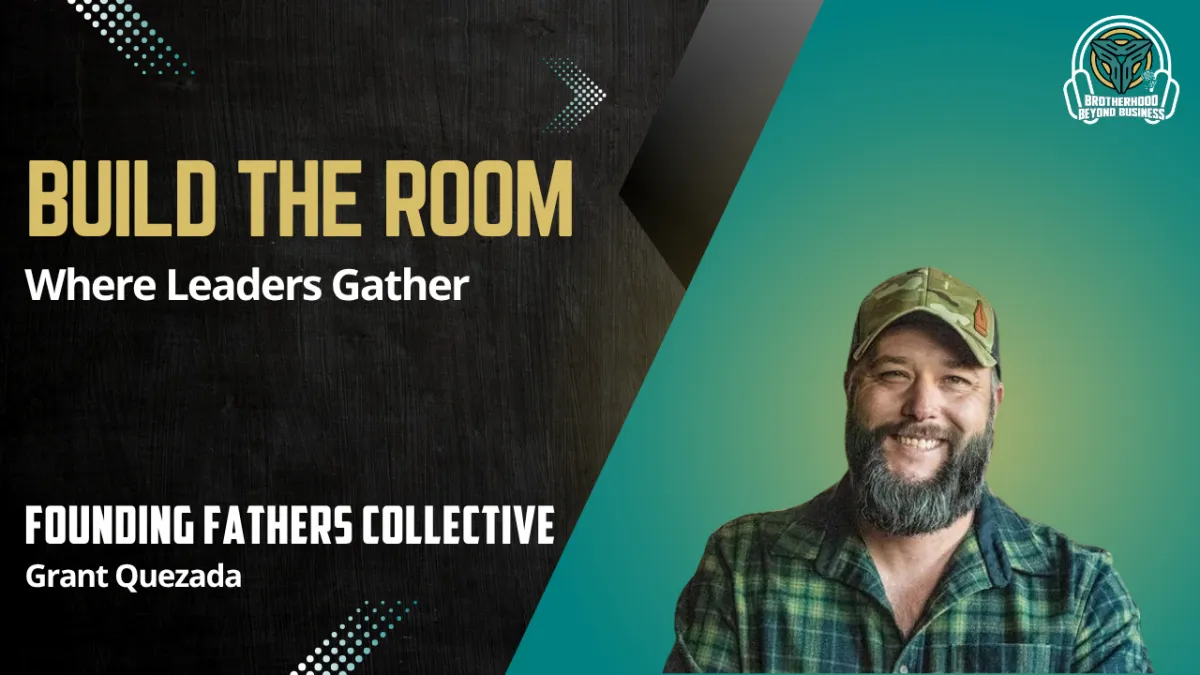
Ep 46 | Building Founding Fathers, Third Spaces, and Legacy with Grant Quezada
Ep 46 | Host: Trev Warnke | Guest: Grant Quezada
🔥 Why This Episode Matters
What does it actually take to build a business that becomes bigger than the owner?
In Episode 46 of Brotherhood Beyond Business, Trev Warnke sits down with Grant Quezada, founder of Founding Fathers Collective in Prescott, Arizona, to talk about entrepreneurship, leadership, family, community, and the long-term vision behind building something that can outlive you.
Grant's story starts far from a traditional entrepreneurial path. After serving eight years in special operations and completing multiple deployments, he left the military and returned to a skill he had developed earlier in life: cutting hair. That one skill eventually became the foundation for a much larger business vision.
Today, Founding Fathers Collective operates as a large hospitality and community concept designed to bring different businesses, professionals, and people together under one roof. The bigger idea isn't simply owning multiple businesses. It's creating a third space where people can work, connect, build relationships, and sharpen one another.
For entrepreneurs, the conversation gets even deeper. Grant and Trev unpack what it means to invest in employees, give people autonomy, build a strong culture, bring your family into your work, and know when a business model is actually ready to scale.
🎧 Listen to the Episode
👤 Meet the Hosts & Guest
Trev Warnke - Instagram | Facebook | LinkedIn | Profile
Trev Warnke is the host of Brotherhood Beyond Business and a business owner focused on helping entrepreneurial men develop stronger businesses while becoming better leaders, husbands, fathers, and men.
Through Brotherhood Beyond Business, Trev brings business owners into honest conversations around accountability, leadership, faith, health, family, and the realities of building a meaningful life alongside a successful business.
Grant Quezada - Profile
Grant Quezada is the founder of Founding Fathers Collective in Prescott, Arizona. His entrepreneurial journey began after leaving the military, eventually taking him from a one-chair barbershop to a much larger hospitality and community concept.
His approach to business is centered around people, culture, autonomy, service, and creating opportunities for the people who work alongside him. Grant views entrepreneurship as a continual process of testing what you're capable of building, learning from setbacks, and becoming a better version of yourself.
About Founding Fathers Collective - Website | Instagram | Facebook | LinkedIn
Founding Fathers Collective is a Prescott, Arizona-based hospitality and community concept built around the idea of creating a modern third space.
The 12,000-square-foot concept brings together multiple experiences, including a barbershop, coffee shop, cigar lounge, speakeasy, jiu-jitsu studio, gym, dance studio, men's health, and other complementary businesses. Grant's vision is to create a cohesive environment where people can gather for business, community, hospitality, and personal development.
📌 What You'll Learn in This Episode
Why Grant left a career in special operations to pursue entrepreneurship
How a one-chair barbershop became the foundation for Founding Fathers Collective
Why building a strong culture can make finding great employees easier
How leaders can give employees autonomy without giving up accountability
Why entrepreneurs need to build systems and metrics before attempting to scale
How Grant incorporates his family into his business and entrepreneurial life
Why the people around you can determine how far you grow
How creating a physical "third space" can strengthen a local business community
🧩 Episode Summary
Grant Quezada's entrepreneurial journey is a powerful example of how skills developed in one season of life can become the foundation for something much bigger.
After leaving the military, Grant returned to barbering and began building businesses from the ground up. What started as a single-chair barbershop eventually evolved into Founding Fathers Collective, a 12,000-square-foot concept designed around hospitality, community, and shared experiences.
But the real story isn't the size of the building or the number of businesses operating inside it. It's Grant's philosophy around people. He believes leaders have a responsibility to develop the people they employ, give them room to solve problems, and help them leave better than when they arrived.
That philosophy also extends to his family. Rather than separating his children completely from his work, Grant brings them into the environment he's building so they can learn how to communicate with adults, handle problems, serve others, and understand what entrepreneurship actually looks like. He connects that directly to his idea of legacy: if he can't lead and steward his family well, building a successful business isn't enough.
The conversation ultimately comes back to growth. Grant isn't interested in scaling simply for the sake of getting bigger. He wants to prove the model, understand the numbers, build the systems, protect the culture, and then take the concept into additional markets.
For both Trev and Grant, entrepreneurship is ultimately a personal challenge: How much are you capable of building, and who can you bring with you?
🕒 Episode Timestamps
[00:00] Grant's background and military career
[03:01] How Grant got started in barbering
[05:13] The vision behind Founding Fathers Collective
[08:33] Building a business with vision, clarity, and an exit in mind
[11:16] Building culture and attracting the right people
[16:02] Empowering employees to solve problems
[17:54] Full potential, leadership, and building opportunities for others
[19:15] Entrepreneurship, fatherhood, and bringing family into the business
[26:58] What it actually takes to scale a business
[42:19] The third-space vision behind Founding Fathers Collective
💡 Quote Highlight
“You have to invest in the people knowing that they're gonna leave. But if they can leave better than when they got there, then you're doing something right as the owner, as the operator, as the entrepreneur."
🚀 Next Steps
👉 Get our weekly Build the Business, Build the Man., Build the Edge, playbook to get one actionable task to implement into your business and life each week --> Sign Up
👉 Download our Your Circle is Your Ceiling eBook
👉 Learn more about Our Method
📚 Resources & Links
Follow BBB on: Website | Instagram | YouTube | X | Facebook | Buzzsprout
Watch the full episode on YouTube
Listen to the full episode: Spotify | Apple Podcasts | Buzzsprout
🚀Full Transcript
Trev Warnke (00:45)
All right guys, welcome back to another episode of the Brotherhood Beyond Business Podcast. Today we're here with Grant of Founding Fathers. We're gonna have him dig into his personal life. We're gonna talk about why he started Founding Fathers, what Founding Fathers is all about, and we're gonna end with his legacy and where he's going with everything. So Grant, go ahead and kick us off.
Grant Quezada (00:59)
Hey Trev, thanks for having on, man. yeah, so I'm from Prescott, met my wife in second grade, joined the military in 2006. So I was 22 at the time. Spent eight years in special operations. we had our oldest son at the time, last couple years in. I was shooting by the time he was two, I think I was deployed for another three times. So I was over there for nine deployments. And he was two and I was already done with another three. And kind of at that point it was like
Okay, do I want to continually maintain this pace, you know, at a career level, or get out and kind of reinvent the wheel and do something different. So always loved business, been reading business books since I was about 14, 15. and just find it fascinating with the ability and the freedom that business can give you in the sense of like everything is on the table. Your own creativity and drive and willpower really drives what your potential might be and what you're capable of doing.
And there's no real guide rails. You know, it's like the last frontier you can you can tackle as an individual, which is business, small business, and obviously growing business, and you have to do with the team. And so I got out in 14, started everything with a one-share barber shop. two years later had or sixteen months later had two locations. And then a year after that, bought a building. a year after that, opened up the whole concept. So in the middle of COVID.
But within that space, you know, it's a twelve thousand square foot building. We have a barber shop, nine chair barber shop, open seven days a week, twelve hours a day, a coffee shop, a top wall, there's a cigar lounge, there's you know, speakeasy, there's a jujitsu studio, a gym, dance studio, men's health. So I own the majority of them. Then there's a few businesses where you find the right partnerships and like bring them into the concept and there's alignment there with
With shared values and mission statements of like how they want to be perceived by the community, how they wanna serve, how they wanna bring people together. And then like everything, you know, iron sharpens iron and you're just working together as a team to kind of create an elevated experience for the end user, right? So
Trev Warnke (02:57)
So what let's go back in time a little bit. What start like why barbershop? Like why was that?
Grant Quezada (03:01)
For you. Yeah. So when I was twenty, I moved from here out to Missouri and so I got into hairdressing as a as a joke. So a buddy of mine, first day I was out there, he's like, opens up a a birthday card and there's five hundred bucks cash in it. This is time frame of like two thousand two or three. And that's a lot of cash back then, especially when you're you're a twenty year old kid, you know. So I asked him where he got the money, I'm thinking it's an uncle or
Something like that. And he tells me it's one of his parents' friends that was a hairdresser up in Baltimore owned a salon. And he's like, dude, this guy sends me and my brothers five hundred dollars a year since we were kids. And I was dude, I could cut hair. And so he tells me I could totally see you cutting hair. So went into went into hairdressing. worked in a university town. There's about six universities or colleges in Springfield, Missouri at the time. And I was very blessed to get a job with
Still to this day, a very good friend of mine, mentor, Paul Catlett. So Studio 417 out there. And he's taken that concept from like a couple chair salon into I think it's fifteen, twenty thousand square foot salon, and he owns 10 or 15 barbershops now. And him and his wife are great friends. They have a couple boys, but just a he's about nine years older than I am. Very motivated in the sense of business, very competent, very driven. And so
worked with him for a couple of years, always wanted to go in military and joined when I was twenty two. So when I when I got out, I knew that was a skill set I could fall back on. And that's that's what happened.
Trev Warnke (04:27)
Okay. So yeah, I mean it's not the normal path. We see a guy your size, it's probably not that normal thing. I'm thinking like it's gonna be a barber. But like it's not I mean it's a it's a great fresh and service in general. Like I think a lot of people we went into this this 2010 on, people went into true white collar stuff, right? And everybody's investing in white collar jobs and now white collar is kind of being destroyed by AI and stuff, and we're looking at the true service-based industries from plumbing to electrical to barbershops to even like things like coffee shops and things of that nature, like.
are really the foundations of a community that people kind of forget about. So when you were designing Founding Fathers, did you have the f initial idea these were the different businesses you want? What kind of or what kind of got you into, you know, obviously you're doing a barbershop ready. I thought, okay, coffee shop, like what kind of created the design, the speakeasy and all that stuff?
Grant Quezada (05:13)
Yeah, so so I got out in late 14, I think August time frame, I opened up the barber shop in December. It was a one-shared shop with, like I said, with about 16 months, went to two locations. but my goal was always how do I maximize the footprint of what I'm doing and create a like a master plan third space. And so that's kind of where the concept came from. and for me, looking at third spaces, it's like where do people congregate within a community?
And it's in the space of hospitality, right? It's like gyms, it's coffee shops, it's bars, it's restaurants, barbershop salons, stuff like that. And so I've a I've a huge passion for growing business and obviously empowering teams, but really a service to other people and like creating a a a cohesive brand and concept that will collect the right type people. And you really can't do that outside of
hospitality. So there's plenty of other ways to to make money and provide for yourself or your family within the business space. For me, like I said, I just I love people, I love the ability to create something unique that has some complexity to it. You know, nothing's new. Everybody knows coffee shops and bars and restaurants and you name it. But where it gets unique and a little bit more difficult is like how do you bring everything under under one roof to where it works synergistically and cohesively and
And it's a seamless experience for the client or the customer or the member on a daily basis, you know. And then you're creating a space where people come back and frequent, you know, every day, several days a week for a myriad of different reasons, whether they want a coffee, they want to go to the gym, or they want a cocktail, they want to come down for a date night or play games or use utilize the spaces like we're in right now to where they can be productive and and work in what they're doing for their profession. and so that was the goal. So
Here we are six years later, you know, we're getting ready to revamp the whole concept. We're doing a massive remodel, should be submitting to the city here within the next month. That'll be a whole 800 square foot kitchen, breakfast, lunch, and dinner, an entirely new bar within the speakeasy, revamping cover back patio, all sorts of stuff. So it's gonna be about a two, two and a half million dollar project build out. And then from that concept, the goal then is to grow into other markets. So
hit Presky Valley, hit six or seven locations down at Phoenix, and then just start taking the model to other locations. So
Trev Warnke (07:33)
Yeah, I love. I mean, I've always looked at scale scaling businesses. But when you look at scaling businesses, most people go for the ones that are low, low, low ticket to scale, right? What yours is a high ticket scale, right? Like cost wise, because just for an addition here is going to be two, two, two million, two point five million dollars. I don't think people realize how much money has to be invested in these kind of these ideas, right? I think the average person that's watching this that that's is in prescribed, they probably want to know more about.
founding fathers and that kind of stuff. But it's the the side behind that I like to really point out to people like what what are the struggles like these business owners go to to make these awesome things happen in the area that people don't realize. Cause as entrepreneurs we kind of know that journey that there's a lot of money behind it. There's a lot of not taking pay behind it, right? There's lot of like there people think you own this big location or making, you know, let's just call it make millions of like grants like really crushing it. But the amount you've had to invest back into it, people don't even realize. And like so just talk about some of the like
I wouldn't call pitfalls. What is the struggles of like building something like this and even keeping this going?
Grant Quezada (08:33)
Yeah, a lot of that is you need vision and clarity. And so you need to understand w what's your end goal. I had a a dear friend of mine who's known me since I was a kid. I grew up with his sons. but he was my CPA for the first several years and and when I was getting started in business, one of the first books he gave me and rec highly recommended was The E Myth. and read that book, but one of the pieces of advice he said too was, Hey, you need to build this thing with an exit in mind. So
You can't just you can, you can create a business out of thin air and run it, but really you have to be able to have the foresight and intention with why am I actually building something. You know, like one, I'm building it for myself and my family, two, you're building it for the people that you employ and the ability to create opportunities within the ecosystem of your community, right? So whether it's upward mobility for team members.
or the ability for them to connect with other people within the community so they can like spring out and move into other opportunities for them as individuals. It's that's your responsibility as a leader, right? Build something massive, bring people with you. and then if they leave, are they leaving or exiting on good terms and are you able to help them land on their feet somewhere else, right? The vision and goals that I have for Founding Fathers as I'm growing it, you know, they're mine because I want to see if what I'm capable of doing as a person.
What can I build as a man? How can I make a massive impact in the local community? Who can I do it with? How are we going to do it? What's the impact that we leave? What's the legacy we leave? But on top of that, the people that I employ, what what do they want to do? You know, are they willing to go along for the ride and be a part of the the brand and what we're doing and service to other people? Or do they need the the job for a year or two as a placeholder until they s you know graduate college or or they move on to something else?
It's a lot easier to define that when you have clarity of what you're doing and what people's personal, professional, financial goals are and where they want to go. And then everything's laid out on the table. So when the time comes that they might leave, I'm already aware of that. And it's like, dude, let me figure out how to help you out. You you said you've been wanting to do this for a year and a half. The time's come. I've made the proper deductions for them. They can then spring into another opportunity that, you know, is more vectored in in a vein or focus that they want to get to.
So it's it's fun to do business in that capacity because everything is kind of seen on the table. And it's not like as the business owner or the entrepreneur, you're you're holding everything tight handed and in fear constantly of losing good people. It's like, hey, you have to invest in the people knowing that they're gonna leave. But if if they can leave better than when they got there, then you're doing something right as as the owner, as the operator, as the entrepreneur. So
Trev Warnke (11:09)
Do you s do you find it a struggle at all in a a smaller town like Prescott to find the talent that you need to keep growing this thing?
Grant Quezada (11:16)
I've always heard that. I haven't really found that. We haven't found it as a team. A huge part of that though is we're very clear on like what our mission, vision, values are, what we're trying to do, what we're trying to incorporate, how we're helping the people out, the type of people we're looking for within the organization. And so because we have that level of clarity, we know exactly who we want to hire. And we're very clear on because of those mission, vision values, like this is what we hire and fire by.
And so everybody on our team knows that. there's a healthy level of balance, healthy level of accountability. it's a fun work environment. And so it I haven't seen really having any problems with with finding the right people because we just know who we're looking for. And so we tend to attract those type of people into our organization, right? You want people who are proactive as an individual, who have hobbies, who have some level of ambition or drive.
In their own personal lives. And they're not just here to to check in and check out, right? That the goal is how do you create an ecosystem that provides opportunities for people within the vertical stratosphere of of what you're building, but also opportunities outside if they need to leave. And you need to cultivate that. But more importantly, you need to teach them how to cultivate it within themselves to where they have they they are figuring out how to goal set, they're figuring out their own autonomy, they're figuring out how to
find drive and motivation to excel in their own lives. And that's a that's it's harder way to do business, but it's far more fun and it's far more impactful when you can like speak into other people's lives and get them motivated about their own life and like what they're capable of doing.
Trev Warnke (12:49)
Yeah. And I think one thing that like you said, reason you haven't found an issue that I've seen for other businesses over the time of work in business coaching and stuff is when you have a vision truly where you're going, you create this own referral system of like employees that start referring good quality people to you because they want to work with them. You come with members that are like, I want I'd love my son worked here kind of thing. So you build that culture, that culture comes first and the great talent actually usually follows it. Whereas most businesses go chase after the great talent, hoping it will improve their business.
instead of the reverse process. So I love how you kind of approach that. Like we're gonna go through the values and standards first and we will cultivate the right people and you're growing those people versus expecting them to come. I think in a small community like Presc people get a little bit wrong in this idea is it's gonna be really hard to attract great talent from like Phoenix to come up because homes are expensive here. there's not maybe as many kids here comparable to maybe Phoenix. So the sports and stuff aren't as diverse. So there's other reasons why people talent might not want to come.
There's a lot of talent here that can be homegrown into that. And the average business though doesn't want to invest in the people like you are.
Grant Quezada (13:48)
Yeah, when you're a smaller business or when you're getting started, so much of that responsibility falls on the leadership, right? Like it it's your ability to cultivate and kind of set the precedence and the cadence and the and the vision of where you want to go and how you're gonna get there and who you're doing it with. But you need to bring your team with you, and that means you have to invest into you know what they're doing and how to do it properly within the organization. You know, you have to empower them, you have to set that left and right limits of
what that looks like, success or fail. And then you have to be able to ultimately trust them to do the right thing. Everybody wants to be seen as a competent person. They want to be seen and trusted for why you put them in that position. And something that might take me five steps to figure out on the floor, somebody sh can figure it out in two or three. And it's like, well, I don't need to be hamstrung to my own proclivities or my not proclivities, but my own naive naivete or my own ego on
Hey, this is the proper way to do it. You know, it's like, hey, this is what's worked for me. Maybe you can figure it out faster, or maybe they do it in seven steps instead of my five, or they do it in two or three steps instead of my five. But as long as the job is done and they feel like they have the autonomy to get it done correctly, that's what you want. You want people who can think for themselves and problem solve themselves. And they're not constantly hitting a wall and then immediately instead of problem solving, it's like, I'm just gonna go ask the leadership team. I don't how to do this, you know.
Because then as a leader, you're constantly getting drugged back into like having to fix basic things that you know you've you've learned over time and you need to empower your team to do that before you so you can continually grow and get to those next levels.
Trev Warnke (15:27)
Yeah, I think I maybe your military background helps with that a little bit, like trying to like get people to be to to own their own skill. But I think the average, specifically white-collar group of people, they're so used to like, I'm just gonna create an SOP and this person's gonna follow the SOP. The issue comes in, problem solving doesn't happen in SOPs. So you still have to have an SOP and get that idea laid out. However, I don't think the average business owner is really empowering their team. They want to have this like high level of control. Mistake goes wrong, they wanna come down on these guys, versus like, hey.
That was a mistake. Let's figure out figure out how to how we're gonna fix this. You come with the answer on how to fix it. I would say for the major majority of business owners don't think that way.
Grant Quezada (16:02)
Yeah, yeah, you have to be
You ideally you come to a lot of different problems with I mean you you can come with solutions, but your goal is to cultivate a culture to where you're allowing your team to create their own solutions. There's always gonna be problems. Doesn't matter where you're at. That's just the human condition, condition of businesses or life in general. So can you get individuals to think for themselves and problem solve for themselves and feel like they have the autonomy and the authority to like
make the right decision. And at the end of the, at the end of the day, even if they make the wrong decision or poor decision, it's not like that's going to tank the business. You know, you it and it's okay. We all learn through fail failure or a setback. that's the best way to learn, right? You you do something, you make a decision, it's a poor decision or it's the wrong decision. How quickly can you adapt, overcome, you know, how resilient are you as a person? and so if you don't
Teach how to do that or invite them into a better version of themselves, then you're constantly s setting yourself up to be like the nanny, right? Or the constant parent. And at some point, you know, if we're all adults, it's like I don't wanna be constantly watched over and being told what to do and not trusted to to be competent in my skill set or my job. So.
Trev Warnke (17:20)
Yeah, I was actually talking to somebody recently about salaries for employees. And they're talking about, well, I don't think they do more to be worth more money to me. And I said, well, the biggest obstacle you're running into is one, you're at not giving them the ability to do more. You're only giving them the ability of what you want for parameters on this person. But even if you just give somebody open up somebody's ability to do more in your business in general, sometimes they don't even want more pay. They just want the ability to like I w like you kind of said, like, why are you pushing founding fathers to this limit? Like, how far are you gonna go with it?
Cause you want to reach your full potential, what you're capable of, challenge yourself. Everybody has that challenge. It just looks different in their life on how that challenge looks.
Grant Quezada (17:54)
Yeah, and we're not it's it's not like you know what your full potential is until you hit it. And then are you capable of going further? And are you capable of going further? And so the pursuit for me as an individual, as a man, is like, what am I capable of achieving in the sense of like how big can I grow a concept? How many people can I employ? How many people can I empower? How many people can ha what are the opportunities within what I'm building that
really provides longevity to where people are like, I can see a career here. I started here and I exited here and I have, you know, a Roth IRA or I have a retirement or have medical, you know, like what other reason is there to grow a business than than actually growing it to for it to be successful for the owner, operator, and for the rest of the team? You know, you can't do anything without people. So you need to understand the vehicle that's gonna get you to where you're going is people. So
Trev Warnke (18:48)
So as a father, you have three kids? Yes. Yeah. so what are the obstacles you see? Cause I I kind of look at a business like this, like there's probably more late later hours than the average business owner thinks about. also possibly more early mornings. What are some of the obstacles you've seen as being a father, like running one of these businesses? And how have you like one, like talk to your family, like, hey, these are the obstacles, these are why I'm doing this. You know, the idea teaching your kids why we do the work we do. what's kind of your philosophy on the family and how you kind of attack that?
Grant Quezada (19:15)
I just incorporate my family into what I'm doing. So I have three kids, fourteen down to nine, fourteen, eleven, and nine. And so, you know, they they hang out at the business. They're always hanging out, talking, conversing. I'd much rather put them in that that atmosphere that we've created where you're collecting good people. And then my my children by by being in that
atmosphere ecosystem, they're conversating with adults or having thinking differently or processing or learning how to conduct themselves as younger people as they navigate their way through age and through maturity. And and I think it's a very healthy environment by just including them in what we're doing instead of trying to, hey, you guys can't come around here or you need to be home. and they might get in the way here and there. That's children, but
It's okay. You know, like you have to figure out how to have that we all hear that term work-life balance, but the reality is like there's no such thing. You know, you're you're always gonna be working, you're always gonna be thinking of something to problem solve or fix, and you just need to include your family in on that story of what you're doing, you know. Ultimately, the legacy I'm trying to leave with on the business of of course is gonna affect my family. But if I can't steward and and lead my family, then I'm not gonna do a good job doing it.
At the business side. So you I just incorporate both and love having my kids around, love introducing to people, love the ability for them to have conversations and talk with people that are, you know, ten, fifteen, twenty years older. and actually carry on in in some capacity a dialogue and even if it's not them just simply being scared of adults, you know, like not knowing how to conversate or ask questions or articulate themselves, those are good skill sets to have and
There's n I I don't know of a better atmosphere to learn that than within the hospitality space where your job is service to other people. but it's also dealing with people who might be persnickety or have issues with, you know, something went wrong here or it goes wrong there, and how well you can how well can you receive the criticism or the critique or or the problem and and turn it into a win, looking for the opportunity to turn it into a win. And in the reality of business in general, it doesn't
matter. I tell this to my team all the time, but it doesn't matter what you're doing in the in the context of how you provide for yourself, whether you're a doctor, an attorney, a plumber, a construction worker, a barista, that's that's what you're doing to provide for yourself. But the business we're all in is people. So the faster you can realize that and understand it, you realize that's how you're going to get the traction of the momentum you need in order to grow as an individual or to grow other people around you. Like most of the problems
or most of the solutions you're looking for, you have to have the gumption and the drive to figure it out. But you also understand like there are gonna be people that are a little older, a little wiser, maybe one or two or five rungs up the ladder than you when it comes to success, whatever that might look like. There they've been there, they've done it. And if you have the humility to just ask for help or guidance, you're gonna get there far faster through through working with people than trying to just bash your head into the same wall, you know.
Trev Warnke (22:21)
I mean, what you're doing there is exactly what my dad did. So he owned a owns a big manufacturing corporation. We were kids, like I just remember you just go to the factory, you do the work, you're just around there, you're goofing around. But also we learned the weld at a young age that most kids didn't get that experience. You gotta learn how to do AutoCAD, all the things that it it stimulated creativity for me as a kid to learn all these different skill sets. Now, when I was in school, maybe that stuff wasn't as interesting, but when I was at the factory, like all this stuff is cool because I can see how that stuff's being put together. Well, how I'm actually using it in the real world.
And for your kids, the advantage is like, hey, this is, you know, maybe when I'm in school, some of the stuff will be interesting, but it'll portray back to like us talking to this older guy that was like reading these books. I'm like, man, that's really cool. And then maybe they're more interested in that stuff. So getting them in environments where they can actually see how life skill sets work, I think that's one of the biggest issues with kids before college, is they go to college thinking they know what they want to do, but have never experienced any parts of life. And they get out of college and be like, wow, I need all these other skill sets that I have no idea how to do to actually just run to do any business.
Grant Quezada (23:19)
Yeah, yeah. I mean i you can have a certain level of intelligence, obviously that's gonna get you pretty far. but your emotional intelligence or your relational intelligence carries a lot of weight, you know. You can you can make up for a lot of things with just hard work and determination. Intelligence plays a key factor, but if you don't know how to relate to other people or show some level of emotional intelligence with
people that are around you, your peers, people that are above you, people are below you, whatever it might be, you're only gonna get so far, you know? And so it's you're gonna hit a point of stagnation or Peter's principle where you're kind of stuck and you have to get out of your own way to figure out like, do you one do you have the humility to figure out, okay, I'm I'm stuck or I'm at a point where I I I I haven't been before and can you figure out to like pop into a different vertical or or pop over and
and reinvent yourself or or continually refine yourself. and that that is the pursuit of life, right? You ideally I don't I'm not the same man now in my 40s as I would be in my 70s or 80s. And I'm not the same man in my forties as I was at 15 or 20 or 25. So you should always constantly be pursuing like a refining yourself, adding value to yourself, refining who you are, your character
your growth, your intelligence, you know, your educational level. and if not, life gets really boring, right? So
Trev Warnke (24:44)
Yeah, I mean, if if any young if
Grant Quezada (24:46)
Yeah.
Trev Warnke (24:47)
there's a young person watching this at all, I think for most successful entrepreneurs, it's pretty rare that the first business that we go into or the first v vocation we go into is actually where we end up. But it's kind of like building skill sets over time. Like I gotta get this skill set to almost go to that next skill set to you're just accumulating skill sets long enough to really develop enough to be, hey, I can own some component of this or I have enough, I have enough mission behind what I want to do to go that next phase.
Grant Quezada (25:14)
Yeah, I I think I was reading statistically, I think our generation and maybe a little older, most people in the workforce, it's somewhere on like forty different jobs they rotate through through their life. Whereas we go to our grandparents and it's like two or three. Yep. You know, they kind of got to the factory or whatever it might be and they stuck in that type of career path for fifteen, twenty years because the opportunities largely weren't there, or because the lack of
awareness or understanding of what's around them because they just didn't have the internet. They didn't have the ability to understand like, dude, I can do this or I can do that. And so in today's day and age with the modern era, you know, some of the positives with social media or or the internet is is the ability to really understand opportunities that are out there and then how to figure out how do I get there. You know, like do I want to do this job? You know, I can do this step and then I I can ladder over here. and it's because of connectivity.
So now and it's
Trev Warnke (26:09)
The idea that you've talked about a lot is like hard work. You just gotta consistently put your head down in the in a sense of whatever you're doing, be in whatever you're doing for a long enough period of time to develop a really strong skill set, not worrying about what the next job is. And I think even for us, as like you're building out founding fathers to a bigger thing. I'm working on building a brotherhood to a national level. it's the idea is like we still have to have our our feet where they're at. Like we gotta build whatever this current model is to capacity to prove that this next stage. So for you guys, like here's what founding fathers almost like your vision. Here's what it needs to hit for me to feel confident to now
Just go to PD. Yeah. And then we have these metrics, not like you just because you have a good idea means it scales. It's like, no, there's a lot of hard work that goes from stage to stage. And for anybody working jobs, a lot of hard work to go from job to job to job and build that skill set. But you gotta just give it time. And for me, it's like follow God's mission, right? Like wherever God's mission is taking you. That's kind of the you gotta be listening long enough to hear. So
Grant Quezada (26:58)
Yeah, absolutely. Your ability to I mean sc scale something at any level. You you have to put in all that hard work on the back end, you know, like how do we replicate the KPIs, the metrics, you know, what are the SOPs? What's the standards? What are the roles and responsibilities for each one of the positions? You know, what's the cost incurred to go into purchasing a building compared to like leasing or renting? You know, what's the what's the bill out cost? What's the economic value and
community we're going into, you know, what's the median household income? What's the demographics? How many people are in this area or region? Is it sustainable? if I open up one in Presca Valley, am I gonna cannibalize from this location ten percent? Is that is that sustainable? Or is it gonna be like fifty percent? And then we tank both locations. So you have to be very wise with what you're doing and and I don't know all the answers, but the reality is like I know people that do
Or I know companies that help you scale and do this stuff properly. So it's that's where it's worth that front end investment to figure out how do I do this properly to where I don't fail and break and then create those opportunities vertically within the business to continually grow and and offer long-term benefits and value to the people on our team.
Trev Warnke (28:15)
Well, with today's social media, the problem that you see is like these things scaling so fast or these people growing, making millions of dollars so fast. But I don't remember where I saw it exactly. But the average millionaire starts their business at 42 years old and they've had to build enough skill sets up a long enough period of time to be able to even create whatever that business is. And then that that business doesn't turn into a million dollar business until like they're 52. So it's like 10-year window of time of them like proving these ideas versus the ones that are scaling super fast.
I've seen a lot of businesses go out of business real fast because they saw an idea, it did well to start it off with, they scaled so fast versus like what your guys are doing. It's like, hey, we're gonna get all these metrics figured out. Scale can happen really fast when you have the the right model. And like, okay, we've proven it multiple times now. We can go this thing can take off with just finances at that point. But the scalability is not how much money you can get from other people. The the scalability is the model working efficiently right each spot. So that way when you invest the money in, you don't lose all that money.
Grant Quezada (29:09)
Yeah, very, very true. You know, and that's that's a whole nother level and a game to play in business, which extremely piques my curiosity of like what am I capable of doing? And how do we do this together as a team? And how does the concept grow? And like I said earlier, you can't do anything without people. So if you're trying to create something that has massive value to
the organization to all the team members to the community which is what a business does it serves the community at some capacity whatever it might be I'm a dentist I'm a doctor I'm a lawyer plumber electrician barista you're adding value to the people within the team and then by extension the people that want your services and so as an individual it's like I believe I'm capable of more I'm up for the challenge I love a a good challenge
life is challenging. So it's like, let's just keep going. You know, like what can I what can I capably hold myself to and how when I hit my own Peter principles, how quickly can I adapt and overcome and and pivot and make the right decisions, you know, and and keep moving in some direction, you know, obviously in a growth trajectory. So
Trev Warnke (30:19)
And that's what you're saying right there is exactly what makes entrepreneurship fun to me. The average person sees it that sees a business like, they get freedom of time. It's not as free of time as people think it is. they get freedom to make how much money how much however money they want in a sense, but there's a lot of like putting back into the business for a long period of time to actually make the wages that people think you might make. but the for us, like people like us, is like I mean, I this
It's endless. Whatever I can do is up to what I'm capable of doing and what I'm capable of building other people to do. So it's all on me, which I think is the most fun part. It's the game, like being a former athlete, like it's the only thing left I have that's truly competitive, where it's like it's only me versus me, really. It's not me versus other businesses, but it's me versus me and compet competing become the best version of what I can do. And that's what's like what wakes you up every day is like that's super exciting because it's all on me and that's actually really fun.
Grant Quezada (31:05)
I completely agree, man. There's there's only a small minority of people in in in the world, in America, that can really step out and and risk it all. You know, you have to have a high risk tolerance in order to open up your own business, in order to grow it. You know, opening is not you're wearing all the hats, you know. So you have to understand the finance, the management, all the structures, the SOPs, you have to be the technician.
And then you slide in another person, and then you have to figure out like, okay, how do I train this person to do or replicate one or two or three of my tasks? You know, then it's another person, then it's another person. And so everything, everything rises and falls in leadership, right? How how well can you create a culture that you're empowering your team but also invested in your team success and like teaching them to succeed and and giving the grace needed where
Where need be, when they might mess up. You know, we all do, it's fine. But I think it's one of the best worthiest causes you can do as a human being is like create something out of nothing, right? And it's controlled chaos. I love it, you know, coming from the military side, it's I I think my brain was definitely rewired and working in that environment for so long in the special operations community. And so this whole notion of going back into working as a civilian and
Doing a nine to five, I just can't do it. You know, like I have to work kind of just all the time doing doing something productive and and having the flexibility to like, like I said, I today I hopped on a call regarding some business at 6 a.m. for a Zoom call. It was supposed to be an hour, what almost two hours. Then it came over here and it's like, so you just you're creating time. You know, how do you maximize your time? How do you maximize your schedule? When can you fit things in?
When you're focusing in the business, on the business, outside the business, growing the business, who you're doing it with. So it's it's a fun place to be, but it's not for everybody. And you know, most people in life are they have a stabilizer personality. You know, they want stability, they want to know the left and right limits, they want to just show up and perform, be relied on to do it. And if you thrust them into a chaotic position of like, hey, you have to take ownership of something and run and manage and
problem solve on the fly, that's a very uncomfortable place for a lot of people to be in. So it's it's definitely a mindset. I would assume you probably have to be born with it, but at some level too, you're you've probably had to experience a lot of adversity in your life in order to to do it well. And because there's always going to be setbacks or there's going to be problems or unforeseen issues that you're going to have to come up with solutions that you haven't before and keep your wit about you.
while everything else is failing. Like the famous poem by Rudyard Kiplin If. I know if you've ever read that. Fantastic. It's one of my favorite. But you know, can you keep your wit about you while everything else is failing? And it's it's a difficult place to be in, but it's also extremely rewarding and very exciting to to really understand like what am I capable of doing? You know, am I capable of moving to the next level? You know.
Trev Warnke (34:00)
Yeah, and the thing I'm gonna put out there for other business owners is decide that like the average person in your life, obviously not even average, majority of people your life won't understand the mindset that we have. Like my wife, she didn't come from an entrepreneur family. I did come from an entrepreneur family. So my family understands like kind of the cost trade-off. My wife, when we first started doing it, she didn't come from that. So when when when stuff would get a little chaotic, she'd are we gonna be okay? I'm like, honey, and we're always okay. Like I have no doubt, I will bet on myself.
every single day and twice on Sunday I will do it every single time because every single obstacle comes up, there's a way out of it. Worst case, worst case scenario, I have to go work for somebody else and I'm the best employee they've ever had. Like big deal, but I'm probably not going to do that. Right. So it's just like I the idea of betting on yourself. And like you talked about a little bit, I I think from like your different experiences of people met you over life and people that are still in your life is like having a a circle of people that you can rely on that are at that level or higher than that level is a valuable tool for you. Like we call it kind of like your circle is your ceiling.
Like you have to have people that surround you that kinda you still have to have some people you can go to, like 'cause I don't have a lot of people I can talk to about the chaos. It's nice to have people that do understand chaos, like, dude, it's fine. You're gonna be fine. Usually they're they're they're a pep rally, but dude, you're gonna be fine. Just get over it. Get over yourself. So it's kinda nice to have that circle. Do you have a circle like that?
Grant Quezada (35:11)
Yeah, I do. I have several several really close friends that are all entrepreneurs or business owners, so they understand the stress and the chaos of man managing what they're building.
Trev Warnke (35:21)
Let's start to wrap up.
Grant Quezada (35:22)
But they understand the stress and of what they're building and so the the positive is like we can talk at that same level. You know, it's not it's just that finding the other individuals for us, you know, it's like
My circle is going to be a bunch of my male friends, but you find the people that are your peers, then you ideally you can find a circle that is above you by a generation or so, 10, 15 years, 20 years that have gone through what you're doing. And then when you're going when you're griping up, they can help you reframe it because they've largely all of them have been there before. So if they're good or if they persisted and you know persevered and had resiliency.
They popped out the other side, but they all have the same stories. Dude, I almost failed here, went a debt over here, had to borrow money here, had to leverage this, had to sell this. And then if they just kept with it, at some level they pop out 10, 15 years later, 20 years later. And so it's good to have your core group of buddies that you're going through the chaos with, but then also can you find mentors or older men that have
experience that, you know, once or twice or three times, you know, like, hey, I started a business here, multiple businesses exited, and you can glean information from them and realize like, dude, everybody goes to this. This it's not just me that is experiencing this setback or this problem or this issue. It's like that is par for the course. You know, it is controlled chaos. How quick can you identify the issues, come up with something that is a reasonable solution and then execute on it because action and momentum is
i it's needed. You have to make action, massive, you know, clarity in what you're doing and move forward. Get off the X. So
Trev Warnke (37:04)
Yeah, no, it's I mean, having older mentors is something I think most people kind of pass like they're no longer they're not doing business now. But the chaos they went through is just as chaotic as you did. And like you said, a lot of times it'd be kind of like you're kind of just whining because realistically you you got num three more steps where you have to really worry and you're a long ways away from that. So it is cool to have that. So let's go ahead and wrap up. I want to kind of end on where are you going? Where's founding fathers going? Like I've already you've kind of talked about the book. What's the the future of what where you're going on your path?
Grant Quezada (37:32)
Yeah, the goal is starting submitting to the city. I ideally we start the entire remodel at the end of the year. So, you know, you have to deal with the city and refinance the bank, all those other moving pieces in order to get it to the next level. Based on the timelines, red lines with the city and and recapitalizing and reinvesting back in the business. We're talking November timeline.
Build out should be around five or six months. You know, we did the entire build out for Founding Fathers Collective and it was from start to finish gutting the entire building and everything was brand new. it was eight months. So all we're doing is like the south side, the south side of the building. So I think reasonably six months. It's gonna be a you know, a quite a large project, but we can compartmentalize and break it into rooms without having to shut down the whole place. So it should be open, you know, late spring.
twenty twenty seven. And then during that phase and timeline, then it's really focusing on okay, how do we how do we start identifying where the next locations are, how are we gonna do that, how we're gonna fund it? what does that look like? templating out the the entire business model to understand everything we talked about earlier, like the correct SOPs, what the financial targets are for each one of the concepts.
how everything's codified under one roof, what the technology packages, I mean, absolutely everything. It's all the fun business stuff that you need to understand and and identify and have clarity on in order to grow to that next level. And I foresee, I really want to get to Prescott Valley because it's right in our backyard. And ideally that would be like the flagship, meaning, hey, that the template of that 45,000, 50,000 square feet.
is home in Prescott. This was the proving ground in Prescott, but Prescott Valley is like where the the flagship is. And then Peoria, because that's north and they've done a phenomenal job of building out their infrastructure on how they're gonna grow as a community. But then identifying key locations down in the valley. So like Chandler, Gilbert, you know Mesa, Phoenix, Scottsdale. So hit those areas.
Trev Warnke (39:34)
Very
cool. so let's go ahead and leave seventy percent of our viewership are business owners. So just talk just a quick little thing about like what business memberships you guys have here.
Grant Quezada (39:42)
Thanks, man. Yeah, so we have three, three different business levels. So we have a the membership or the speakeasy was built with intention of of collecting the right people. I hate bars. And when I when I bought my liquor license and then built out the whole concept and knew I was gonna do a bar, it was my biggest consternation was how do I how do I do this well to where it's not a race to the bottom or degrading in the sense that
You're only seeing the worst in people, but how are you adding value to bringing people into the concept, the right people? Right. So the goal is really just finding the productive, finding productive people within the community, largely within the business space who are still working and productive and like understand economically like what their focus is and then what's going on in the in the greater area. And so we the goal is to attract those type of people and put them into a room, you know, in in the extension of Founding Fathers Collective and then
They're doing life together, they're doing business meetings, they're working within the space, they're hosting parties, they're coming to parties. So the three different levels. They're like a solo, which is three thousand. It's easier to find all the the information on the website. So if you just go to foundingfathers collective dot com, you can find the memberships. And then we set up a meeting. There's only three of us that sell memberships. So we our goal, of course, is how do we maintain the culture within
speakeasy and find the right people that see value in what we're doing, how can we add value to them as as individuals or collectively as maybe their team. and then bring them on board. So our retention rate for six years in in with the concept being open is about 84% year over year. So that's pretty phenomenal for retaining a membership level status. and then I know as as the whole revamp happens
There'll be a massive amount of clarity and and new stuff that we're offering for the memberships.
Trev Warnke (41:29)
Yeah, and in s I mean, I've been a member almost a year now. And you guys are just every single month just gotten better and better, more events coming on, just like little things that make a huge difference. For me, I've grown the majority of our business just out of there. You know, even just being able to use these rooms have been really beneficial to like being like, Hey, we're gonna do it at Founding Father, so everybody knows where that's at, you know? And the ones that don't, it's kind of cool. Business owners walk in and be like, Whoa, I know this thing was here. That's kind of cool too, to like, Yeah, guys, like this is and then we talked about business memberships a little bit because like it's valuable because then I'm hanging out here. I'd love you guys hung out here too.
'Cause then we have a chance to talk business and do things together and like sometimes work side by side while you're working on projects, like we work on stuff. So it's a cool just I look at it obviously from a a personal side for people in the area, it's really cool, but as a business owner, it's very unique because it's a spot where we can actually come together, hang out, do business together. I think more business owners need to do business together just instead of just trading leads, actually doing business together.
Grant Quezada (42:19)
Yeah, absolutely. And and that is what Founding Fathers is. You know, it's like how do you create the proverbial table that everybody can participate in and somebody needs to own the space? And so I created the space and everybody else that's in business. It's sometimes it's a little awkward when it's like, I have to go to his office or he has to come here, or where do we find the random coffee shop we can go to, or the maybe over dinner, and that's that's fine, but
The focus and the goal for Founding Father's Collective was creating like a master plan in third space that collects individuals within the community that brings them together. And that, you know, ideally we're sharpening each other, right? Like your water bottle says, iron sharpens iron. So you're bringing people together that then can be productive in each other's lives or their own lives, but you're doing it through an organic level of networking. that that that's the best way to move the needle, right? It's like
How can I meet people? How can I genuinely be interested in them, their stories? And where's the where's the synergy between what you or I might be doing that we can then work together to like, hey, I'll I'll support you over here because you got this type of business, you support me over here, and your network continues to grow and like everybody's succeeded. So
Trev Warnke (43:27)
Yeah, that's a unique thing in Prescate, like where I came from in Illinois. It just doesn't happen that way. So even like the Phoenix thing, when you go to Phoenix, creating a space like that, and you almost almost have to train people a little bit in the community. Like, this is something that's actually okay. Like small communities can do that. Big communities get almost trained people to go into that. So that's an obstacle that you guys will have to figure out as you go to. Yeah. well,
Grant Quezada (43:45)
Yeah, absolutely now.
Trev Warnke (43:47)
I appreciate your time today, Grant. Guys, thanks for joining us for another episode of the Brotherhood Beyond Business Podcast. You can find Founding Fathers Collective at Foundingfathers Collective dot com, all over the place on social media as well.
Follow their stuff, join their memberships, come hang out with us. Talk to you guys later.