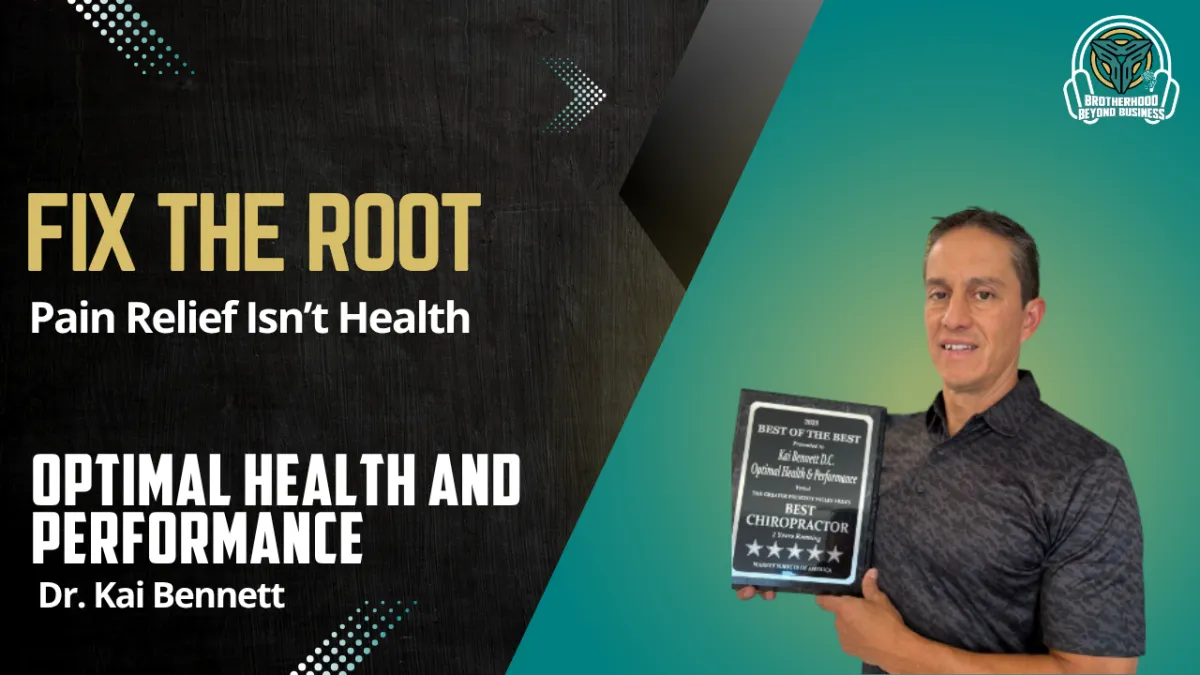
Ep 36 | Building True Health, Not Just Pain Relief with Kai Bennett
Episode 36 | Host: Trev Warnke | Guest: Dr. Kai Bennett
🔥 Why This Episode Matters
Most entrepreneurs treat their health the same way they treat a problem in their business—wait until it breaks, then fix it.
The issue is, your body doesn’t work like that. You can’t outwork poor health. You can’t ignore pain forever. And you definitely can’t perform at a high level if your body is constantly compensating.
This conversation matters because it calls out a mindset that’s costing guys their energy, focus, and longevity—and replaces it with something that actually works.
🎧 Listen to the Episode
👤 Meet the Host & Guest
Trev Warnke — Instagram | Facebook | LinkedIn | Profile
Trev Warnke is an entrepreneur, coach, and co-founder of Brotherhood Beyond Business. Through the Brotherhood community, Trev works with male entrepreneurs who want to build strong businesses without sacrificing their health, faith, or family.
Dr. Kai Bennett — Profile | LinkedIn
Kai Bennett is a chiropractor and the founder of Optimal Health and Performance in Prescott Valley, AZ. He helps individuals move beyond temporary pain relief by identifying root causes and building long-term strength, mobility, and performance.
Optimal Health and Performance — Website | Facebook | Instagram
Optimal Health and Performance is a chiropractic and wellness clinic focused on helping people move beyond temporary pain relief by addressing the root cause of dysfunction. Their approach centers on building long-term strength, mobility, and performance so clients can live and operate at a higher level.
📌 What You’ll Learn in This Episode
Why pain relief is not the same as real health
The difference between reactive care and proactive performance
How unresolved issues keep coming back as recurring pain
Why entrepreneurs ignore their health until it becomes a problem
The connection between physical health and business performance
How to build consistency in your health routine
The importance of addressing root causes, not just symptoms
🧩 Episode Summary
Trev Warnke sits down with Kai Bennett to break down one of the biggest blind spots for entrepreneurs—how they approach their health. Most men wait until something hurts before taking action, and even then, they focus on quick fixes instead of long-term solutions.
Kai explains why this approach keeps people stuck in cycles of pain. Treating symptoms might give short-term relief, but it never solves the underlying issue. Over time, those small problems compound and start to impact everything—from energy levels to performance in business.
The conversation shifts into what real health actually looks like. It’s not about reacting—it’s about building a system. One where strength, mobility, and consistency become part of your daily life. That’s what allows you to operate at a high level without constantly breaking down.
At the core of it, this is about ownership. If you want to lead in your business and at home, your body has to support that. And that only happens when you stop waiting for pain and start building real health.
🕒 Episode Timestamps
[00:00] Intro & topic overview
[05:45] Kai’s background and approach
[14:20] Pain vs true health
[24:10] Why issues keep coming back
[35:30] Impact on performance and energy
[46:00] Building consistency in health
[56:15] Final takeaways
💡 Quote Highlight
“If you only treat pain, you’re always going to be chasing the problem—not solving it.”
🚀 Next Steps
👉 Download our Your Circle is Your Ceiling eBook
👉 Learn more about Our Method
📚 Resources & Links
Follow BBB on: Website | Instagram | YouTube | X | Facebook | Buzzsprout Podcasts
Watch the full episode on YouTube
Want to listen to future episodes: Spotify | Apple Podcasts | Buzzsprout
🚀Full Transcript
Trev Warnke (00:40)
All right, guys, welcome back to another episode of Brotherhood Beyond Business podcast. Today we're gonna be sitting down with Kai Bennett and we're gonna talk about his business.
his life and the legacy he's looking for in the Prescott, Prescott Valley area. So we're to go ahead and kick it off with Kai. Give me your name, your business, and a little bit about your background on why you started your Kai practice business, and then we'll dive into your family and stuff after.
Kai Bennett (01:00)
Okay, well my the business is optimal health and performance and We started it probably I Wouldn't say seven eight years ago and My main business is it's it's health business But it mainly focuses on getting results. We want to get people healthy and so that's that's our main goal is to get get results and so I
I've learned numerous, numerous techniques over the years. When I first got out chiropractic school, I went to every seminar I could get my hands on just so I could learn how to fix people and help people. And so a lot of the stuff I do now is just a conglomeration of things that worked or things that do work. so basically the system that I have now is pretty good. And so that's...
That's the main thing that we do there is chiropractic, but also there's a muscle technique that I do. called advanced muscle integration technique. It's, it's pretty, pretty phenomenal. So if the chiropractic stuff doesn't take care of it, then we, we moved to the muscle work and that usually takes care of the rest of it.
Trev Warnke (02:05)
So and that's in Prescott Valley. Prescott Valley.
Kai Bennett (02:07)
Presque Valley.
You know, we're off of viewpoint. So you're going towards Presque Valley on the freeway here and you get off on viewpoint and it's in that neighborhood there on the way.
Trev Warnke (02:18)
So from, so obviously I would say most people probably know what chiropractic looks like. For you as a chiropractor, what I always kind of, we've interviewed different chiropractors over time. And I think one of the sticking points that a lot of people have is the nervousness of chiropractic in terms of bones popping and that kind of stuff. So I always like to like, when we talk to chiropractors, like let's get that misnomer out of the way first and kind of talk about that.
Kai Bennett (02:46)
Yeah. Well, I mean, I understand that part of it too, because let's just say if I have 10 people in a room, I probably take care of each one of those people a little differently based on their history, based on what they're bringing, based on their apprehensions about getting their neck popped or whatever. So I have instruments and things like that. If people are, you know, have any apprehension about getting a chiropractic adjustment the way they think of it is, but I have instruments that can take care of that part of it. So.
But yeah, I mean, that's something that we're sensitive to as well. But there are a lot of people that say, hey, it didn't move because they didn't hear it pop. So there are those people too. So like I said, 10 people in a room, I probably do 10 different techniques on those people.
Trev Warnke (03:29)
So that's, in my opinion, that's unique. I've been doing chiropractic since I was, I think I went to my first chiropractor at 11 years old, so it's been big part of our family's life forever, chiropractic has. And so I'm obviously a big component of it. It's helped us out a lot. It got me through some major football injuries in high school and throughout college. And so, but you would always have to find,
the chiropractor that would use the technique that worked for you, right? So, example's like what you just said. It's like, have a lot of different ways to skin a cat, you know what mean? Versus like most chiropractors, you go to them and it might be like, just do like manual manipulation. I'm just going to do joint popping or we're just going to have one where the table drops out and the table does all the work. We're going to do ones where, I mean, the ones that they just run the thing up and down the person's back. That's the only version. A lot of times it's like,
Sometimes it's a combination of those different things too, but that is nice to know that for a person that's like nervous about chiropractic, if you've gone to a chiropractor and you didn't like getting your neck popped because that scared the crap out of you, it's like, hey, that doesn't have to be the only way we do this. Whereas like for me, I love to hear the things pop. My wife is the one that says, hey, if it doesn't pop, I don't think something went right. Mom is a type that like, I would rather not hear something pop.
I so it's like, just inside our own family, I know we have that thing, it's like my mom and my dad completely swears off chiropractors like they're the devil, you know what mean? So it's like, it's the idea is like you have that side where it's like, but he had, for him, he had a bad experience at one point. And for me, I've had a great experience and I also owning gyms and stuff, I understand physiology and I understand what's going on, that there's, you're not gonna be able to snap my neck, like in the techniques you guys are using, like there's nothing that I have to really be concerned about.
Kai Bennett (05:18)
Yeah, and like I said, we pretty much accommodate most people with the techniques that I have. And I believe we have a system of chiropractic that kind of encompasses everybody because there's certain techniques that I do that I don't understand why most chiropractors don't do those techniques because they work. And we all learned them in school, but most people don't do them. I would say probably 5 % of the chiropractors do these techniques that we learned in school, but they don't.
They don't use them.
Trev Warnke (05:49)
Could you go
and just talk about a few of those things? Yeah.
Kai Bennett (05:52)
Yeah, the main one that I do, and I check this on everybody, first thing, every visit, most visits I check this, it's the upper cervical region. Because this area is so loaded with, well, I call it the fuse box to the body. If there's a misalignment here, that's gonna affect not just here, but your whole system, even your organs and things like that. So I have a system of evaluating that, seeing how we need to adjust that very specifically, and we do an adjustment.
here very specifically to get that pressure off that area. So that's just the start. And then the rest of it, I have a system that checks your pelvis and checks other areas of your spine that need to be focused on. And so a lot of the stuff I do, I consider very neurological. And so, but also I like to be able to check it afterwards to make sure we made the change, not just crack and say, okay, see you later. I want to check, I want to adjust it and then see if my work has been effective.
And so that's why I love what I do because I can go back and say, okay, this worked or no, there's still some things going on. We've got to figure out what's happening. But the main thing I do is the upper cervical work. And then the rest of it's just the system that I try to follow based on the techniques that I've heard.
Trev Warnke (07:04)
Can you explain the system at all? when you say system, to them like just trying to let this person kind of feel from the outside like, hey, like I've been to a lot of people probably been to three to five different chiropractors over their life just trying to find the right thing. So I'm just looking really good. The real question is what are your differentiators? Like what's the thing that like, man, if you came to me, this is what would feel a little bit different than the other chiropractors you might've been to. It might be the same as some of the others, but like this is what we do.
Kai Bennett (07:27)
Yeah,
like I said, the first thing I check is the upper neck area. And basically, I always look at that as I look at your leg length, because that's determined by, in most cases, that's determined by what's going on up here. Also, strengthen your arms and legs. And that determines how I'm going to adjust your neck and what specific vector I'm going to be adjusting that. So you do the adjustment based on the analysis. Then you go back and check it.
A lot of cases people are stronger, their legs balance out. And then from there, I'm going to check your pelvis. then, so we turn your back over, check your pelvis, adjust it accordingly. And again, that's where people say, I don't like this technique. Well, let's do another technique that's going to be okay for you. But even then I want to make sure it's effective. So we'll adjust your pelvis, make sure that it's neurologically good, check it again. And then that's when I go to, it's called the zone technique.
It doesn't really matter what it's called, but the zone technique is really, it's based on six areas in your brain that control everything in your body. So we do an analysis that checks which area of the brain is not connected correctly. And then you do four specific adjustments to certain areas of the spine. And that could be adjusting like,
traditional chiropractic or we can use instruments based on what the people need or prefer. And then we do those adjustments, then we go back and check those areas again. And basically it's just six areas of your skull that determine that. And so I can tell if somebody's having digestive issues or if they're having glandular issues or musculoskeletal type issues based on those points of your head.
as soon as you go do those stimulate those four areas in the spine and then you go back and check it again. And so if that area is better, then that tells me their body's working on that stuff. And so and also people have like extremities stuff that needs to be done. I've done numerous seminars on how to adjust extremities and so like shoulder issue, elbow, knee, whatever. So and then
That's pretty much the technique or the system that we take people through.
Trev Warnke (09:36)
Yeah. Cause like for the average person, like the things that they go to go get surgery for are things that if they saw you first, can either one delay surgery for a long time. So the example would be like, we talked to extremities, a lot of people that have carpal tunnel issues, they came to you and got some work done on the issue from the shoulder all the way down through the hands or through this area. The tension in the muscles is the bigger issue for a lot of people. And it actually is getting the carpal tunnel. It opened up, right? Yeah.
Kai Bennett (10:02)
Well, if you look at the actual statistics, the carpal tunnel stuff, and that's just one example, the carpal tunnel surgeries are not very effective because that's not really where the problem is. Even though that's where the pain is, the problem could be anywhere where the nerves locked up in the elbow, the shoulder, or in most cases it's because something came out of the neck. So if you can take care of each one of those areas, a lot of times the carpal tunnel will just go away. But also that's where the muscle work comes in handy because if
If somebody comes in with a shoulder complaint, I'm gonna do all that stuff I just said, but we're gonna adjust the shoulder. Now, at some point, they're gonna say, it's all better, or it's gonna be really specific. So if somebody tells me that it hurts right here, in my head, okay, which muscle's attached there? And then I'm gonna go specifically check all the muscles that attach in that area and find out which one shut off and reactivate that muscle. And so that's another area where I'm...
Unique I guess there's only I think three or four chiropractors in state of arizona that do this technique. Okay, and it's pretty phenomenal So but a lot of times the adjustments take care of it If it doesn't then I know what to do to get that area back in place. The cool thing is too. It's also diagnostic Because if the muscle stuff doesn't work Then there's something wrong whether it's a fracture or a torn ligament or tendon Or a tumor or something in there that's not allowing it to heal
So if it doesn't reactivate, boom, we get some imaging, we find out what's going on actually in there. So it's also diagnostic. So we're not wasting a ton of time, you know, finding out what's going on.
Trev Warnke (11:38)
And that's where I think sometimes when people get stuck in their head, the word chiropractic, because they've heard over the years or whatever, is the different types of chiropractors. So many things, even what we're talking about. If we took the big picture, I wouldn't even really call you a chiropractor, because if we just go in the sense of you're fixing a lot more things in the body, then most people think a chiropractor is really just spine-based, right? But you're actually working on all different parts of the area. I'm sure if they have...
Things with your knees and stuff there's things that you can do fine or through muscle tissue and stuff to make it so the knees aren't as painful
Kai Bennett (12:11)
yeah, just want to balance, you know, every all the muscles all the systems that go to that area. So yeah, it's it's pretty crazy You know in chiropractic, you know spine pain neck pain Low back pain mid back pain. That's what we're thought of as but if you if you actually study the anatomy You understand that we're more than that. We're because those The what comes out of the spine is the nerves. So those nerves could affect your you know, as I said earlier your glandular system your
digestive system, your circulatory system, it could affect all that stuff. And so we have people that get out of back pain and neck pain, but also they're reporting to me that they're sleeping better, they're digesting better, they don't have as many organic issues as they used to, more energy. those are some things that I really love to watch people and watch them get better that way. So yeah, there's a lot more to chiropractic than just neck and back pain.
Trev Warnke (13:06)
So for me, like I always use chiropractic as being an athlete, being something that's very active to like continue to allow me to stay the same level active as an aged. So we own a gym out in Chicago and we pair our gym with a chiropractor there because what we have is a lot of clients is they do workouts for three months or whatever. Something breaks apart because they're not doing anything outside of here, right? They outside the gym, they're not doing any mobility or whatever. Then we get them to a chiropractor to get them to keep their membership going longer. And I think a lot of people are looking for
So I look at chiropractic, you guys probably call it maintenance or something like that. We needed to be working on this stuff long term. think a chiropractic has, once you're fixed, most people just like literally bail. It's like, hey, good, move on, right? But maintenance for me has always been one of the biggest tools because it allows me every single, like we go hiking, all the different things that we do. It like allows me as I just turned 40 a couple of weeks ago, as I'm 40 years old, I feel like I'm probably 28, 29 and body.
management from these chiropractic, me and my wife use chiropractic physical therapy and body massages from time to time just to keep our bodies like feeling young because as somebody that I feel like I'm pretty healthy, is my body feels beat up all the time because I'm pushing it.
Kai Bennett (14:15)
Yeah, yeah, and you know, that's that's a great point because you know, we I look at it more as like a continuum rather than just a stopping point. Because, you know, there's that thing where you hear, you know, once you go to a chiropractor, you always have to go. Yeah. And I look at it like, well, once you brush your teeth, you always have to brush your teeth. So to me, that's it's the same thing, right? So initially, we'll see people a little more frequently just because there's a lot of scar tissue and a lot of
neurological habits that your body goes into that we're trying to get into a better position. So once that's in a better position and your body's starting to take over and do all the work, we don't need to see as much. my goal is to get to people every four to five weeks, maybe even two months, whatever, just based on how well they hold their adjustments.
But initially, like I said, we do see people more frequently to break up those patterns and get things where they need to be. And that's where the muscle work comes in handy too, because if things aren't holding, there's gotta be a muscle there that's not allowing it to hold. So you reactivate that muscle, boom, they just start getting better from that point. So yeah, that's the goal is to get people to that. But I think I've got to do a lot better job of explaining to people that, hey,
This is, know, this really how much you want to get better is really up to you, right? So, and if they don't choose that way, then I didn't do a good job explaining it. So we're working on different systems and different ways of explaining it so people get it. And so when they make that decision to stop, then we know we did all we could to help them understand. you know, a lot of times they'll come back in a...
couple of months with the same thing, we just kind of start over again. And that's hopefully, but they understand that that's the decision they made. So
Trev Warnke (16:10)
Well, that's one thing that you said was scar tissue is that's something that I overlooked for a long time was like, obviously scar tissue from surgeries that you get most don't even realize they get scar tissue from surgery. That's a huge one. And it's there like in most physical therapy and that's paid through like doctors don't even really attack that kind of scar tissue along with. So you get that and there's working out scar tissue that's built up. There's scar tissue. There's a lot of ways to scar tissue. And the other component is.
I think a long-term health concern besides scar tissue, really, if you don't pay attention, is just natural inflammation that they create through diet and life.
Kai Bennett (16:41)
Yeah, so yeah, I think.
The ideal patient, can we talk about the ideal patient? So the ideal patient, really, the ideal patient for me is somebody that wants to be a partner in their health. So they don't just come to me and say, here, my health is in your hands, just do it. I'd rather have somebody that's saying, hey, whatever you tell me to do, I'll do it, but also let's get this working, and if you need me to eat better.
do more different exercises, specifically work with a physical therapist that way, then we can do that. So like I I want somebody that wants to be, I wanna be their partner in their health. And so those people are more willing to do what you ask them to, but those are the ones that wanna get better and they get better. that's my ideal patient is somebody that just wants to be my partner, their partner in health.
Trev Warnke (17:33)
looking at more like the true definition of healthcare system versus like the sick care system. Sick care is where we're just going to get you better enough to get sick again, which is like in chiropractic, I'm going to get you better enough, healthy enough to be out of pain, you can do. But healthcare is like, now you got to take care of this from 40 years old to the day you die versus like a lot of people think I just need to take care of this long enough to get out of pain and then until the injury or the pain flares up again in a few months from now or a year from now.
versus like you're saying the ideal person's like, hey, and then this is how everybody should think about health going forward because it's the thing that we actually a hundred percent, 80 % control. I would say we don't a hundred percent always control our health, but there's some things like cancer stuff that's not really in our control. But for the most part, we have control of that, but most people act like they don't have control of it. But the stuff that you're talking about is like habitually you your own things you can do, but also you can, there's a lot of resources out there through chiropractic, massage therapy, things that can keep you longer term feeling better.
Feeling like when you're in your 70s and 80s, not looking like you're the person that you think. Something's an 80-kaifotic person, right?
Kai Bennett (18:36)
Yeah, yeah, you know, I tell my patients to it's like, you know surgery is an option But let's make it the last option, know, I there's a time and place for that But let's let's see what we can do before we need to do that And so yeah, there's so many different things with that We're trying to get our patients to understand about health and true health rather than just being out of pain So once they understand that what you know, they're gonna say, well, I got a start
stop eating the cake and drinking the soda and the beer and all that stuff. so once they start taking the steps on their own and making those decisions, it's so cool to watch them get better without me having to say anything.
Trev Warnke (19:16)
And you guys take inside your thing from our conversation, especially you guys do have a more holistic approach because you guys do like things like supplements. What else do you guys do besides like what people would think as traditional chiropractic care that people wouldn't know that you guys are doing?
Kai Bennett (19:27)
Well, we do supplements and we also do nutritional counseling. We're going to start doing that as well. And then we have a machine in our office called the StemWave, which it just goes after inflammation and joints and different things. And it's really, really been cool to watch that machine work. We also have lasers that, man, those lasers do a lot for inflammation.
They also help with neurologic turning different neurological reflexes on and things like that. So we now have some massage therapists in our office too. Okay. So.
Trev Warnke (20:03)
With massage therapists, is that part of the system you build out? They go from you to a massage therapist? Is that a separate thing that they can come in and just get massage or how does that work?
Kai Bennett (20:12)
It's separate. Yeah, it's separate. We have a really good massage surface now and then another one that's going to be starting. It's actually my daughter. She graduated from massage school not too long ago.
Trev Warnke (20:21)
without
keeping it all inside the same business.
Kai Bennett (20:24)
But once she gets licensed, she'll be good to go and we'll get her rocking and going. yeah, it's part of the... We recommend it, but really, I like to have a bunch of names to say here. Not just one, we want to give people like three or four names that they can go get massages from. But the two in our office, they're really, really good. So we're going to recommend them a lot. But I think it's part of the system.
So eventually we gotta add that into our repertoire too as far as what we can do for people.
Trev Warnke (20:57)
Yeah, I think when people take a bigger control of their health and you guys ensure part of your process is like, as you do your, they're just like, Hey, here's like the next stage you need to do. you let's say somebody's I'm guessing in there and you're like, you have a crazy amount of information. Like if we don't take care of this, you're not going to get that much better. So I'm sorry. You guys are in probably different ways, counseling them a little bit. Like, Hey, here's the thing you need to do next. But you guys, instead of being like, just so you know, you need to do these things, but I don't know how you're to do these. You have those services inside of your business. Like, Hey,
We do have these things to improve you.
Kai Bennett (21:28)
Yeah, and you know with the stem wave that's how it kind of works. We work back and forth. There's some people that come in just for the stem wave because they saw an ad or something like that. And our technicians actually work really, really good. they'll work with them and if something's not getting better, so they're like, I think this would really respond well to the MIT work or getting an adjustment on that might take it the rest of the way.
A lot of the things that we do are synergistic with the chiropractic stuff. So it's pretty cool to see the different services we have that can help people.
Trev Warnke (22:02)
And I talked to my mom, mom's, he should be 69 this year. And so she's been doing chiropractic most of her life. It doesn't, it has a horrible diet, right? Absolutely horrible diet, eats like a child. And so one of things that we talked about is she's aging, inflammation has become a bigger and bigger bigger issue for her. It pretty much runs her life in certain ways because like, and the thing about inflammation is, well, more of it's under your control than you realize.
But people want it because obviously you have the diet, have other tools like that you can use. But it's that idea that I look at it, obviously owning gyms my whole life, I've kind of like always looked at everything from a very like, I control my own health. And when people, somebody that's feeling really bad, right? I like your body hurts. Through the tools that you guys are talking about, you're looking like you're six months away from feeling, maybe even less, like you're really six months away from feeling a thousand times better.
If you just invest in yourself just for a little bit, imagine in six months, I tell this to my mom, if you spent six months eating just like a normal human should eat, you would feel like you're 68 years old instead of 77 years old.
Kai Bennett (23:09)
Right, yeah, yeah, that aspect of it is pretty important. Because I look at it like, if somebody comes in, let's just for example, somebody comes in my office and they come in with headaches. We adjust them, they get better, their headaches are almost gone by the time they're into the visit. And then a week later, they come back, they have the same headache. You're like, what's going on here? Adjust them, they get better, they leave, come back next time they have the same headache.
What am I thinking? I was like, what are you doing between these visits? Because you were really good when you left. And they said, well, I keep banging my head against the wall at home. And then I get the headache back. And so just tell them, would you stop hitting your head against the wall? And a lot of times they stop hitting their head against the wall and their headaches are gone. And they stay gone. And so I look at that same thing with nutrition.
I can adjust them, but if they go home and eat Twinkies and drink beer all day, it's going to come right back. And so if we can just change that little part of their thinking, they're going to get better, right? And that's the inflammation part of it. And so that's something we want to make sure we're addressing too, so that people aren't coming back all the time. They're coming back for the maintenance rather than getting fixed every time.
So there's a lot of different ways in our office that we can address those things, whether it's through doing different exercises, workout routine, and eating, you know, eating better, and then just having some different strategies to cope with stress in their life. So I think those three things are really, really important to address.
Trev Warnke (24:46)
What kind of age group do you guys work with? All ages or what would be, where do go?
Kai Bennett (24:49)
Well, I adjusted a she's two weeks old. I adjusted her yesterday and, and, and then I adjusted, think a 92 year old last week.
Trev Warnke (25:00)
Yeah,
yeah. And you would, I'm guessing, I mean, I've always been recommended from the time you were a baby on, we didn't have to do it at that time, but I've always been recommended. So you're saying chiropractic should be beginning of life to end of life.
Kai Bennett (25:12)
yeah, yeah, I mean, because you think about when do people get their first misalignment?
Trev Warnke (25:18)
during the birth and
Kai Bennett (25:19)
Birth process, right? So that's the best time to get adjusted. Because if we can start their nervous system outright, they have a lot less problems later on, especially early on. Because mothers complain about, they're not latching on well enough, or they cry all night, or all these different things. But if you adjust a baby right when they get out, the changes that you see are almost immediate because they don't have all the stuff.
that we have.
Trev Warnke (25:47)
I the conceptual side is like if everything's stacked perfectly and all nerves are not being shut off at any point in their life to begin with, imagine if you're going through a birthing can now and something shut off from day one and you don't find it out until you're 13 years old. What could be happening without you even realizing it? It's usually for a lot of that nerve stuff, it's usually a slow process than like usually an instantaneous like, my God, I just pinched a nerve. It's usually like one thing shut off that's going towards an organ that's not functioning as much.
Kai Bennett (26:14)
Yeah, I mean with babies too, you got to really know what you're doing because they can't tell you what's wrong. Well, the way they tell you is they cry or they can't latch or they don't have a bowel movement for a couple days or whatever. So that's their way of communicating. So you've got to know what you're doing as far as the neurology and things like that. But man, it's so cool to watch them get better.
And like I said, the mom comes in crying next time because their baby slept all night. they were like, so that's one of the coolest things I've seen as far as watching the human body do its thing, watching the babies get better.
Trev Warnke (26:49)
take a step back on this. Where did you get your chiropractor? You said you went, did you go to Palmer?
Kai Bennett (26:53)
I
went to Palmer in Iowa, Palmer College in Iowa, yep.
Trev Warnke (26:56)
So I think I told you for me, that's a big deal because I grew up in Iowa and like everybody, I feel like every third person in Iowa is a chiropractor. And so everybody's getting, they all went to Palmer and Palmer's like the key one. So when I do hear a chiropractor, I know Palmer's changed a lot, I'm sure since you've been there and I don't know a lot of that come out home recently, but when I was younger, like that was the standard of like, hey, we're gonna teach the best things. People that go to there. whenever I go across the United States and different places I've lived over the years,
usually when I'm looking for a chiropractor, my first thing, like let's start with a Palmer chiropractor first, figure out if they still fit the things I've learned over the years, but that's usually my starting point.
Kai Bennett (27:34)
Yeah, I mean that's why I chose Palmer because it was considered the Ivy League school of chiropractic. I don't know about now. Now it might be a little different as far as where it stands amongst the chiropractic schools. yeah, I had a great experience there. And at the time, it was a wonderful college. Did you up in Flagstaff?
Trev Warnke (27:56)
You guys grow up in Prescott or where are you?
Kai Bennett (28:01)
I grew up in Flagstaff and we moved here about 14 years ago, or I did. And then I commuted from back and forth Flagstaff for about a year and a half and then we moved the whole family here.
Trev Warnke (28:10)
So let's go into your family a little bit. Tell me a bit about your wife who's actually sitting over here. tell me a little bit more about your wife and then family and all that.
Kai Bennett (28:20)
Yeah, well, my wife's awesome. I love her to death. She's awesome. She probably wishes I was dead. No, no, no, no. But no, she's awesome. She's amazing. She's kind of the brains behind our family. So yeah, I have three wonderful, wonderful kids. One is one is 26 and the other one's 24 and then my daughter's 21. So then we have three.
awesome grandkids from them. then, yeah, and they all graduated. We've been here for 12 years as a family and they all graduated from Bradshaw Mountain High School and they're pretty active in the community and stuff. yeah, but yeah, I grew up in Flagstaff. I have too many hobbies.
Trev Warnke (29:10)
We'll work right to the press get specifically.
Kai Bennett (29:11)
Well, I I had my practice in Flagstaff for 12 years and then I got made an offer to work in an office in Prescott Valley Okay And it was a pretty good offer. So I was like So I said, okay, let's do that So I commuted for about a year and a half and the idea was for me to learn the business part of it and then set up a satellite practice back in Flagstaff Okay, but my my wife Jessica got a job as a principal at Bradshaw Mountain Middle School So I guess I said we're I guess we're moving
So we moved the whole family here a year and a half later. So that's kind of what brought me here to Prescott Valley.
Trev Warnke (29:47)
For me, my wife's a teacher as well. so she, the only way I was able to move here, real this, cause I've been wanting to move to Prescott for years. We're from the Chicago, I'm originally from Iowa. My wife's from the Chicago area. And my wife, the kind of deciding factor, if I can get a job there, I'll be in, luckily Arizona is looking for teachers are crazy. I was really easy. But so she got a job there right away. Right when we decided to move here and I was like, we're able to move because I do everything remote now. So I do everything from here, but I was a big moving part is like get.
getting a teaching job here is relatively easy, which is not always a good thing. But yeah, that's awesome that she's in the teaching profession or was in the teaching profession.
Kai Bennett (30:25)
Yep, she was a principal there for about 10 years and then she resigned there and then You know, I needed an office manager. So she came on the business as an office manager and Within a year she doubled our business and she's been great ever since so I'm glad they It didn't work out there. So
Trev Warnke (30:43)
I'm gonna put you on the spot a little bit. I know she's over here in the corner. But this is good for entrepreneurs. Because a lot of entrepreneurs do work with their wives. It's a very common thing in entrepreneurship. Their wife has some role in their business or vice versa. The wife's entrepreneur and the male have some role in the business. What is one thing that makes it you guys work really well together and what's one obstacle you guys have to get better?
Kai Bennett (31:05)
Well, I think what what the thing that helps us a lot is we have a great relationship I mean we're sometimes brutally honest with each other and so But so that I think that's an important piece of it, but sometimes like that could be a hindrance to so But yeah that I think the the fact that we can talk about things candidly and in bring out the problems and discuss those problems and things like that, so
You know, and I think for a while there, we were really good at separating business and home. so that to me, that's a good aspect too, because when you're at home, you want to be family, right? And be with the kids. and, and so that I think that helps a lot. And she's, she's had a pretty, pretty quick learning curve with being, you know, being a principal going right into a business. So she,
She did really well with that in the beginning. She would ask questions. And for me, I just trust her quite a bit with that type of stuff. Because I know she's going to do the right thing as far as researching what's the best way to do it. And so I think the honesty and being able to discuss things and the trust I have in her.
Trev Warnke (32:22)
You said you guys there for a while do a good job of keeping business and life separate. you guys know that the kids are out of the house? Do you have trouble doing that or?
Kai Bennett (32:30)
Yeah, I mean, I, yeah, we talk about business a little bit more at home now, but a lot of times when I get home, I've been, I've been working with people all day and doing that. So when I get home, I'm just like, you know, so I'm just tired and I don't want to talk about it, but there are times when we're like, Hey, we got to work on different things and discuss this, you know, getting ready for this podcast. were up a little bit last night, just, talking about different things that we could.
we could relate and go from there. But yeah, mean, even then it's not a source of contention. And so I think that's why it's been good.
Trev Warnke (33:11)
Yeah, I think no matter what business and relationships with your wife and thing communication, like you said, in honest communication is always going to be the most important thing. The ability to be candid and have those tough conversations. My business partners and all my businesses are actually my best friends. Literally people that are my best friends and everybody always said never go in a business with your best friend. But I've always been such a strong communicator that I will be straight honest with them, like brutally honest, but
with the accountability side, like, I'm gonna be, it's reversible. You can be really honest with me. But the idea that you said is like, when you have full trust in somebody, can walk, like the gym in Chicago is being ran by my best friend as a business partner. I don't have to worry about anything falling apart because that relationship's so strong, like that will never, that kind of idea is like, if something happened to you, your wife could keep the business going while something's going on for you. that trust is a valuable tool that I think when people get into business with their spouses, it's like,
If you can keep the communication lines clean, you'll do great. It's when you mix the communication lines and business and life gets too intertwined and you can't find the differences between the two. And now you're arguing about finances. That's where it can be an obstacle, but it can be really awesome if you have the.
Kai Bennett (34:23)
Yeah, and like said, I put a lot of trust in her with the finances and stuff too. And I know she's learning quite a bit still. And, you we're all learning together. But yeah, I trust her quite a bit with a lot of that stuff. So I think that that shows. But yeah.
Trev Warnke (34:36)
So
your one daughter is going to be doing massage therapy with your eyes, what are the other two doing?
Kai Bennett (34:41)
My oldest last night took his final exam for to become a structural engineer. He just got his master's. Oh, awesome. So we're excited for him. We're happy for him. He's pretty smart kid. He's a lot smarter than his dad. So he gets his smarts from his mom. And then my middle son, he's working on becoming an osteopath. OK. So that's exciting for me because that's a pretty good profession. And I hope he learns how to adjust and manipulate.
like the old time osteopaths. So. Very cool. Yeah. my oldest, my boys have some wonderful wives and so that support and love them. My middle guy, Parker lives here in the area with his wife and two granddaughters. And then my oldest lives in Logan, Utah. Okay. And they're going to be moving to St. George here summertime. So yeah.
Trev Warnke (35:20)
Do they live in the area or live elsewhere?
So I mean, it's good that the kids are doing well. I mean, that's that role model side of that. You know, me, we've talked about different things throughout your thing. how has, you know, raising a family and doing a business together, right? Give me like an obstacle that you ran into when the kids were younger. Like what's an obstacle that you ran into that was a hard thing as a business owner while also raising?
Kai Bennett (36:01)
You know, obviously you want to as much time as you can with them. And, you know, being a business owner, you know, unless it's planned out a few weeks in advance, you've got to try to stick with that. So we had a pretty hectic calendar. But if we knew something was going to happen like a month down the road, we would plan for it and make sure I can get off work and go do that. having a good schedule.
early on that helped quite a bit. And that also helped me because I coached a lot of their teams growing up and I had to have a good calendar in order to go to practices and games and all that stuff. you know, being able to schedule that time and do that with them.
Trev Warnke (36:47)
That's one of the things when I talk to entrepreneurs about flexibility, like what are the benefits of being an entrepreneur when I talk to people? One of the benefits is the ability, if you're good at it, you can create flexibility in your life. Now it doesn't mean you get easy hours, because hours usually aren't the easiest, but you can create flexibility that a nine to five parent can't do because their boss isn't gonna let them off to go to a ball game or whatever, but you can create that flexibility, but it also means that there's a lot of months where you're grinding that.
It doesn't always work that way, but that is a cool thing about entrepreneurship.
Kai Bennett (37:16)
Yeah, I mean, you definitely there's sometimes you have to make sacrifices because so when I was coaching basketball, I didn't get a lunch because I had to schedule that time to go to practice. So I would work through lunch, throw something down and get dressed and change, go to practice. And then I would come back after practice and work for another hour. So we had to make up that time. But still, that gave me the flexibility. If I own my own business to be able to do that. And so
But yeah, I mean, even when I was coaching it, it was a lot of work and then I was tired, but man, it was fun.
Trev Warnke (37:51)
It's kind of funny because I think about entrepreneurs, we're very busy people, always very busy. But we are the most organized time people because most kids sports, the coaches of those kids sports are entrepreneurs. A lot of the guys that I've met here are growing up my life. My brother runs a huge corporation and he's the coach of their football team, the coach of the baseball team, and he runs and organizes all the other sports and he runs a multi-million dollar corporation.
And so and then people that I've met throughout Prescott and stuff a lot of them are the little league coaches and they're running chiropractic places They're running physical therapy places. They're running founding father place. This is like amazing how Entrepreneurs step up to a level but it's like you wouldn't if you saw ours if the average person saw our schedule They'd be like, how do you survive the day? I got to tell you this morning. I woke up in Orlando
in Orlando this morning flew here to come back and make sure I get some work done before I jump into a podcast and I'll go from here to do work again to be able to fly out next week to somewhere else. So it's just ideas like we have the ability to schedule things and do that kind of stuff because we are organized in certain ways. lot of people just realize, got to realize that like entrepreneurs, you see our business, but you don't realize most of us are pillars of the community because we're doing way more than just business. We're also leading things.
We're the ones where charity groups come and ask for money from us to lead the charity groups and then, can you organize this charity group for us? It's amazing the kind of stuff we get asked to do and we do it just because that's what we do.
Kai Bennett (39:15)
Yeah, yeah. you know, because our, you know, I always, not always, but I forget to talk about, you know, the spiritual aspect of that too. And so we're pretty, we're pretty involved in our church too. So I mean that you got to balance that as well. But yeah, but you know, I give a lot of credit to my wife because she's the one that's scheduled, hey, you got to be here. Boom, I'm here. Right. And I'm just like, okay, where do I go now? But, yeah, I give a lot of credit to her as far as
the scheduling and running the family and stuff. But the spiritual aspect, I don't think we could do it without it.
Trev Warnke (39:47)
Yeah,
I mean that's a big part of what our brotherhood business talks about a lot is the the mission God gives us in our businesses because one of the things that we want to do through the Lord's work is be great at what we do. One of the biggest purposes God put us on earth to do is to work and that work can be any type of a line of work that you're in but do your best to be the best that you can at that. That's proving to God that you're taking advantage of the potential and the gifts that he gave you.
And as entrepreneurs, put a lot of effort into that. But part of that other gift is not to just work, it's also to lead in the faith. So by being part of your church and also leading sports teams, because you're obviously coaching your kids, but you're also coaching everybody else's kids at the same time. So you're a leader and a pillar in the community for that kind of stuff too. And that goes very under looked in entrepreneurs. And a lot of parents in general that goes under looked, not just entrepreneurs, parents in general don't get the credit they need for a lot of that stuff because parents are always the ones leading and their schedules are.
insane. We don't have kids. have an insane schedule and I don't have kids. I couldn't imagine having kids on top of that schedule. My siblings all have kids and their schedules. would die if I saw it. There's a drive that's different when you have the love for the person you're doing it for. It gives you the energy to keep going because you want to support them. But it is like you said, there's the spirituality, the faith side of it allows you to know that everything that you're doing
Kai Bennett (40:51)
I think you could make it work.
Trev Warnke (41:07)
I mean, for us in our business, a lot of times COVID was a good example for us. During COVID we leaned on the Lord heavily because I had to keep praying. We had to keep praying, praying like this is really, really hard. And there's no, especially when we were in Chicago, you guys, don't think had as tough restrictions as we had here, but Chicago was really, really tough. And we had to lean heavily on the Lord at that time and say, Hey, we don't know if we're going to keep, be able to keep doing that. And every single time we'd get a little weary and we pray and be like,
The mission is the mission, just keep working. We made it through and now we're doing great, we're doing a lot of other good things, but our faith as entrepreneurs has helped us keep making that step that we don't really want to take.
Kai Bennett (41:46)
Yeah, no, and I were you in this area when that when that no, no, no, no, no, no, no, no, no, no, no, no,
So I prayed about it and said, no, I think we're good. Let's open back up and, know.
Trev Warnke (42:00)
At ours, Jim, we weren't following the rules that Chicago had because we didn't believe in the stuff they were doing. And luckily none of our clients did either, which is very helpful. But Chicago itself made it tough because you wouldn't get new clients because new clients didn't even go to gyms, know, and like that kind of stuff. But it's one of those things. That's just like a period in our life that we've all, my dad is 78 and he built a huge corporation in his time.
But he talks about like the 80s and like different times in his life when stuff was really really hard that we can't even imagine. He was also in the Vietnam War so like I he's gone through over the years. It's like sometimes I compare the little things that I've read into my life. I never have to fight in a war. don't have to do any of those kind of things so I'm very lucky there but in terms of the faith continue to I'm glad you brought that up because faith is an important part for an entrepreneur and if an entrepreneur doesn't have, if you're a Christian and you're not putting
God into your business in terms of like letting him be a level in your business. You're leaving, well first of all you're leaving one of the most important things in your life out of your business. You're also leaving a guiding light out of your business too that will help you keep moving forward. If you're doing a good mission, the Lord will help you on that mission. So I think that's really awesome and that's awesome that you've raised your family and stuff through that.
Kai Bennett (43:06)
You bet.
Yeah, definitely. like I said, our kids, know, my two boys actually served missions for the church. know, one guy, one, the oldest went to the Philippines and he served there for two years. And then my middle guy served in Brazil. And so he was there. It was middle of COVID too. So that was kind of weird for him. yeah, I mean, I'm impressed with their, their faith and their willingness to serve. So it's pretty.
They're good example for me too.
Trev Warnke (43:38)
I mean I spent time living in other countries when I was younger and I did that completely selfishly just being like I want to live in Australia for a year and I want to live in Wales for time. I never did it because I wanted to do something better for others. It's impressive at their ages to do that mission work to be able to hey I'm going to do a mission work and do some hard things. You get great experiences obviously and I'm sure that for them that rooted them in a lot of life that's going to help them after. But it's like I couldn't imagine at that age making choices that weren't super selfish.
Kai Bennett (44:05)
yeah, no, they they'd served for two years and they're yeah, they learned a lot on their missions as far as how to talk to people communicate and set schedules, budgets and all that stuff. So yeah, they they learned a lot. So good examples for me.
Trev Warnke (44:20)
Where's the next step for you? What's the legacy you're going towards? Like what are you trying to do over the next five to 10 years? Like where are you going with your business currently and where is your life going over the next five to 10
Kai Bennett (44:31)
Well, currently in my office right next door, had a gun store. They were awesome, but they found another spot and they moved to a different spot. So now that spot's open. So they asked us if we wanted that spot. So I'm like, yeah, let's go ahead and do it. now we're building out areas for that, that, you know, a couple of four five more treatment rooms and things like that. So we're looking at bringing in another chiropractor, maybe providing a few more services as well.
So right now I'm in the middle of creating a system, you know, we talk about systems. So if I can get my adjusting system written down and being able to make a reading, this is what I do here, this is what I do here. If I can get that system down and then show it, we can bring another chiropractor in and then they can just continue that, you know, how to get the results.
then to me that system can run the office. And again, I can take time off or spend more time with my family or just have that business run itself. So she's in the process of doing the business part of it as far as the systems. And so we want to create like a health center that people can come to to get results. that would be cool to see.
run generations. So that's kind of what we're working on is that now.
Trev Warnke (45:54)
thing you said there that always crack me one it's not if you can build it it's when okay when we build this system we will go to that stage and that just keeps our mind going like we're going to do it entrepreneurs there's not a single thing we can't do right it's the only obstacle that we have is we talked about time and scheduling there's only so much time to work and then also work on your business which is great that you have your wife that can help with some of the working on the business and partner to work on that
But the idea is that's usually our limitation is time and energy, let alone, and that's why most entrepreneurs, most business owners need to think about business in a scale that like we're building this over 30 years. Nowadays, the internet's like you should build, you'd be a millionaire in two years. I don't know what business you're creating there, but it's gonna fall apart in three years. But the idea is like a lot of this stuff, because if you're a good entrepreneur that does a good service or does a good business, you're at capacity at all times, and you're always trying to find ways to create.
Kai Bennett (46:40)
Yeah.
Trev Warnke (46:48)
higher levels of capacity. You said for years, like I want maybe someday I'll be able to like take some more time away. But training that new staff member that new chiropractor is going to take a lot of intensive work for a year or more to get it there. So but we're always as entrepreneurs always painting that picture for like, this is the vision we're heading towards to go get there. And I think it's awesome that you guys are you're already taking that step by having a new space. It's the idea is like, hey, now we have the space, the only limitation is our ability to spend the time to get to that periods. Yeah.
Kai Bennett (47:17)
Yeah, and it's pretty exciting once we started talking about it and looking at a broader vision. It's pretty exciting to see what we can be capable of when that happens.
Trev Warnke (47:28)
I will. And that's, mean, it is a thing that you said you have your daughter that can do massage therapy in there. So that's giving her a legacy. There's, you know, there's just so much, the next generation that you're leading things to. my dad built a big corporation and handed it down to my siblings. there's, there's someday going to hand it down. have, they all have tons of kids and so they're going to hand it down to their kids some days. And that, that's a legacy that comes inside of that. But even if you're not going to hand it down to kids,
you're still being able to hand this off to somebody that's going to be the next generation because part of your legacy is building something really awesome in Prescott Valley. In Prescott Valley, when you're no longer running that, knowing, hey, this is now something that can keep, and the systems that you built are the things that are projecting it in the future, and your leadership is projecting it into the future.
Kai Bennett (48:06)
Right and when you when when you're saying that I think about a franchise, right? So what we're trying to do is create a franchise that we can run ourselves That anybody can step in and run it and so or any chiropractor can come and do my system and and so creating that franchise we'll be able to run our business smoother and in Who knows maybe I'll be able to open up another office somewhere else and then create that so create more jobs create more health and that
community whereupon.gov.
Trev Warnke (48:36)
Yeah,
and that's all systems, systems and then leadership is most important thing is when you get to that next stage, which, know, meet at that stage and was here to help you guys with whatever you need. like, like we've built multiple different locations over the years and ended up selling over time because it was a side where it's like, well, as you start to go in different directions, like, Hey, my attention is being diverted here. So we've sold those, but the idea with each one that we built, it was just systemizing, then finding the right leader to run it. And then me leading that leader to run it. So.
Kai Bennett (49:03)
Yeah, well I had I heard a speaker one time while I was talking to him and we were talking about our business and things like that He says why do you build a business? I was like So we can make money and he was like so you can sell it And I was like, Well, that makes sense, but you can't sell something that's it's it's a lot easier selling a lot It's a lot more profitable probably if you do have those systems in place. Yep. So yeah, I mean
Trev Warnke (49:31)
Most, so we, I always call it, have the ability to exit your business. What that means is you never have to exit. Someday you will have to exit, because you're gonna have a point where you're gonna want to retire, or you have to exit just because. But conceptually, you want to build a business that you could exit, which means that you could sell it or not sell it, but the idea is like, you can then hand it off to a kid or something of that nature, you can exit your business. But when the business is completely reliant on just your skill that's not replicatable, it's not sellable.
Because if you can't replicate what you do, the next person coming in can't actually perform that. So what are they buying? They can't buy something that's not, so when you build those systems out, this is how we do it, this is how we replicate these things, which realistically for what you've done, all that's just education, right? Systems and education is like, so it's replicable versus, I mean, there's very few things I could think of. Maybe a painter would be somebody that probably can't replicate a painter because there's certain skills that are developed, possibly not. But there's very few things you could replicate. yeah, most entrepreneurs, their biggest obstacle with
that stage is they don't take the time to figure out what about what they do is a system because it is a system because you do it every single day in an order or however you do it. When you take the time to put that down on paper and organize that way, it's like, well, and there's always going to be like this big mind map of like, well, when this happens, this happens. I'm not going to be able to get that all down over time on paper, but
Conceptually is like that's where you're training leading that next person like here's the next stage of education you need to go Here's the courses that you need to take before you start teaching this thing, right? Sorry actually implementing this
Kai Bennett (51:00)
Yeah, and I totally agree with that. mean, it's also it's less stressful once you get to that point. So, I mean, you know, we're always looking to see how we can make create less stress. But, you know, to me, creating a system is the way to do it. But you've got to do that.
Trev Warnke (51:18)
And the thing that entrepreneurs always have to think about is the concept of leverage. as a person, time is a leverage, but you only have so much time. And so by adding that second chiropractor, that's your next stage of leverage because your business is trading time for money because you've got to manually do something to these people. So your only way to really leverage that in your business, like software companies can leverage it by having software go to thousands of people, right? Because the same software went to thousands of people. But when you're in a service-based business,
Your only main leverage point is actually leveraging another of you, another one physically of you. So your leverage point is, now we actually have to take that step to add another chiropractor to the business so that they can expand our services or least duplicate our services.
Kai Bennett (52:00)
Yeah, yeah, I mean, that's yeah, it's a big undertaking, but I have faith.
Trev Warnke (52:06)
So for you, if somebody in the Prescott Valley area, Prescott area wants to like come check you guys out, what's your sales pitch? What's your things like that? Come try us out and like what's their initial process? What do they go to in the first
Kai Bennett (52:20)
Well, mean, one thing that's really cool is we don't do, we hardly do any advertising. The only thing we do is we have a website. That's it. Last month we brought in 40 new patients or clients basically off word of mouth. And so that's where I think a lot of leverage goes because we get results. that's the main thing that I want people to understand is that
Other people are, my patients are telling their friends and family that, this guy gets results. And so that's what we base our marketing on is the results. ⁓
Trev Warnke (52:54)
And
do they come in with like, when you come in, you're always going to do an initial assessment.
Kai Bennett (52:58)
Yeah, so they can call and you actually you can text as well as you can call our office or text us say, hey, I'm a new patient. We're coming in, Nicole, a friend is amazing. And she'll find a spot for you and get you in. And then, you know, once that happens, then you come in. I'm not a big fan of paperwork. So it's minimal paperwork because if you're going to write it down, we're going to talk about it anyway. So we sit down and have a discussion about what's going on with you.
And then I do my evaluation to see what's going on. And if you're a good candidate for what we do, then we go ahead and start that day.
Trev Warnke (53:34)
So you do get an adjustment the day of. That's good. Cause like a lot of some chiropractors are that way and some others got to come back for your next appointment and you're sitting there in a little bit of pain being like, I'm in pain right now.
Kai Bennett (53:44)
Yeah,
and so no we do work on people in most cases Yeah, so So and then from there, you know, I want to see how their body responds So I like to see people usually within a day or within a week or so Sometimes if it's really acute we might see them in a few days But usually we see them in a week or two because I want to see other body response. I don't know We've done a great adjustment. I want to see how the body responds if we need to
Trev Warnke (53:48)
Yeah, as long as it's a good fit.
Kai Bennett (54:10)
see them more frequently or less frequently depending on how well they do. then we'll communicate that on the second visit and say, you know, this is what I recommend. And so, yeah, so that's pretty much the system that we do.
Trev Warnke (54:25)
So it's not hard to get ahold of you guys, get booked in a relatively short period of time, get them out of their pain, at least get a starting process going. This is a very broad statement, but for the average person that comes to you in pain, does it take a couple weeks for them to get out of that pain enough that it's like functional pain, or what do you think? I that's obviously broad because a lot of...
Kai Bennett (54:45)
Yeah, well see when people don't get better I kind of take it personal Because I want them to get better sometimes more than they do because I you know, if something's not working I'm in my brain. I'm like, why is this not working? What do we got to do? I saw I'll change techniques here and there But what it comes down to really is the muscle work if I can get to the muscle work and building the muscle work Probably takes care of 90 % of the issues if that 10 % is you know
tumors, fractures or tears. So that then, but we're still helping them because we're helping them to get to the right place. So, you know, that's what really drives me is the results. So I wanna make sure people respond well, but yeah, man, that's really the toughest part for me is when people aren't getting better, I wanna know why. So I have a pretty big tool bag of different techniques and different diagnostic things that I can do, but.
I would say usually if most people, you can see a response after about a month. We'll get them to a month and say, yeah, you're going to do well, or you know what, we might have to go get some diagnostics, or here's a few people that I can send you to see if we can get more results with you.
Trev Warnke (56:00)
I mean, that's pretty good if you think about a lot of the people that are having issues, unless it's obviously a very cute thing that just happened to pinch the nerve real quick. But for the most part, they've been dealing with these issues for like years and then finally coming to you like, man, my back's been hurting for like three years now. Can you fix this in three days? Well, no, but like a month or two months is comparable. It's like when we talk in fitness for weight loss and somebody's like wants to lose a hundred pounds, they want to lose that in three months. I'm like, well, you took a year to put on a hundred pounds.
I give me at least a year to take that stuff off.
Kai Bennett (56:32)
Yeah, and then once they get there, am I done? Right? No, but you know, and that's what I tell people, say, look, if we're working on you, or let's just say, you're working out, you look in the mirror after a year and go, okay, I'm done, right? And then you stop working out, what's gonna happen? Right? It's gonna come back. you know, but again, with chiropractic, we...
We don't need to, once we get to a certain point, your body's gonna do all the work. So I'm just here as a maintenance type thing, just to make sure things are balanced and keep it that way.
Trev Warnke (57:04)
thing I think a lot of people don't realize is most of the things that they deal with are habitual things in their life that they're doing all the time. Like some examples, like some of the stuff that you're correcting, because they're sitting at a desk with bad posture all day long. like why all of sudden would you, it's kind of the nutrition thing. you go back to your old eating habits, you're going to put on weight again. But with chiropractic, if you're still using these bad habits and you're not seeing your chiropractor consistently, one, it'd be great to improve your work habits. Not always going to be the case.
but the idea is like, well, if I'm not gonna improve that habit, then I probably need to see my chiropractor often enough to do a little bit of those habits that I'm.
Kai Bennett (57:40)
Yeah, one thing that I would like to do is on our social media, create videos like...
Because of some of those things, like you talked about, the reason why somebody continues to have lower back pain is because the way they're sleeping. So we want to create a few videos because I can explain it to every patient every time they come in, or I can create a video or something like that that they can watch any time they want that talks about how the best way to sleep and how to do that.
If your pillow is not the right height, you're not gonna sleep or your body's gonna twist in a way that it's not conducive to holding your adjustment. Or, you know, they're not gonna hold their adjustments if they drink beer and eat Twinkies. So if we have a video that says, we're trying to make it as simple as possible, right? You know, just get more protein, eat more protein, whether it's meat, whether it's protein shakes, good protein shakes, or, you know, those are some things that we wanna put in videos and things like that.
to make it more simple and more reproducible that way.
Trev Warnke (58:35)
Yeah, here's that that you do 20 % of these things, you're to get 80 % of the benefit of things you're to do if you could just raise your chair height up to the correct height for your computer, you're going to get rid of some trap elevation throughout the day that you're dealing with this causing all that upper back pain. So it's little videos like that, like, hey, implement this one change into your life. I'm not asking you to now never eat sugar again. That's too extreme. But here's some simple things that you do take your protein level from
for most females are eating 30 to 40 grams a day, let's take that maybe to 100 grams a day. The idea is like, let's get two numbers that actually help you, or more of a per pound body weight kind of concept. The idea is like, here's a simple next step that you could take.
Kai Bennett (59:19)
But know, I think people want to know why too. Yeah. Yeah. If they want to, you know, if I just tell them, increase your protein, they're like, okay. But if you tell them, hey, if you increase your protein, your hormones are going to be better. Your energy level is going to come up. You're going to be less injured. You'll hold your adjustments better. So this is why you need to do your protein. They're like, oh, well, that makes sense. Right. So I think if you can explain the why in in a understandable way, they'll feel like, oh, okay, that's okay. I can do that.
But you know, I tell people if you don't get your pillow right, it's good business for me because you're going to be coming back. So let's work on getting your pillow height the right height and getting you sleeping properly so that you don't have to come back as much. So you're not coming back acute every time you come in.
Trev Warnke (1:00:05)
I completely agree. love the way you're doing. love the fact, just from the conversation we've had over the last few months and the fact that like, you're looking at that expansion model of the fact that like, how do I take my great skillset, add more to it and be able to then add another category so you can take on a bigger load so then you guys can affect more people in the community. You're doing this through your family, having your family be part of it. You and your wife are doing awesome things in the community. You're doing it through faith. So I just love that what you guys are doing for the Prescott Valley community. And I think a lot of people,
I mean, lot of people know you, obviously you're getting 40 new clients a month. You got 40 new clients a month. That's a lot of people, but there's still thousands of people that haven't even probably heard of your business. It's an interesting thing about being a small business is we're usually the best kept secrets, which means that the negative, we're not doing a lot of marketing is that people that don't get referrals just don't know about you. But conceptually is we are the best kept secret, but we're always doing the good things. And I think you're doing a lot.
Kai Bennett (1:00:58)
Yeah, and you know also what we're working on is creating a network of different practitioners too so that we can refer to people that you know obviously if something's not working we can send them to a physical therapist because I believe that me chiropractic and physical therapy work like this. Yep. Because I know what I do makes their work better and what they do makes my work better. So if we can create that relationship with them even with other chiropractors because there's some things that I mean I don't
like there's certain parts of chiropractic that I'd rather not do just because there's a lot of paperwork and things like that. So I can send them to somebody or, you know, orthopedic surgeon or some type of another practitioner. So we're trying to create those relationships as well so we can trust the people that we send our patients to.
Trev Warnke (1:01:46)
It's that value alignment where it's like, hey, if I send them off to you, I'm not expecting you to like do something different than what my philosophy is, which means that if I send somebody off to you and you have no desire to talk about, you don't think nutrition is important for these people at all. We probably don't align because realistically pretty much any physical, even like if somebody doing massage should talk about your water intake, your hydration intake. Things are like, hey, if you do these things better, you'll get the best effect versus like sending them off to an orthopedic surgeon that instantly is going to be like,
you're going to have to do surgery no matter what versus like, hey, I don't think you, I think you need to go back to CHI and this is what we maybe need to focus on. That alignment between a network is really important versus just sending them off to referral just for the sake of referral. That's where you kind of building.
Kai Bennett (1:02:30)
It goes both ways. We want to create a business too that they can feel comfortable sending their people to so it goes both ways so yeah
Trev Warnke (1:02:38)
Very cool, good, great, dignity in your business today, Kai. I really appreciate you being on the podcast. Guys, thanks for joining another episode of Brotherhood Beyond Business podcast. We're gonna have all the links to everything about Kai's business at the bottom of the YouTube page and on any of social media pages. Catch you on the next one.