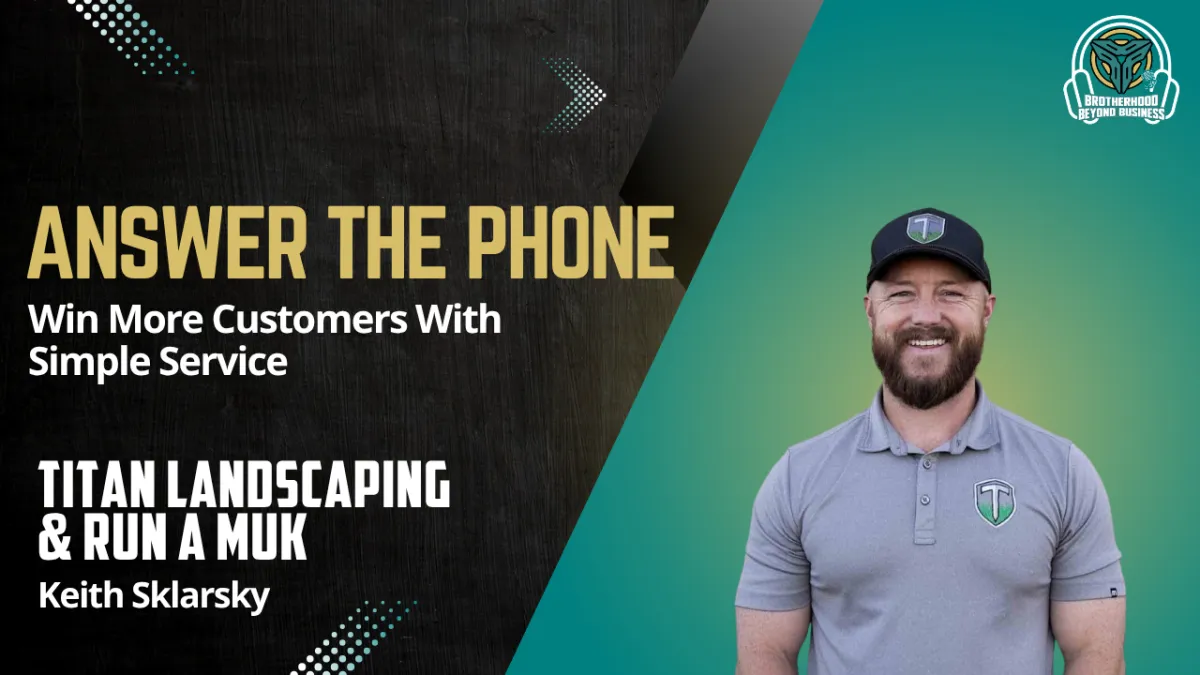
Ep 31 | Building Businesses Through Customer Experience with Keith Sklarsky
Episode 31 | Host: Trev Warnke | Guest: Keith Sklarsky
🔥 Why This Episode Matters
Most business owners think growth comes from better marketing, more leads, or the next strategy. But the truth is, most businesses aren’t losing because of a lack of opportunity—they’re losing because they fail at the basics.
This conversation hits a nerve for entrepreneurs who feel like they’re constantly chasing new clients while struggling to keep the ones they already have. There’s a gap between what we say we value and what we actually deliver day to day.
Keith brings it back to something simple—but not easy: discipline in how you treat people. This episode is a reminder that long-term growth doesn’t come from hacks. It comes from doing the small things right, every single time.
🎧 Listen to the Episode
👤 Meet the Host & Guest
Trev Warnke — Instagram | Facebook | LinkedIn | Profile
Trev Warnke is an entrepreneur, coach, and co-founder of Brotherhood Beyond Business. Through the Brotherhood community, Trev works with male entrepreneurs who want to build strong businesses without sacrificing their health, faith, or family.
Keith Sklarsky — Profile | LinkedIn
Keith Sklarsky is a multi-business owner based in Prescott, Arizona, operating companies including Titan Landscaping, Run A Muk, and Hassayampa Canine Resort. He is known for building service-based businesses centered around strong systems, responsiveness, and exceptional customer experience.
About Titan Landscaping — Website | Facebook
About Titan Landscaping Titan Landscaping is a Prescott-based service company focused on delivering reliable, professional landscaping with a strong emphasis on communication, timeliness, and customer experience.
About Run A Muk & Hassayampa Canine Resort & Spa — Run A Muk Website | Hassayampa Website | Run A Muk Facebook | Hassayampa Facebook | Run A Muk Instagram | Hassayampa Instagram
Run A Muk & Hassayampa Canine Resort & Spa are dog daycares and boarding facilities focused on giving dogs an active, social, and well-structured environment. It’s built around real care and engagement so dogs go home calmer, happier, and better behaved.
📌 What You’ll Learn in This Episode
Why customer experience is the real differentiator in local businesses
The hidden cost of constantly chasing new customers
How answering the phone can separate you from 90% of competitors
Why referrals should be your primary growth engine
The role of discipline in building trust with customers
How to scale multiple businesses without losing quality
Why simple systems outperform complicated strategies
The connection between business success and personal responsibility
🧩 Episode Summary
Trev and Keith break down the reality most entrepreneurs avoid: growth isn’t about doing more, it’s about doing better. Specifically, doing the basics better than anyone else.
Keith shares his experience building multiple service-based businesses by focusing on what most people overlook—communication, responsiveness, and consistency. Instead of chasing every new lead, he emphasizes maximizing every interaction with the customers you already have.
The conversation moves into how small actions compound over time. Something as simple as answering the phone or following up quickly becomes a competitive advantage when most businesses fail to do it. These aren’t advanced tactics—they’re fundamentals executed with discipline.
At its core, this episode reflects the Brotherhood mindset: take ownership, do the work, and build something that lasts. Not just in business, but in how you show up as a man leading your family, your team, and your community.
🕒 Episode Timestamps
[00:00] Intro & Keith’s background
[02:30] Starting vs buying businesses
[05:00] Customer experience as the real advantage
[08:30] Retention vs chasing new leads
[12:00] Why answering the phone matters
[16:00] Balancing business and family life
[20:30] Scaling multiple businesses
[26:00] Leadership, responsibility, and community impact
💡 Quote Highlight
“Any chance you get to make the customer’s day better—you need to take it.”
🚀 Next Steps
👉 Download our Your Circle is Your Ceiling eBook
👉 Learn more about Our Method
📚 Resources & Links
Follow BBB on: Website | Instagram | YouTube | X | Facebook | Buzzsprout Podcasts
Watch the full episode on YouTube
Want to listen to future episodes: Spotify | Apple Podcasts | Buzzsprout
🚀Full Transcript
Trev Warnke (00:45)
All right guys welcome back to another episode of brotherhood beyond business podcast I'm taking here today with Keith's Klarzki, and we're doing it from the press kit location We're gonna dive through Keith's life understanding the different businesses that he's running and just focusing on his life and him as a man So in our conversation you can just look at me the whole time enough to worry about okay, okay? All right, so first thing Keith just give me your story of how you I know you're not originally from Prescott What you did before that how you came here now kind of what you and your family are doing now sure
Keith Sklarsky (01:13)
Yeah, so I grew up in Southern California and lived most of my life there. We ended up coming out to Prescott to visit some friends who had moved from Pasadena, which is where my wife and I were living, and came out. were looking for a place to move our family to get our kids out of California. Came here. We visited one time. We're like, this is it. This is the best place we've found. We traveled a lot of places trying to find that right spot.
Found it, came here and we decided, okay, we're selling the house and we're gonna move. At that time I was working, I was doing some entrepreneur stuff and then I was working at UPS doing sales management for them. So, dropped that. That would have been 2020.
Trev Warnke (01:58)
Is this ⁓
Keith Sklarsky (02:03)
It was right after COVID.
Yeah. So we did that, moved, put an offering on a house out here and the rest is history. I have two kids. Two kids, ages? My daughter's nine, my son is five.
Trev Warnke (02:13)
And you're married with having kids.
And so talk about the businesses that you're currently running here and how you got into the different businesses. Because I know your story is a little different than the average entrepreneur story in my opinion. The average entrepreneur, in my opinion, of like comes up with an idea and is like, I'm going to like, they're probably a technician, right? They're a technician that's like, hey, I could probably turn this into a business. Sure. Whereas for you, I feel like your path in Prescott has been a little bit different.
Keith Sklarsky (02:43)
Yeah, I I tried my hand at entrepreneurship through starting something and I had a couple of things like that that never really panned out. My entrance into business ownership here was purchasing an existing business which is Runamuck, which is a dog boarding and daycare facility. And that one was not performing that well. I basically bought it for the price of the building and then came in and made the adjustments that I needed to to make that a
viable standalone business. And that's how it is operating now. Like it's a great business. Our customers love it. So that's kind of how I got started with that. That rolled into me partnering with one of my current business partners and finding other dog locations to buy. So I just started cold calling other kennels in town and found somebody who was willing to sell. And we rolled that into, that's how we bought our second location.
Trev Warnke (03:31)
Yeah, and that's how I actually ran across to you is like I was we used Run amok originally and then we moved to Chino and that was just too far to come all the way over to Run amok. And then you guys said I think you just purchased is a Humpus.
Keith Sklarsky (03:43)
I can never say it.
Trev Warnke (03:45)
Hacienda, you guys have just purchased Hacienda. And so that's when we started taking our dog Duke there. I think one time you were sitting at the front desk running, just talking to somebody, whatever. And I was like, just love the customer service that you guys provided at like, you know, and our dog loved it and all that kind of stuff. it's like for us, it's not having kids, that's our kid right now. like, whoever takes the best care of our kid. So I love the customer service that you, I don't know what it looked like before that point, because I obviously never seen it before that point, but what you guys have done, that's when I reached out to you, is like, hey, you're running a really good system.
my opinion because all the businesses that I run are completely built on the customer service. We have technician things we do like we own a gym, marketing company and those things are customer service, workplace customer service is what I truly believe is the most important thing. So when I saw you guys were doing that I was like, okay that's pretty awesome that you guys are doing that and then I found out I didn't even know at that time that you worked or owned Titans.
Keith Sklarsky (04:35)
Yeah, and then we ended up finding another partner and we purchased a commercial landscape company and a pest control and weed spraying company. And then we do a couple of other things. built houses in communities too. So we're trying to do a bunch of different things and they've all worked out well for us. But to your point, the common theme throughout all of it that I've found is that customer experience.
You can call it customer service, whatever you want. It's like when that customer comes in, they're going to give you money or when you run into that customer throughout your day, they're paying you to provide whatever service it is and you need to make sure that their experience is great. Any chance that you can make their day better, we need to take that opportunity and do that for them. Because it's easy for us to, you know, we're in our job, we're doing what we're doing every day. It's easy to...
that the customers are so important. we, like, I try to make my staff aware of, like, every time you do something, put yourself in the customer's shoes and how would that be perceived if you were on the receiving end of this interaction? Is that how you would want to be treated if you were coming into somebody's location? So I think just changing how people view what their interaction with the customer is is so important to the product that our consumers end up getting.
Trev Warnke (05:52)
Yeah, I think I would say for young entrepreneurs, that's probably you're so you're in such a hurry to get new clients, you have no clients, right? Yeah. And so it's just like new, new, new, and almost like you just kind of like not even worried about the people that you did get, you're just chasing new. And I do think when you're early on in business, it kind of has to be the equation because you got to have enough to make revenue. But then there's got to be a point when all businesses flip the switch where it's like, well, actually retention of our current client, I think from the beginning, it's always the most important thing. Sure. But for new people, like,
That retention side like we do a really good experience from day one. We're gonna keep this person You know for landscaping it could be for years, you know, you could be keeping them for years on this kind of thing And so it's like how long can you keep this customer get this customer for coming back? You know yesterday I did that podcast with hair by Joey and he had talked about the fact that like when he gets somebody cutting his hair I could keep them for 30 years, you know 30 years old So the idea is that customer service is the most important customer experience the most important things we want to keep them coming back for sure
that you have that built into your philosophy, but think a lot of young entrepreneurs miss that because they're always chasing another new customer when the revenues, you've got to keep that base revenue or even you can take your current clients and increase the revenue through them by offering more services.
Keith Sklarsky (07:07)
Yeah, or I mean, some of the biggest companies that I know when I talk to the owners, referrals are some of their biggest lead sources. And that's a free thing that you can get from somebody just by giving them the experience that they're looking for. So it's not just that they're going to be willing to spend more money with you and continue to stay with you. To your point, like all of our businesses have an opportunity for us to.
interact with that customer for years. And we want to be able to provide the service where they want to keep coming back to us for years. But yeah, it's just, so important to not forget. Like I know it's scary when you're first started now, like, man, I really need to go get another customer. I know that this one, the one I've got is calling me, but I'm in a meeting with somebody else right now. Like the dollars that you have are the most important. We need to find a way to maximize the experience for the people who've already agreed to work with you.
And if you do that, I think in the long term, that success is unmatched.
Trev Warnke (08:00)
It's a...
Like you said with the referral side, it's like that one person can become three pretty quickly, giving them a great experience. That person can go talk to three other people and that's a quick multiplier. know Alex from Rosie's big on that multiplier of turning one into three. And so I love that idea that you're focusing on this, great experience, and then also being bold enough to ask for a referral too. Like, hey, we did a great job. Is there somebody else that you could really benefit from this? So based on that, what would you say are your two or three differentiators
Keith Sklarsky (08:27)
Yeah.
Trev Warnke (08:32)
from other landscaping, I mean you got different businesses, from the different businesses that you run, what do you think you're doing, you pick one business or the different businesses, and what are the things that you think you do different than other services that are on the similar thing in the area?
Keith Sklarsky (08:44)
Yeah, I mean, it would be different for all of them. Like in the landscaping one, I think the biggest thing is just timeliness and professional communication. If you do that, if you answer your phone, if you respond to emails, if you get bids out to people, you're already gonna be different than 90 % of the other competitors out there. So if you're providing that, that's the customer experience on that side, right? Like if I need something, can I call you and get it done?
So I think that's where we differentiate ourselves on the landscape side on the dogs It's really just the experience that the dogs have that we kind of differentiate where our two locations Provide a different environment for different types of dogs But both of them give your dog at the end of the day like our goal is your dog goes home And you don't have to take them out for a walk right like they're completely exhausted They're good to just go home and lay down and you
are free to do whatever you need to do the rest of the day. And then our people, on both, on all the businesses, but like, if you've got great people that you trust and you delegate the responsibility correctly to, and you let them go do what they're best at, they're gonna far surpass what you as an individual could do. So allowing the team to get out there and interact with the customers and provide the right experience.
the dog places provide the right product and service at the landscape company is really what kind of sets us apart. And we work really hard to make sure that we bring in the best people that we can.
Trev Warnke (10:14)
Yeah, I would use the dog one for example. when we live in Illinois, we always took our dog to a doggy daycare, but it was probably once every other month. He just didn't seem to really enjoy it. The second we took him to you guys, they'd run amuck the first time and he came back. I think it was like the first time we had to go through like a testing, which is awesome because the first one didn't do that. So it was awesome that he has like a temperament testing kind of thing. And then from there he came back and the third time he was excited to like go instead of before he was always nervous to be dropped off. And the same thing as the Hampa Sampa.
Keith Sklarsky (10:43)
Pass the upper?
Trev Warnke (10:43)
Hump
you. I was gonna say the other one for that one, same thing. He knows when we're going that direction in the car, he's super excited about that, which tells me that he loves the experience there. And my main differentiator for me was the fact that you guys really let him play a lot more. The other one that we took to, they stick him in a cage every, they go off for 15 minutes and then in a cage for like an hour.
15 minutes and they said that was how you do it. Well then when I went to you guys he got a play on it. This dog comes back and he's exhausted. I love this like he's not like want to play when we get home. And so that was a huge needle mover for us. Okay we can actually take him there more consistently and make it part of our routine to take him. I mean love the thing that you said on the landscaping side of things.
Keith Sklarsky (11:21)
Right.
Trev Warnke (11:24)
Actually, in a couple different podcasts I've had this year, multiple people have talked about that side of it where just answering the darn phone is a step above 90 % of other businesses. The amount of things that have to go to voicemail or the amount of questions that don't get returned in a timely manner or quote or whatever, that's, in sales they talk about you need to answer within five minutes of whatever they do, right? Because they're gonna be moving on to whatever's the next service because they're trying to get an answer relatively quickly.
And think a lot of people, businesses struggle with that because either one, they're trying to be the technician and the business owner, or they're just like, don't like answering the phone. think that's pretty common where, know, especially with the new softwares and stuff, everything goes to texting. I'd rather text back and forth. But in a place like Prescott, there's a lot of older people that still just want to do a phone call. And I think that's a hard thing. know Joey on our podcast of the day, he said that he's like, it's amazing how many people, like he's the person that still answers the phone a lot there. And he's like, it's just amazing how they just want to have a five minute conversation while we're setting up their hair.
Sure. People just want somebody to talk to too. So I do think that is a differentiator. That's so simple. It's like just running your business. Yeah. Taking advantage of the fact that you actually got a lead, convert that lead. Right.
Keith Sklarsky (12:31)
Yeah, the thing I don't like about text is so much can be misconstrued through a text. Like you could misunderstand the customer's tone or the customer could misunderstand your response to that. A phone call I think is much better to, especially with like something that's a lot more detailed, but just anytime that you can talk to somebody on the phone.
when you're talking about your customers, I think you should take that opportunity. You never know what that conversation is gonna turn into. And every time that you do, you're building a little bit of trust with that customer. And that's probably what Joey's talking about. Like, yeah, I'm just getting my haircut, but I also wanna know before I go in there, am I gonna like this person? they gonna, like, how you treat me on the phone is a pretty good indicator of how you're gonna treat me when I show up. So those are all just little opportunities to me to be able to prove.
to your customers that you are different, that you are gonna do what you say you're gonna do, and that you do pride yourself on providing a great experience for them.
Trev Warnke (13:27)
I think so.
When you said there about tone, I think about when I write emails back to clients, I'm very specific on making sure I'm writing with a tone and using certain things, like either laughing inside of there, because sometimes when you email back as customer service to them, let's say something went wrong with the software. So, for example, they're using our software. Something goes wrong with the software and all of a sudden they might be upset when they see the thing. Well, I want to come back with as much of a happy tone as I can create inside of an email. It's super hard to do in text, you don't have enough.
I try to always create that happy tone because I am when I read their email I like sometimes get like oh man I get my heart rate gets elevated because like there's something wrong But the idea is like I don't know their tone or anything They might just real quick email that had no tone to it at all I do like how you said that is like texting for sure it creates tone email It has a specific tone to they don't understand you can I can make it a little bit better But it's so much so much I can do so we actually shoot a lot of loom videos like video recordings of stuff to send back to our customers a lot of our customers like to send it
email because they don't have time to jump on a phone call. So we just send back a lot of loom. I'll just respond in the loom video because I want to create that like, Hey, you know, Oh, there's no big deal. We'll fix this real quick. Here's how I'm going to fix it real quick on this loom video, just to add that happy tone. So that person feels instantly satisfied. But then like, Oh, cool. Like, this is a quick fix and there's no big deal.
Keith Sklarsky (14:48)
Yeah, like I said, both ways it's easy to just forget. The people that are reaching out to you are also busy. They may just be sending something quick. It may not even be an issue to them, but then you've got yourself all worked up. man, I gotta do something. I gotta make sure that they're happy. That may not even have been what the issue was. So that's why think phone or in person, if you can do it, goes a long way.
Trev Warnke (15:09)
Yeah, it's I mean if you just take in the account like a text between you and your wife like I think about touching me my wife's like Sometimes like I won't even mean to put tone into it I was like answer real quick and it'll be misconstrued on her side saying or are you upset about something like no, not at all What are you reading? But her perspective might have been like the elevation of her what she was doing at the time might have read that text wrong That's just between some people that love each other not not even really know
Keith Sklarsky (15:35)
For sure, yeah.
Trev Warnke (15:36)
Dive
into your family life a little bit. So I know when we first talked about that, being a, yeah, your family life is really important to what you're doing in life. I think even when we were talking the first time we talked, it was like, it's kind of like why you do what you do business wise. And you're doing that stuff more to build up the life for your family than even being like, man, I love running these specific businesses, right? It's more like, hey, I'm building business and it's fun because business building is fun. But it's also like, I'm doing this specifically to build up my family.
Keith Sklarsky (16:01)
Yeah. Yeah, I mean, think that society's lied to a lot of people and told them, you know, go chase your dreams. Excuse me.
which I think is a fine thing to do, but you've also gotta provide for your family. yeah, part of the reason that I'm doing this is so that I can show my kids a certain skillset that I never had, never got shown to me, and I had to go out and learn, and I can shorten the time span on them learning it by years. And then also to provide the quality time with them that I want, like when I was working for somebody else.
You don't get freedom of when you wanna go on vacation or when you wanna go home or just meet them up for lunch. You're on somebody else's time. And so you've gotta be cognizant of that. Now, whenever I wanna meet up with the kids or my wife, we just do it. And I don't have to worry about is somebody gonna be upset. At the end of the day, the deliverables are on me. I know what I need to get done and what I need to execute to get the business where it's supposed to go.
I'm gonna do those things and I can fit that around the time that my family needs me as well. To me, all of this is nothing if my family is upset that I'm doing it.
Trev Warnke (17:18)
Yeah, that's, the entrepreneurial trap. I talked about it, I heard one person say this in a meeting I was in one time. He said, the reason sometimes he died so much in the business is it's the only area where he feels like the superhero because he doesn't feel like at home he can be the superhero. And I remember that conversation being like, well why don't you feel like you can the superhero at home? That should be the one place you can be the superhero. But the idea was with business, you get the instant reward of the...
profit or something, you you get a metric that moves life forward, right? And at home, it's really in certain ways delayed profit. I like what you're talking about, these, I'm teaching my kids things along the journey that maybe we won't even come to fruition for 10 years from now. But I'm building their character and the moments aren't always perfect. Some are amazing, the hugs and the things we get to do are amazing in the moment, but they're not always as instantly rewarding as business is. But it's like,
I mean, from a faith perspective, it's literally what God puts on earth to do, right? It's to like, go out and multiply, right? And to build and lead others. And it's like, we can go out and lead communities, we can lead businesses and that kind of stuff, but if you can't lead your own family and do that kind of stuff, well, what was the purpose of all the things you're doing? At least from a faith perspective, you're not going down the right path or the direct path that God probably put you on the path to do. So I love that have that perspective. And as a...
I was kind of pitching this back to young entrepreneurs as they learn this kind of stuff.
When you first start business, sometimes you have to be all in, right? You just got to be all in because the business needs it, because that's creating that, providing for the family. But you've got to know when that cutoff time is when it's no longer outweighs the time spent, right? Because conceptually, there's always going to be another metric to chase. There's always going be more profit to do. There's always going be something more you can build inside of business, buying new businesses. But if they take away from your core values, which is spending time with your family, that kind of stuff, then what's the point of adding another business or adding another project?
under your plate, it's gonna pull away from those things. So go all in for a period of time. can't tell you based on what your business is, how that period would be, but I can tell you there is gonna be a point when you need to the switch. And usually it's hopefully you can do some of that before you have kids so that you don't have to wait your kids 10 years old before you can flip the switch. Which when for you do you feel like, always from the beginning were you able to flip that switch? like, hey, I'm able to like balance this? Or when did balance start, I don't even know what balance is, the harmony between the two makes sense.
Keith Sklarsky (19:42)
Yeah, I mean, I think for the landscape one was probably the longest one, but there was just so much for me to learn. Like I think there's, there is a part of it where like you're doing yourself and your family and your business a disservice if you don't understand it, right? So you've got to do some long days and sacrifices to make sure that you understand what's going on. As soon as I get to that point and I know what I need to start delegating and what like.
what processes we need to put in place or what needs to be fixed. That's when I can really start to step back. So I don't know what the time frame is different on any business that you're gonna look at or own. recognizing like, okay, now I know what is going on. I know enough to fix these things. I don't need to be here 18 hours every single day from sunup till sundown and have no time for anything else. Like you're always gonna be able to find work.
to do to stay busy as a business owner, right? And so you really have to prioritize like, is this busy work that I feel like I need to do? Or is this stuff that the business doesn't move forward if I don't do it? And like that comes just with, like I said, time of being in the business and understanding. But I think most of it you'll find you can delegate and you can create processes for that will free you up.
immensely and give you the time and flexibility to do stuff that you want to do. And then if you are staying in your business, you know, 12 hours a day, I think that's a choice that you're making and you're probably not making the right choice because you haven't prioritized and figured out, okay, what am I actually doing that moves this forward?
Trev Warnke (21:18)
Yeah, I think that's where the gurus get us all confused. know, like with the YouTube stuff, like Elon Musk working 24 hours a row or Alex Ramosi, like not having kids because he wants him and his wife to build the world's biggest business. Like that's cool. That's their goals. but I would say that's like a 2 % goal. would say majority of humans, specifically men are probably wanting to build a family and build, they're building their business for their family, not to become a billionaire. Right. Um, but we get stuck in the guru trap where the gurus are like, well, you've got to do this to build and make this much money.
But like I mean, I think most people I talked to is like most men don't even have like a specific target I need to make this much money a year, right? don't you know, need to be like I see that I know roughly what the metric is what I need my hand My family would be in a really good place Anything above and beyond that is great However, if it sacrifices from other goals, it's just not there But the gurus tell you like just keep going after more because the more you make the more opportunity to create Well, what are those opportunities if you're giving up these other?
Keith Sklarsky (22:15)
For sure. Yeah. Yeah. And to me and a lot of people that I know, it's like, it's not even a money thing. Like it's freedom and a sense of accomplishment that you get that you can't match on any job that you would ever have. I would much rather make 40 grand a year and have my own business than go back to the corporate world where I was making, you know, mid six figures just.
It didn't make me happy. It doesn't matter at a certain point. Now you're trading money and you're miserable and your family has to deal with a miserable person. That doesn't really help anybody. That's not the life that I want to live. yeah, think people have a number in their head, but really the thing that moves most of these businesses forward, I think, is just an internal drive to do things different and do things that you want to do and have a great...
company, have a great culture with your people. Those things, think, when you stop worrying about the money and you can just focus on, why am I here, why am I doing these things, then everything else starts to become a little easier and the money flows easier from my experience. You focus on the stuff that is important. Focus on what you need to do to move the needle and let the rest be noise. You can't control a lot of this stuff anyway, so don't even worry about it.
Trev Warnke (23:32)
Yeah, that's perfect. That's the...
Entrepreneurial trap is the fact that you can work forever. You can literally do whatever you want. But it's like not the reason anybody got out. I think almost everybody that got into entrepreneurship want to create flexibility. More than even financial flexibility. Just like flexibility. nobody takes advantage of the fact that they have something they can create the flexibility you're talking about. It can create the flexibility to the lifestyle that you want to live. And everybody's lifestyles are different, right? You don't have kids. might be okay. I'm okay with working evenings, but I want the middle of my day.
to like spend time with my wife. If have kids, they're probably, they in schools? The only time I wanna work and I wanna be off for their sports. That's entrepreneurship's cool in that way. We don't have somebody saying you have to work these specific hours if you wanna get paid this stuff. But it's a trap because we, as soon as you get into it, you're like, oh man, now I could work all these hours and just setting those boundaries, that's important. How has your wife along this journey helped out with creating the values and setting the core values for your family?
Keith Sklarsky (24:29)
Yeah, I mean she I mean she's the a Huge driver of what the the core values of the family are right? She's the one that is with the kids most of the day we Do a mostly homeschool program for our kids, so they're learning from her all day You know working through the stuff, but she also You know she does a great job when they're out and about in town I'm making sure that
she makes time to come meet up with me wherever I am so that the kids can see like throughout the day. And it's just like a habit for them now. Like they know they get to see dad whenever, you know, they're around and I'm around. And I think as they grow older, they'll appreciate that. They're like, most kids don't get that experience. They don't get to just leave school and go find wherever dad's working and go say hi to them or grab lunch with them, you know? So she does a good job of reinforcing
that and then also reinforcing the why of what I'm doing. So when there are days where something comes up and I've got to be gone in a time where I'm normally there, right? Cause that does happen. I don't want to make it seem like I have complete control and if something came up, I could just say, no, like there's some things that I have to go do and there's times that it falls into time where I'm normally not doing it, but this is what the customer or the business or the people need. And so I'm going to go do it. And she does a great job of explaining to the kids.
why it's so important and what is like hinging on me being successful, which is, know, 50 or so families of people that work for us that are relying on me to move this business forward and keep giving them opportunities to raise their families. So that's a big burden and the kids are starting to understand like.
Okay, dad gets a lot of flexibility, but there's also a lot of responsibility that goes along with that.
Trev Warnke (26:15)
I think that's what we touched on there with the burden of other people's families that I people don't realize that entrepreneurs have. It's awesome because you get a provider, but it's also a big stress. My dad has a pretty big corporation and he has a lot of employees. And the thing that he always talked to me when we were young and I love that you're in this journey is that fact that like...
when he would talk to things, said, I gotta make sure that these guys are provided for. And he told us that a lot when we were kids. My responsibility is not just to bring any more, it's just to bring home money for you guys, it's also to provide for these guys. And if somebody loses their job because I didn't do what I was supposed to do. I always thought that was, being taught that from a young age was really important to where my journey ended up as I got older. All my siblings run that corporation and I own my own businesses. So we all have that entrepreneurship in our life. And we're all responsible for employees. And it's good to know that that's a way we
you're taking care of the community, but also if people don't realize it that the owners, I think sometimes employees just think like the paycheck. They don't think about the burden that the owner's going through to make sure that's keep getting this paycheck. And I think that's something that is overlooked a lot.
Keith Sklarsky (27:19)
Yeah, yeah, I also don't, I mean, I certainly didn't when I was working for people, but you'll understand that most business owners, a good business owner is gonna care about that too. it's not like, you're not just a number, especially on a small business, like you're not just a number, like maybe I don't get to talk to you every day, right? But I'm doing my best to make sure that you still have a place to come and work. And I, you know,
I it, know they're doing the same, right? They're coming to help us grow and I appreciate that, but there's a lot of stress that goes along with making sure that all these people continue to have the opportunities and it doesn't just happen, right? Like I think it's easy to look at what any business is going through and be like, okay, well, you know, like it's just going. No, that's not just moving. Like somebody's driving that business forward. Somebody's winning new accounts. Somebody is doing something different to continue to grow and provide those opportunities.
It doesn't just happen by chance.
Trev Warnke (28:20)
Yeah, I heard,
My sister was telling me about an employee that was complaining to her that, I could be doing that other employee's job and making their money too. And it's like, he's a salesman, right? Everybody always thinks salesmen are doing nothing because they are sitting behind a computer, right? This is somebody back in the factory kind of thing. And she had to, there's that moment where it's like, do you realize like the fact that if he makes three sales this week, it pays for your salary for most of the year? You get to keep your job because of this. And that's the same, like that's a sales. And then you have the CEO or whatever on top of that that's like, hey, I'm making sure
all these salesmen stay in business. think it's so tough. I've been in entrepreneurship pretty much my whole life. I've never worked for anybody but my dad, but when I took over his corporation, I was vice president right away. So didn't really work. He wasn't even involved at that time. So I've never really had that experience of working for somebody else. never, the idea is like, don't know if I ever thought if that person was taking care of me or not, but I always have thought about that from day one is the fact that like, hey, every single...
moment of the day the thing I expect everybody else in this business and so me being the best version myself really helps out with that and it's just I just think a lot of people in the community need to realize that all entrepreneurs out here are making it so all communities are moving forward because that's the only way I mean no business can run with that I mean unless you're a government-based business and it's still coming from our taxes so like it's still like realistically being
Small business entrepreneurs are paying majority of the taxes. So realistically, our whole society as Americans is built on small business entrepreneurs. And I just think people need to realize that we are supporting the community at times.
Keith Sklarsky (29:51)
Yeah.
Yeah. And the other thing is like the business owners that I know and talk with, we all have the same goal of like, we want to grow our businesses and we want to grow the opportunities within our business so that people can have great jobs and raise their families comfortably. Like, I don't think that gets talked about a lot because like you can't really convey that to an average person, but business owners care about providing opportunity.
upward mobility and a place where people enjoy working and are happy and can provide for their families. So it's easy to forget that and think that they're just out to make money. A lot of them that I know aren't that way and a big part of the reason why they're doing it is to provide things back to the community.
Trev Warnke (30:39)
Yeah, I think,
My dad talks about this a lot with dad. He's like, always has opportunities for people, but he also expects people to raise themselves into those opportunities. And that's I think a lot of employees kind of struggle with that concept is like, there's these opportunities for you to do it, but I'm not just gonna pull you up to those and give you a higher salary. You've got to earn your way up those steps up that ladder. But I do think you're right. Most entrepreneurs are like, hey, I would love to have more sales and I'd love to have you come from the ground up and become a marketing person for our company. You've just got to earn your way into that path.
that because from an entrepreneur perspective every person that levels up technically should level up your business. If you level up a new salesman that person is going to bring in this much more money for your business. So it's like hey we'd love to level up every single person in this business because all that does is just it brings up higher profit margins that we can then reinvest in the business.
Keith Sklarsky (31:30)
Or it may, some people make the decision that, okay, I'm gonna move somebody up and it's not gonna improve the bottom line of the company, but it's gonna give them an opportunity and it'll free up time for me. That's another decision that's not always, that's not just, okay, I'm doing this because I'm making more money. It's like, okay, I'm doing this because there's multiple people that benefit from this opportunity coming to fruition for this person. But the other thing that you talked about,
The opportunities are there, people just don't take it. I'm not gonna force somebody into another role. There's spots there, you can see them, you can see where the teams need help. Somebody's gonna step up and fill that role, but it's not gonna be because I went and told them, you need to go do this. If you express to me that you wanna move up, okay, now you know the opportunities, you find a way to help out these areas where there's...
help that needs to be had and you'll find yourself in a better spot for it. I'm not going to force that on somebody though.
Trev Warnke (32:30)
Yeah, I remember I think it was Andy Fasilla who runs that. He has a podcast called Real AF. And what he talked about is he's always looking for people to become their personal best. And by showing me you're doing your personal best, that's how you move up in a business. He's like, it's just like, you're the person that might pick up garbage that was on the ground. think just, you just show, if you show up every day to your business with your personal best, people, the entrepreneurs, the CEOs of the company will notice those things. It's not even like, hey, I gotta be like hit these certain metrics.
to move up. It's just becoming your personal best every single time you're there and that gets recognized. think most people kind of forget that is they don't show up every single day. I mean people that do usually do get rewarded for it but if you don't show up every your best every single day it's a choice. You can make a choice show up your personal best. Show up your personal best long enough somebody will notice and that moves you up in a business.
Keith Sklarsky (33:16)
Yeah,
yeah and also like if you're not doing, I've seen it with employees and business owners alike, it's like if you're not doing your best, not only does everybody recognize that you're probably should be doing more and aren't, right? But you also, you're an individual, you don't feel good about yourself. You don't feel good about the job that you're doing, even if you're doing a good job at whatever the current job is that you have. But if you've got aspirations to be doing more,
You're not taking steps to do anything about that. You're not going to be a great employee. You're not going to be a great person to be around because you're not going to be happy with what you're doing.
Trev Warnke (33:54)
Exactly. So in this, in the brotherhood, we talk about business, life and legacy is the third thing we talk about a lot. So when we talk, going through the things you talked about, I think there's obviously the business legacy and there's personal legacy. Just talk to me a little bit, like what is your legacy that you want to either leave your kids or legacy doesn't mean like what's the end of the thing, but what you're trying to build by your journey.
Keith Sklarsky (34:17)
Yeah, mean for my family, I'm just trying to show my kids that anything is possible. That they can do whatever they want, that nobody can stop them, that the whole world is open to whatever your imagination can come up with, you can do. I don't know if my kids are gonna wanna do anything entrepreneurial. They may be perfectly happy with going to work for somebody and I would be totally fine with that.
but I don't want it to be because I didn't provide them the tools and the knowledge and a roadmap of how to do something on their own if they wanted to. So yeah, family-wise, it's just really showing them the framework and what it's gonna take to do these things if they want to do it.
Trev Warnke (34:58)
Yeah, I think so think about like the AI revolution right now the way I think about AI for younger people you can think about it Hey, I'm life is easier for me now or I think about at least I've used it so far in my life to be like I can learn things so much faster now I mean I can level up myself and so I think of these younger kids my wife's a teacher and so a lot of them are just using it like they have ways of To do it through school right? Yeah, it's a cheat their way through school And they're young enough sometimes you just don't realize at that point in life, but like as you
get older is like when you talk about with your kids is like is the cool part for that generation that's coming up is you can learn anything. You're already teaching that to your kids. If you can learn anything, you can do anything you want in this world. But you also get the choice to do anything you want in this world. You don't have to. You don't have to become a millionaire or billionaire. You don't have to run businesses. You could be the world's greatest artist. But the idea is like everything's at your fingertips to learn whatever you want. I think that's kind of cool. I would imagine...
you know, talking to my dad going through when he was growing up, they didn't have that concept that you can do anything you want, right? And we're probably, in our generation, it's been a little bit more, we could do college, you can go to college, do whatever you want kind of thing, but I don't know if it was truly, when you go to college, specifically path-wise, it's like you kind of stuck on that path a little bit, and now it feels like, man, right, with the technology and YouTube and all the things out there, it's like, it's an endless possibility.
Keith Sklarsky (36:18)
Yeah, for sure, yeah. You can find any business. There's so many ways to make money. Just put your mind to it and you'll figure it out.
Trev Warnke (36:26)
Well, thanks for the podcast today, thanks for talking today. Alright guys, thanks for listening to this episode of the Brotherhood Beyond Business podcast. Talk to you later. Alright, appreciate it.
Keith Sklarsky (36:34)
Thanks dude, how'd that go? Good. Sorry, my freaking throat started.
Trev Warnke (36:37)
that happens to everybody in podcast, so don't worry about it.