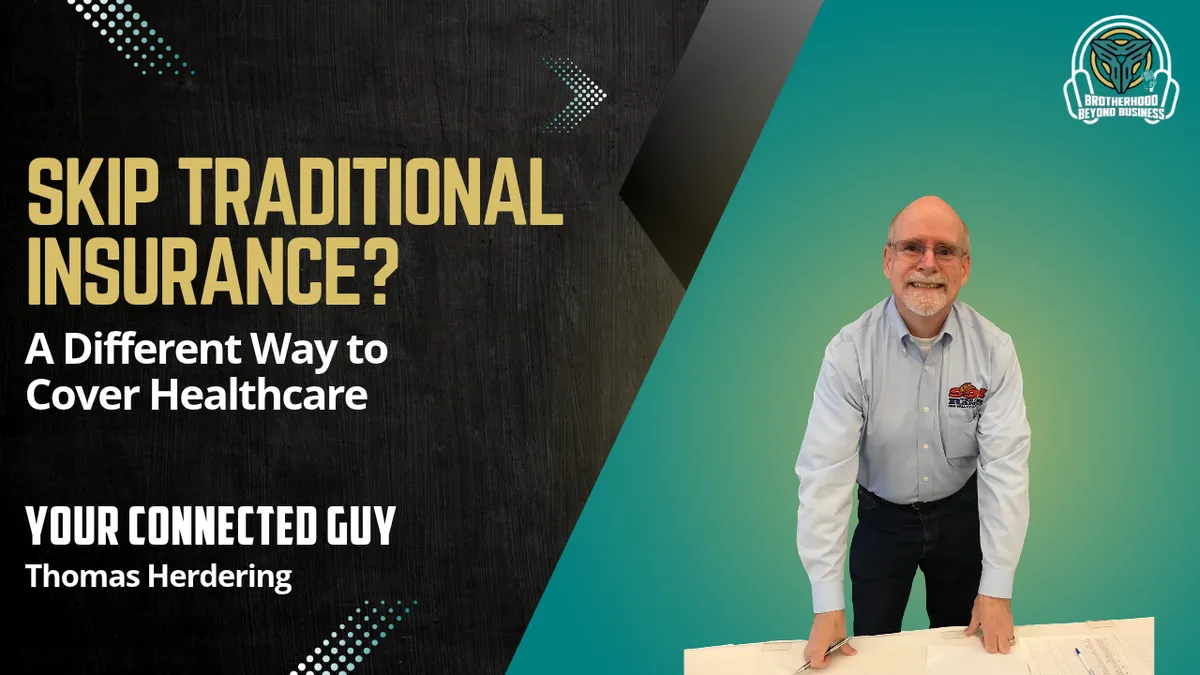
Ep 50 | Health Sharing, Lower Costs, and Better Options with Thomas Herdering
Episode 48 | Host: Trev Warnke | Guest: Thomas Herdering
🔥 Why This Episode Matters
Healthcare costs have become a serious challenge for families, independent professionals, and small business owners. Many entrepreneurs want to take care of their families and provide meaningful benefits for their employees, but traditional health insurance can put significant pressure on their budgets.
In this episode of the Brotherhood Beyond Business Podcast, host Trev Warnke sits down with Thomas Herdering of Your Connected Guy to discuss health sharing, how it differs from traditional health insurance, and why it may be worth exploring for certain individuals and families.
Thomas shares his family's experience with health sharing, how he discovered Impact Health Sharing, and why that experience eventually led him to build a business helping others understand their healthcare options.
The conversation covers direct billing, medical bill negotiations, prescription benefits, wellness rewards, and ways small businesses can introduce employees to alternative healthcare arrangements. It also addresses important considerations, including pre-existing conditions and the need to understand how health sharing works before enrolling.
For entrepreneurs, this conversation is about taking ownership of important decisions, managing business expenses, and finding solutions that support both family well-being and long-term financial stability.
🎧 Listen to the Episode
👤 Meet the Hosts & Guest
Trev Warnke - Instagram | Facebook | LinkedIn | Profile| Personal Website
Trev Warnke is the founder of Brotherhood Beyond Business and a business owner committed to helping entrepreneurial men strengthen their leadership, health, accountability, faith, and relationships. Through honest conversations and a community built around brotherhood, Trev helps men build businesses that support their lives rather than pull them away from what matters most.
Thomas Herdering - Facebook | LinkedIn | Profile
Thomas Herdering is an entrepreneur based in the Prescott Valley, Arizona, area. After years of navigating healthcare options for his own family, he discovered health sharing and became interested in helping others understand how this alternative model works.
That experience led him to establish Your Connected Guy, where he works with individuals, families, business owners, and referral partners who want to explore healthcare options beyond traditional insurance.
About Your Connected Guy - Facebook | Website
Your Connected Guy helps individuals, families, and businesses explore health-sharing options through Impact Health Sharing. Thomas explains how the model operates, how eligible medical expenses may be processed, and what prospective members should understand before making a decision.
Based in the Prescott Valley area, Thomas also builds relationships with local business owners, healthcare professionals, and insurance brokers to help people evaluate options that may better fit their circumstances.
📌 What You'll Learn in This Episode
How Thomas and his family discovered health sharing after experiencing challenges with traditional healthcare billing.
The key differences between health sharing and traditional health insurance.
How direct billing and medical bill repricing may work through Impact Health Sharing.
Why prescription benefits, dental and vision options, and wellness rewards matter when evaluating healthcare arrangements.
What individuals and families should understand about pre-existing conditions and eligibility.
How small businesses can introduce employees to additional healthcare options.
Why healthcare costs deserve a place in broader business and family financial planning.
How professional relationships and local networking can help people discover options they might otherwise overlook.
🧩 Episode Summary
From California to Prescott Valley
Thomas begins by sharing how his family moved from Southern California to the Prescott area. A visit to Arizona, family connections to Prescott, and a growing appreciation for the local community helped convince them to make the move.
After retiring from his previous career, Thomas started looking for a meaningful way to contribute to the community. His personal experience with health sharing eventually led him to a new business opportunity.
His story highlights how personal experiences, community relationships, and an openness to new opportunities can lead to an unexpected second chapter.
Why Thomas Chose Health Sharing
Thomas explains how his family first explored health sharing after encountering difficulties with traditional healthcare billing. That experience introduced him to a model in which members contribute to a community-based approach to sharing eligible medical expenses.
He later discovered Impact Health Sharing and became interested in its additional features, including provider billing arrangements, prescription benefits, dental and vision options, and a member portal for reviewing activity.
Thomas emphasizes that health sharing is not health insurance. The two models operate differently, and prospective members need to understand those differences, particularly when it comes to eligibility, pre-existing conditions, and which medical expenses may qualify.
Direct Billing and Medical Bill Negotiations
One of the central topics in the conversation is how medical bills may be handled through Impact Health Sharing.
Thomas describes situations in which providers can bill directly and others in which members submit itemized bills for processing and repricing. He also explains why understanding a provider's billing options can matter when managing healthcare expenses.
Rather than assuming the first amount on a medical bill is the final amount owed, families may benefit from asking questions about pricing, requesting itemized statements, and understanding the available billing arrangements.
The key takeaway is to understand the process before a medical need arises, so you can make more informed decisions when healthcare expenses come up.
Healthcare Options for Small Businesses
Providing employee benefits can be difficult for small business owners, especially when traditional group health insurance is beyond the company's budget.
Trev shares his perspective as a business owner and explains why having an additional option for employees can still be valuable, even when a business cannot afford to pay for a traditional insurance plan.
Thomas discusses several ways businesses can introduce health sharing to their employees, including educational presentations, enrollment support, and employer contributions toward costs.
The broader lesson is that business owners should understand the options available to their teams and communicate those options clearly. Any arrangement should be evaluated against the needs of the business and its employees.
Pre-Existing Conditions and Eligibility
Thomas and Trev discuss why health sharing is not the right fit for everyone.
Pre-existing conditions can affect eligibility and how certain medical expenses are handled. Thomas explains that individuals with significant ongoing health needs should have a detailed conversation about their circumstances before deciding whether health sharing is appropriate.
The discussion reinforces an important principle: do not make a healthcare decision based on price alone. Understand the guidelines, limitations, eligibility requirements, and potential financial responsibilities before enrolling.
For some people, traditional insurance or another arrangement may be more appropriate. The right decision depends on individual circumstances.
Managing Healthcare Costs for Families
The conversation also explores the financial pressure healthcare expenses can place on families, including business owners who may be financially successful but still struggle with the cost of coverage.
Thomas shares examples of how families evaluate their available options and why some people investigate different arrangements for different family members.
Trev also reflects on how unexpected medical emergencies can affect even young, healthy individuals. The discussion highlights the importance of planning ahead rather than assuming good health means healthcare coverage will never be needed.
For families considering health sharing, the next step is to compare the details carefully, ask questions, and understand how eligible expenses would be handled.
Building Relationships and Growing Your Business
Thomas's business has grown through networking, professional relationships, and referrals from people who want to help families and businesses explore their options.
He describes working with business owners, healthcare professionals, and insurance brokers who recognize that different people may need different approaches to healthcare.
As he looks toward the future, Thomas hopes to expand his network of referral partners and independent professionals who want to help more people understand health sharing.
His experience is a reminder that business growth does not always come from aggressive selling. Sometimes it comes from developing expertise, building trust, and consistently helping people solve problems.
Career Transitions, Legacy, and Future Goals
Near the end of the conversation, Thomas reflects on his career path, which has included aerospace, insurance, technology, broadcasting, retirement, and now health sharing.
His current goal is to grow Your Connected Guy by working with more referral partners and independent professionals who can help people investigate healthcare options.
The conversation closes with a broader lesson about legacy and meaningful work. A second career can provide an opportunity to contribute to the community, build relationships, and help people make decisions that affect their families and businesses.
For entrepreneurs, success is not only about growing revenue. It is also about finding work that aligns with your values and creates a positive impact on the people around you.
🕒 Episode Timestamps
[01:09] Introduction to Thomas Herdering
[01:37] Moving from California to Prescott Valley
[04:40] Family, community, and building local relationships
[11:34] Understanding health sharing and why Thomas chose it
[13:30] Direct billing, medical bill repricing, and member benefits
[18:34] Healthcare costs and how the health-sharing model works
[21:01] Health-sharing options for businesses and employees
[23:38] Pre-existing conditions and choosing the right arrangement
[26:54] Why healthcare options matter to small business owners
[30:52] Managing healthcare needs across different family members
[43:06] Medical bill negotiations and understanding provider pricing
[50:00] Healthcare costs, incentives, and the role of providers
[53:45] Community referrals and growing the business
[55:02] Career transitions, legacy, and Thomas's future goals
💡 Quote Highlight
“Is it perfect? No. Is insurance perfect? Absolutely not.”
🚀 Next Steps
👉 Get our weekly Build the Business, Build the Man., Build the Edge, playbook to get one actionable task to implement into your business and life each week --> Sign Up
👉 Download our Your Circle is Your Ceiling eBook
👉 Learn more about Our Method
📚 Resources & Links
Follow BBB on: Website | Instagram | YouTube | X | Facebook | Buzzsprout
Watch the full episode on YouTube
Listen to the full episode: Spotify | Apple Podcasts | Buzzsprout
🚀Full Transcript
Trev Warnke (01:09)
Hey guys, welcome back to another episode of the Brotherhood Beyond Business Podcast. Today we're here with Thomas Hertering. He's going to walk through his personal life, tell you how he got to Prescott, a little about his life. Up to this point, he's going to walk you through the business, what he's doing currently, and just kind of give you what's all going on in his life. Thomas is local here. He's only been here, what, two years?
Thomas Herdering (01:26)
Two and a half years.
Trev Warnke (01:26)
Two and a half years. So pretty low, pretty new to the area in general. I've only been here four years, so pretty new for me as well. so we're continuing to navigate this side of Prescott and all the joys have here. So I'm gonna have Thomas kick it off and tell us a little bit about your background.
Thomas Herdering (01:37)
Yeah, so yeah, I'm another California transplant. But yeah, the short story on that, if it's short, is what in 2023. My brother had moved down to outside of Tucson, Saddlebrook. And we went down and visited and we were talking, it's like, well, this would be great place to to live. And then it got hot. And that then we stopped that conversation, but it got us started.
And that family conversation, what if we left Simi Valley, California? What would it be like? And it, you know, the wife and I and the boys, we thought, you know, maybe there's a possibility here. So we talked about it for about a month. And then in December of 2023, actually go back, let's see, I guess it would be about September, my sisters were actually coming back from Prescott.
Turns out that our great great grandfather had graded the streets of Prescott back in the late 1800s. wow. So we thought, well, that's really cool. And my sisters were talking about the palace and Charlotte Hall and the archives and all that. So we thought, hey, we should go check this out. So we did some research online and thought, you know, this looks like a really promising place. And we came out, did an Airbnb for a week, fell in love with it. And then through networking, I
Been networking for a long time in business, talked to some realtor friends in CME, where we were, that led us through to a realtor out here, Sam Shapiro. And we came back for two more weeks in I think it was January of 2024, and stayed out in Chino Valley at our friend Lee Kennedy's house. Thank you, Lee, very much for that.
And he just said, yeah, stay at our house, use it. I'm not going to be there. Explore, see what you think. We ended up buying a house at that time and went back to California, sold our house, moved in in it was took the keys on March 28th of 2024. And now we ended up in Grandville. Absolutely love it there. best neighborhood I've ever been in.
And my wife was already ingrained in Heights Church, which was phenomenal. She'd been in CBS for years. So it was a national, natural transition for her to go into the CBS group for women in Heights. And that worked out great. So we started forming connections there. Meanwhile, I was working on the house, making the changes to make it, you know, how we like to live.
And was probably about a year after that I'd finished the house and thought, you know, dear lord, I gotta find something to do because I was technically retired. And I thought it would be fun to find something in the community to do. And that's when I noticed in one of the BVM magazines that gets distributed between Prescott, Prescott Valley, and so on. there was an ad by Jimmy Roy at Sally B's talking about this.
Health care that he had for his employees. And I thought, I wonder what this is. We've been using health sharing for our families, health insurance. I mean, health sharing is an insurance. We had left Blue Cross in 2023 because of problems with that, the Obamacare. And so I went into Jimmy Roy and I said, hey, is this health sharing? And he goes, you know about that? And I said, Well, we've been using it for like 12 years. I said, No quite a bit about it.
So that led into, okay, who introduced you to this? And he said, this guy, Larry. And I said, well, I want meet Larry. And from there, I met Larry and learned about a company called Impact Health Sharing, which turned out I knew a little bit more about health sharing than Larry did. And I said, Larry, I want to sign up for this business. I want to sell it out here. I've been looking for something to do. This seems like it was a perfect timing, meant to be.
And from there I signed up myself as my first customer, and it's just been going great ever since. So that's the short story from Simi Valley, California to how I ended up here and in the business. We have
Trev Warnke (05:44)
how many kids do you have? Ooh.
Thomas Herdering (05:45)
two, Andrew 26, and Steton, who's 16. it's amazing. That was another great thing about Arizona is our our son Stetin has had some challenges, special needs.
And because of Arizona and the ESA funds, this kid has been so turned around. My wife was homeschooled for years, both boys homeschooled. Can't say enough about how this community, the business community, the tutors in town, things tied through Heights Church that we've discovered that we've been able to apply to our son Stutton.
especially through the ESA program to help, you know, kids like this out. And then our oldest son Andrew got his masters a couple of years ago from UCSB and now he's teaching at Yavapai College at the C Tech building. So that's been another joy here. So Yeah, it's
Trev Warnke (06:45)
Me and my wife have every single time we're like thought we found all the good things in Prescott, like something new happens. It's whenever so l so we moved from Illinois, originally grew up in Iowa, so I'm used to small town life, right? I was used to small town and then moved to Chicago or I moved to Chicago, she was from there. A whole different world for me.
Not my kind of world. Like I just felt like I just lived in my house because I didn't want to do other things. So moving out here for us has just been so freeing to get kind of back that small town feel. But this, I grew up a town, 600. This is not that small. Right. But I can do everything we have to here and not have to drive 45 minutes to get to something. so I do love that component of the town. But like there's always just like these little nuggets that just like make this town so special. I don't know. Every time I get somebody that's like, hey, I'm thinking about moving, I'm like, check out Bresca.
Like my business partner from Illinois is moving here in the next year, which would be awesome to have them close, his two girls and his wife here close. I've had different ones that are looking to move from different places. I'm like, God, just try, just check this place out. Like check it out. Every single person that's ever checked it out's just been like, this is not what I imagine Arizona be, right?
Thomas Herdering (07:43)
Yep.
Trev Warnke (07:44)
And like in a good way, right? You think it was just like Scottsdale hot, you know, expensive and hot. Not that this place isn't expensive. There's it's not the cheapest place by any means. but they do really love the environment. So I think a lot of people had your experience with like they move here, they they they visit here and be like,
really see living here, you know, especially coming from California, which is kind a per like you're used to the environment, well, beautiful weather and that kind of stuff, but the environment's a lot different there. and then moving here, like you still get beautiful weather and that kind of stuff. But now I get maybe different environment that might be looking for.
Thomas Herdering (08:13)
Yeah, yeah, it's amazing how small this town is. funny, you know, I was sitting in the palace one time and I'm sitting there looking at the the picture of the movie picture of Stuart Bonner or Junior Bonner, excuse me. and which leads me into I'm noticing that the person who wrote it was Jeb Rosebrook, who is the father of Stuart Rosebrook, at who is the director of Starlet Hall. I went to high school with Stuart Rosebruck.
wow. Notre Dame High School, Sherman Oaks, California. that's crazy. So small world. I hadn't realized that. And then to put that together again. And and there are more and more people that I know or have known in the past that I'm finding here. That they've been here all along. It's just wild.
Trev Warnke (08:58)
Yeah, my it happened in our family. literally, my the a girl my mom went to high school with, they moved to they both went to a small town in Manning and they ended up both moving to Carroll over time. It kind of fell apart. and then all of a sudden, it turns out her son lives here in Prescott and they come down for the then winter here for Prescott. My parents come down in winter for Prescott. And so like those little connections, no clue that they, you know, they had people here from Car small town Carroll, Iowa, 10,000 people has, you know, their sons down here in Prescott.
so it's just it is kind of cool, like that that connection that you get sometimes from these places. But it's just in general, the people here are just good. I find I mean it's tough comparison. Like I'm kind of comparing people to the Chicago area, which is like there are good people there, but just nobody talks to each other. There's no relationship side anymore there. And I don't know if there ever has been, but like there's definitely no relationship side coming from a community like that. you know, people don't know their neighbors, they don't know any of that kind of stuff. I grew up with knowing my neighbors, you know, being a small town in Iowa, you know everybody, not.
Want to know everybody, but you do know everybody kind of thing. so moving here has been so refreshing in that way. having like, hey, now look, I can just talk to somebody, you can go into a random place and talk to people, come to Founding Fathers and you just get to have conversations with so many cool guys. this is like just just been like a gem for us to find in our life. And you know, you and we're both strong in our faith. I feel like God, like this is a a variation. I've been praying for a lot of things for a long time to find that because I always knew I was gonna move. I didn't ever want to live there, but I know my my wife would move. And then once she saw this place, she's like,
Day one, we visited here a year before we moved here. And she's like, I love this place. She's like, it reminds me of your of Iowa, just a lot bigger, you know, because she'd visited enough time. So, well, maybe we can move to Iowa. It's just a gorgeous place. Like, there's nothing to do in Iowa. Nothing to do. And so if we ever have kids, I want them to have things to do, you know? And so moving here and visiting, they're just like, my God, I love this place. And that was that first stepping stone. Okay, she loves it. I think that's God to continue to put that path like all the places we looked at. One spot is like this is a good Christian place for you to grow your family, to put our values of our brotherhood are trying to build.
these the kind of people I'm looking for are in this kind of town. So
Thomas Herdering (10:51)
Yeah, we had the same experience when we moved to Granville. Within probably a week, we had everybody's cell phone and realized that we, I mean, it was natural. We were all looking out for each other. You know, if there's a package delivery, someone's on vacation or whatever, you know, you help them out, you go grab it. And you know, if I need anything, I can reach out to any of my my neighbors. Obviously, I can also reach out to my networking groups too, but it's it's just that Prescott, Prescott Valley, the people.
coveted relationships, they're friendly. We all want the same thing. We want a peaceful community where we can, you know, either retire or build up our families. It's it's amazing. So kudos to the founders of of this community.
Trev Warnke (11:34)
So let's
dig into impact sharing a little bit. Explain more about how what that that service works, why you chose that over health insurance, give people a background, 'cause like even the people that I've introduced to health sharing is it's that conversation like, well, what's the difference between it and health insurance? Just kind of pick let the the the people know like why isn't a good choice for a lot of people.
Thomas Herdering (11:53)
No. Well, I mean, it goes back to our story. So we had a Blue Cross plant in twenty thirteen. And at that time my youngest son bad sadly was desi diagnosed with epilepsy. And so we were in a major regional center in California and they were spinning their their heads because they were trying to figure out the billing. it it's crazy because
Yeah, those bills, turns out that hospital was never paid. And it was just due to the broken system that was really starting to get a lot worse. And our healthcare broker at the time ended up introducing us. He said, You know, this isn't working out. He goes, I'm sorry I sold you this. It's like, you know, there's probably something good that's gonna come out of this. And I he goes, Well, it might be this thing called health sharing.
It's like, well, what is that? He goes, Well, there's this company at the time, it was one called Samaritan's Ministry. And he explained how it worked. It's basically a community that put their money into it and then pay the bills. So the story supposedly goes back to the 70s, where a pastor got really sick and he didn't have insurance. And in turn, what happened was his congregation.
Hold their funds together, put it in a bank account, and started paying the pastor's bills. Well, that's now the model for modern health sharing. There's about, as far as I know, 13 companies out there that do this. They all have their different twists. And with Samaritans, it was good. It did great for us. But there are some weird things for us that we had to send out personal checks when there was a need.
And even the post office tells you you don't want to do that nowadays. there was no dental with it, there was no vision. There was there was a few other things. But again, it worked great for us. But then I, like I told you, I stumbled onto this thing called impact health sharing. And what was different about it, obviously, right off the top, it offered a dental and vision component. That was huge. It was around the same pricing for us, so that was good. So
Typical health sharing, you're gonna find out that it's usually around 50% cheaper than health insurance. Health sharing, you need to be really clear, it is not insurance. And I know a lot of insurance broker friends will say that, but it's not insurance. Well, that's sort of a taboo thing now, because insurance denies over 80 million claims a year.
Sure, if you have pre-existing conditions, that's a discussion you have to have when you're talking about health sharing. But for the most people who are healthy, 95% of the community population is healthy. This is an amazing model for them. But impact health sharing differed because it did offer the vision, it offered the dental. It has an EDI number just like insurance companies. So the doctors can do direct billing. That was huge.
Normally, with most health sharing, what you end up doing is you negotiate the cash price and then you send the bill into the health sharing company. Impact has both options. You can ideally, if the doctor will take it, they'll process it just like insurance. Easy peasy and impact pays within a couple of weeks. Otherwise, if you basically say, look, doctor, I'll basically pay the bill, give me an itemized statement, then you basically upload it in your impact health sharing portal.
And they will basically process it, reprice it for you, which is huge. They do the negotiation on your behalf. And then in turn, you end up getting an estimate of sharing, basically saying you may owe this amount. So that was light years ahead of what we had before. So the great thing was you could go to any doctor. You also got prescription planned with it. I went in Costco yesterday. I filled five prescriptions and didn't pay a
Dime. That was mind-boggling. That was phenomenal. they have this thing because we're all used to hearing about deductibles. Okay. Deductible for a family, $2,500. What insurance? They do have that, but usually the premiums are really high. But here's what's really cool about impact. They have this thing called wellness rewards. So if you have a gym membership, you can take that receipt.
You can send it into impact on a monthly basis. They will deduct up to $150 off your deductible, or as they call it, primary responsibility amount or PRA. But it's not just gym memberships. You can see a direct primary care doctor. Those are like a subscription doctor you can see now. That bill can be sent in. vitamin infusions, acupuncture, buying vitamins at Amazon.
Or Costco, send in that receipt. But again, you can send in up to 150 bucks a month over a year. That's what 1700 bucks or no, it leaves 1800 bucks. And that leaves you with a deductible or PRA in this case of $700 over 12 months. That's huge. Just last year looking at it, we met most of it through the the wellness rewards.
And then a few doctors visits and we'd met our $2,500. So that was a game changer for us, also. So yeah, just huge differences, easier to use. They have a very straightforward portal that everything you see, every bill that goes through, whether it's wellness rewards or a normal doctor visit, you can look up drugs, you can look up doctors. it tells you exactly where the community is on funds.
What they're spending, you can even actually see the family that is in the most needs. And if you see that you've helped out a family, you can even send a positive note to them, which was cool too. You can even, let's say there's a kid down the street where family's great, but they just don't have the means to take care of the kids' healthcare. You can actually sponsor a child or a, you know, it could be even a family. And the obviously the premium or the
payment goes the sharing amount goes through your portal. You're paying through it for it, but now that kid has health coverage. So things like that were just such a game changer for us and made such a big difference. And yeah, like I said, I signed up for the business and in turn became my first customer. That's awesome. And now I offer it in the community. And it's growing and I offer it in all and 48 of the 50 states can't operate in Washington and Rhode Island.
But that's just because of the legislature there.
Trev Warnke (18:33)
It wasn't like Hawaii and Alaska.
Thomas Herdering (18:34)
And you know, a another common thing people ask is, well, you know, how much does it typically cost? Okay. So like a 35-year-old, let's say take them, it'd be like 246 bucks a month for a single person. If they had a family, it would be like around, you know, three or more, it'd be like 500 bucks. If that family had like 20 more kids, it's still gonna be around 500 bucks. So it's all based on age.
It tops out at 64 and then they have a Medicare component basically that adds on to Medicare. So very reasonable. And then the question that does come up is how can it be so economical? It's because it's not insurance. So you don't have a CEO making millions of dollars. You don't have the lobbyists, the attorneys, and all that. It's not publicly traded. All health sharing is run as a not-for-profit. So that way it's all above board.
Everything's visible in your portal or on that nine nonprofits 990. So it's a big difference. Is it perfect? No. Is insurance perfect? Absolutely not. So for those families who are struggling now who or don't have health coverage, this is an amazing option because most of the calls I'm getting now are referrals from insurance brokers or even doctors.
And just other families who discovered this and are passing on the the good word about it. So
Trev Warnke (20:04)
Yeah, I even have like some guys I'm gonna be talking to next week about this a little bit. And they I'm I'm impressed for business owners that they don't even have insurance for their own family. Just because it's gotten so crazy for them, even as business owners, financially, you should be like, well, maybe guys you you know should be able to afford more. Well, not really, not when it comes to insurance, multiple kids, that kind of stuff. It's just and I for my life I've never imagined not having health insurance, just always have. Like it's just like I need you just pay for it, right? Even though I've very rarely ever used it in my whole life.
But it's just like, hey, this is like safety, you know, that's why I have life insurance. I don't know when I'm gonna die, but just in case. but the amount of people that are going without it kind of like blows my mind. And people that I wouldn't I wouldn't imagine without, if I'm being honest. Like if I'm like, hey, the people going without are probably people that just don't have much income coming in, they just can't afford it. I'm seeing people that are running good sized businesses like it just financially doesn't make any sense. I'd rather just put that money away for multiple years in a row and create a little bit of a nest egg to pay just in case an emergency happens. because it's it's just not economical right now.
Thomas Herdering (21:01)
Yeah, and it's a bit I love doing presentations to businesses. When you have a group of you know 10, 20, whatever employees, I can do up to 49 people. then it has to be ACA compliant. But to have a group of employees sitting there that it's like, okay, great, you know, how are we gonna afford this? This this actually opens the door. And the great thing is actually four options for businesses to offer this to their employees. First one is
Just bring me in. Let me do the pitch. When they s they hear the pricing, they realize there's a difference. When they hear the the benefits of it, they know there's a difference. The second option is the impact has this great tool basically where they'll do a welcome call with a business. They'll make sure that I've educated them. They will basically, if the business wants to move forward, they create a portal for them with Impact where they can add the employees.
And they do payroll tokens basically attached to the payroll and basically will deduct the amount that the business wants to offset the cost for them. So that's that's a second option. the third option is some businesses actually will offer a an allowance. There's not a tax gain there for the employee, but you know, they want to help somehow. So they'll basically give an allowance to the employee for their health sharing in this case or
Or whatever it might be. and then the fourth one is somebody could just go wild and crazy like I did. Sign up for the business. It was so une economical to do. You get your own website and and I just went from there and then just started networking out here in the community. Yeah. Big difference.
Trev Warnke (22:40)
No, it it's impressive. I know like I'm definitely signing up for it. we've talked about that. Like it's but it's just and like I said, I've had insurance for all my entire life, always had it. I'm a very healthy individual. Me and my wife take good care of our health, never really once ever had to use it for anything, honestly. which kind of sucks when you see that every year you pay the bill, you're like, gosh, I haven't still used the same thing. But it's for it just makes a lot of sense to me, like.
People get so upset with health insurance in general, but they want to defend health insurance so much too, right? They get upset with it, like, why can't go off of health insurance? Because it's like, well, all the complaints you have about health insurance, you probably have less complaints about impact sharing, but they're still gonna be, like I said, not everything's perfect, but like nothing's perfect over here by any means. so it is kind of that that part where I think the biggest complaint I've had when I've talked to people is like just that difference between health insurance versus just that difference of health insurance versus impact. They get nervous between those two.
And it's like I don't understand the nervousness for me looking at it as a size like may maybe preexisting conditions and maybe we talk maybe a little bit more.
Thomas Herdering (23:38)
And and that that's key. So if somebody has a pre-existing condition, let's say they have type 1 diabetes and they're older and they're, you know, they're potentially gonna have some vision issues, they might have circulation issues, that's probably not going to be a good candidate. I had some people though, I have somebody I'm talking to in Chino right now. She's going through cancer for a second time around, but she got dropped by Blue Cross. So
She needs something for herself and her daughter. Okay. So we know right up front that if you have cancer, that is going to be something that's going to be denied. It makes sense. But what she wants from it is she understands she can work out the cash pay price for her bills, but they can still be processed through impact in this case, because impact will take another look at them, at the bills, and they will reprice them.
They'll have that second set of eyes on them. So that's huge. But then if anything else comes up outside of that, health-wise, impacts there for them. Any health sharing company would be. It's the right thing to do. But she also has coverage for her daughters. She has access to the prescription plan. She has access to the dental, the vision. So if it's something that is severe, you know, it it needs a really, it needs a an understanding, need to have that conversation.
But for the vast majority of us who are fairly healthy to healthy, it's an amazing option. If they in in this case, impact would people would want to know, well, how much do they cover per member per year? It's $500,000 per member per year. Some people, and well, they might have something in their family. Well, you know, my my dad, you know, died of a heart attack at whatever age. Well, if you have a heart attack and you've got your
Your blood pressure and your cholesterol and you're managing all that impacts, you know, that's okay. Just because your father had it doesn't mean you're gonna have it. They're gonna be there for you. But for those people who are really nervous, then I say get a catastrophic plan on top of it. I've got great health insurance brokers out here that I can refer you to that are some of my best referral partners. So if you're nervous about it, let's talk about it.
But otherwise, if you're the typical family, especially, you know, you're bringing up your kids and it's getting expensive and nobody's having any real issues, it's a great, great change. And what I really recommend is if now you've saved, I've seen some people save over $5,000. That's how insane their premiums were with their insurance. If you're making a savings, you know, that's significant to you and your family.
The question is, and you've been given a gift. What are you going to do with it now? I've got some great health insurance, excuse me, financial advisors I can steer you to. And, you know, do you have a retirement? Let's talk about that. Do you have life insurance? Let's talk about that. I'm not gonna advise you on that, but I I highly recommend you've been given this gift. Let's see how you can improve your life and your family's life for the future.
Trev Warnke (26:54)
That's great. one of the things I want to go back to was the business owner side of it was because a lot of people that listen to our podcast are usually business owners. And I think the point part that I think about it as a small gym owner out we could we couldn't afford to pay for our health health insurance for our good coaches. It's just not feasible. However, just having something to offer them that's a good, like, hey, you know, you're I I'm not gonna
pay for we we wouldn't even be able to cover parts of it. Which is like the idea is like having an option like, hey, I know we can't afford for you to have health insurance. However, here's our very reasonable plan that you could do that could make sense for you to have health insurance and still work for us. Because for me, I'm on like almost catastrophic insurance for me. I'm still paying almost like three twenty five a month for catastrophic insurance. You know like for under you guys it's like two forty something. And I'm getting way better than cat I mean my deductible is ten thousand you know which is twenty is twenty five
Thomas Herdering (27:42)
Twenty five hundred.
Trev Warnke (27:42)
and so it's the idea is like those little like that
Even though I don't plan on using it hopefully regardless, still saving that money. But I think as a business owner, I look at that perspective of being like, I just want to have if I could just have an option for the people that I know I can't we can't afford health insurance for you, or we're not gonna offer that. However, here's a good thing that if you when you become a coach of ours, here's our impact sharing plan, here's something that gives you an option. If you already have health insurance options elsewhere, great. If you're like if you don't, this is a reasonable price. and I think that's a big tool that business owners can kind of keep in as like
an addition to the benefits package. A lot of like small businesses maybe don't have a benefits package, but just having options like good referral, like here's how I cause you're gonna need that. So I need to give you a good chance to do that. And think the ones I've been talking to locally that I'm trying to c connect you with are that conversation is like, hey you guys I know you can't afford to have this for your employees. However, the idea is like why why don't you have an option just in case they need this? Somebody that just becomes like I'm sure he won't care like Hair by Joey. We've been talking about that with him.
with hit 'cause he's he all his people that work for him are independent contractors. So because of that, it doesn't really make sense for him to give he doesn't really have a benefits package for independent contractors. Right. But having an option for them to here's like a really good option for you to do impact sharing, but here's this hey hey I know we don't have health insurance. You're working your own business technically inside of our business, but here's a good option for you to do as a as almost your independent
Thomas Herdering (28:58)
What what's the typical age of a trainer, say?
Trev Warnke (29:02)
most coaches are probably twenty five to thirty five at most and super healthy.
Thomas Herdering (29:08)
So most people will find that, you know, especially my son Andrew, he just just turned 26. He left our family plan with Impact Hellshine, he's transitioned onto his own 26. Every 26-year-old, same price, 211 bucks a month. Very, very reasonable. And again, dental envision all included with a prescription plan. So yeah, look to say that 35-year-old, it's like 246. and then yeah, it goes up based on the age.
But yeah, very reasonable, economical. And again, if the if if a company comes in and they set it up or you know, they do the payroll thing, they can offset it. They choose the amount that they're gonna help their employees with. So yeah. Well
Trev Warnke (29:49)
I
for that cat that age group, I have a story that I always tell them because a lot of them just I just go without insurance. I'm really healthy. But one of my best friends, 32-year-old to 32 years old, worked, he was owner of our business at the time. And so he was in the gym all the time, that kind of stuff. Healthy, played hockey all the time, nothing you could ever imagine health-wise. And it was brain cancer. You know, 32 years old playing hockey, just got dizzy, fell over.
Took the thing, you got brain cancer at 32 years old. Completely healthy was not, he's not one of those people you'd be my God, he's walking, he might big belly, nothing, super, super healthy, fit, all that kind stuff. and then two years later, passed away because I mean cancer went to remission, all that kind of stuff. Well, came back. but that was also aside with like, I remember that conversation beforehand, all of us talking beforehand. That's actually how we got life insurance for through our business too. Was one of those things like, hey, seeing this at 32 years old, I'm I'm done playing the I'm healthy enough category.
Because it's like I just don't know what it's gonna look like anymore, knowing that my one of my best friends at thirty-two years old passed at thirty-four years old and he was one of the healthiest people I knew. And so it's like no longer playing that game of like, just I'll be fine. Like it's just not worth it. The cost isn't enough to do that.
Thomas Herdering (30:52)
Yeah, it kills me the the stories I hear. I'll have somebody call me and they'll get a quote. And then, you know, a couple months later they're in a hospital. And, you know, the question is, well, you know, can I still sign up? She said, sure, you can sign up, but now you've just tagged yourself with a preexisting condition. It it's brutal. I had a family recently that had had the quote and they'd had it a couple months before, and then the wife ended up in the hospital.
And it's just like you know, you it's you know, it's like going to Vegas. You're you're playing Russian roulette. you know, one other thing though, along those lines of like the pre-existing condition that's interesting is sometimes I'll have a family. Let's say it's a family of four. I I do have a family that did sign up. in this case, the the husband has an issue, it's a long-term issue. but the the wife and the two boys, they're great.
And they had troubles with Blue Cross, and the premiums have gone through the roof. And so they started to discuss this. It's like, well, the husband has this issue, the wife and the kids are issue, have their their child, or they don't have any issues. So, what ended up having, what we did was we signed up all four of them for impact, but left the husband because of his pre-existing conditions on their insurance.
Took the wife and the two kids off the insurance. Now they're still paying less than the Blue Cross bill they were getting. Husbands sort of got dual coverage. They'll still run his major bills through Blue Cross, but anything else that comes up can be added on to impact. So that's a great way to go because you end up getting the best of both worlds. So there's quite a few stories I've seen with them.
Trev Warnke (32:38)
Yeah, I also when you said that when we first had a conversation with this, that my that the idea of being able to play off bolt insurance is is like such a cool component, knowing like, hey, just because one person in your plan can't be part of this plan doesn't mean this plan is obsolete for you. And I think that's a lot of people's cases is there's probably one person in their family that really needs possibly health and like true health insurance.
Thomas Herdering (32:59)
Mm-hmm.
Trev Warnke (32:59)
And the other people don't need to be, and you don't have to be on the same plan for this to work. I didn't I my parents, their whole life, are always on different plans because my mom has been generally really healthy. My dad had cancer at in 95. And so he's been on different health insurance because of the pre-existing conditions and all that kind of stuff. Always been on different health insurance to my mom. so that one of the until obviously they got on the Medicaid or whichever one when you get older.
Thomas Herdering (33:20)
Medicare. Yeah.
Trev Warnke (33:21)
so Medicare until they got on that. But the idea is like w for my whole life we always had different insurance. So it never dawned on me people didn't think, but most people just like.
Going to the same insurance. Me my wife have different insurance because hers is through, she's a teacher, so hers is fully paid through this school. So I've always had my separate insurance from there. I think people need to think about that more often. And their idea is like, hey, it doesn't have to be just because we signed up for this one insurance, that's the only insurance we can use. I think that's health insurance companies kind of sell you into that concept. Like, hey, well, if you have multiple people on your plan, it's cheaper. Not that much cheaper. And I don't even know if that's true for all health insurances. but the idea is like it's not that much cheaper comparable to mixing together two different plans.
Thomas Herdering (33:55)
yeah, yeah. You know, and one other thing people are probably thinking, well, what's the negative stuff on this? Yes, yeah. So the things that that need to be brought up with people is yes, have the discussion about pre-existing conditions. That's huge. so the other thing that people will face typically with most health shares, if you smoke or vape, there's gonna be a surcharge for that. It's usually like around 50 bucks. If somebody has a BMI 40 percent body mass index.
Of 40% or more, there's a surcharge for that. If you have, say, a motorcycle accident, okay, impact in this case will only cover up to $100,000. Okay, it's a risky choice. it it just about any insurance would do this. If you do something stupid and it was just flat out negligent, you're they're probably gonna deny your claim. That happens all the time. You know, we wanna make
The healthy choices, not the stupid choices. people ask about pregnancy. So ideally, impact's rule is they want like you to be on the plan for 10 months before, you know, you say, hey, we're gonna have a kid. And I get that. You know, it's a a baby coming into it would be pretty much a pre-existing condition. Yeah. But again, you can't ask a company, well, you know, you know, cover this just because I signed up. It doesn't work that way.
So you need to make those those choices, have that understanding before moving forward with something like this. And Impact has a very clear guidelines that the way my normal process is, somebody will be interested. I get them on the phone, or I'll do a Zoom call with them, or I'll meet them in person. We'll go through everything. I'll run the quote right off the bat, and then let's talk about the family. Let's learn about each other to see if this is a fit.
Once we've gone through that, I've answered their questions, then I send them an email. It has a link to my impact site. It has a link to this impact guidelines where they can go through the coverage, the rules, you know, all the legal stuff. And it's a searchable document. So there's nobody's hiding anything from anybody. I also give them a summary sheet of coverages. I also send them links on the wellness reward, the prescription plans, the
Annual wellness visit the impact covers with the they also provide $150 worth of testing that they'll provide you. I also give them in that email the dental and the vision program. And then again, always leaving the door open for more questions. So very, very transparent. I'm gonna put it out there. I know a lot of people out there in the health insurance industry who will not. I want everybody to be educated before they move on or switch from something that they thought was working.
and I want them to switch and have a full understanding, especially realizing all the positive that comes along with health sharing. And you know, you might end up being a kid in and going to Emory Riddle or going to the University of Redlands. You know what? You need an ACA compliant, Obamacare compliant insurance plan for that. I'm not gonna take those families, or maybe that kid going to school will have to all have to refer to somebody else.
Who does insurance? But I want people to be educated, I want everybody to be f happy in that family, and just make sure there's no questions moving forward. I think
Trev Warnke (37:19)
There's two questions I have for you after that. One is I wanna dive in after this to about the pregnancy side because I think a lot of people reason they always get health insurance always has such good for for having a baby, right? So I'd love to dig in that one. But before that point, well, maybe I can't forget what I was gonna say, but the education side. I think for the most part, most people are very uneducated. I'm in that category, uneducated on health insurance because nobody took the time to even cite like what documents should I be looking at? What should I be researching on this kind of stuff?
What should I be comparing this to? It's usually like, hey, I have to have health insurance. You sign up for health insurance. And that's kind of the end of the play, unless you're somebody that's had to use your health insurance a lot and knows what to be looking for. But if you're somebody that hasn't, like for me, it's like I've just never paid attention because like just don't plan on using it. But the concept is like I think the education side is lacking for most health insurance companies because most people aren't asking questions about it. I think it's good to have that stuff ahead because weirdly enough, more people are probably going to ask more questions about health sharing impact than than they would actually ask about health insurance.
because it's like, well, this feels nervous because this is not the the norm. This is outside the norm. So they're gonna ask more questions. So it's great that you're educated, which is kind of weird that they don't ask those same questions about health insurance.
Thomas Herdering (38:23)
Yeah, well it's new, so it's unfamiliar. So that's why it is good to ask questions. And we probably should have been asking those questions all along. I heard a story recently where there was a woman whose max out of pocket was astronomical, was two hundred and fifty thousand dollars. It's like she's well, is that bad? Well, do you have that sitting in the bank? No, which does bring up a question. So how does it work? So
We we talked about the $2,500 PRA. You come on, your year starts. And that's nice thing with Impact Health Sharing and any HealthShare, you can sign up at any time of the year. That's a big difference. You don't have to wait for open enrollment. But so you start going to the doctor, you're turning in your wellness rewards, you're seeing your PRA or deductible start to drop down. So once you've met that, then people say, Well,
How much do they cover after I've met my PRA? Then basically it goes to a 90-10 split. So Impact Health Sharing is paying 90% of the bills that come through. You're paying 10% to a max of $5,000 max out of pocket for you. So you got your $2,500 PRA and you got a $5,000 max out of pocket. After that, Impact pays 100% of any eligible claims. That's huge.
But I like people to think of that in those three steps. You've met the PRA, the $2,500, then you've met the if you have a catastrophic year, which you know, $5,000 out of a lot of people's pocket would be catastrophic. But it's better than the $50,000 because impact would have covered $45,000 for you, and you're covering $5,000. So then after that, it's, you know, 100% impact will pay of those eligible bills. So people need to be aware of that.
And that's how insurance works too. You're always gonna have your deductible you gotta meet. Then there's gonna be an amount that's gonna be based on that max out of pocket. There might be an 80-20 split where insurance company is paying 80, and then you're paying 20%. Some are, you know, more, some are less, whatever. But then after that, at some point, the insurance company or the health share is paying 100%. So I want people to have that education. And I gotta give kudos to a 28-year-old.
kid who had like a family, he had three kids, and he did not understand any of this. And it was because of him, I've always wanted to make it very clear for people. I want you to understand what is the PRA, what is the deductible amount, what is okay, what's next up? It's your max out of pocket. That's what you'd be worried about. What's that gonna be coming out of my wallet? And then after that, then you know it's clear sailing. But
That clear sailing is in really troubled waters because if you're racking up medical bills that high, then you know, it's it's challenging. So, but that's where it's great that you have a company like Impact. I mean, $500,000 on re renegotiated bills, which they'll do for you, that's that's a big chunk of money. If somebody again is gonna have they have family history or something like that where medical bills could top more than that, then
We need to either taught two things, catastrophic insurance on top of it, or maybe you need to be on a a traditional ACA plan. And again, we have friends that we can refer you to for that.
Trev Warnke (41:48)
And then this I was gonna talk about the pregnancy part. Yeah. Explain more about
Thomas Herdering (41:51)
You're asking a lot of questions about this. Do we need to talk?
Trev Warnke (41:54)
Not yet. Well, I mean unless our tr our choice is that not adopt until forty five. But we always me and my wife always had this conversation, but if God changes those plans, that's God's path and we don't get to choose God's path. So I I never know. Right now, as of right now, we're good. but the biggest thing is I I a lot of the the people I work with in business coaching and stuff are c still in that pregnancy age. And the biggest thing I always get with with just health insurance in general is like well luckily we have health insurance, I have really good coverage for pregnancy. Nothing I've ever gone down the route to even
pay attention to, but that's just something I get brought up in this age group of, you know, 30 year old to 45 year old people that I do a lot of business with. It's always like, well, sh we'll we won't like this health insurance because of just the we're gonna have kids. So so how does that work? Like how how's impact kind of compare?
Thomas Herdering (42:35)
So yeah, once you're on the plan for about 10 months, and then you you get the good word that you're gonna have a kid, then impact's gonna be there. I wanna say it's a hundred and fifty thousand if they'll cover on a pregnancy. I know our last our our youngest son, Steton, his his birth was brutal. and but I remember that was I think around forty thousand dollars. So
It'd take a pretty significant birth to to max out on that.
Trev Warnke (43:03)
So that's good to know 'cause I have no idea how much all that costs.
Thomas Herdering (43:06)
Yeah, well again, who knows? It's such a pot shot. I mean the bills these days are pretty crazy, but again, a lot of doctors ask for what they want. That's not necessarily what they're gonna get. I mean, they have their their billing that they do, and a lot of them will bill higher, but they do expect that the bills get renegotiated. And I I've got a family that's just signing up right now. They actually want to renegotiate, they want to do the negotiation.
of their bills right there on the spot. Which, you know, like Dignity Health. I met with the VP of VP of Revenue, which is the guy over billing for Arizona. And he actually was saying, you know, for for people who are on health sharing, their best bet with dignity is actually ask for the cash price because their cash price with dignity is actually less than what impact typically would be
Offering to the doctors. So impact's model is it's Medicare pricing plus 20% over that. Dignity, what from what I was told last week, their pricing for cash price will actually be less than that. So I had this recent family that lives out here in Briskett. They want that. They're going to go in, they're going to say, nope, don't run it through impact. They want the cash price. Then they'll run that receipt through impact.
And then they'll let impact process it and then the family will deal with the PRA and the max out of pocket from there. So it's it actually is a more economical way to go. And it's their choice. So
Trev Warnke (44:43)
I think it's cool though, like explaining that kind of stuff. Because I think most people wouldn't even think about even looking at the idea of what does a cash price look like. The fact that you can still take that cash price, because I actually have a friend who I'm interested in getting on this because he's got a family of maybe five of them, I think. and so getting on this and he's like, well, they just do cash price right now, they still get cash price, but they can still have impact, take that cash price and run it back through impact.
Thomas Herdering (45:05)
Yep. Yeah, just don't pay the bill. Get the get the receipt. And on on the family. So again, the way it works when I quote, I quote for one person, two, or three plus. So again, you can have a family of twenty kids. It's still gonna be the same price for three plus. So that's one of the other great things about it.
Trev Warnke (45:25)
And that was a mind-boggling part for me. Obviously, we're just two. but like the mind-boggling part was that because all my family members all have like tons of kids. My dad's one of 15. So, like just in in general, like my whole side of my family just has tons of kids. And so when you said three of those, I'm like, my God. And I was talking to my brother the other day about what they pay for insurance. I'm like, wow. So I got a lot of little people over time I'm gonna connect you with at as I get better understanding of the impact side, so I can better explain to them components, what is that side where it's like when I
Because it's just, you know, I've only really been paying for myself. Whereas Erica's always her school's always covered it, we never had to worry about that because you're you a hundred percent covered in schools, usually for the most part, and she's hundred percent covered all of our schools and insurance. So we don't ever pay attention to what so it's just my cost. So when I start to hear other people's costs of insurance, I'm like, how do you like afford to have health insurance? Like your job doesn't pay that big of a percent, like that what your health insurance is eating a percentage of your salary is a huge percentage, not including a mortgage on top of that and like
All the other things you have to have for that car insurance all is just mind blowing how people can afford that and and wages just aren't increasing at the rate that health insurance is increasing, just like anything else. So
Thomas Herdering (46:27)
Yeah, I got a call last week and just had a call another call this week with a family. I was referred by a midwife business in Ventura County, California, to a family in New York. And that family in New York, family of eight, husband and wife, and six kids. And their premiums have gone up again.
And so they reached out to me and they said, Yep, we are all healthy, no issues. We see our doctrine, all that. Their price was, I want to say six because of their age, I want to say it was six five a month. And they were just floored because again, one, two, or three plus. And here they are, a family of eight. So it was very economical for them. Yeah.
Trev Warnke (47:14)
What do you see in general since you've been using this? How much do the premiums go up yearly? What would they go up a certain percentage yearly?
Thomas Herdering (47:21)
It's not very much, it's only a few bucks.
Trev Warnke (47:24)
mine I'm on cash traffic and every single year it goes up twenty dollars a month regardless of anything changing it's like hey this is this expectation and it's like that it just kind of I mean I know insurance is gonna go up slightly in general just because like inflation all that kind of stuff I used to have been telling a lot of business owners you need to build into your prop your thing you should be taking a three percent increase every single year because you're affected this is a business as much as every individual is on on business wise so if you're not taking any little bit of increase to cover inflation or rent
Rent for most brick and mortars goes up three percent minimum every year. So if you're not taking that increase, you're become less profitable every single year in that kind of idea. So so I know businesses naturally like that are going to have to go up, but like it's sometimes this percentage that are taking these jumps, it's like that's not reasonable, these jumps.
Thomas Herdering (48:08)
Yeah. So impact's pricing has been stable for five years. It has not gone up. wow. Yes, we get older and the price goes up because of our age, but their pricing has been stable for five years. so that that speaks volumes by itself. So
Trev Warnke (48:23)
Shows you that it's like I said it's a non-profit for profit. but the idea is like they're trying to really do a service for people versus a purely profitable business that's looking at how you said most people when they don't pay attention to the back end of how and I'm obviously business-minded about everything you do, so I always pay attention to the back end, the C-suite, because the C-suite is what makes businesses so expensive. And people always like these C-suite people are the ones that make humongous amounts of money that make everybody else pay for their salaries because they
And they have shareholders publicly traded now, pay these publicly traded ones. a lot of fitness so come from the fitness industry, a lot of fitness franchises eventually became publicly traded. all of a sudden, the the changes that they make and stuff to their business, because I pay attention to that world a lot, is they have to make these businesses because now they have people in these publicly traded things that they have to make these changes regardless, because this is what's best for the shareholders, not what's best for the people working out there.
And that becomes a suit that's becomes super annoying as a person that understands, like, hey, I run a fitness business that's not publicly traded. We don't make these changes because we're just we are the shareholders. And I want what's best for my clients, not what's best for the back pockets of the 15 people that are invested in this thing. So and that's on these health insurance companies. I don't think most people pay attention to that mo that idea is like these C suites make tens of millions of dollars a year and you're covering their their expenses, all the stuff they're doing in the world, because they can get away with it, because but now we realistic because of the monopoly for a heck of
time. And now the monop they say it's not a monopoly because there's different businesses that can do it. It's still kind of monopoly a little bit. And how I picture monopolies, health impact sharing is a truly different model, which allows that, okay, that takes away from the bit like this one over here can can do the same things with the same idea without you monopolizing. Hey, this is just where the price is.
Thomas Herdering (50:00)
Right. Yeah, especially you know, as again back to the gentleman Jace and I met last week at at Dignity Health. And he was saying, you know, it's challenging. Dignity, Adventists, those are all not for profit hospitals. And it's very difficult for them, because
You know, they're trying to make a buck and cover their costs. Prices have gone up on everybody. And but then you look at the profits of the major health care and health insurance companies. Their profits have gone into double digits. So let it sink in that when you are on those traditional insurance plans, your health care is publicly traded. They are profiting from you getting sick.
So we, you know, everybody most people have investments. I don't know, it sort of gives me a sick feeling thinking that I could be profiting if I was investing in these companies from people's health. That's that doesn't seem right. Yeah. So
Trev Warnke (51:03)
It's I not don't want to go conspiracy theory, but sometimes I worry the reason there's not a cure for cancer it right now is because cancer is a very lucrative business.
Thomas Herdering (51:11)
yeah.
Trev Warnke (51:12)
And so it's like that's always bothers me a lot because it's like, hey, there's a lot of there's billions of dollars in cancer. maybe even trillions of dollars now with how much cancer is in the world. and so it's like that always bothers me to be like, Hey, there's we've found the cures for a lot of things by now. So you know
Thomas Herdering (51:26)
And and you know, there there's a lot of great people that work in the cancer industry and they've dedicated their lives to it. They've a lot of people have dumped a lot of money into it. So, you know, prayerfully somebody will come through there and turn the world around. And then back on the insurance side of things, I can tell you some great, honest insurance people that I trust, that I would personally trust if I got into a catastrophic situation, maybe where
I had to make a switch. I don't ever see myself switching to an insurance again. But I have great people that I would trust. I would refer people to if they're in that boat. So I'm not saying it's perfect for everybody, neither is insurance. But again, we work together. Like again, like I said, some of my best referrals now come from the insurance side of the business. So, and and there's some great doctors out there. You know, you mentioned some doctors.
There's lot of doctors out there that don't have coverage. You know, you mentioned business owners, but yeah, it's sort of wild. A lot of doctors think I'm in the business, they know their connections, they know where they can get things cheaper. But you know, this is now a great option for them. They can leverage the best of both worlds. Yeah. And and
Trev Warnke (52:45)
my brother-in-law is a doctor, my sister-in-law is a doctor. doctors get bad raps in in certain ways from me. They get a bad rap, but but when you know the heart of the people that are doing a lot times, doctors for the most part go with inc incredible like desires to help people, right? Yeah. And so finding good solutions for their people are now they're not all of them are created equal. I think sometimes on the surgery side they're trying to sell surgery more than they're trying to sell fixes. you know what I mean? But
On that the side of it though, with them being doctors is like I know their heart and why they got into it, why, but there's profit to be made at these places. And it's not leave it's not even the doctors really on the profit side specifically. It's like, hey, I work for a big big entity and I have to make money. I mean, this is what we have to do, kind of things. But the doctors in general, they want good desires for people. So having options for some of these is a great tool. Like, hey, like, you know, if you don't have health insurance, we do have these, there are these other options kind of things. I think that would be a a a good game changer for the ones that are
Especially in the ones in the holistic space for sure, that are more like, hey, we know where, you know, insurance isn't gonna be the best option for you 'cause but that'd be better for you to to have this kind of insurance.
Thomas Herdering (53:45)
Yeah, I had a great story a couple of weeks ago. I was a meeting with a woman business owner out here. And we're meeting at Founding Fathers, and I'd gone through my normal presentation, and then we started talking about seeing doctors. And she goes, yeah, I see Thomas Gann over Advanced at Advanced. And she freezes for a second. I go, whoa, what just happened? She goes, He just walked in.
Thomas Gann walks over. And so she says, yeah, I'm meeting with Thomas here about health sharing. And he goes into five minutes about how great health sharing is. And I'm like, wow, this is awesome. And then he actually is talking about how he has one employee who sits there eight hours a day dealing with the insurance companies. Which is brutal. But what's really neat is I met with her again. what was it?
later when it was last week or whatever. So there's been two meetings with her. And she goes, yeah, I signed up. And when she looked in the portal, she saw Thomas Gannon actually signed up to be a provider. cool. Which is really great. So kudos to him and from what I understand he has a great practice. hopefully have an upcoming meeting coming with him. I love meeting with doctors, business owners, even families and individuals who just are looking for another option. It's always worthwhile investigating.
Doing their research.
Trev Warnke (55:02)
So the thing we like to end with is legacy. And I know for you this is your second career in a sense, right? From
Thomas Herdering (55:08)
Well, I've had a few. Early on aerospace to ended up at Farmers Insurance at one point, even at Technicolor, with stints through technology jobs and and then yeah, ended up my retirement business. I was at I retired from broadcast. I'd started a s a radio station with some other guys in Ventura County, California. And then I discovered this.
Trev Warnke (55:32)
Yeah. And so with that, what what is what's your goal over the next let's say five years? What are you trying to do with with
Thomas Herdering (55:36)
So, where I'm going is it is getting busier and busier, especially with the changes with the Affordable Care Act, Obamacare. my health insurance friends, those brokers, those agents are starting to steer me more business because more and more people are falling out of the traditional insurance model. So, as my businesses, I'm getting more and more of those referrals. I really need to share the wealth. I really want to find those.
Whether they're business owners, especially in that insurance space that aren't captive agents that can add on another product, this would be another product for them. Think about those people you're losing out as an agent. And here's a way for you to retain them with a great product. so I'd like to add on more insurance agents to take this, but I also am looking for independent people who are looking for something else to do. I
My my commitment to them is if they sign on for the business, I'm gonna be there, I'm gonna coach them through everything I learned. I didn't jump into this to just sign up people to bring them on into the business and walk away. My business now that I've done this, I am very well versed at it. I am willing to and I will commit to anybody who comes into the business. I'm gonna tell you before you sign up what every aspect of it is. Good, challenging.
We'll go through it all, see if it's a fit for you, and I'll bring you on. And then I'm going to coach you through what you need to do to help people out in the community and build your business and have a nice little income on the side there. Or it could be you can make amazing money out of. So my goal is to build a bid business and share the wealth and really be out there to help these people who don't have coverage or who have been looking for a new option.
Trev Warnke (57:30)
So let's go ahead and wrap this up today. Give me what's the best way for somebody to get a hold of you?
Thomas Herdering (57:34)
Great way is to reach out by phone. If you're in the Prescott area, it's 928-533-4886. Again, that's 928-533-4886. If you want to get wild and crazy, I'd rather talk to you first. But if somebody wants to go check it out, you know, before talking to me, you can do that. You can go to your connectedguy.com. That's your connectedguy.com.
That'll lead you into my impact site, go down the page, click a little box, and then you can go in, you can run quotes, you can explore. But I'd really ideally like the phone call first, and I'll walk you through the good, the bad, the comparison. If you want to lead to insurance, I can do that. But otherwise, I'll tell you the good and I'll tell you why we did. I mean, most people have heard it if they've got this far in the podcast, but I'll I'll tell you the straight score. Yeah.
Trev Warnke (58:27)
Awesome. All
right, guys. Thanks for joining us for another episode of the Brotherhood Beyond Business Podcast. All Thomas's information will be on the YouTube video. We're going to put that down in the description below. We also have a blog on our website that will be there, Brotherhood Business, Brotherhoodbeyond Business.com. Have a full blog that'll link off to his website as well. So you can find all that stuff on our stuff as well. In the YouTube video, you can find it anywhere you need. Thomas is a great tool. I mean, he's he's a great asset for you to be able to like reference his stuff.
So look at that stuff early, totally fine, but really pick his brain before you make any decisions one way or the other about any of this kind of stuff. It's good to know what you're talking about. What you need to know, the little details for that, guys. We appreciate you. And also he works with 48 states. So meaning like if you're listening to this podcast and you're in our Lake Villa area or you're in our Hampstead, North Carolina location for the Brotherhood, you can still use Thomas for that stuff too, guys. So I'd love for you guys to research that stuff. Health insurance is not gonna get any cheaper. It's gonna continue to climb.
So it's a big thing to pay attention to as business owners and make sure that you give options to your team members as well. Thanks again for joining us on another episode of the Brotherhood Beyond Business Podcast.