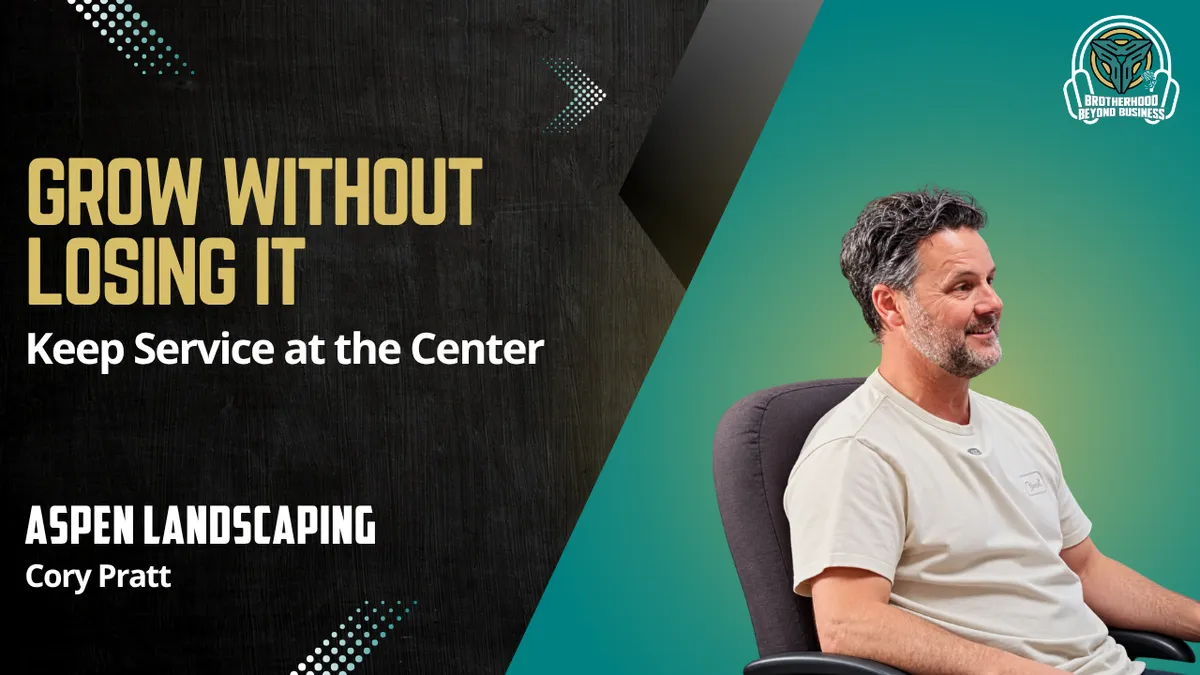
Ep 51 | Cory Pratt on Growing a Business Without Losing Customer Trust
Episode 51 | Host: Trev Warnke | Guest: Cory Pratt
🔥 Why This Episode Matters
Growing a business is a good problem to have, until growth starts affecting the very thing that made customers choose you in the first place.
For many small business owners, that moment comes when there are too many calls to return, too many responsibilities to manage, and not enough hours in the day. The owner becomes the bottleneck, and customer service starts slipping.
In this conversation, Cory Pratt of Aspen Landscaping shares how he moved from being a skilled landscaper to building a growing company in Prescott, Arizona. He explains how hiring the right people, developing leaders, and creating a strong company culture helped him grow without losing the personal relationships that matter.
This episode is a practical reminder that sustainable growth isn't just about getting bigger. It's about building a business that consistently takes care of its customers and its people.
🎧 Listen to the Episode
👤 Meet the Hosts & Guest
Trev Warnke - Instagram | Facebook | LinkedIn | Profile| Personal Website
Trev Warnke is the host of Brotherhood Beyond Business. He brings entrepreneurs together for honest conversations about business ownership, leadership, accountability, and building a life that supports the people and priorities that matter most.
Through his work with business owners, Trev focuses on helping entrepreneurs strengthen their businesses while continuing to invest in their health, families, and personal growth.
Cory Pratt - Instagram | Facebook | Profile
Cory Pratt is the owner of Aspen Landscaping in Prescott, Arizona. Born and raised in Prescott, Cory began his landscaping business in 2007 after years of hands-on experience in the industry.
His journey has taken him from working in the field to leading a growing team. His approach centers on customer relationships, dependable service, developing employees, and building a company that reflects his values.
About Aspen Landscaping - Facebook | Instagram | Website
Aspen Landscaping is a Prescott, Arizona-based landscaping company founded by Cory Pratt in 2007. The company handles projects ranging from smaller landscaping improvements to large custom installations.
Its services include landscape design and installation, residential and commercial maintenance, cleanups, and irrigation work. The business focuses on quality workmanship, clear communication, and providing customers with dependable service.
📌 What You'll Learn in This Episode
Why being skilled at your trade doesn't automatically prepare you to run a business.
How to recognize when you're becoming the bottleneck in your own company.
Why hiring people who share your values helps protect customer relationships.
How to build a company culture where employees become an extension of the owner.
Why loyal employees need recognition, support, and opportunities to advance.
How answering calls and following up can help a local service business stand out.
Why clear communication matters when schedules change or problems come up.
How building a business can create better jobs and opportunities in the local community.
🧩 Episode Summary
Cory's story starts with a landscaping opportunity that unexpectedly turned into a business. He knew the trade, but learning how to manage a company, lead employees, and handle the responsibilities of ownership took time.
As Aspen Landscaping grew, Cory faced a familiar challenge: he couldn't personally handle every customer interaction and business responsibility. Rather than choosing growth at any cost, he worked toward building a team and culture that could deliver the same level of care customers expected from him.
The conversation also explores employee loyalty, leadership development, and the importance of creating opportunities for people to grow within a company. Cory explains why the right employees deserve to be valued and given a path forward.
The episode closes with a practical lesson for service businesses: answer the phone, communicate clearly, and follow through. Growth matters, but the relationships behind the business are what make it worth building.
🕒 Episode Timestamps
[00:42] Introducing Cory Pratt and Aspen Landscaping
[00:56] How Aspen Landscaping started in 2007
[02:19] Moving from skilled landscaper to business owner
[04:59] Growing a business without losing customer service
[10:02] Building a team that represents your company values
[13:37] Recognizing and developing loyal employees
[49:05] Aspen Landscaping's services and business focus
[54:22] Why answering the phone still matters
[57:56] The importance of follow-through and customer communication
💡 Quote Highlight
“I'm more concerned about that relationship I have with that customer, than just the bottom line all the time.”
🚀 Next Steps
👉 Get our weekly Build the Business, Build the Man., Build the Edge, playbook to get one actionable task to implement into your business and life each week --> Sign Up
👉 Download our Your Circle is Your Ceiling eBook
👉 Learn more about Our Method
📚 Resources & Links
Follow BBB on: Website | Instagram | YouTube | X | Facebook | Buzzsprout
Watch the full episode on YouTube
Listen to the full episode: Spotify | Apple Podcasts | Buzzsprout
🚀Full Transcript
Trev Warnke (00:42)
All right guys, welcome back to another episode of Brotherhood Beyond Business Podcast. Today we're here with Corey Pratt of Aspen Landscaping. We're gonna dig into his business, get to know the man behind the business, and get to know the legacy where he's going with this. Alright, Corey, just go ahead and give me some i introduction to you as a man, your business, what you're doing.
Cory Pratt (00:56)
Yeah, as far as the business, I it just to give you kind of a background, it originated, started in two thousand seven. and it began kind of by accident, like I think like we were talking about a lot of businesses do. I was I I bore I was born and raised in Prescott, so lived here my whole life. got some background in in landscaping at Yelpai College. I worked there for a couple years in high school.
Got out high school, went to college and worked there while I was going through college and then got a full time position there. So that was kind of my background. We moved away for a couple of years. When I came back, I just went to ja work for my brother painting. and then one day I was able to do this job we were painting. I was able to do a I give them a bid for a full insult, which was a pretty good size insult for me, especially at that time. and I just started, I thought, well, geez, if I do this on the side in the evenings, I'm gonna be here for six months. So my business accidentally started. I was like, Well, I
I told my brother, I'm like, Hey I guess I'm not painting anymore. I'm doing landscaping. And I knew what I was doing. I was good at landscaping. I'd like I said I'd done it for for many years prior to that. And so I I launched the business and it was kind of just out of necessity and need. So pr I got that that install and then another one right after that. And that kind what propelled me into business at that point.
Trev Warnke (02:01)
Yeah. And like we talked about before this podcast we're going to was like, that's actually a very common thing in businesses. you usually you learn the technical skills, there's enough call and you find the call for it. You get it, you do good work, people are like, Hey, will you work for me? And then all of a sudden you start to like grow into a business. Yeah. And like you talked about, you're you had to kind of develop the business acumen to go along with that. Yeah.
Cory Pratt (02:19)
And that was definitely years down the road. I knew landscaping. I didn't it's funny because I think at that time in my mind it wasn't like, yeah, I'm I I run a business, but I wasn't running a business. I'm like, I'm a landscaper. I don't I don't have a business. I'm just a landscaper. So it took many years to down the road to to start really learning business to where I can when I started realizing that, hey, I'm wearing, you know, I'm wearing ten different hats, I'm doing five, you know, ten people's jobs and
I couldn't grow beyond that. I started realizing, gosh, I have to hire outside of myself. I'm never gonna expand. I didn't know. I didn't know if I should just stay there and stay very small. I think part of the pull for me to stay as a smaller business was just I love the interaction with customers. I like being that personable owner. I like being able to be reachable and and I, you know, there's there's there's a part of a in business is kind of a turnoff at some to some people. So and I think really with our demographics in a lot of ways is
the larger companies, larger corporate, you'd kind of become a number and you're not a face and an actual name and a person. And I I like being having those relational, you know, working relationships with people. So there's kind of that, I think maybe I'll stay small, but then it's like it just wouldn't work. I because if you do something good in business and you're you're good at what you do and you care about people, the the I think the I think it'll make you, it'll force you to grow. So it's like, well, what am I gonna do? Am I gonna grow or not? So from that point on, I think it was just a matter of like, how am I gonna grow? Is it just all about just
creating a monster of a business, or do I want to which really wasn't my forte. I wanted to grow, but I wanted to keep that feeling of like, you know, the the professionalism of a corporate company where services are met and you can talk somebody, you can get through and and you know, they're they're run like a well old machine, but at the same time personable enough where it feels like if one of my guys is going out and talking to a customer, it's just an extension of me and what I would be doing. And they feel that like, I have connection with the with the company. And so just trying to maintain that. And that's kind of what we kind of had moved towards.
since you know, since our since we started really growing and pushing that. So
Trev Warnke (04:10)
I think a lot of business owners get that part wrong, especially in today, the YouTube gurus out there are like scale as fast as you can to exit your business concept, right? So let's just take whatever you're you're you're good at this, let's explode it to, you know, 10 trucks and just explode as big as possible, as fast as possible, make it worth a lot of money and sell it. Yeah. which I think is the wrong strategy because most people don't build a business to exit the business. They build business because they enjoy what they're doing, they make good money on it. The only reason you scale is like, hey, we're doing a good job.
From there, we can go ahead and now let's produce a little bit more money. I can bring and take care of more staff. I can give people jobs and do that kind of stuff. so I think the way you did it is like that's the scenario dream scenario when I work with business clients. A lot of times, like, hey, quit trying to scale so damn fast. Yeah. Get really, really good at what you do. Yeah. And pe the demand comes. Like you said, the demand hit you to be like, hey, I can't just stay too small because the demand's bigger than I'm able to do.
Cory Pratt (04:59)
Yeah. I think that's yeah, that I think it's the torment of a small business owner. It's like, my gosh, I'm I I there's there's only one of me and I can't keep up on returning phone calls. So now the very thing that you built your business on, which was customer service and that friendliness and connection with people, you can't do anymore because you've outgrown that ability, right? And so it's like, well, either either just really scale back and stay small and just live with the fact that you're gonna have to tell some people no and not be able to do the work that they want you to do, or you you begin to build a culture that revolves around who you were as a person, hopefully.
Your ethics, the way you would want things done, and let people around you be an extension of you. And that's kind of what we, that's kind of where we went with it. Because you know, it's frustrating. You're like, yeah, man, I haven't called this person back. It's been all day, or it's I miss calling them back. That's because, you I had to do billing and I forgot and then I had to meet that person. That was emergency came up and the usual business stuff, you know, fire here I gotta put out, and that happened. Before you know it, I forgot to call Bob back. And you know, Bob is forgiving because you know, he knows you're a small business owner, and so he's, yeah, I know, he's a busy guy and Corey's, but that.
only goes so far. You know, after a while you're disappointing, you're kind of disappointed in yourself. I remember just being disappointed in myself. Like, man, I am I'm not doing it's not who I am. Like I want to take care of my customers and I'm not able to do it. And you know, luckily people are forgiving. They they're that for that transition time, you feel like you know, people are forgiving 'cause they know you're a small business owner. They know you're stretched, but they still like you because you know they like you and they like your work. They know you do good work. So they'll put up with a lot, but then after a while it just is it becomes out of character for you for the person, for me personally. It was like that's out of character. I can't be that person.
I g I gotta make sure I'm taking care if I'm gonna take care of these people, I need take care of So then it's like hiring. I need to hire outside of myself. I need to hire people that'll be an extension and build a culture in the business that these people are an extension of me. Hope you know, that's the hope and that's what you try to do. So
Trev Warnke (06:35)
No, I mean that is the crux of small business owners like exactly 'cause like what you said is what you what we're people run into right now for the most part is you have somebody that you know is really good. They never answer their calls, right? They never do and all of a sudden you're like, well, I want to work with them, but that I can't get anybody on the damn phone to respond to me. So then you go off to a a different company that doesn't do maybe as good a work, but now this is landscaping. Now you're on this a landscaper. It's like, well, I'm just gonna keep using that same landscaper. And then now they're in this like repetitive
motion of always using that person even though they wanted to use you because they weren't following you weren't following answering calls. So that's a great that you caught that early to realize, hey, I can only I only have so much leniency to give this to be able to not respond to people as fast as we need to to scale. And I think that is a big part where business owners have to like, hey, catch that moment. Yeah. And be like, hey, this is our service, customer service is the the the most important thing in all businesses. So we've got to take that to another level.
Cory Pratt (07:25)
Yeah, no, for real. And I and and I think you were being forgiving. I don't think I caught it soon enough. It it took a long time. And I think that became the we were talking a little bit beforehand. It's like I knew landscaping, I didn't know business. And so that was the lag of like, okay, I'm I'm actually running a business. I need to learn business. Like it it's it's almost like two things operating at once, you know, like, yeah, I'm great at landscaping. And that's usually the I'm sure you know, especially doing doing these in in meeting businesses, like, man, people are great at what they do, horrible at business.
Or people are great business people, but they don't know the trade well enough to really be professional at it or to pr or provide a good good product, you know. And so it's like one or the other. And somewhere in that interim, you just hope you the whole thing doesn't go under. And I think it's a miracle it didn't in many, many ways, but it didn't and it stayed afloat long enough for me to to recognize the need and to try to adjust and then and I love business, that's the thing, I love landscaping and I love business just the same. They're they're both so enjoyable to me. So it's a good combo. Once you get it, yeah, that takes time.
Trev Warnke (08:19)
Is funny, so I do meet with a lot of business people, and it's amazing how much there's a dichotomy there. These guys are great technicians, and you imagine their business is really big, it's crushing it. And you go to the business side and it's so rudimentary, like, holy smokes, like you don't really know business that much. Or this is it's like in terms of that side, yeah, it kind of blows my mind a little bit that some of the business that but that also tells me as a business coach concept is like being great at something is the most important part of business.
Like you gotta be really good at this. There are businesses out there that do the opposite. So I originally come from the fitness industry. So there's a lot of franchises that do business really well and they're really crappy at training. There's a lot of trainers that are really good at training that do business really bad. Yeah. And so the idea is like franchises get the the the the leverage for that because the small businesses can't. But it an idea, like you were saying, is like it is a tough part because like you wanna be you gotta be great here. Over here, you don't have to honestly be great in certain ways, but the businesses that are great here and then start to catch up here.
That's where they make real progress.
Cory Pratt (09:15)
Yeah.
That's interesting. Yeah. I and to know that ahead of time would have been would have been great. But you it's part of the process. I think it makes you better and and makes you appreciate, you know, the people that stuck with you that I mean, I've got guys even even workers that stuck with you through a lot of that. It's like, man, these guys are great. For them to stick with me at from that point to this point is like and and there's a loyalty there that you appreciate. And then of course customers as well. You know, the ones that you're able to retain, which were most of ours, which thankfully, you know. So
Some long term customer. The guy that I that drawing over there is my first my that was that that was the my first job. That was the one that I was painting at that guy's house, and then I hand drew this this thing. He is still a customer today. I do maintenance there, what is it, 20, 20 years, almost 20 years later. wow. So yeah, isn't that crazy? So I still go there every month. It's kind of funny. Well you do good work. Yeah,
Trev Warnke (10:00)
People have no reason to change, right?
Cory Pratt (10:02)
that's that's what we hope. That's what we do, is what we try to do. So yeah. And then it's just you know, the battle of I'm sure we'd probably get more into that, but then it's just the battle of
of of trying to create a culture where the where the guys that represent you are a a good representation of you. They you basically are who you, you know, they're doing what you would expect them to do if you were out there talking to the customer and so forth and so on. And we're getting there. I think we got it, we got a great team, great leadership team. when I say we're getting there, I mean we're there. It's just you always wanna grow that and continue to build leaders. And that's what we've tried to do. take people in, give them a, give them a route.
in in the business to be able to better themselves, to be able to grow in the business and not just be considered a worker forever, you know. We want to give them a a place to where they can advance, you know, and not just monetarily, but in a position and be more of a leader. So
Trev Warnke (10:46)
Like where I was going exactly next. I actually so I know Elijah, who's your GM here, or in that sense, and then Daniel, he's in my B and I group as well. Yeah, and so I have like some relationships with them, and they're great representation for you outside of there because I mean, in certain ways, I would imagine they're they're so professional, I'd imagine they're business owners, like they're they're actually with at B and I had no idea. Besides the fact that I knew you and a lot, I knew Elijah, and then he had said that he works for you. I had no idea that Elijah wasn't the owner of that when I first met him because he was just talking so so highly. That's so it's good to find talent.
to coach up that talent to get them to really buy in 'cause when it one of the hardest things about being a business owner is you you are the owner. So employees have a a level of investment, but they can't be a hundred percent bought in the same way you are. Right. But when you can get people to be ninety five percent bought in or like, man, they're on the mission for the time that they're with you, like that's a that's a hard thing to do. And it's a hard thing to do that for a long period of time.
Cory Pratt (11:35)
Yeah, no, that's a great point. And it's and then you the I think the key is like when you find those people, you just definitely wanna reward them and and keep them, right? And so 'cause it is an unusual person and I'm sure you know that by running your own businesses to find the person that almost is is ninety five percent or even ninety percent, eighty percent dedicated as you are to something that's not technically theirs, but they see they see that you know, they see the vision and they wanna be a part of it. That's amazing.
In that in that regard, our our office manager who we had we had lost excellent office managers because she had she had they moved, her and her husband. we picked up who's now our office manager, Lori, and she literally left a corporate world job as a manager to come here and it blows my mind. I still this day I'm like, why would you do that? But she saw the need and I think she saw the vision. It's like, I would rather be a part of this and building this than be a part of this where
the systems are already in place. If you find major f fa faults in those systems and you wanna you wanna address them, you can't because there's a system that's brought down from corporate from some other state. And so there's no way to make those adjustments. You just gotta do what you're supposed to do. I think she appreciated the fact that she'd come in, help build this, have her input and help build the system that one day will be something bigger than her and greater, you know? So it's really cool. You find those people, you gotta love
Trev Warnke (12:46)
those things as an you know we've been entrepreneurs most of our lives right yeah and so as an entrepreneur we see this lens of like I don't know why somebody wanna work for me and not go build their own business kind of concept because we're just so used to building our own business. Yeah but majority of of humans aren't designed to be entrepreneurs because the risk is just we we live in a world a high level risk like you said like how many times it probably matter like man this thing's going under tomorrow.
Cory Pratt (13:06)
Right.
Trev Warnke (13:07)
And so like
You know, going through for for us in a gym in Chicago, we had COVID and COVID was hard in the Chicagoland area. Yeah. and but the idea is like the amount of times thought it was gonna but my mindset always goes back to that idea is like, man, like why would somebody want to work with me when they could go build own business? But the thing that we've got to realize is like most people don't want to build their own business 'cause there's so much risk in that. Maybe they can't scale their salary the same as we can over time, but they like the the the consistency. They love to be part of something, but they can also like go home and escape it versus us like we can't escape.
Cory Pratt (13:37)
No skin. It follows you everywhere. Yeah. No, that that's a great point. And yeah, I guess to value to find those people and value them, that that's a good point. I like that's very true. And you gotta you gotta appreciate the fact that they're willing to jump in and and to be a part of something that I honestly they I'm sure they can see see in some regard on a newer business anyway, the writing on the wall, like this may or may not make it. I may or may not have a job, you know. luckily we're further enough along, I think Lori felt secure here, but
But still, it's a still a small business compared to corporate business. I mean, there's definitely security there that she wo she would have beyond what she has here, you know. But it's so cool to have that that vision and wanna wanna be a part of what we are and and really just fit in so well. So yeah, you find those people, you I you gotta appreciate them, take care of them, and then give them a path to you know, the whole idea. I think for me moving forward, maybe I I don't wanna jump too far ahead because I later on you wanna talk about legacy, but like just being able to give those people paths to grow and hopefully the business grows, we keep that culture.
and then in so in so doing, these people have a path to also grow, be able to be helped financially, be able to have positions, you know, that are that are, you know, equivalent of what they're deserving of for being faithful all of those years and being willing to stick it out with you. So I want to give people a path. I mean, I think that's part of the the downfall to number one, small businesses and and number two, especially like the service industry or construction industry. It's just it is known as typically just dead end jobs, you know. You're getting
worker bees that just come in and work and don't in a lot of ways you don't expect to ever get to to to progress anywhere other than just this will be my job I'm gonna do maintenance the rest of my life or whatever. And I don't want that for them. You know, I I get some people they're they're wired for that and that's what they that is their wheelhouse. It's where they like to be and that's fine. We we find that out and but at the end of the day I want anybody who's responsible, has some sort of you know leadership quality that we can help them to to move that forward and help them financially I want to do that.
I wanna help people out, you know. I I don't think I was given the opportunity to I call I just consider myself a steward of this. So I don't think I was given this business and blessed with it to just just for me. You know, I want other people to be able to benefit from it. So
Trev Warnke (15:34)
I do think when you said like I feel like that that's the trades industry in general, right? People used to think it's like, Hey, those are dead end jobs. But those trades are like I mean, they were our past and they are
Cory Pratt (15:43)
Yeah, they're kind of revival right now. Yeah.
Trev Warnke (15:45)
Like
I think most people need to like stop poo-pooing them and be hey, this is the I mean, I mean, I just look at Prescott alone, there's lot of older businesses that those owners are getting to the retirement age. Yeah. You gotta have young people to come in and run those things and it's like an obstacle because it's hard to afford homes here as well.
Cory Pratt (16:00)
Yeah, that's true.
Trev Warnke (16:01)
In general, like I I've done a lot of marketing for like plumbing companies and those or throughout the nation. It's like people don't realize how important these these are the foundations of all the towns in the United States, all your trades businesses, your landscaping businesses.
Electricians, like there's just so many things that are the the foundation, those businesses aren't going away. So going to them is a good job. It's a steady job. And I do think for the most part, most business, most small business owners, big business, I think that's a whole other category. Most people lump us into the big business concept because they don't really understand small business. Small business owners, almost all of them desire to help their employees grow. It's a desire. You want to get them better jobs. You invest in them. Sm big business, I get it. They just don't.
care franchises, there's no model for them to go into that. They're like, I don't really care how much profit we make. Yes. But small business owners want to. They want to improve it. But one of the hardest things for small business owners that the average person doesn't realize like the margins aren't as large as everybody dreams they are. They're always like, man, you guys are making so much money. It's like, well, gross revenue is pretty good. Expenses are hellish.
Cory Pratt (17:00)
Exactly. We're making all this money. Where? Where's it at?
Trev Warnke (17:03)
I don't
know if you've seen it, but we're not really driving anything fancy around here. Like, but it it is one of the cruxes. I mean, you see, that's part of why we do this podcast. Yeah. Is to let people know the the the man that what's going on as a bit entrepreneur. Entrepreneurs, I think in in sus in today's society are put on a certain pedestal. and I it feels it's great, you're an entrepreneur, but the opposite, I feel the opposite is like, hey, I don't think most people realize the entrepreneur life. It's not the Jeff Bezos life. Yeah, they always think it's the Jeff Bezos life, not the Jeff Bezos.
Yeah. It's the entrepreneur is like we take on a heck of lot of risk. Yeah. but we also are really good at betting ourselves. And I'm never going to complain about taking on risks because, like, hey, I'm willing to bet on myself every single day. Yeah. but then also we have responsibility then for all these employees. Like, I'm sure some of your biggest stresses are not like, how do I keep getting paid? It's like, how do I pay these guys? You know, that's the biggest stress that happens as your team grows. Like when a job's not happening, it's like, I don't know, I'm not worried about my finances and changing. It's like I have to lay a couple people off if this job doesn't go through. So those are the things on the business side. So, how big is your team?
Cory Pratt (18:02)
we currently are right at like twenty-six employees. And so that's in field and in office. yeah, and so I think, you know, go yeah, yeah, that's really all I have. I got 26 people and we we hit I'd I'd say like office-wise, we're a little bit overhead heavy, but it's kind of purposeful, which means our our revenue, like you were saying, is is decent, but then the you know our take home is is and and the gross profit margins a little bit less only because we have a
little more overhead than probably what we need. But the reason I have that is I want I think that's how I can provide good service to my customers. Is somebody's there to pick up the phone all the time, return a phone call, getting that that takes that extra overhead to get away from the whole like, man, I didn't have time to call you back. Like that doesn't I don't want that to exist. So I want to hire that problem away. And I have, you know, so we have Laurie, we have a salesperson, I've got Eli as a GM at this point. And so
All those things help us to keep our service at top notch. And that's my, that's my goal. So yeah, it might mean I have to take less myself or the business itself makes less. That's okay because I think long term, again, I think the market will the market will force us to grow because you're providing what people want. And that's good service and you're personable and they you're trustworthy, you know. And so, anyways, I think and what's also nice about being a little bit without without, you know.
without your business going under being a a little bit heavy, overhead heavy, is that, you know, we can now grow we can grow into that. So I've I've made space there where I can grow. So I'm not scrambling after the fact like, well, we just grew and now I this is a problem, that's a problem. I don't have the people to handle this. And you're scrambling to create systems on the fly. And me and Eli always refer to as you know, building building the airplane in while you're in flight. You know, you're piecing this thing together and
Hoping you can get wings on before the thing crashes. I I try to be a little more proactive and see problems and and and prepare for them, even if it means taking a little less money to, you know, to be able to grow into the overhead we now. Because I'd rather have the service. the point is I want that service. Being a service industry oriented you know, business, I want that to be number one. I want us to be known for that and and good quality and all those things. Like, you know, we everybody says they want that, but that's that is my number one. I'll lose more money by making sure things are right than.
than anything. But in other words, all if I've got a return, if I've got to make things right, if I've got a something has to be like, Hey, this one's on us. I apologize. I I'm I'm more concerned about that relationship I have that customer, than just the bottom line all the time, you know.
Trev Warnke (20:22)
Yeah, and that's I mean that I think small businesses always inspire to be that, but you don't always see it, right? Yeah. You could one, their margins are tight and they're like, I don't want to take that that hit. But I do think good entrepreneurs are that one's like, I know I'm gonna take a hit on something that maybe we did wrong, but I want it right because like I want to make sure this person's happy because I'm looking you look into the long game. Yes. And this person's talking to three other people and like, hey, even if you guys made a mistake on the job and you come back and fix it right away, that person's ten times happier than you could ever believe because like, yeah.
I don't I don't care if you messed up, but just fix it if you did mess up. That's totally fine. Like most people are like you there's a lot of leniency with customers. Yeah. If you treat them right, there's a lot of leniency that we and not that you need to take advantage of it, but the idea is sometimes it happens. Yeah. And I think if you're a good service, it's okay to have mistakes happen because people are like, Hey, totally fine. It happens. Yeah, no big deal. As long as you'll fix it and take care of it all. But business a lot of I mean, I think big business for sure. That's why I I coming from fitness, I get upset with franchises. There's franchises in all industries, right? Yeah. I get so with franchises because they don't do that.
Yeah. Well, they just continue to like, hey, you know, we're a franchise. We're the first person you click on Google because we can get away with that because we're franchised. Yeah. We give you a bad service. You get bad taste in your mouth for landscaping. So you don't hire a landscaper for five years because you got bad service from somebody. And then you finally get them. And now you have to overcome that, like, okay, I really like landscapers because my last landscaper sucked. Yeah. And but the idea is we have to battle that out. But like you give that great service, you take care of your customer.
I think good entrepreneurs are that same too, where it's like, man, I will risk my own money. I will put my own money on the line, take less salary to give a thing because we like we said we're betting it's it's an investment. We're investing on our future. Yeah. And we know our future our the money we take home right now is valuable. But realistically, the the what that turns into five years from now is tens. Yeah. So it's it's worth doing that. So I love that your your strategy goes that way. On the employee side of things. So, you know, I love when you're talking about like the
You're you're kind of investing on the front side. I mean, like we're gonna be overhead heavy first on the front office so can grow into that. Yeah. Because as you're smaller, you're on the opposite side. Like we're gonna bootstrap every damn thing we can do. Yeah, right. Eventually get to a point like, hey, let's go the opposite way. We're not having to bootstrap everything, let's be ahead of the game so we can start to do that. when did that mindset shift come?
Cory Pratt (22:32)
Well, I would say it wanted the mind sh mindset shift wanted to happen probably like in twenty nineteen. But I I you know, I'm sure a lot of other business owners can relate. It like, can I afford to hire somebody to to do stuff for me? Can I afford an office where you know there's that that fear and you're so busy wearing five different hats that it's like you can't even find the time to find out if you can afford to hire somebody to take off.
Take one of these things off of your plate. And I'm sure there's a lot of other small business owners that, or even right now, that are dealing with that. I don't think I can afford that. And I met I talked to actually funny, Eli came to me one one evening and he had worked for me pre previously and then moved to Ohio and came back and he had asked me, he's like, Hey man, I you know, I think he had lost his job in the city or something. And he's like, Can I come back to work for you? just just doing maintenance, whatever you need, just maintenance. And and I knew Eli previously
that you I've known Eli for years and so I I know he's a he's a button pusher and he's a thinker and so I was like man I'm what do you need to make and he told me at that time you know it's a scarcity mindset because I really just don't know I'm just doing too much and I was just like I I mean I don't know if I can give you that I and I and I and it just popped in my head I'm like well why don't what if you just what if I hired you what if I was able to hire you here's what I'm looking for and that's what I just kind of level what I need is another me man I I can sell I can go out I'd love customer service meeting with customers
I know the trade inside and out. So I can design, I can sell a project. I just because I'm doing that, I can't do everything else. Cause then I get home and I'm doing building at night and I'm up till 10, 11 o'clock at night. And, you know, I'm I'm I'm the office manager, I'm the GM, I'm the project manager, I'm the owner, I'm the, you know, again, all these hats. And I'm like, if I could just get somebody to start implementing the things that I don't have time to do, that's what I really need. And I again, like I said, I knew he was a button pusher. I he'd come to me at one point, he's like, hey, what did you do to he was starting a little business and what did you do to you know, in the early
you know, stages of your business. How did you succeed? And I'm like, well, honestly, if you want a good business model of how to succeed on business, you would just do everything the opposite of what I did. And then you should be fine. Cause I did everything wrong. And somehow we're still afloat. So I was in this this is in 2023, by the way. I'm in this jam. So I I knew I needed it. And for a year or two, I'm like, I I remember even just telling my wife, I just need another person like that, like me. If I could just get one more person that just thinks like me, as business minded. And when you're working in the trades, you're just often around pe guys that are just
Just workers. You know what I'm saying? You're like, there's just guys there. And this is no offense to them. It's just that you can't pull that guy and be like, hey, I'll just make you a business second. Here you go. You're a GM. It's like, doesn't fit the shoe, man. And you know, takes the right person. So I knew that about Eli. And I just asked him, what if you did this? And I'm like, I and he's like, I would love to do that. And he he was excited about. I could see his eyes light up. And then, but I was like, I don't know if I can afford them. Let let me think about this. And so I gave it a couple of days, thought about it. And I just was like, hey, I mean, worst case scenario, we try this, it doesn't work.
I stick you back in the field and I got somebody doing maintenance that I need anyway, you know? And so we did and he ran with it, man. It was, it was awesome. He he really did treat it for the first couple of years like it was his own business, which I totally appreciated. I think I think you know, some people are like, Did you take advantage him? Did you I he loves, he eats and breathes this stuff. So to him, it was like the best job he ever had, I think. from just what him talking, you know. So it was right in his wheelhouse. He got the liberty to do, like, hey, man, we need a.
We need a system. I just we need to get sci we need to get QuickBooks and and a whole system. And SRM involved, we need a our yeah, like house call pro. We that's what we use for our all of our scheduling, all of our bids, everything we needed everything need to be consolidated. So he just did one thing at a time. He just basically built the office part and then worked himself out of that job and we eventually hired an office manager. Then he did the next part and then worked himself out of that job and hired somebody for that. So that's when the shift happened the shift happened in twenty twenty three. I knew it.
pro way, way before that. I just was in over my head. You get to the point. The problem is I think the you get as a business owner, you get too you have you get too far in and it's almost like I think that's where another place where you can fail. It's like you're too far in like you don't have time to to learn or do anything. You can't fa I can't go back. I can't all of a sudden I need to I need to go like I my thought was like if I hired an office person, who's gonna train them? I'm out in the field all day every day. Who's gonna take time to train I like I was so busy I couldn't even hire somebody to help me to be less busy.
'Cause who's gonna train them to do so? Where am I gonna find that time? Midnight to three in the morning? And you know what I mean? So he took that and we took the risk and he just started doing that. And I could just keep selling and so forth and so on, because that's what I was good at. I know the industry. And so it was perfect. It's almost like it was the combined, like what we talked about earlier. It's when you you know the trade, but you don't know the business. It was almost like bringing somebody in, even even though he hadn't really had any businesses, but he just had a lot of insight and the two of us work really good together. It's like he was the business, I was, I was the
the I was the the trade itself and he was the business side of it and we just combined and it worked and then it it was great because it's freed me up and I I loved the idea of business, just never had the time to really invest in it. Right. So that's when it shifted, I think, and that's when we really took off in growth as well. Because I was maxed out. Just like a a fish isn't going to grow any any larger than the bowl that it's in I was like I was sticking out of the my fin was out of the top. My it was I was way in over my head at that point. I needed people.
And so that helped and then from that point we just grown and expanded. So it's been good.
Trev Warnke (27:31)
I love that because so what they usually teach business coaches will say, Well, make a system and then teach your system. But like you said, when the hell do I have time to make a system? You know, like I don't have time to sit down and make the system for the person to do it. So I've always leaned towards find a person of character that's relatively talented and that let that person run with it. Like put up you you you hire first on character first, right? Yeah. And then you're looking for somebody like you said, you you probably had plenty of people working for you that had good character, but talent
in that avenue, like you couldn't move them into that that that space. But you can outsource that to like, hey, and especially in a small community, you know a lot of people. It's like I know that you can find some good count character, good character, and then talent and put those together like, hey, just so you know, I'm hiring you for this expectation of like, you're gonna have I I you can pick my brain as much as you want about this stuff. But you've got to figure a lot of this out yourself. Yeah. I remember when I for my dad's corporation, he's owned a huge manufacturing corporation, multi-million dollar corporation. When I took over at twenty two years old,
He didn't have a damn system in the whole business. You know, not a single thing in the whole business. Wow. And it was just more one of those things is like, you're my son, your job is figured out. You know, just like so we had to rebuild the literally make the whole business run and function like a manufacturing corporation should. Yeah. But everything was done just be by a lot of gumption, right? We'll just we'll get it done. Yeah. Versus like things should be working at as a process and all kinds of stuff. but I think for the most part, because the entrepreneurs are in that same category, we we built
We've grown almost too fast in a certain way. You grow so fast and you're so integrated into things. It's like I don't have time to step back and be able to do that kind of stuff. But I do think like how what happened for Elijah there is an awesome story because I think that's actually a better path, especially in a local market. If you're a nationwide company, you can probably go out and hire specific talent that already knows that skill set. Yeah. But in especially Prescott, which doesn't have a crazy amount of young talent around here, is you gotta kind of find good character people that have a relatively smart smart character.
Put those two things together and okay, now we'll we'll give them the opportunity to grow and just have them invest in it.
Cory Pratt (29:26)
That's exactly what it was. So yeah, it was it worked great, man. It was it's been really great. It's been a ride. And then it's funny because we are in a lot of ways a good team because we we always consider he's the he's the gas and I'm the brake. So we're good balance. Some things like he's like, or we just need to move forward. I'm like, okay, yeah, you're right. I'm I'm stalling this, I'm overthinking it. That's my tendency, and other stuff, which I think it's lean more. I give him a lot of leniency at the at the front end.
And I think over time he's realized, man, the brakes actually saved me from a lot of headaches. I should use those more often. So, but it's a good balance. We've we've we work well together as far as that goes. And yeah, it's helped a ton. We've we've you know not only grown, but he he he got the vision of you know, for for example, I've there was some I've I've heard about a larger company in town, landscape company, that that had said and that they were, I'm not a landscaper, I'm a I'm a marketer that just happens to do landscaping. And so
I just wanted to make it very clear that's not who I want to be, man. I want to be a landscaper who does good business well. Cause I just think that's and and that if that's okay. If there's different ways of doing things, that's fine if that's their approach. I just feel like that goes into the whole, like, it's all about the bottom line. It's all about just if I can get my name out there, brand rec recognition and awareness, and just have the opportunity to bid 10 times as many jobs as everybody else. I there's a lot of room for error there. And I just would rather build it from the ground up and make sure that I'm taking care of the customer and build off of that kind of character.
And he got that vision and ran with it. So that was helpful. Somebody that that did not only wanted to could push that growth, push the gas, move us forward, put things in place, implement systems while I'm just out there selling, but then also get the vision of, hey man, we're growing, we're growing. But hey, I want to maintain that that that culture. I want to build a culture and maintain a good culture in this company that it doesn't matter. Like the that you had mentioned earlier, it's like it's small business, like they're the the the customer's married to you, like they they know Corey, but then at some point.
I just can't be out there anymore. You can't grow and be everywhere and and be, you know, doing customer service and meeting customers as much as I love it. It's just impossible. But I don't ever want that to feel like I want, like, you know, Eli Richardson goes out, like, yeah, we love Eli. Yeah, who's Corey? We just just send out Eli again. sorry, can't I send it to Eli? Daniel's gotta come out this time. Eli's got something else going on. well, we love Daniel. At first they're disappointed. Just the whole culture of being whoever you send out, like they instantly can is it likable, respectful, professional in in the my company that
All of a sudden it doesn't matter who you send out. They're just an extension of you. And that's that's the hope to build it. And yeah, it's gonna build a lot slower. we could we can go just full marketing and build probably faster and scale faster, but I would just rather build it the way we're building it, make sure that the customer is the is at the center of all that and then build off of that. Cause I think that I think the market will force you to grow. I think that'll just come if you take care of the customer. So yeah.
Trev Warnke (32:05)
From a marketing perspective, looking over over history, most businesses that are 10, 15-year-old businesses are ones that are built the way you're building, not the ones that build from pure marketing gas, right? Yeah. specifically the idea of marketing gas really came on heavy in 2020, right? Where people are like, well, you know, if just people are just dumping crazy. I mean, marketing's been around forever, but I'm talking about like digital marketing, that's just dumping money into and businesses have grown real fast from that.
But they've also disappeared real fast from that because man, if you don't do great service with all this and like even like answering phone calls, if you're not a person, if you're getting all these leads and you're not following up with these leads, people fall off still. So quality work done over a long period of time. I you know, how long you said you've been twenty years? So
Cory Pratt (32:47)
Twenty years, yeah. Next year. Yeah, in twenty twenty.
Trev Warnke (32:50)
twenty years. And like most people like they they talk about that five year window, right? Once you're past five years, you're a real business, a legit business. That's a true thing, because the the real struggles in the first five years are incredible. But
Struggles don't stop after five years. Yeah. You just know, okay, I can overcome most crap. Yeah. And now you're just resilient enough to be like, I'm not I'm not failing this. Exactly.
Cory Pratt (33:06)
Yeah, yeah.
Trev Warnke (33:08)
I'm not gonna give up because I'm gonna I've made it five years and it's gonna keep going and fighting through all the crap that's coming ahead. but it is conceptually building it. I I've I'm different than a lot of
Of people, I I I go slow to go fast. Yes. Right. And so it's just like I just want to go slow. I want to get things really, really foundationally well. Yeah. And then we can pour gas on top of a great foundation and and get going with it. And and we call it buy speed. How do we buy speed to that process? However, it's like if the foundation is weak and then we just throw all this stuff on the systems aren't there, all of a sudden you're ending up with a the a lot of the consumer issues, that bad reviews, all that kind of stuff going on.
Cory Pratt (33:41)
And we we had a we had a moment when early on after I hired Eli, where we did grow so fast but didn't have the structure. and that's where we came up with the the phrase of building the building the plane in flight. And and we had to pull back, man. I mean, we still continue to grow, but just 'cause the business, the foundation of the business was there. So all we had to do is apply all the you know, the just just update you know, modern things like our our our our systems and all that stuff, just basic stuff we just
immediately implemented that type of stuff and grew doubled our revenue. So it was it was because we had a good foundational business, it's like we just had to plug in some things and it was just automatic low-hanging fruit. We'd refer to it as, you know, just this little thing, pluck that, pluck that, and and you're growing without even trying. but the problem was that caught us off guard on the flip side of that was like, my gosh, you know, now all of a it's like we don't the right people in place. We got guys out there that are clowns. They're not an extension of who I am, that are that are get you know we're getting bad reviews and it's like, no, no, no, no. That's like
I we had to like pull back and like we have to build this thing right. And so that might have been in tw part of twenty twenty four. And it seems like there's constantly those you're trying to keep that thing on track. There's constantly those you're pulling back and making sure like, hey, I'd rather pull back right now than keep just pushing this thing forward in growth. I'd rather pull back right now and let's get this system right. Let's let's I don't care if it takes us two months, three months. There's times where I sit in here and just do nothing but think about the most minute details of maybe
What does the installer do when he shows up here in the morning and basically print out a system of what I want and why, why though? It's not just a matter of like, this is what I want you to do, follow these rules. It's well, this all links to this. And if we do this and we follow up with this, then that'll keep us from ever missing this, this over here and leaving the customer hanging. And if we do that and we collect the check on time, then there's not this leverage by the customer to hold that over our head and look for things that are wrong. I would rather collect the check, walk out. If they ever find anything wrong, I want to be there the next day, take care of them. Like, my gosh.
This is the best company ever. You know, just thinking all these little tiny, minute details through. We'll just spend, you'll spend a whole, you know, day, a week, a month working on trying to trying to build that just to make sure it's right. So then we can grow. And it's sometimes frustrating. You just want to grow. You start seeing money and you and it's not to me, it's not even about the money, but it's like, hey, money means that people can start getting raises. You know, we can get equipment. It's more about like building the business to me. Sometimes you just gotta slow down and and just get the base right, you know. You know, it's like you could either
You could either build a pyramid with the with the big side down or the or the pointy side down. And I feel like sometimes like, okay, this thing's upside down. We better pull back before it topples, you know? And but it's been good. It's it's so it's fun. I love business. I love it, is I think part of that is just this, we're still learning so much. We've come a long way in the last few years. I think we both have just put our heads together in this and just wanted to learn the business side as much as possible. And but then also pulling back and be like, hey, I want to keep the culture, man. I don't want to lose that ever. That's I think that's gotta be number one.
And I it's funny, we we always refer to, you know, McDonald's and In N Out or both sell hamburgers, but In N Out is a it's an experience. McDonald's is just some young kid thrown and this is no no shot to to McDonald's people work there, but just you it's just some young kid has a job, kinda knows what he's doing, halftime to get your orders wrong, you go to there you can go get a hamburger in in and out. It's it's a well-oiled machine. They're there, you're you're respected, you're treated with respect, they're well paid, they have pride of work. It's just two different worlds making the same thing. And I wanna be
You know, I wanna be the in and out of landscaping, not the McDonald's. So just because I wanna have that customer service there, the good product, the quality, everybody wants that, but a cost, you know. So
Trev Warnke (37:04)
Well, that's I mean one of the things that you said along there was the stage that you're at as an entrepreneur now is the fact that like, okay, I'm not I you can't replicate, you can't be at all these jobs, right? So your main time is spent, like, how do I turn these people into me? How do I coach them up? Like you said, the systems you built for what they do on the job site, that's exactly your the stage, like that's the most important stage that most entrepreneurs don't actually want to go to. Yeah. They either want to continue to be the technician because they really enjoy it, or two, they to like I just want to sit behind the desk.
And I don't and but my I hire somebody, they should be able to do it. Like, well, you've got to coach them up to be a representation of yourself. Here's exactly how we show up the job site and we walk through here's why we do this. I love that you guys have that system because I do think a lot of I run into this a lot with a lot of businesses saying, like, I just can't hire good talent. And I was like, I do get that. That's not always the easiest thing to do. Sure. but the other side is like, how much time do you spend coaching this person up? Spending time actually turning them into
the th the the version that you want. Is it is it really this person's a problem or is you like just hired him said, here's the job, go do it, right? Yeah. Versus like here's here's how we show up to the job site. Here's when we leave here's how what we say to the customer. This is like how we clean up the job site when we're done. This is all the things that we have expectations and that this is why we do them. And then checking in so ought every so often like are these things consistently being done versus just being like, you know, here's the the I find this in plumbing a lot, not to put offense to plumbers, but you see in plumbing a lot in people I work with is just like they hire somebody that has plumbing background.
They hire to be part of their team. They might have owned a plumbing company in the past and it failed and they just hire a plumber. Yep. And that is like, well, they how to plumb, so they're just gonna go out to the job site and do it. Well, they might do a good job in the plumbing component of it. Yeah. But all the other things that you might have the expectations of keeping it clean, how clean they don't teach 'mini of that stuff.' But they they get mad at like, Well, they're a good plumber, but they're an asshole. It's like, Well, did you tell them how to talk to a customer? You know what I mean? Like that's yeah, it's not really a fair thing to do. But I I love that you guys have thought about that. Yeah.
Cory Pratt (38:49)
Yeah, it's it's it's such an integral part. And you do it. The the de it's funny, you you we've got dunno how many stages we've been at in this, but it's like, yeah, I think we've arrived. And then you're like, my gosh, we're just getting started. And it's like you're starting all over. It's a whole nother level of like, if we're gonna do this, you gotta really do it. You gotta like really dig in and it takes a lot of stinking thought. I think, you know, maybe maybe some business owners, it's just they stay small just because it's it's number one, it's easier if and not to say that if you're a business owner and you've lasted through that five years and beyond.
I've talked to quite a few of them that's that settle in like at a certain this is my comfort zone. I'm good here. And they you like you have potential, like grow up like no, no, but they want to be more hands-on and involved and and and that's not a bad thing as far as when I say hands-on, I mean like I you want to have a pulse on your business. I want to be involved in my business, but I also want it to be able to not depend on me. I want to be able to walk out of here for a month and know that this is this is running great just as I'd want it. But also I want to be involved, you know, while I'm here, I do want to be involved. So trying to build that business. But I've guys who's like, man, you you have such potential, but their comfort.
They're just comfortable here because it's easy. It's easier. You know, they've done all the hard work to get here. And we've all pressed through different walls, which you would know more than me in business is there's those, there's those walls, man. And to get from one one point of revenue to the next. And they press through and they've they've they try to get to that next one, like, that really sucks. I'm coming back down here and I'll settle in and make my money and be happy. And and it's kind of it's fine. You know, there's it's it's not for everybody as far as you don't have to grow your business huge, but and and that's again to me, I
It's like it's a challenge. I think it's an entrepreneurial thing that you probably have the same things like, why would I not try to push that wall over? You know what I mean? It's like it's a challenge and it's business and it's enjoyable and and and I'm only gonna learn from it and I'm probably gonna screw stuff up, but that just means I'm gonna learn. And so, you know, I think it's Alex Ramosi who says, like, fail fast, right? So if you just just fail quick so you can figure out what you should do or shouldn't do and move on and try to grow. But and maybe just be lazy minded too. It's easier, it's easy. I I mean some guys just been doing it for so many years, just like myself.
I can totally see at a point just settling into a a point and just being like, This is good. You know, I've worked hard enough. I've grinded out, but it's like, man, you did all that hard work. Just like I just wanna keep pushing it forward. Let's see how far we can take it and and maintain what we want as a product.
Trev Warnke (40:57)
Yeah, I think there's a natural entrepreneur competitiveness too, where you want to see your best version. Like, okay, yeah. I want to push myself to that level that like I know I can go to. I mean, I'm a I'm a strong my faith and I always feel like God has a has a potential for me. And like whenever I think I've reached my potential, I know I'm nowhere close to it because there's no way that God thinks I can I can know what my potential is, right? Yeah. It's just like, man, I went this far. I did really, really good job. And he's like, No, you got you got a lot more of that. Yeah, you know, like you're you're just touching the top of it, you know? And so I do think for the average person that they get comfortable.
is there's a there's a there's a a scarce mentality there. I mean like hey, I've gone far enough and like the next stage is hard. Like all the stages to get there were hard too. Like and like you said, like maybe they're just tired, maybe they'd pushed through enough layers, but I think for the average person, it's like you can push through more, you just gotta like be but the people that get comfortable might ski that that I would love that you don't get comfortable is that
The fear is like when you get comfortable, that's when things start to erode on the backside too. When they start to get comfortable, all of a sudden their business starts shrinking without them really paying attention to it, shrinking, right? Yeah. And so like when you're pushing for is Vince Lombardi has has a quote that's like, the pursuit of act the the the pursuit of perfection, you end up chasing excellence. So the idea is like you can't ever hit per perfection. Yeah. But by doing that, you're chasing excellence along the way. You're becoming excellent at things as you're pursuing perfection.
And so it's the idea is like that by that chase of always trying to be better, you're trying to improve yourself, you're making better systems, you're getting to that thing, versus like if you get comfortable and you kinda become stale, well then what starts falling off? And that's why it's like I get nervous on on business like you don't have to continue financially for the numbers to keep getting bigger. Yeah. But you do need to keep pushing yourself to be like, How am I how am I getting better in a
Cory Pratt (42:29)
Yeah, like a step but I guess a business is never really static, right? There is no you're either increasing again, like you said, it may not be revenue, or you're shrinking somewhere. Something's falling off. Yep. You never get to just s really settle in. We call it settling in, but something's going going south somewhere, something's failing, something's I'm that's a good point. Yeah, I agree with that for sure. So
Trev Warnke (42:47)
With me, I moved out here about four years ago and I own a gym in Illinois still. Yeah. And have a business partner there. But we started to take our our focus off of that. Like, hey, we're at a good number. Like I want to build, we have a marketing agency, a business coaching, like but let's build this. Yeah. By just trying to keep that at let's just leave it where it's at at this much over about a four four year span, we went from about forty thousand a month to thirty-two thousand a month. Like it's eight thousand dollars per month we were down just because we were taking our eyes off the ball.
Yeah. You know, it's just like because our attention was just far enough off off of it, but okay, we weren't we were doing all the same, all the same services were happening. Yeah. But just because you stopped pushing over here and you're hey, we're just gonna relax a little bit, it just naturally like just started decreasing, you know? Yeah. And so it's like one of those I would that's going going through that experience has helped me become a better business coach, be like, hey guys, like there's okay, there's areas you can get comfortable at, but we've got to be very careful what comfort looks like. You know, because the idea is like it, like you said, this is very hard to be stagnant, it's really very hard to stay in the same spot because.
Every single business has has turnover and you're going to have that and you gotta be able to replace that turnover. So okay, so as we've gone through all of this, like where are you guys going with with with with this? And what's the the next I I don't like to go too far out because 10 years, who knows what's happening ten years. But like in the next three to five years, like here's what we're trying to chase after.
Cory Pratt (44:00)
Yeah, I think I think at at this point it I and I probably mentioned it more before already, but I think our my biggest goal is to be able to take the take the to meld the mom and pop, the feel of a mom and pop that every it did. And this is again, we kind of chatted about this earlier. Like I think in a in a city you can just get away with pushing marketing, pushing a niche and get in, and you could probably have a successful business doing one thing really well.
Let's say just installing turf. Fortunately, in a small town like this or smaller town, it's like I I couldn't probably stay alive or at least grow something big enough just doing one thing. Like just we just do turf, or we just do one aspect of it of installation or whatever. So we do it all. There's a lot that we do. I just think moving forward, I would want to maintain that. What my goal is in this business is be able to maintain the feeling. And I know it's kind of a
Very subjective word, the feeling of a mom and pop business when people are when when people are working with aspen landscaping, but meld that with the professionalism of a of a corporate style or just say a larger company because I wouldn't say corporate, just a bigger company where you feel people tend typically relate that to tend to just become a number and a person. And I used to know the owner, now I don't know anybody. And you know, when these people call me and talk to me, there's no relationship anymore to try to basically meld those two things together.
And I think, and me and Eli have talked about this, like it means we're not gonna grow as fast. It's gonna be a much slower growth, but I think at the end of the day, it's gonna be a better growth. And that's I think moving forward in the next five years is to just just to to actually succeed in doing that. And then and in so doing, I believe the market will force the growth. And again, we'll keep doing what we do, and obviously, you know, we do Google ads and all these different things like anybody else. but it was strictly originally built on just word of mouth. And so when we added all those things, which is instant growth, but I just
want to continue to grow. And the reason for growing is I just think it number one, it's part of part of my nature. And like you said, the competitiveness of competitiveness of an entrepreneur, sure. I think it's all that stuff. And then also I just I think it's like, you know, there's also, you know, people take shots at bigger companies or even corporations. It's like, yeah, but they do provide a lot of opportunity for people. And so to me, I also look at the business as an avenue to be a blessing to other people, you know, and to give them
something hopefully other than just a dead end job. Or if it or if they're just a worker and that's what they want and that's their wheelhouse. I have no problem with that. But give them a well paying job to do that, you know? Let them be here for, you know, 10 years and still be getting raises and still increasing their knowledge and and in, you know, because they could still be doing the same thing, but becoming better, just like we said, even in business, becoming better at that business. Maybe you're not, you know, and you're not now a manager because you like just doing maintenance, but you become the maintenance lead, but you're becoming
you know, more proficient at what you do. You're now you're training other guys under you. You've learned to, you know, more about the business just to better yourself. I think it's just bad when anytime we come and stagnate, right? So yeah, I just want to give people that opportunity. Like, hey, I want this to be a a blessing and a help for people in the community to provide good jobs and give them an avenue to grow as well in in a field that otherwise would be considered, like you were talking about, a trade that's usually a considered a dead end job. I kinda wanna I don't want it to be that for them. So
Trev Warnke (47:04)
Yeah. And I think the way society is going currently with the the white-collar job is now we're gonna try to be as least amount of employee employees as possible, right? Right. We're gonna have the least amount of employees make the most money possible. Yeah. And so we need more blue-collar jobs that just continue to create more jobs because white-collar ones are cutting as many employees out as they can. Right? Kids are going to college to get a white-collar job and like there's no jobs available because AI has allowed a lot of these companies to eliminate half their staff, right? and so I think
Like specifically for Prescott, obviously being a small town, but the whole United States in general that need to be investing in the trades. If you're a young kid investing in getting skill sets and one of the trades or multiple of the trades, right? Absolutely. My dad built a multi-million dollar corporation and he started off as a truck driver and then became an electrician and then opened a plumbing business. And the learning those skill sets allowed him to learn the things he needed to do and then became a salesman for Carrier Corporation, which is an air conditioning corporation.
Like he worked his way through those just building skill after skill, but they were all in the trade skill sets and eventually had a moment where he was working on his fish pond, and an idea came to him working on a fish pond because of all the skills of being able to wire and plumb and do all the things he was doing with it. Idea came for geo film, like this could work, and then that patent never my dad finished, I think left school at 16. Wow. So didn't finish his high school degree. so this all those things like the idea, but like because those skills that you get in trades and and even like I think a
Stuff I do in my backyard for landscaping is like awesome stuff that you get to learn. They're multi-dimensional. You can use them in so many different areas, right? And so I think a lot of people need to spend more time. But for you on the job side of things, as a legacy too, is like creating jobs for local areas is a huge benefit to the local area. The amount of people that you employ versus like, I mean, me as a business coach here, I have me. That's I'm the only person I'm employing, right? Yeah. And so it's like I don't employ a p a bunch of people. And so we need more people that do employ employ a bunch of people. It's an important legacy for
Small towns like this, or even like Prescott, I mean I mean like Phoenix, like big towns like that, they're gonna need those things because the white collar jobs are are not disappearing but shrinking.
Cory Pratt (49:02)
Yeah. gonna be a lot of people looking, so yeah.
Trev Warnke (49:05)
And it there are a lot of people looking already. So with that, let's go ahead and just do some quick talk about aspen so people understand that maybe they've never heard about so what give me like your top five to seven things you guys do, like where are the main areas you're focusing in landscaping?
Cory Pratt (49:17)
Yeah, so we've we basically do any with anything from small to large installation. So that could be, you know, that could be anything from I've got a dirt yard and I just have the the money to basically not have weeds. So I need rock and fabric. So it's as simple as that. We do anything small to full custom, you know, six figure installs. So just anything in between. We don't we're not only doing one type or the other. We'll take on anything.
Trev Warnke (49:40)
Are you guys doing that architecture architecture work for that? Helping them lay out what it looks like.
Cory Pratt (49:44)
Yeah, so yeah, exactly. So I I was typically the, you know, when I was selling, I was doing all the design and I had it's an interesting thing and I have an eye for that kind of stuff. So and I've done landscape forever, so work and have an RCI. so that worked out, but I hired a a gentleman who's now doing sales for me, also very good at it. So he's yeah, methodically works through what are you envisioning, what you need on any, you know, major project, you know, what are your wants, what are your needs, what do you have to have? So, you know, depending on budget, we wanna just help people get into what something that
That they want. Number one, not trying to push what we, you know, if I can up. I'm talking about upselling and getting more money out of you. I want you to enjoy your yard, fulfill the needs that you have for that yard, whether you entertain a lot, whether you don't entertain at all, what's going to be helpful for you? And then design them something and then build it for them. And then ultimately to transition from that, we also then do maintenance, anything from commercial to residential maintenance. And then we have flex crews, we call them. And so flex crews take on like hourly cleanups.
small little install projects that might be a you know planting and different things. Our installers obviously also do planting, but we try to cover the whole gamut where if you need a if you need a cleanup, we can just do it hourly, we can come out and bid it for you. If you need a full install, small or large we'll come and bid that. We can design it for you. and then just regular monthly maintenance to take care of your property and maintain it and you know, it help you it's commercially or residentially, then we we provide that. So
Trev Warnke (51:01)
Okay. So one stop shop for anything like Susan Days.
Cory Pratt (51:04)
Yeah, and that kinda yeah, and and irrigation, got an irrigation tech full time as well. So yeah, all those. And it's all you they some of them kind of interchange like when you're doing installation where our installers can do install irrigation as well. But our irrigation tech is literally either helping them or maybe doing the irrigation part of an install so they can keep folks on other stuff, although they're capable, or he's out doing repairs, you know, he's so he's full time out just taking care of irrigation problems. So yeah. So pretty much anything that has to do with landscaping, we take care of it. So
Trev Warnke (51:32)
What's the best way for them to get a hold of ya?
Cory Pratt (51:35)
Well, you could obviously call the office, go old school, give us a call here at the at the office phone number, which is nine two eight seven seven five two five seven three. we're online. So if you look us up, Aspen Landscaping here in Press Git, it'll pop up our web page. you can there's a contact info there. There's free quotes. We get free quotes, of course. yeah, so any of those ways, your normal ways, Google us. we we do good work. So you can go look on while you're Google us, you can go look our Google reviews and
We're one the highest rated companies in town, larger comp companies with with a a lot of Google reviews. So four hundred and fifty something Google reviews, most of them are five star. So yeah, we're that's what we and and we we've we try hard to build that and and I I like it. If you can go on and read some of those and enjoy those because they're all just legitimate. We don't, you know, we don't want to tell people what to say. We don't ask, we just say, Hey, if you like what we did, appreciate you leaving some feedback for us. And yeah, they do and
People say a lot of great things. And I I think what I love to look at on there is is you'll see everything from from Roland coming out to talking to us and figuring out a design to talking to Lori in the office to my my lead installer and his whole crew. Everything was seamless. Everything was great. They that's what I love to hear. That's telling me that my guys are and the company as a whole is an extension of what I would want it to be if I was out there. So
Trev Warnke (52:45)
I think reviews are always great in the sense that people don't need to do that. They're not getting paid to do that. They leave your review is like, hey, realistically, like the average person's probably not gonna take the time. But to have 450 people do do that, so that's actually a great thing. Like I think the average business, the average business has less than 30 reviews. Like total. The average business has less than 30 reviews. So be able to get enough people to be able to do that is a great, like
Cory Pratt (53:09)
It's cool. And that's been since we didn't even we I didn't have I had a generic web page with that. We had no Google reviews, I think maybe a handful prior to twenty twenty-three. That's when we really started it. So that's in the last six years. and again, we don't incentivize, hey, we'll give you money off. If you say something nice, like if it ain't genuine, like if you're not happy, first of all, don't go on Google. Just let me know. And I wanna as as the owner, I wanna take care of you. Why aren't you happy? What did we do wrong? What can we do right to make this right?
but yeah, we don't coerce prepoll or hey, we'll give you a discount. We'll give you if you give us a Google review, you know. We just ask if you're willing to appreciate it. And most of the time, a lot of guys it's funny, some of our guys, although they're supposed to at least ask if you you know, hey, if you would take the time, we'd appreciate it and leave it at that. a lot of people just do it on their own. They, you know, our guys will forget to ask and and we'll just Google a lot of our Google reviews, they just pop up on their own. People just do it without even being asked. So that says a lot. And that says a lot of our crews and our guys, I really they're just professionals, they're good, good people. Yeah.
Trev Warnke (54:03)
That especially when are doing it on their own, that tells you the desire to let other people know that this is a good experience. I think if you do good work, the average person is gonna desire even if it's not a Google review, they're they're gonna tell their neighbors. Yeah. Like for landscaping it's like neighbors are good. Like that's an important part for you. It's it's they can actually work with your neighbors. So
Cory Pratt (54:18)
You
can go out and see what you did and the guy's saying it was great. You're like, It is great. Okay, yeah, I'm gonna hire them. So yeah.
Trev Warnke (54:22)
one thing that you said earlier that I wanted to harp on for other business owners is especially in the prescape area, answering your phone is extremely important. Older people want to call. They don't want to do the texting, they don't want to do the emailing. Like for me, I'd rather a business text me. I'm not gonna I'd rather not take a phone.
Cory Pratt (54:38)
With ya. Yeah.
Trev Warnke (54:40)
Older people around we have a lot of older people. It's like 50% of the population here. They want to still do a phone call. Answer your damn phone is an huge component to that. Yeah. be polite and and courteous on the phone for sure. But I think a lot of entrepreneurs
You know, we talk our our market is like throughout the United States. We our our podcast goes all over, but we also ha have a big out of our currently thirteen hundred subscribers, I want to say eleven hundred are actually from Prescott. and so we have a pretty big we've focused on growing this area. Yeah. and so but one of the the things I have talked to a lot of business owners about is like people in this area just don't answer their phone. And a lot of that's a huge thing for you guys that you guys do that. So like making sure that entrepreneurs do answer their phone is a huge component. Talk about having phone calls.
and everybody wants to do the the lead follow up that's automated. But like these older people need phone calls. You need somebody call them. Yeah. And older people will, if you don't answer your phone, they'll call somebody else. Yeah. Younger I I won't. I'll give you a couple days to get back. Yeah. I'm like cool. Like I probably don't even want to answer this right. Just give me a an a quote in the next few days. An older person, my dad would call and if you don't answer that phone, he's calling somebody else. Yeah.
Cory Pratt (55:40)
Yeah. No, it's it's so true. And that rarely is maybe I mean, if you have an irrigation league, rarely is there an emergency in landscaping. But man, it's true if if you need to get a hold of a plumber because you have a plumbing problem, you're not like waiting around leave I like you're not leaving messages like, well just wait for them to call me back. Like first person that answers gets the job, you know? And and and there's is you're right, old people they w the elderly people want that connection, they want to talk, and that's that's what we make it a point. I tell told Lori it's like early it's like, hey.
Just if you're on the phone, unless you're right in the thick of something that you can't just be like, I know you're giving me information right now that's super important. Can you hold a second and be rude and let me get this other call? But I'm like, at any point, if there's any stall and you're inputting information, then all you can ask them. If the another phone call's coming through, hey, do you mind if I put you on hold while I get some of the information put in really quick? Grab the other phone line, say, hello, this is a Lori, whatever. It's last asking landscaping. Can I put you on hold for a couple minutes or can I call you back? What would you prefer? I'll call you right back. I'm just on the other line.
My point is, I don't I don't want that to ever go to a voicemail if I can help it. Yep. I want them to talk to somebody. And if they talk to somebody like, no problem, yeah, call me right back. Most people can handle that. But if I get to a voicemail, it's like they're not gonna call me back. That's kind of your assumption in the trades. I'm gonna leave a voicemail, I'm not gonna hear it from them, or if I do it'll be tomorrow, and by that time I'm like moved on, you know. So I try to make try to make that you know, part of what we do is just super important there. Like just make sure that we cover we get a hold of these people. And then of course on rolling on the back end as he's
Doing bids, follow up on the people. He's got a routine that that we hold him to in a system where you're calling, updating them, letting them know. And it's just all about communication. You'd I know from experience and doing this bad in the past and just being overwhelmed. Like it's amazing how, like you said earlier, how forgiving people are if you just communicate with them. And not that you should take advantage of that, but man, things just happen. If you just let them know, hey, I'm really sorry this happened or that happened. I'll have that to you by no later than the end of the day or something like that. They're good with that. I'm good with that. I know anytime I get a phone. If I don't hear from somebody, it's like,
Okay, apparently I don't mean anything. Yeah. My business is irrelevant. And but if they just let me know, hey, is it okay if I switch this? I'm running late. This cool man, thanks for letting me know. I'm good with that. And if I can't accommodate that, well, let's just schedule another day. It's just the communication I think is killer. I don't know how many people I show up to. Yeah, I did. I called these people, they never showed up. Call these people, they never called back. Call these people, they showed up and then never gave me the bid. It's crazy. I'm like, wow, wish I was that busy. I don't even have to worry about calling customers back. No, no. So
Trev Warnke (57:56)
That's of my big biggest business coaching obstacles for people when I'm talking to people is like, did you follow through? Follow through is so bad. And if you can just be a business that follows through with the mm most basic details of making a call or finishing a quote, like the person gave you a chance to make money. And you're like, well, I guess I don't need that money right now. I don't know, like obviously I've only been doing business for about 15 years now, but like I don't know what it was like 40 years ago, but I imagine it wasn't that way. I imagine people were always like.
Follow up was an important part. Like I think my dad and sales wise, that they have a thing. They when somebody they they still do some paper stuff in their business because they don't want to ever miss the details.
Cory Pratt (58:32)
Something yeah.
Trev Warnke (58:33)
And I think a lot of younger companies now don't worry about that too much. They like you said the marketer. I'm just I just looking for volume. I just need enough volume and we'll if we follow up with enough one, we'll get enough hits, right? Yeah. versus like, hey, I'm gonna follow up and get those leads.
Cory Pratt (58:45)
Absolutely. I think it's it's kind of funny. I think if like you go into a a restaurant or or a retail shop and they just treat you like trash is rude and meaning you're like, I these people walked in your door with no other reason than obviously intent to purchase something. They're there for food. Like I'm not coming, like, how much are your burritos? Okay, 399. I'm gonna yeah, I'm gonna nobody's driving around looking for you guys the cheapest burrito. I showed up like insane to me that you treat me horribly. Like I'm here with money to pay you as a business. So I I I kind of treat you know that on our end it's a kind of the same thing. Like, dude, these people called you.
Because they need something done for you to neglect them, forget about them, not call them back, it's like that's wild. They want to give you money, or at least give you opportunity to give you money and you're just blowing that off or forgetting about them. And I get it, everybody makes mistakes. We've dropped we all dropped the ball at some point or another. But but just to be negligent is like, that's wild to me, man. It's like you don't want to be in business, I guess. You know, so it's huge. I get a lot of that though, just just answering phone calls. I try to make that again. I think it just goes back to the culture and the customer service side. It's like, take care of the people.
I mean, they are I I tell my guys like you better not be arguing with me. You better not have any if you have issues, work it out with them, be kind, be polite. Just at the end of the day, remember they are your paycheck. They are why you have a job. They are why I have a job. So yeah, you take care of them. It's service industry oriented industry. And so take care of the customer.
Trev Warnke (59:59)
So I mean that's every customer, every every client of mine that's I do business coaching, they want more leads. Yeah. It's like I don't think anybody has an issue with leads, honestly. There's like probably enough leads out there. Yeah. It's you following through and doing your your com the the final part of that and converting yourself. But you a lot of businesses out there. So yeah. Corey, I appreciate your time. But
Cory Pratt (1:00:14)
You man, appreciate it.
Trev Warnke (1:00:15)
guys, thanks for joining another absolute Brotherhood Beyond Business Podcast. All Aspen landscape stuff will be below and all the links will be below connected. Find on our blog, find on YouTube, anywhere you want. Have a great day, guys.
Cory Pratt (1:00:25)
Thanks. I appreciate it, boy. Appreciate you. Thank you. So great. Thank you, man.