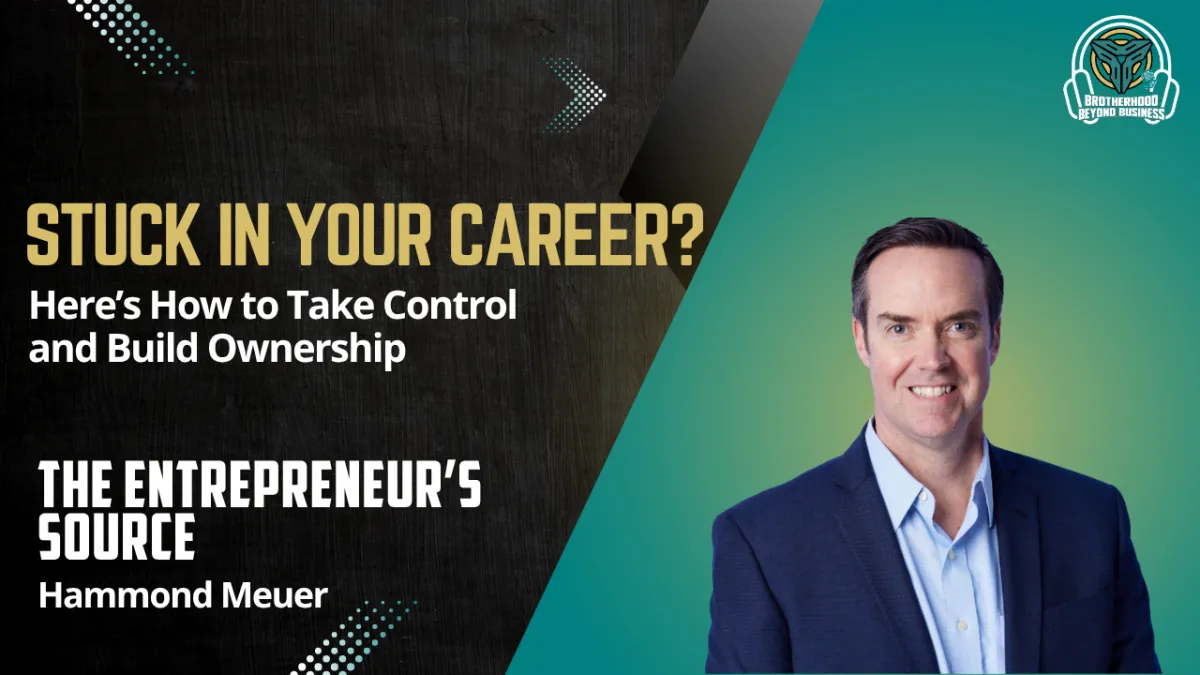
Ep 32 | Finding Career Clarity, Ownership, and Purpose with Hammond Meuer
Episode 32 | Host: Nathan Johnson | Guest: Hammond Meuer
🔥 Why This Episode Matters
Every service-based entrepreneur hits the same tension at some point: are you building something meaningful, or are you just chasing growth?
In healthcare especially, there’s pressure to scale fast, sell hard, and package services in ways that feel more like marketing funnels than real care. But when trust is your currency, shortcuts cost you long-term credibility.
In this conversation, Dr. Brian Kelchen breaks down what it looks like to build a modern chiropractic practice rooted in integrity, patient relationships, and disciplined decision-making. For business owners who care about doing things the right way — even when it’s slower — this episode is timely.
If you’re building a reputation-based business, this one will challenge how you think about growth, referrals, leadership, and long-term vision.
🎧 Listen to the Episode
👤 Meet the Host & Guest
Nathan Johnson — Instagram | Facebook | LinkedIn | Profile
Nathan Johnson is a leader within the Brotherhood Beyond Business and the owner of Game Changing Performance. He helps entrepreneurs pursue excellence across business, health, and life through structured accountability and high-performance standards.
Hammond Meuer — Profile | LinkedIn
Hammond Meuer is a Career Ownership Coach with The Entrepreneur’s Source. He helps professionals gain clarity on their next move—whether that’s business ownership, franchising, or a new career path—by aligning their work with their lifestyle and long-term goals.
About The Entrepreneur’s Source — Website
The Entrepreneur’s Source is a coaching organization that helps individuals explore business ownership opportunities. Through a structured process, they guide clients to evaluate options like franchising, acquisitions, and startups so they can make informed decisions that fit their life—not just their income goals.
📌 What You’ll Learn in This Episode
Why most professionals feel stuck (and how to break out of it)
What “career ownership” actually means in today’s world
The difference between starting, buying, or franchising a business
How to evaluate opportunities based on lifestyle, not just income
Why clarity should come before action
The hidden risks of staying in the wrong career too long
How to align your work with your family and personal goals
🧩 Episode Summary
Nathan and Hammond break down the real issue most professionals face—it’s not a lack of opportunity, it’s a lack of clarity. Too many people are operating on autopilot, chasing promotions or income without ever stepping back to ask if the path actually fits their life.
Hammond introduces the concept of “career ownership,” which shifts the mindset from being an employee or business owner to being fully responsible for your direction. Instead of reacting to circumstances, you start designing your path intentionally.
The conversation dives into different paths to ownership—starting a business, buying one, or going the franchise route—and why each option comes with different trade-offs. The key isn’t picking the “best” one, it’s picking the one that aligns with your goals, time, and lifestyle.
At its core, this episode is about taking responsibility. Not waiting for the perfect opportunity, but building clarity so you can move with confidence. That’s what separates men who drift from men who lead.
🕒 Episode Timestamps
[00:00] Introduction and why career clarity matters
[02:45] Why most professionals feel stuck
[06:10] What a Career Ownership Coach does
[10:20] Different paths to business ownership
[16:30] Evaluating opportunities based on lifestyle
[24:15] Misconceptions about franchising and ownership
[34:50] Aligning business with family and personal goals
[45:00] Final thoughts on taking control of your career
💡 Quote Highlight
“Most people don’t have a work problem—they have a clarity problem.”
🚀 Next Steps
👉 Download our Your Circle is Your Ceiling eBook
👉 Learn more about Our Method
📚 Resources & Links
Follow BBB on: Website | Instagram | YouTube | X | Facebook | Buzzsprout
Watch the full episode on YouTube
Listen to the full episode: Spotify | Apple Podcasts | Buzzsprout
🚀Full Transcript
Nathan Johnson (01:10)
Have you ever had an experience where like you're watching your kid do something, whether it's, it could be arts based or athletic space and they flopped horribly. And then like you make your sail, you make, make yourself go to the side and you're like ready for them. The moment they come off the stage or anything and you're just, they just like collapsing your arms. You've ever had those moments.
Hammond Meuer (01:30)
I'm going back in the memory machine And that's one of the reasons I love sports is because you get to practice failure Mm-hmm, you know you get I think we talked about when we first met and there's nothing or others I know it's a cliche but it's like whether it is a grade or a performance you're up on stage and stage fright hits ya or you missed a free throw when all eyes were on you or you're on the pitching mound and
how or in the batter's box. And it's one of the reasons I just love youth sports is to because you can put an arm around them. There's still ice cream after the game. You know, there's still the enjoyment and to see how kids respond and develop resiliency. because I mean, my kids have been through COVID. We had a house fire. I don't know if I shared that with you.
And some of these, you when I was downsized, some of these real events that people go through every day, I mean, the unexpected loss of a loved one or whatever it be personally or professionally, resilience and grit. I mean, it's important.
Nathan Johnson (02:38)
So you watch them the first time and it's like I want to quit I'm gonna do something and then you're like you build them up you give you the reinforcement and then you watched That happen again multiple times. You're like now. I don't even have to be the one to Reinforce the fact that you don't want to quit just because you failed one time
Hammond Meuer (02:52)
and the older they get, and then I got, you know, now an 18 year old and coming off a sports season and probably some difference of opinion, let's just say, with coaches. was like, buddy, there's gonna be that in life. You know, you're gonna work with or for people who you don't agree with. But you kinda gotta figure it out.
Nathan Johnson (03:14)
Do you think he's come to that realization of that chapter of his life?
Hammond Meuer (03:18)
I don't
think so. I think it's one of those things where you're going look back and be like, maybe, maybe, like we all do probably, right? With our parents, like, yeah, maybe this is what mom or dad were trying to, were trying to tell me, you know, that this is whether it's a teammate, whether it's a game, a coach, your expectations, I mean, both for parents and kids.
And it's just interesting how he coaches as well. it's just one of the things I find interesting is how just the coaching and I'm all for it. You and I both do it. And I like to just simplify it. Basically the actions through words. Is how we approach it. And we can have a great dialogue. Or I can be chatted with a prospective client.
and give them some ideas or listen or ask questions and pull some stuff out of them. Say, hey, have you ever thought about X, Y, or Z? He's like, yeah, I thought about it. Well, I was like, would you be open to taking action or what's prevented you from taking action? And then clients will pull in the reasons why maybe they haven't. Usually it's a spouse, for example.
It's always interesting, the same things we sometimes prioritize in our life can be the reasons why people may not do something, while my spouse may not be in favor of it, or things like that, at least in the world of business ownership, for example.
Nathan Johnson (04:47)
And then there's that
guilt that can set in from wanting to even take action on those things, right? But I like that intro, we're talking about your kids, as men and then business owners and all these aspects, most of us, we have kids, right? And then if either other men have experienced that same thing that you opened with, that topic of I'm gonna have to help my kids through sports and then when they're done, it's almost like, yes, part of their chapter is over two of their lives. But then as parents,
Hammond Meuer (04:51)
live off here.
Nathan Johnson (05:14)
that part of their life is over as well as they help them transition to the next part. I am Nathan with the Brotherhood Beyond Business. I'm here with Hammond today and we're going to get to know him a lot better and his business. So tell us Hammond, after that great intro, who are you? What do you do? What is your drive?
Hammond Meuer (05:29)
I'm
Yeah, absolutely. Well, thank you for having me. This is great. I've enjoyed our discussions thus far. My name is Hammond Meyer. I'm a career coach with the Entrepreneur Source. We have almost 300 coaches around the country. We started it back in the mid-80s, so over 40 years, and we help coach professionals.
Basically figure it out reach a point of clarity on what it is truly they want to do a lot of the professionals we work with Usually fall into one of two categories. It'd be there recently been downsized Or they're currently employed but not happy and I like to smile and say, you know, it's it's like a neck-and-neck race sometimes on which group is outpacing the other but there are a lot of frustrated professionals out there and for a lot of different reasons and
We work with professionals who may be in their, I mean I've worked with professionals in their 20s, mid 20s all the way up to their early 70s. And they will say very interesting things whether it's their parents who may have been impacted by the 08, 09 crash for example. And they'll say things like, I don't want that to be me.
Also talk to people in their late 60s or early 70s who say things like I'm being forced to retire and get out of the workplace But I still have gas in the tank. I still want to stay active and do things. and everybody in between And we simply work with them to Frankly establish some professional goals. What are we trying to do? What are we trying to achieve?
In my corporate life, I love to coach. I think maybe we talked about this a little bit. love to coach, but I don't like to manage.
Nathan Johnson (07:11)
When did you realize you liked to help other people become...
Hammond Meuer (07:16)
Great,
great question. I come from a family of educators. Education's always been big. It's not only maybe learning about what other people do, but it's a lot of times learning a little bit more about ourselves and who we truly are and what were the experiences that maybe shaped us personally and or professionally. Those are some of the things we talk about because there's some very...
fascinating impactful stories people have not only about their professional journey but sometimes even their personal and I think that's why sometimes we've been our clients appreciate the personal touch we bring to a professional situation. Now on the flip side we represent companies who are looking to build and grow their brands I like to say literally and figuratively all over the map.
continental United States. And we also have referral partners that we work with to simply help professionals gain clarity on what's next for them. The businesses we represent are franchise based. And a lot of people think that's, you know, fast food, burgers, fries and donuts. And that might be one element, certainly. But a lot of the businesses we represent are service based.
there in the trades.
Nathan Johnson (08:30)
Okay.
Electricians, plumbers, just that people. Okay.
Hammond Meuer (08:35)
mechanical, electrical plumbing, is a little bit more on my background, but also these areas where certainly people need help. People, seniors, senior care, consultative type, physical activity, gyms, franchising, again, a lot of people think it's, there's a lot of assumptions too, by the way.
but it's essentially the business in a box. think I've, maybe you and I chatted about the set analogy, right, and for those parents, and even if they still do play with Legos. You know, I always like to ask the question, what's the most important piece in the Lego set?
And we have fun with the question and there's really no right or wrong answer but at the end of the day I like to say that the most important is the instruction manual. And it's just the idea of following a step by step to whatever it is you want to build. And in the franchise space, professionals start to, okay, grab. And that's just one form of entrepreneurial.
Nathan Johnson (09:33)
They like that a little bit more.
Hammond Meuer (09:38)
type ownership. But then there are individuals. The thrill is in the beginning stages of figuring it out as you go, building a startup business. because I've met with a lot of business owners who have said, and again, with the benefit of time, go back and say, wow, I wonder if my business ever had an owner's manual or a
you know instruction quite to help me build what i want to build or continue building that's a really interesting discussion sort of the dichotomy between startup business versus a franchise business verses you know we're living in a day now where people are looking to get that maybe they've been downsize they're looking to acquire existing business that's a much different type of animal
startup which you've done, franchise world which I live in, we also work with business brokers to make introductions if someone was interested in acquiring an existing business. the entrepreneurial spirit is alive and well in this country. There's no doubt about it. It's just really given an opportunity to that professional to
Nathan Johnson (10:45)
Thanks
Hammond Meuer (10:54)
communicate and really what got him started on a path, what maybe a goal or a thought or dream involved a significant other or a family member. I don't know if I've ever placed a client or I haven't met their spouse.
Nathan Johnson (11:11)
wow. Do you remember the first time you ever placed that first client, whether it was, like you said, unhappy professional or someone who'd been downsized? And then this is like when you stepped into the entrepreneur circle and you were like, I can do this. I can help people.
Hammond Meuer (11:26)
Yeah, was actually It was actually This is where it was what's fun because you can kind of go from coach and cheerleader right, you don't want to Micromanage like I said because usually once they go with their franchise They have a coach assigned to them within that business and they provide the day-to-day Moving forward as they get their their feet wet and get established
Nathan Johnson (11:35)
Nice.
Hammond Meuer (11:52)
And you know, I were chatting at one point about like LinkedIn and the power of LinkedIn is just, like to, I try and keep things simple mostly for my own benefit, but just connecting professionals with other professionals and whether it's a recommendation. I think that meant more to me than the placement. Placement is more, it's kind of like a graduation, right? I know it's like the culmination of the work done, but it's really that.
the continuation of their journey as an entrepreneur with a roadmap and a plan, which again, depending upon one's age and stage, there's excitement. There's, yeah, maybe a little bit of fear, but it's more like nervous excitement. And I think one of the interesting things is the professionals that I work with are very confident in their ability to do a job. Like that's what's really cool too.
And it's just.
you know, maybe helping them sort out some of the noise or confusion, whether it may be coming from an outside source or listen, I'm as guilty as anybody overthinking something. You know, let's just, we provide a disc profile, dominance, influence, stability, compliance. It's just a behavioral tendency.
with all of our clients just to get a better idea on who they are simply as people. Usually personal happiness dictates professional productivity. And I think that's one of the maybe secret sauces because again at same time we represent organizations who are looking to build and grow. They want to bring the right individual into their
Franchise or world who's going to you know enhance their reputation? Who's going to be a performer? Who's going to share in the benefits the successes of that given brand and those are Those are some of the assumptions. I think some of the people Maybe have on franchising in general I'm actually a franchise owner with the entrepreneur source so all 300 of us
We represent the same brands. We have the same referral partners We follow the same sort of step-by-step methodical Playbook if you will but of course, we all have different backgrounds. We all maybe network differently We all have different relationships within the community that we that we simply Utilize to differentiate ourselves, but we've been through the franchise
franchise agreements we have relationships and we know what it's like about you know the fear factor if you will and helping to just relate to those clients who are seriously exploring those types of opportunities
Nathan Johnson (14:45)
So when you you mentioned like obviously like being a coach and watching those type of, you know, they go from coach to cheerleader. I just wanted to touch base on that. like, is that like almost the best parts of the job? Cause like, you're like, I did a good job. Like they are off and running now. It's like, it's like a coach on the basketball team, right? It's like, I practice, we run these things. And when it's executed beautifully, it's like, it's like that sense of a little bit of sense of pride and joy that comes from those.
Hammond Meuer (14:57)
Yeah, it's so cool.
I just got one yesterday actually from a gentleman who I met through just a mutual connection, phenomenal guy, very interesting background. He's always had an entrepreneurial spirit. He's got a background in the financial world and he has invested in an electrical contracting franchise in this area, Northbrook, little south of here and Barrington where I live.
That's why I say you just go from coach to cheerleader and you always defer to their business coach at the brand. I do. But it's like quick little questions on, I'm setting up this. Or do you know anybody who can help me with that?
In his case, might have been a lawyer or setting up his business account banking wise, little things like that. You never necessarily direct them exactly what to do, but just, hey, here's some of the people either I use or I know other people who have used them. You might want to look at that, but that's just more of a cheerleading, excited being there, if I can be, because we do work with people all over the country.
you know whether it's a grand opening or but just the the excitement they have I've always been the one to kind of stay back and let the spotlight be on them I do not like the spotlight I do not want the attention it's really about the client putting them in a position not only just them but also the business
So they can kind of like the one plus one equals three. when the client has a point of clarity and they say, you know, this is an opportunity that I really think I can excel at. And I see myself as part of the succession of this business. We like, I like to talk about culture, leadership and succession as it relates to.
anything really in business because you know in my past life I worked with a lot of independent startups. I worked in the manufacturing and the electrical world where I saw a lot of independent small businesses. Whether it was one or two people or hundreds if not thousands, culture, leadership, succession and you really got to go three for three.
it's not one of these things like you gotta go two out of three or yeah they got great leadership but a questionable culture and you know questionable succession plan but these are the types of discussions I have with clients when they need a brand and they truly see themselves as part of the succession they want to carry the flag I live it myself the other coaches around the country are
as genuine and as just down to earth. have a phenomenal culture with great leadership at the entrepreneur source. You know, engaging in peer advisory groups. You never feel like you're on an island, you know, even though most of us work for ourselves. We don't have employees. We don't necessarily have real estate, which are two variables that
our clients learn about as they explore potential business ownership. Do I want real estate? Do I want employees? What type of investment? I always like to say the real estate, like the mobile real estate in a service industry where the service goes to the consumer in the trades, whether it's a van or mobile pet grooming.
or electrician or in-home gyms, in-home physical, between the pandemic, the baby boomers, Amazon, throw any other lifestyle trend in there. Instacart, more more people want that service coming to them and they're willing to pay for it.
Nathan Johnson (19:05)
Instacart now.
So yeah, they the income. I used to mention the disassessment. So have you used those type of things in the past and then like someone's come to you being like, all right, I wanna go down this avenue and you can have a discussion with them and be like, well, you actually be best suited down this path or do you just kind of say, okay, where if you wanna go down that path, we're gonna do it?
Hammond Meuer (19:29)
Yeah, usually I always try to let the client dictate and we will sometimes intentionally or they say, oh, I know I don't want anything in this area. the area, maybe it's something in the trades. Hard pass on the trades. Most of our coaches will show them something in the trades and we do that just to be 100 % confident.
Nathan Johnson (19:46)
So it's a hard pass on those.
Hammond Meuer (19:57)
and until the client can really, and I think this brings up another interesting point, give you a really concrete answer as to why. Why not? Or it reconfirms what they initially thought. Because a lot of times, sometimes it's easier to ask that question, what don't you want more of in your professional career? A lot of times, the professionals are...
You know, I tell the story sometimes of my, at the time, 70 year old father, I don't know if I shared this with you, the first time, who, now this goes back almost 15 years ago, because he's almost 85. On the day of his retirement, he said, party, home at age 70. He goes, now I just gotta figure out what I wanna be when I grow up. And I'm like, here's a retired educator, spent 50 years, and he's making that comment, and he was kinda serious.
And I was like, you know, when we ask these 18 year olds or they're getting off, you know, whether it's a college or figuring out what they want to do or who they want to be when they grow up, it's so hard. But when you get a 50 year old or a 45 or even a 30 year old who's unhappy or who has been downsized multiple times.
and you ask them the question, what don't you want to be when you grow up? You get some really interesting answers. You get some really, I don't want what my mom or dad had. I don't want a bad boss. I don't want a toxic work environment. I don't want an hour and a half commute. a woman about a month ago, had an hour and a half, each three hours a day in Tampa. She's like, whatever it is,
I just need to get three hours of my life back at
Nathan Johnson (21:46)
That's so much. mean, you think about every week and then every year, how much of your time is this?
Hammond Meuer (21:51)
And as I saw if you did what would you do with your time and the answer she has and I was like that's And that's why it's different than we're not corporate recruiters. Hmm We don't like we talk about things I say that will probably get you fired in a corporate interview because we talk about things like family and kids and They tell me about your spouse
What does your spouse do? What does your spouse think you should do? And have you ever talked about possibly owning a business? And if so, what are the fears? What excites you? Have you ever, I mean again, are a lot of professionals, they might have had a side gig or experiment maybe at the Jam and Jelly at the county fair on the weekends when they were growing up or some entrepreneurial itch that...
They either haven't scratched or I like to tell people I was involved in a nonprofit in my hometown and was like to think pretty successful in that, doing the right things for the right people.
Nathan Johnson (22:54)
Is that where you got started with this? Because you really care about helping people find their dreams and not like I'm talking about like not the employer that helps their boss achieve their dream. I'm talking about like you, you know, laterally help other people achieve their dreams while you're achieving yours at the same time.
Hammond Meuer (23:09)
Yeah, I think I've always looked at it as like kind of serving others and whether it was more about education or maybe I shared the joke with you about the basketball nonprofit where the coach said, I'll tell you what, he was a young coach. He's a great coach, 30 years of age, just really good at the X's and the O's on the court. And our joke was he's like, well, if I handle the X's and the O's on the court, you handle the X's and the O's off the court.
Nathan Johnson (23:37)
to deal with the real problem.
Hammond Meuer (23:39)
And I wish I would have known like and he was so right and that's that's another cool thing is learning from and he's actually an entrepreneur he owns his own practice basketball training development he's now invested in a gym and in ozone gyms down in Naperville and he's built it out and and he's when you talk to a parent about their kid
And whether it is academics or athletics, you know, as you and I have just, even just today, we're sharing, enjoy the time with the children, enjoy those car rides, enjoy those because they won't necessarily come to an end, they'll just be different. And if there's a lesson you can take from, you know, the competition or the experience that you can apply to your next chapter, you know.
Nathan Johnson (24:29)
Right, because as a dad right now, of the five and two year olds, talk about like, am, especially her, their mom and I, we're their whole world. Right? And there's gonna be a time when it becomes 99, 98, 97, 96, and we're just gonna see it continually trickle down, but we're less and less of the world, and it's gonna be like, oh my gosh, this is hard.
Hammond Meuer (24:51)
90 % of your child's time is spent with you up to age 18. The time you get with your child, like 90 % is up to the age of 18. And then I leave the house, and I'm like, wow.
Nathan Johnson (24:57)
90 %?
Yeah.
Then we're fighting for time after that.
Hammond Meuer (25:12)
And those are the types of themes and topics that come up with our clients. And again, generally speaking, the two things, right? Most people want more of time, And the younger, in general, the younger, the professionals we talk to, they'd say, like, I just want to make money, money, money, money. It's like, okay, let's talk a little bit more about what that means to you and why.
And then some of the more experienced and older will just simply talk about the time and the time they have left. they say things like, I need a little more of a purpose in what I do. Like, I need to know that I'm making a difference in somebody's life. we just, again, not to oversimplify it, but we just say, well, let's maybe go on a journey. Let's go out and learn about
maybe the people who need help out there. Because there a lot of people who need help out there. But let's also learn about maybe some of the problems that need to get fixed. It's kind of like a lot of what you do. I there's a lot of people, whether it's their physical, mental, well-being, and even spiritual, will be helping them to feel better about themselves. You're directly solving a problem, but also helping people. And is it, you know, this is not to get too philosophical.
But every individual may struggle with something much different and unique and have their own set of variables that they're bringing to you and the gym and that they're trying to reach their goals. And at least on the professional side, there's a little bit that going on too, but never want to ignore what's going on personally in the life, because it's real. I I've had clients who have had...
Passing the death unexpected death of like a spouse had a client who had a very unfortunate child take his own life while we were working together and It's Like how can that not impact? any of us Right and it's like so to stick your head in the sand or not ignore that or to ignore that and not have that I mean
Again, that's why I say we're not therapists, we're not counselors, but we do, it's not uncommon for personal things just to come up in terms of who's their circle of influence, who is their board of directors in wanting them to succeed should they pursue business owners.
Nathan Johnson (27:47)
Right, as your coach, they're perhaps confiding in you a little bit. They've already informed you of this horrible thing that's happened in their life. So there's that level of trust that you've created with them. why here? Is it because the family's here?
Hammond Meuer (28:01)
Yeah,
family's here. I married a girl from the Northwest Burbs. say it's not the weather or the sports teams, why we live in Chicago, but I'm from the area. I went to school out east, I worked out west. I relocated back here about right around 9-11, back in the early...
Nathan Johnson (28:16)
quarter of a century ago.
Hammond Meuer (28:17)
Yeah,
it's okay.
Nathan Johnson (28:20)
I always say it like that, maybe it sounds like too much.
Hammond Meuer (28:22)
I was alright, I can share with people my age, I'm 50 years of age and I see those 25 metta young
25 year old and it's just so fun to hear their stories and the things that have impacted them and maybe I've shared the story of a 22 year old college graduate who just invested in a franchise like out of college and he's now on his third contract with him he's in his late 30s and he's doing great.
Nathan Johnson (28:48)
Is he doing a trade? Because you mentioned your specialty is trades. Why do think that's your specialty or did you want that to be your specialty? ⁓
Hammond Meuer (28:53)
I
think it found I think it's kind of a little bit of both I mean first of all there is such a need and this isn't about the first time I bring it up as a potential with somebody you know to say you know Nathan what do you think about the trades just keep it and just yeah oh I mean and that was you know the gentleman just recently I'd worked with and this isn't about you know a lot of times some of these assumptions
are, my gosh, I need to go back to trade school or learn how to turn a wrench or no, no, no, no, no, no. This is about leading the team. This is about hiring those technicians to do the work, but someone's got to read the KPIs. Somebody's got to own the business, you know, communicate with, you know, the franchise or build, grow, develop.
everything that frankly most of them have done in corporate world in some cases. They are very confident in their ability to do that but the trades are in such need. I think we're going through a little bit of a...
Just a little bit of a redefining in this, especially post COVID, where more and more people are spending time at home. They're working from home. Maybe the baby boomers aren't planning on selling their homes at least anytime in the foreseeable future. But guess what? Stuff still breaks. Stuff still breaks and whether it's reactive, water heaters, plumbing, HVAC.
or proactive. grandpa, grandpa just bought a new Tesla and needs a charger in the garage. He's got to install it. Absolutely. those are the types of, a lot of them I like to say are boring, predictable, but profitable type businesses. These aren't.
Nathan Johnson (30:31)
that installed.
Hammond Meuer (30:43)
It's not the next semiconductor factory going up in Libertyville or anywhere. These are businesses that everybody needs, but to what degree it may align with what somebody wants to do, that's a different question.
Nathan Johnson (30:56)
So
you're just looking for leaders to lead and then like explain to them, hey, let the technicians be the technicians. Yeah. Right. A lot of there's maybe a lot of people out there that are really, really good at their trade that don't want to distress of owning the business.
Hammond Meuer (31:10)
Exactly, that's a point. And those are the types of, that's the type of information and education, because we make the introduction. So we'll represent franchise businesses and then usually three we'll introduce. Once we get to a certain point with a client, we'll introduce three. I'm meeting with a couple virtually a little later today. She's an educator. She's not happy.
He's been out of work for about six months. And one of the, maybe in the second or third call, she brought him into the call after about our second call together. It just started out.
Nathan Johnson (31:47)
You and her and then she... Get over here!
Hammond Meuer (31:49)
I
gotta get out of it. And this is really interesting because I am talking to a lot of people in the healthcare world or education who will say things like, got into this profession because I wanted to take care of people in healthcare. I wanted to educate a kid. However, over time it's become about something else. I didn't change. I almost feel like, you know, they'll say things like the industry changed on me.
It became more about flipping beds or state test scores. Work, absolutely. And those are very valuable. Like those are nuggets. It's like, what if we took your same desire to help somebody or educate a kid and we just pivoted a little bit? We just pivoted 45 degrees and we were to introduce you into an opportunity.
Nathan Johnson (32:18)
workplace politics.
Hammond Meuer (32:41)
like senior care. What do you mean? Well, you know, by 2030 the entire baby boog generation will be over the age of 65. Yes. Right? That's a fact.
Nathan Johnson (32:53)
We all know that that's for the anytime the babe boomers do something. There's a new trend there. Yeah
Hammond Meuer (32:57)
Absolutely,
absolutely. It's something that's fascinating in and of itself and whether, you know, now my parents, they're a little older, they're in their mid-80s, but when you look at things like companion, they're lucky, we're all lucky that their kids are still in the area. But there's a lot of families who are not. They're hundreds of miles away, but their business is like seniors helping seniors, which is a franchise, where people in their 60s.
roughly help people in their eighties. But that's a business. I mean, that's a concept, but there's also medical, there's non medical. There are business opportunities, senior proofing homes going into absolutely. it's a franchise. They've figured out the mind. This is what's so interesting. And I guess it's one of the, not only do I get to meet great individuals and entrepreneurial professionals as well, but learn about these businesses.
Nathan Johnson (33:39)
thing.
Hammond Meuer (33:53)
And it's not just what they do, but it's how they do it. And that's what I think where franchising comes in with the playbook, because what they do is they send in an occupational therapist first to assess the house, to follow the discharge instructions from the medical. So whether it's the grab bars or the ramp is installed. And so you send in the occupational therapist first.
Nathan Johnson (34:17)
Yeah
Hammond Meuer (34:21)
first to the house, to the residence, because usually it's not the patient who needs it who's calling, it's their loved one. It's the spouse, the adult children. So once the occupational therapist comes in, then they send in the contractor to do the work. Those types of business opportunities, they're not going anywhere.
Nathan Johnson (34:39)
Yeah, they'll explode in the next 15 years then. Explode. From now on. Absolutely. Because 65 to, they're probably going to live to their 80s.
Hammond Meuer (34:46)
Absolutely, we're getting
help here because they're seeing people like you and they're going to want to put they're going to want to do it. We know that they're going to want to do it when they want to do it on their terms and their homes. And for the the for the businesses that acquiesce. Sure. And that's what I've heard of. This is a cool one. Actually, my parents have, you know, just senior senior chef just coming in, preparing meals.
Nathan Johnson (34:55)
in their homes.
Hammond Meuer (35:12)
in your house, like leaving you with a week or two weeks worth of meals in the freezer for... Exactly. Comes in, interviews, gets an idea of what people want, and yeah, it's a franchise. And people say, well, the franchise, it's like, why can't I just start that myself? You could, you absolutely could. And most people sometimes forget that all franchises started as successful startup businesses.
Nathan Johnson (35:19)
Kind of like these meals. What do want me to cook you? Exactly.
Hammond Meuer (35:38)
they just evolved and the owner wanted to develop the instruction manual.
Nathan Johnson (35:43)
So you mentioned like, franchise, like what is the most misunderstood thing you think about like with your business and then starting up a franchise?
Hammond Meuer (35:51)
Yeah, you have some really good questions. This one I think if I could hammer one point home, and we chat with our clients about this, the biggest assumption is probably a franchise just wants me because either I have money or I'm interested and then they're just going to get me to sign and then they're
Yeah, and it couldn't be further from the truth. mean the franchises didn't get to where they are by just bringing any anybody on and I always like to ask people have you ever researched what it took to own a Chick-fil-A? And it's one of the most well-known now game a lot of what we represent is non food based or whatever but everybody knows the Chick-fil-A name and if you just Google search it and you look at the requirements of
what it takes to own that and whether it's, forget the investment financially, it's the time. And it really is working in that place for months over a period of time. But boiling it back down to one of the biggest assumptions, when I introduce a client to a brand or multiple brands, I've had clients get really, individuals get really excited.
About the business and they'll be like I could really see myself doing this and Here's why and my spouse is excited and they start thinking and they've just had one or two calls On that third call the franchise comes back and says we're sorry. No, you're not a cultural fit and The individual is like blindsided they're like
What were you talking about? And a majority of the time it's because not a cultural fit basically means you were coming in and trying to tell somebody how to rerun their business. That's not what they want, right? It's, can you, don't, I like to say you don't tell Mrs. Fields how to remake her cookies. She's not interested in that. She's interested in more, selling more cookies.
Nathan Johnson (37:44)
⁓ okay.
Hammond Meuer (37:57)
Right? And now, the good news is we talk about that stuff before we even introduce them. But it is why we do talk about culture and leadership. And I think it's another maybe misnomer because I even do it with the entrepreneur sources. You're still part of a group that does want to continue to get better and build and grow and maybe do some new and different things and be part of an advisory group or be part of a
you know coach coaching quorum that is looking at a new way a new software you know using AI in our business or however whatever trends might be going to still explore you can still be a part of that but they're still at the end of the day a basic playbook to build and follow and grow your respect
Nathan Johnson (38:44)
I
mean it to be honest it sounds like obviously it sounds like opening a business but the difference is is like For you it's gonna start with you and then they're gonna start with the actual business coach like you mentioned earlier from the actual business and so it starts where you Let's say we're like we're doing climbing a mountain for example where you are leading them first, right? They're following in your footsteps as it goes along the way and then eventually maybe it's more of a walk side by side Yeah, and then you mentioned like the cheerleading side where you're now
kind of watching them on, watching them climb and going, yes, yes, you got this. And then finally they make it.
Hammond Meuer (39:20)
And everybody's got a different path. I sometimes use the toy story or the store. The toy store sort of analogy. And again, I've had clients say swimming pools or wading into a pool with swimmies or jumping into the deep end. And there's, I love all sorts of them. But at the end of the day, pursuing a corporate type of role.
is much different than an entrepreneurial and a startup is much different than acquiring an existing and which is much different than a franchise. And if we were in, you know, a toy store and we were looking down the W-2, that's over there. And we encourage that because the more you can compare and contrast opportunities, especially when they say things like
toxic work environments or bad bosses or commutes. Okay, we'll make sure you get answers to those questions. But if you were to start up your own thing, how many business owners do you know? And how many business owners do you know who started their own thing and been successful at it and go talk to one? And then they're gonna come back and compare and contrast. Now this aisle here, this is sort of like the franchise Lego. Because every one of these businesses that we look at, at the end of the day, they all have the
the operating instruction manual. But that's much different than this one over here, because I got a referral partner who would love to meet somebody who's interested in buying an existing business. Then maybe that retired baby boomer wants to sell. Because there's some of those, but that is a much different, that's, you don't have to put dollars on everything, but those are usually half a million to a million dollars on them. Those types of opportunities. Which is,
Nathan Johnson (41:01)
Okay.
Hammond Meuer (41:05)
a step up than the tire kickers in the franchise world, which are usually started, you know, six figures up to about half a million. But depending upon real estate employees operating capital, which is much different than the blood, sweat and tears you put in building your business, right? Where there was no, but you wrote your own instruction manual, which is much different than the corporate route.
Nathan Johnson (41:20)
Right. That can go up.
Right, the kid that builds the Legos without the instruction manual. They built their own. They don't build their own little castle. So how has owning this part of the business changed you like as a man, changed your family aspects? Like what has it done for you and your family? How does it show up at home?
Hammond Meuer (41:37)
So here, which eye would we like?
Yeah, I just like to say my five to nine drives my nine.
Nathan Johnson (41:53)
Okay, the time with your family motivates your work.
Hammond Meuer (41:55)
It
was like, cause I guess when I was asking myself the question, what don't I want more? I was like, I don't want to be stuck in an airport or traveling while either my kids are growing up or, you know, my parents, my in-laws, my in-laws family, my wife's family is in the area. you know, there's still, those, those are the types of things that, know, we don't get the time back. whether it was post COVID or.
an opportunity to sort of shoot your shot while you're at it again.
Nathan Johnson (42:28)
So you mentioned like two different bubbles, right? The money making bubble and the time bubble. Are you in the time bubble then?
Hammond Meuer (42:33)
It's
it's interesting. I mean, this is something I've heard from others and maybe you've heard the same. There's people who have used their time in one portion of their careers to make money or maybe build wealth. then what people are starting to do is, want to use now my time.
Nathan Johnson (42:57)
I'm gonna use my wealth to make more time.
Hammond Meuer (42:59)
and then use that time to build more wealth. So then it becomes, okay, well how do you define wealth? And that's a question that you ask and you get a lot of really interesting questions. People will talk about, my portfolio. Or people will talk about, you know, certainly their family or real estate. And I think business ownership is on a path in this country, very similar to what real estate was a generation ago.
Nathan Johnson (43:24)
Okay.
Hammond Meuer (43:24)
Alright, so
a generation ago, and I know you and are not exactly the same age, but you know, and I'd love to hear your kind of take on this, you know, my parents bought a house to raise a family. Correct. That was really it. And there are educators, one's from Boston slash Indiana, the other one's from South Dakota. Farm boy from South Dakota. Could be more different.
Nathan Johnson (43:47)
gonna be more different.
Hammond Meuer (43:50)
And I promise he wasn't thinking about wealth diversification at age 22 when he was right off the farm or out of school and moved to Chicagoland and became like an art teacher. But over time, he realized the value of real estate and started acquiring little bit by little bit. And now, fast forward, you can't turn around where somebody doesn't own.
a piece of property or a real estate investment, whether it's a VRBO or a lake house, a beachfront condo as a diversification of wealth. Correct. So that's another form of wealth. But we're at the, maybe some will say we're at the precipice, some will say we're already there about business ownership. And at the end of the day, owning your own business, what's the objective? What's the goal? And if it's to sell the business.
or if it's to pass along to the next generation, there's no right or wrong, but at the end of the day, it's to provide options. It's to provide options and that succession planning that some people do, but some people don't, right? And it's a lot of times we see, again, rewinding a generation, the trades person who started their business to put food on the table and a roof over the head.
They made a really nice business to it. And now that they're in their 60s, or wherever, and they're ready to maybe move on, it's, what's the succession plan? All right, well, I guess I'm gonna start figuring it out. In the franchise world, it's actually one of the first questions a franchisor will ask a prospective franchisee. What's your end game here? Is your end game to expand?
Nathan Johnson (45:31)
Okay.
Hammond Meuer (45:36)
Is your end game to sell or is your end game to bring in the next generation? And it really, sometimes it catches people off guard because this isn't about just a job. That's why we call these career coaches. This is career coaching. is, all right. And if it's, if it's about diversifying your wealth or in the form of tax benefits, or is this a real estate play in addition to
the business, how do we value the business? Because at the end of the day, there's only a handful of things, right? You can do with the business. Close it, sell it, what's the word? Right? And I've had clients who say, yeah, we're going to pass a franchise. They signed with them. They said, yeah, we're going to pass it on to our kids. Okay, great. Well, we need to interview your kids at the time because
Nathan Johnson (46:11)
⁓ Just pass it on.
Hammond Meuer (46:29)
We need to make sure your kids pass our standards at the time. So just don't assume. We got through it, it was all, but it was one of those things like, you you can't just give it to your kids and you need, the franchisor will say things, well, we want to make sure they are up to our standards when the time comes. And it was a quick little addendum or anything like that. But it's one of those things where it's just being clear on the expectations.
on both sides and that really helps strengthen.
Nathan Johnson (46:57)
How do you get through those moments when like say a franchise or tells a franchisee? No, you're not a fit
Hammond Meuer (47:04)
Getting wise, understanding why that is. Usually it is the cultural. And a lot of times it's back to maybe why the franchise or would be a fit for the franchisee. Like, I can't see myself doing that or...
One of things I like to ask clients is if you could rank these five things in order of importance, how would you rank them? Time, health, family, money, purposeful work. And you ask them that question, you get some pretty interesting, and there's no right or wrong either. Like some people will say, you know, my time is important, or purposeful work is more important, or I just wanna make the money. And they say, okay, well if we show you something that is...
you financially driven you know where you have an opportunity to ultimately grow and know and build a nice business particularly in the trades or in senior care and then they'll come back and they'll say I don't want two dozen employees okay well that's what it's going to take to make what you kind of want to make but at least we know that so it's like well
What if we don't want two dozen employees? if we half a dozen?
Exactly. Where's your happy place, both in any of those categories?
Nathan Johnson (48:15)
Okay, so inside of your business, like you've done it for now for what? you say like 30? Yeah. So how do you buy speed or what would you have done to like buy speed or to get to where you're at right now quicker?
Hammond Meuer (48:19)
Yeah, two and a half almost three years.
Yeah, that's one of the reasons I do kind of like the franchise route is because I can lean on coaches three to five, five to 10, 10 to 20 years who have been doing it. And what's interesting is we kind of learn from each other, right? We learn about, you know, I'll talk to coaches who have been doing it 10, 15 years. They'll say, well, we never had anything like LinkedIn. We never had anything. We had callers or we used resumes.
Nathan Johnson (48:54)
Right. Paper, documents. So you're like a testament then to these people who are like, I'm too old to get out and do it on my own now. Like, there's no such thing.
Hammond Meuer (48:56)
Yeah.
I will say, and we do talk about age, which is one the reasons I bring up, and some will say, yeah, do you mind me asking how old you are? Oh, I'm, they'll say this, I'm 57. Right, well you know what they say, I'm a 57. 57's the new 47. And there's no question that people are working longer because they have to. Don't get me wrong, there's no question, but there is a large number who work longer because they want to.
They want to stay mentally sharp. They want to stay like I was just talking to a gentleman, an estate planner. We actually talked about this thing because he's dealing with wealthy individuals at the time of retirement and what that looks like for them. And he was educating me on the amount of alcoholism. On, yeah, people who...
essentially retired, didn't have a plan and sit home and the alcohol consumption is on the rise and it's just not leading to very healthy lifestyles. And I was like, I had no idea. And he's like, the importance of a plan and understanding whether it's, if it's going to be strawberry daiquiris on the beach, like they think it is, he's like, well that...
You know, there's consequences to that sunburns and alcoholism, I guess, his point. it's, it's, you know, he was looking at it from, you know, the 60, 70 year old perspective, which is, and again, he's, he's like, he's dealing with wealthy individuals who have built, you know, multimillion dollar estates and professionally everything was.
Nathan Johnson (50:40)
Purpose disappears a little bit as well with that job
Hammond Meuer (50:42)
personal struggles
that were becoming what that was like.
Nathan Johnson (50:46)
That was like almost worse than when people come up to Nestor's. I'd rather, like retirement's almost worse. What would I do with my time?
Hammond Meuer (50:52)
And now we're in retirement and just what it means to people. sometimes these are the questions we ask. If you had a couple extra zeros in the bank account or you had 10 years or that person who had that crazy commute of three hours a day, hour and a half each way. If you had those three hours in your day left or back to you, what would you do with them? And whether it's, and people give you really interesting answers.
Nathan Johnson (51:20)
and three hours. Like I think about myself like before I had kids, I was like, my gosh, even if I was productive, I was such a time waster, right? Because every time you get home from work to the time you go to bed, those are hours to be like used and prioritized. I was like, my gosh, like five hours a night is an eternity to like a young entrepreneur who doesn't have kids.
Hammond Meuer (51:43)
are long but the years are quick.
Nathan Johnson (51:46)
Yeah,
that's right. So, gosh, it's crazy to think about. what would you want people to say though about you as a business owner? Or hope they say about you as a business
Hammond Meuer (51:54)
It's more about as a person, know, honest, ethical. mean, even in our disc profile, it's kind of funny. The results come back natural versus adapted. And you know, when we know who we are as people, and of course we can all adapt where we are in certain situations, but you know, our circles as we get older becomes so much tighter.
You know, we're over you know, just kind of my opinion but again, I'm seeing it on both both sides but That's why I love I love coaching but cheerleading as well and just being a trusted resource for somebody to go to When they have a problem when they have because there are a lot of professionals out there who are going through challenges who are
not sure what the next chapter holds. And they've got very interesting stories up until this point. And just learning more about what inspires them, what motivates them, their kids, their spouses, their extended families. And I think that's one of the reasons we pull them into our conversations when we can.
Nathan Johnson (53:03)
So not only that you're available, that you actually care to get them where they want you.
Hammond Meuer (53:07)
And
a lot of times, nine times out of ten, business ownership is not for them. And we'll absolutely tell them that. Or they'll realize it on themselves. And whether it's the timing, back to those same things, the same things we prioritize, time, health, money, family, purposeful work, usually it comes down to those same things we prioritize, or exactly the reasons why.
Nathan Johnson (53:12)
Okay.
Hammond Meuer (53:30)
It's not a fit.
Nathan Johnson (53:31)
So if you were to give like a fortune cookie advice, right? To a young entrepreneur, let's say there's a young man who's like, he's, yeah, he's, they're miserable, right? They like, I cannot keep working. It's called, I cannot keep working for the man, right? I need, I want to be my own boss. I want to work to accomplish my dreams. Could you give a quick fortune cookie type of advice? Thanks for that.
Hammond Meuer (53:52)
love
to know what the dreams are. And a lot of times they're sometimes a little more simple than whether they're time, those five hours, being present those five hours for the family, for the young kids. Like if that's the dream or that's the goal, okay, that's a great place to start. Let's start at looking at something that's nine to five, right? But has maybe an after hours.
which is again another reason why the trades are becoming a call center who can answer a call and you can hit a couple of puns and still be heard versus but you know the dreams the goals you know more people spend time on figuring out what they are having for dinner on a menu than they do on their life goals or plans or how they define wealth
But I think for the people who are frustrated out there, knowing why they're frustrated or what they don't want to be growing up is very impactful and helpful. And utilize that is potentially a catalyst to open, whether we're problem solvers and or people pleasers or some combination of there up because with the baby boom generation.
and or the amount of opportunity in this country in the playbooks that exist, I'm very confident that we can virtually help out any profession.
Nathan Johnson (55:13)
So know your why. It's
never too late.
Hammond Meuer (55:18)
never too late. fact, that's part of the interesting is there's a lot of, I don't want to say noise, but it's getting close to noise. There's a lot of talk about, you know, professionals getting aged out of at least the corporate world. And that's kind of a fun little fact about franchise or franchise or love 50 year old experienced
Nathan Johnson (55:44)
Hogwarts.
Hammond Meuer (55:45)
They're
hard working, they've got a battle scar too from the corporate world. They understand their clock is ticking, right? So they'll say, the average age of our clients are really between 45 and 55. But they're getting younger. They're absolutely getting younger. And because they're realizing the families, their own timelines, the clock is ticking, whatever that.
Nathan Johnson (55:58)
No, I
Hammond Meuer (56:11)
whatever their timelines are, maybe they want to build something by a certain age, sell it, and then on to the next thing.
Nathan Johnson (56:18)
That was awesome. Hey, thank you so much for jumping on the podcast today.