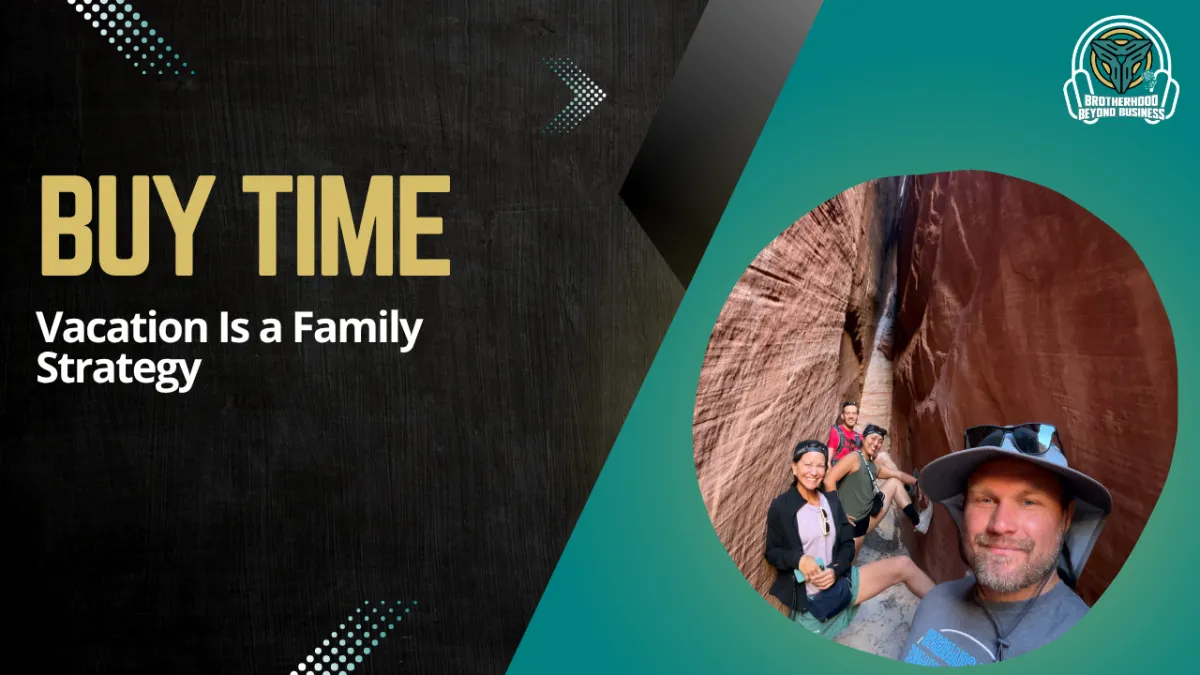
Ep 43 | Why Entrepreneurs Need Vacation to Win at Home
Episode 43 | Hosts: Trev Warnke & Joe Rouse
🔥 Why This Episode Matters
A lot of entrepreneurs say family matters most, but their calendar tells a different story.
The business gets planned. The meetings get scheduled. The goals get mapped out. But time with the people they are building for often gets treated like whatever is left over.
In this episode, Trev Warnke and Joe Rouse talk about why vacation is not a distraction from business. It is a strategy for family, clarity, marriage, leadership, and long-term harmony.
This conversation matters because entrepreneurs do not just need more growth. They need a life that proves the business is serving the family, not slowly replacing it.
🎧 Listen to the Episode
👤 Meet the Hosts
Trev Warnke—Instagram | Facebook | LinkedIn | Profile
Trev Warnke is an entrepreneur, coach, and co-founder of Brotherhood Beyond Business. Through the Brotherhood community, Trev works with male entrepreneurs who want to build strong businesses without sacrificing their health, faith, or family.
Joe Rouse—Instagram | Facebook | LinkedIn | Profile
Joe Rouse is a Brotherhood Beyond Business leader and host known for direct, practical conversations around entrepreneurship, accountability, and personal responsibility. As owner of Breakaway Fitness & Performance, Joe challenges men to build strong companies without sacrificing faith, family, and integrity.
About Brotherhood Beyond Business— Website | Instagram | Facebook | YouTube
Brotherhood Beyond Business is a private, local war-room mastermind for male business owners who want to build better businesses and better lives. The Brotherhood helps entrepreneurs create accountability, sharpen leadership, improve decision-making, and build stronger alignment across business, health, family, faith, and personal growth.
📌 What You’ll Learn in This Episode
Why vacation is not a distraction from business, but a multiplier for life.
How entrepreneurs can use vacation to buy intentional time with family.
Why annual planning should include family trips, marriage trips, and clarity breaks.
How time away from work can create better strategy and deeper thinking.
Why vacation does not have to be expensive or week-long to matter.
How fathers need to understand the time clock they have with their kids.
Why entrepreneurs feel guilty stepping away and how to reframe that guilt.
How to create harmony between business growth, family memories, and personal clarity.
🧩 Episode Summary
Trev and Joe open the conversation by challenging the way many entrepreneurs think about vacation. Instead of treating time away as a loss of productivity, they frame vacation as buying intentional time with your family. Joe shares how vacations became part of his annual planning process. He talks about scheduling trips with his wife, family vacations with his kids, and business trips as separate buckets that help him stay connected to more than just business goals.
Trev shares his own tension around taking time off, especially when vacations pull money away from savings, investments, or business momentum. He also talks about how time away from technology, long drives, hikes, and quiet space have created some of his best strategy and clarity. At its core, this episode is about harmony. Entrepreneurs do not need to choose between building a business and building memories. But they do need to plan both intentionally. Vacation is not something that takes away from the business.
Done right, it is something that strengthens the man behind it.
🕒 Episode Timestamps
[00:00] Intro and why vacations matter for entrepreneurs
[01:03] Joe Rouse on buying time with your family
[02:09] Building vacations into annual planning
[04:10] How Trev prepared for three vacations in six weeks
[05:44] Why entrepreneurs can feel behind even while doing the right thing
[06:12] How time away creates deeper strategy and clearer thinking
[08:31] The tension between vacation spending and building wealth
[12:06] What new business owners should know about taking time off
[15:33] Why vacation does not have to be expensive
[18:02] Redefining what counts as a real vacation
[19:49] Creating harmony between business and family life
[21:00] Why your kids’ ages create a real time clock
[24:10] Building vacations into your annual plan
💡 Quote Highlight
“Vacation is not something that takes away from your business. It’s an addition. It’s a multiplier in your life.”
🚀 Next Steps
👉 Get our weekly Build the Business, Build the Man., Build the Edge, playbook to get one actionable task to implement into your business and life each week --> Sign Up
👉 Download our Your Circle is Your Ceiling eBook
👉 Learn more about Our Method
📚 Resources & Links
Follow BBB on: Website | Instagram | YouTube | X | Facebook | Buzzsprout
Watch the full episode on YouTube
Listen to the full episode: Spotify | Apple Podcasts | Buzzsprout
🚀Full Transcript
Trev (00:34)
All right, guys, welcome back to another episode of Brotherhood Beyond Business Podcast. Me and Joe today are going to be diving into why vacations are important for entrepreneurs, why you actually need to build in some time in your schedule to create the harmony between you and your family. This buys you time with your family because hey, I might not be able to give as much time during a two month span when we're really focused on business, but I'm gonna go all in for a good week or however long your vacations are. So I'm gonna kick it off. Joe loves vacations. I'm gonna have Joe kick off like why vacations are important for him and how he kind of balances it in his life.
Joe Rouse (01:03)
You know, like that's kinda interesting that you just said that, 'cause I've I've never we talk about buying speed, right? You buy mentoring, you buy coaching, you buy speed in your business. But taking a vacation is quite literally buying time with your family because it costs money. and I just never really thought of that statement until you said that right then, like actually buying time. for me, I have three kids. Family's very, very important to me. So a few years back, I would say probably five or six years back, I've
Part of my annual planning process began to involve trips alone with my wife and then trips with the family and then business trips. So it's kind of like three buckets for each year. Sometimes they do, they do overlap. Like my wife is now a part of the business, so we'll go on business trips together. But I started that because it it made me, it helped me truly be optimistic for the year beyond something business related. I think you and I used to talk about how.
I always talk about how like eventually you run out of passion and you're you know, you're working in your business, you're building your business right to build a legacy or you've got a different purpose than when you started. And
I'm like that now, but if I'm gonna plan something or if I'm gonna set some goals, it's always focused on the business. It's like, all right, what do we need to do in the business to get to this next step? So adding the vacations in to my annual planning forced me to get more into the habit of prioritizing my personal life when it came to planning for the future. Because I just wasn't like wired into my brain because I just want to work, work, work, you know, and build, build, build.
So there's that's been a big benefit for me. And then by planning those in, actually picking spots on the calendar ahead of time, like we actually take those vacations. I can budget for those vacations. And it leads to a stronger marriage for us. it gets me memories with my kids, which from that, from doing this consistently year after year, our goal is to hit three at least three family vacations a year. I want to get at least two trips alone with Melody. It doesn't always mean they have to be big, like long trips.
But those those are generally my like baseline goals. And if we can get anything on top of that, it's a bonus. But it's it's it's changed my perspective. like I talked about, like where it was always build, build, build, business, business, business, do this, do this, do this. Now it's like the mo maybe it's where I'm at in my life, but the most important thing is memories with my family. Because those they've just become the most valuable thing to me in my life. They're they're fulfilling for me.
And and the vacations help me create those memories, like and you know, nobody can ever take those away. So that's been that's where the harmonies come from for me is like adding that into my annual planning, which got me in the habit of focusing more on personal the personal side of things in a time when I never would have thought about it. And then now it's just become a part of the routine. it's interesting though to think about sometimes how vacations can be stressful as it pertains to work.
Like you just said you took what three vacations in six weeks? Something like that? Like was there a time where you were thinking about I'm I'm not getting this done or I just missed this opportunity or like how did how does that had that weigh on you while you were gone?
Trev (04:10)
probably less than I thought it would. I think prepping for this the the the three weeks of vacations and six weeks was I I did a lot of prepping for it and I think that helped out because I was really nervous of not that so
Joe Rouse (04:11)
Mm-hmm.
Trev (04:22)
It wasn't client issues I was worried about. We've got things pretty systemized that either if I'm gone, Nate can handle those questions. we have AI that can answer most of the questions. Most I don't really get a ton of client questions unless it's like, hey, I need a slight update on my website or Trev, can you answer me a question? I have a strategy that I need advice on. So realistically, I don't have as many client questions as sometimes I w I think I do. So the nice part is is I'm like but I'm prepping for all those things. So I set up
Joe Rouse (04:45)
Mm-hmm.
Trev (04:49)
I I prepped my clients beforehand before I left for that, meaning like, hey, I had reminders set up for this and the ones that consistently contact me, I made sure they knew I was out of town and wouldn't be answering during this time. So ask asking thing you know ahead of time. so I think I did a lot of prepping on the front side because I was nervous of that. the but the other thing that I did that was beneficial to me during this this six weeks was I made and this was the hard part for me too. I made a conce an effort to remind myself.
The goal is not to make progress in my business right now, is to make sure that I I'm I'm a fire fire fighter during this time, right? And so my only job is to fight fires during the weeks that I'm back to make sure that everything is moving forward. And the cool part is I had no fires during this time and like I'm blessed that there's no fires. but the idea was is I wanted to go in with expectations. My job is not to move any of the businesses forward. My job is to make sure those businesses just don't fall apart. And then I have seasons where I can move it forward. And that's the hard part from that's the stressful part.
Joe Rouse (05:26)
Mm-hmm.
Trev (05:44)
I feel like in certain ways, I'm six weeks behind my annual goals, like what I want to chase that what I'm chasing towards. Like where the brotherhood's going, I'm like, man, I'm six weeks behind like this pace. This is gonna slow down our roadmap. and so there's different things like that that stress me out. But the other part was is I had a lot of like time away from technology and I was able to think deeper without even meaning think think deeper. Like my main my brain while driving or sitting on the beach or hiking.
Joe Rouse (05:50)
Mm-hmm.
Trev (06:12)
went to these like cool places where I'm like, but like what about this? And like, what about that? And like allowed me to think through some some things because I'm always doing work that I didn't get that I'm not really processing the way my I used to, when I was younger, I had to drive back and forth to Illino Illinois to Iowa when we owned our second GCP location. And I had to drive back like every six weeks. And that that's a seven hour drive. And man, my mind created so many ideas during that seven hour drive every six weeks that really launched our business forward during that time.
And I haven't really had a lot of that built in space because like we're doing good things, but the problem is when you're doing good things, you're just focused on building and you're not focused on strategy design. And so I've these vacations for me create this strategy design time, let my brain process the things it wants to process, but I don't really have time in my because I I schedule out every minute of the week, I don't schedule out nearly as much strategy time because like, well, if I'm gonna get all this stuff done in this period, I only have this much windows of time and strategy doesn't always fit in those windows.
Joe Rouse (07:11)
Yeah, it's like definitely helps some things like driving, but you can kind of get into a flow state with some of those monotonous activities, or you just get more rest or like you have some alone time early in the morning before you get started on your hike that day, whatever it might be for vacation. Like, or for me, it's usually before my kids get up and I'm trying to drink some like if we're on a cruise trying to drink some coffee out on the the balcony of the room or whatever it might be, like I have made many business decisions when I've been on vacation. I think that's a good point to bring up.
Just because you you kind of clear a lot out. I d I don't get as worried about f like falling behind on like certain things, like tasks that I still do that I probably shouldn't do anymore. But like as far as the business goes, we we have great we have really great staff. Like and you know, you're you're talking about the Brotherhood and and level up, which are relatively new businesses. I've got breakaway, which has been open for over thirteen years. So I've got a solid staff in place that can help me
Take care of everything whenever I'm out of town, which is kind of what we're all working towards, right? but I have had those same moments of clarity on vacation where maybe I was holding off on a decision, like a challenging decision that I knew needed to be made, but I just kept holding off, holding off, and then you can kind of just you can kind of just let it click. I didn't even think about it that way, but that happens a lot, especially on long drives, too.
Trev (08:31)
Yeah, one one thing I was thinking about as we were talking is when so v vacations for me over the years have been a weird dichotomy in the sense that I have a certain savings goals that I'm trying to build towards. and so it's like vacations obviously pull from those funds, right? So it's like that side idea like, hey, I can't put away as much money as I want. So it's kind of that dichotomy of like vacation versus building up more in in a way wealth.
And so my my d the issue for me is growing up, my dad was always big on building wealth over experiences, right? And so in the back of my head, it's always like, man, like we could be putting an extra 15,000 away this month or this year into you know investing in that kind of stuff, or realistically, me and Eric could probably take about $15,000 worth of vacations in a year. And so it's like, man, that cause we always try to do
Joe Rouse (09:07)
Mm-hmm.
Trev (09:25)
want at least one week. So she's a teacher. So we get one week in we get spring break, we get fall break, and then we get a a summer summer vacation, right? So we usually try to take three vacations a year if we can. This year is a little bit extra just because her family had a 50 year anniversary that we're doing we went to and then we just had a a a last minute San Diego trip that's like, hey, let's go you know San Diego's only a seven hour drive for us. So it's like it wasn't that expensive a trip, but it was a you know a five day trip to make sure you drive seven hours you want to be there for a few days.
Joe Rouse (09:32)
Mm, mm-hmm.
Trev (09:52)
And so in terms of that, like it the tough part for me when I'm figuring out vacations is I love the time away from the business. But the other part for me is like, man, I've justifying it in my brain, like, okay, this is how much money could be going towards this thing versus like putting towards vacations. and so that I think that's probably the biggest obstacle I run into into not maybe that's maybe not just entrepreneur thing, just as a man trying to leave my family financially. It that's probably the biggest obstacle that I run into less about the business and more about the finances.
Joe Rouse (10:20)
Yeah, I I've probably been on the opposite end of the spectrum there. 'Cause I was not raised that way. But I agree with you and I wish I had more awareness and mindfulness of the investment aspect and building wealth. That was something that didn't really become important to me until like the last few years. Like really important, you know, as I hit forty and I'm like, it's like a whole situation change, a whole life season change. but I was not raised in that way.
Because I don't know that I don't know that my parents were doing any investing. And I didn't have mentors when I was younger really teaching me much about that. so I probably I'd I've had a pretty high value on experiences for a long time now, but it we probably would have a lot more saved if we hadn't been getting all those experiences. but it's I'm thinking as we're talking about this, I you know, I said I like to take three family vacations a year.
Sometimes we have friends come with us too. That's a new thing in our lives where friends come with us on vacation. 'cause we got a couple of groups of friends that we're really close with, and that's really changed vacations and made really, really fun. 'cause usually they have kids, they're in similar life seasons. So we make memories with them too. But think about like I said, three vacations with my family and at least two vacations with my wife, Melody. And then you just said you guys get three vacations a year based on fall break and whatever else you said, like summer break.
What about what would you say? Like, let's say you could go back and talk to to me or to Danny, not to you, because I feel like you were raised a bit differently, but to like me or Danny and the business has just opened and you're we're talking about vacation like. Because you know, when you first open a business and you you're you're a staff of one or two, right? You've gotta you gotta handle everything. Like what would you what's the perspective you think a new business owner should have as it pertains to vacation?
Trev (12:06)
I think vacation is different w within pr probably the first five years of your business. And I'm just guessing, like based on finances, knowing our first five years, we're the toughest usually in business. I think vacation doesn't always need to be a week long. You know, I think that's where people get it wrong, is it's vacation means I'm gonna be leaving for a full week or two weeks. Vacation the best vacations for me a lot of times are three-day vacations, right? Take like, okay, we're gonna leave Thursday night.
Joe Rouse (12:19)
Mm-hmm.
Trev (12:31)
be gone all get a full day there Friday, full day there Saturday, drive home on Sunday. we don't have little kids, but I'm sure if you had little kids, that'd probably almost be easier because they wouldn't be so exhausted from vacation. so it's the idea is like I think for a a small business owner just getting starting out, I think doing two at least two of those a year is like a bare minimum. even if you're not married. If you're not married and you're still single, I think that's like clarity space. So when I was before I met Erica,
I used to take a year vacation every single year. I'd take a vacation by myself. It would be just a a a long weekend and it would be a full clarity break, right? So I would just literally go to Wisconsin. So just north of us in Illinois, I'd go to Wisconsin and get like a cabin and I'd be there for two full days of just like it was just me by myself, like hanging out in the woods, thinking out strategy, right? So maybe it wasn't truly a vacation the way people think about vacations, but like that, yeah, for me.
Joe Rouse (13:00)
Mm-hmm.
That sounds wonderful. No, that's a vacation. I prom that's definitely a vacation.
That's delightful.
Trev (13:21)
For the for the phases
that we're in in our in that life when you're first in your first five years. And I and now I still would love one of those. I just can't justify taking that time away from my wife to do something like that. But the idea is is like that was really, really fun. And it could give me escapism. It got me a chance to get away a little bit. But I think it's should be required in your first few years because that's where you like get a chance to like recover. It's just it's just like refreshing for the next phase. And so I think that did a good job for that. And and as I got old get older, I think I still need to remind myself
Joe Rouse (13:28)
Mm-hmm.
Mm-hmm.
Trev (13:50)
Vacations don't always need to be a week long because it's a lot easier to take a four day vacation than it is to take, you know, a full week off from your business and also financially it is it makes huge differences. I've got to remind myself like not every vacation has to be this huge long thing.
Joe Rouse (14:02)
I think that's good advice. I think I think there still should be vacations. There should be some sort of getaway, even if you're not making money yet. Like 'cause you can grind, grind, grind and then get away for a Saturday, right? You can get away for a Sunday, just go somewhere local, especially if you're married and you have a wife, you need to pull your head out of that stuff. Like, even if you gotta shut it down. But I th I think it would be good advice. Like that was something we always still do. We made sure we still had 'cause we had a son, you know, by the time I started my ve started my business and we were both she was still working full time, so there was still we had to find time to get away.
especially if your spouse is wrapped up in the business with you. If you're both going at that thing together, like as a team, it I have an interesting perspective because you know, it was all me doing the business to start with or running the business, as far as my family is concerned. And then eight, ten years into it, Melody's now a major part of it. So she has to learn a lot of the lessons that I learned like
took me five or six years to learn. Right. Like sometimes you just gotta shut the laptop if you have kids, if you have a a spouse. If I didn't, I'd probably just be working all the time. But sometimes you just got to shut the laptop. Like you can't go from if you're working outside of your business and then participating in the business. It's like you can't always do your regular job, then open the laptop for the business and go to it. Like sometimes you have to shut it down. So I think even I think that would be good advice for a new business owner. I mean you know unless they're deeply in debt or they're just
running their business into the ground. Like it would be based on financial numbers. You could probably figure it out no matter what. would communication doesn't have to be expensive to
Trev (15:33)
Vacation doesn't have to be expensive either. It can be like
a a s a a trip where you go t you know, camping. You just literally go camping for the weekend, which is like probably fourteen dollars a night, you know? Like but you can make vacations very cheap as well if you're on a budget.
Joe Rouse (15:40)
Mm-hmm.
And it can be, I like the idea of the shorter, like you might need to shift your perspective, shift your opinion of what a vacation is over the years. Like it again, it doesn't need to be a week long thing, it could just be a weekend. But it does there's always some level of clarity. And I think for us as a family of five, it's it's easier. Like it's when you i if you don't go on vacation, but you have this great weekend, just at home or whatever.
Maybe you didn't get like a ton of time for clarity. Maybe you did. Depends on circumstances. But you always feel feel refreshed when you get back to the business, right? Like if I'm for me it could be Saturday, let's say. Like I got done working on Friday. I worked out really hard. That's a great start to the weekend. I just hang out with my family that night and then Saturday I I gotta mow the grass, which is gonna take a while. I've gotta like edge and weed eat and all that stuff, but I'm outside, I'm barefoot and
you know, just doing my thing and then that night, like hanging out by a fire, my kids are out there, we might make s'mores or something like that. That to me is like the picture perfect weekend that I don't ever need a vacation from. And I can come back to work after we can go to church on Sundays, read the Bible every day. All that stuff like fulfills me, fills my cup and allows me to come back to work refreshed. Like you can change your perspective on what a vacation is and just learn what fills your cup and do that from home too. I mean, but outside of that
Going back to the shorter vacations, like they it you do like a weekend thing, even with three kids, like just going away for the weekend is if if it's done right, if we don't make it too stressful, then it's just as refreshing as that weekend that I just described. Whereas sometimes being gone for a full week or more can be kind of tricky because it depends on what you're doing. If you're like us and you want to go to Disney World or something, like
Those actually that you almost have to call it a trip more than a vacation because you're you're kind of busy while you're there, like making sure you get to the ride and getting a dinner reservation, whatever it is. Like there's a little bit less relaxing to something like that. So I think sometimes those can kind of weigh on you while you're on the trip. And it's not as beneficial as just getting a few of those short ones in throughout the year.
Trev (18:02)
Well, yeah, and that's something I think the expectation of what a vacation is. People sometimes think, like, if I'm not flying to Paris and doing a European vacation, it's not a vacation, or if I'm not taking my kids to Disney World, it's not a vacation. And growing up, we my dad was very focused on money always, because we didn't have any money growing up until he finally like hit it big with his patent. ⁓ but the idea was is like our vacations were driving to national parks, which are relatively cheap to do, staying in tents and stuff, but we got to see the United States. My dad never he didn't
Joe Rouse (18:20)
Mm-hmm.
Mm-hmm.
Trev (18:31)
not take us places. We definitely saw we'd go camping on weekends too, just like to local like campgrounds near us. And so like he was very busy with business, but then that would be his escape like, hey, let's just go to the the lake for the weekend, get a a tent by the lake, and we just go go fishing for the weekend. So those are kind of his shutdowns. They were just always like inexpensive vacations. and I think sometimes I sit there thinking like man, maybe I always tack because me and Erica don't have kids, we go for more of the glamorous vacations because we don't I'm I don't think I want to tent I'm 40, I don't want 10 anymore.
Joe Rouse (18:58)
Yeah. Yeah. Yeah.
Trev (18:59)
but but the idea is my dad was 10 in his 40s.
but the idea is we don't have kids, so we don't really think that way. But I think there's a way people can do it a lot cheaper. And then one thing that you were saying I thought was really like I've been doing a lot over the last year, but really the last few months I've been working on like hobbies again. I've been trying to find real hobbies to do. like right now I'm working on a a sports betting hobby where my goal is I love to watch sports and I want to make it valuable worth my time. Like, can I justify watching like the
Broncos all season long. Well, if I could learn if I could make some money while watching the Broncos, at least I can justify my time watching the Broncos to my wife. Like, hey, we make you know 10,000, you know, we made a few extra thousand dollars this year while I watch the Broncos. I can't always just win our fantasy football league every year. It's not fair to you guys. So yeah. but in in in terms of that, like I do think having hobbies is another way to escape. That's a whole nother podcast we can do in the future, but
Joe Rouse (19:38)
No, yeah, we were just talking about that before this call.
Trev (19:49)
I do think with the vacation side, the whole concept that we're trying to say is it's not about spending money. It's truly just creating that harmony between life. We're look trying to create balance. Balance means that you're probably vacationing all the time. That's not what we're talking about. We're trying to create harmony between that. And we're probably looking out of the side with families. Your family needs that individual focused attention. And they don't need you to be on vacation on your phone or on your computer. This is meaning like you're on vacation, totally dialed in with your kids at Disney World, totally dialed in with them at the lake.
you know, fishing with them trying and if you've ever fished with little kids, like you're there's no chance for you to look at the phone because you're rebating that thing all the time. You know what I mean? Or you're e exactly you're not fishing at all. You're just chasing people around. So that's like the fun of be of that that stage of life. And the cool part, the last thing I'd like to leave with is like with kids for you is kids create a time clock for you because you know, okay, they only have certain points their life where this kind of vacation or this kind of thing is going to be impactful.
Joe Rouse (20:25)
Yeah, you're not you're not doing any fishing, your kids are.
Mm-hmm.
Trev (20:45)
And
if I like don't take vacations as they're growing, I'm gonna miss out on this this stage of life where I can probably only do this with them at this time in life because they're gonna grow older and they're not gonna wanna do this thing anymore. So talk about like kind of the timeline, like as your kids kind of change over the years.
Joe Rouse (21:00)
I
don't think I could overemphasize what you just said more. Like that's been one of the biggest learning experiences of the last three years for me is because I have an eighteen year old and then I have a an eight year old and a six year old. So it's like two completely different phases of life for my wife and I having one child and then ten years. I my fingernails are painted by it. That's that's the I have I have a daughter. I have a daughter. Yeah, that's my daughter. I'll let my daughter do anything, man. That girl
Trev (21:22)
I was I was gonna I was gonna bring that up after the podcast, like okay, buddy.
Joe Rouse (21:28)
She meets me at the door, jumps up, squeezes my neck, tells me she loves me, kisses me on the cheek, all that stuff when I get home. No, no. She's I'm like her hero, dude. Sha I'll let her paint my nails anytime she wants. but yeah, so so that is one hundred percent accurate what you just said. And I am experiencing it firsthand because we're at a point where we will go on a trip. Like we just went on a cruise not too too long ago, and we only took our two younger kids because our eighteen year old didn't want to go.
Trev (21:33)
I thought you were becoming a Bears fan following Caleb Williams or something, so
Joe Rouse (21:57)
And he can stay home like we actu our mother in law lives with us, so we're not quite letting him l stay at home too long by himself yet. But he's he could if he needed to. I mean, and you know, you're there as a parent and you're kinda like, I just had this really fun experience doing whatever it might be. I just saw this really great show and you're like, I wish my other kid was here. But they don't they wouldn't be that happy if they're there 'cause they just don't want to be there. And it's just, yeah, the trips change like
He and I have that alone trip that we take. We go see, we go to Halloween Horror Nights at Universal Studios. And that's something he's he loves. We have a blast getting scared all night long. So yeah, that's a that's a big thing with kids. And it's it's important to take to be able to have the clarity and a mind that is clear or a mind that is open enough when you're on vacation so that you can purposefully be mindful of those moments, whether it's with your older kid.
acting like he's younger again because you just happen to catch him in that moment or just the stuff when you're at the water park with your younger kids, I guess. I don't whatever it is. But yeah, I've I've experienced that firsthand. And that might be why vacations help to create so much harmony in my life. Or whatever we're doing, like I talked about, sitting out by the fire with my young ones making s'mores. Because my older one will come out there and that's like mentoring time for him with me at times. So that's a a major
major thing if you have kids when it comes to vacations and and boun and and being present because you don't get that stuff back. I mean I see it I literally see it. I remember I was so much harder on my older kid than I am on my two younger ones. because I just wanted to make sure he turned out right and he didn't do any you know he didn't end up going down the wrong path and all that stuff. And there's so many things I wish I could have done like just differently to show him love as he was growing up as
with the way I am with my kids now. So it's important.
Trev (23:50)
Well well, I mean, also for you, there's the age difference, right? Have raising a kid in your early twenties versus raising kids in your thirties. You just are in a more relaxed state of life. You've made enough money to like survive, you know, that kind of stuff. Like, ⁓ I do think the stages of life do matter for you when you have kids as well.
Joe Rouse (23:53)
Yeah, I was yeah, I was twenty one.
Mm-hmm. I do care.
Definitely. Absolutely. Things were a lot more stressful before, even with one kid.
Trev (24:10)
All guys, I'm gonna go ahead wrap this up for the day. The last thing I'll leave everybody with is me and Joe don't take vacations lightly in the sense that we do plan stuff. Like this is part of our annual planning. I think that's a a thing too to think about. If you don't have family vacations as part of your annual plan, you need and first of all, if you're not doing annual planning, that's step one. But step two is making sure that you have your vacations part of your annual plan. That way your family has expectations too when they come. And your wife can be like, hey, you know, we have this vacation coming up here.
So that way she has something to look forward to as well. And you know when you're gonna have time dedicated to your family. So when it comes down to vacations, guys, make sure it's part of your life. It's not a detractor, it's an addition, it's a multiplier in your life. As long as you think of it as a multiplier, it's not something that takes away from your business. All right, guys, have a great day. Talk to you later.