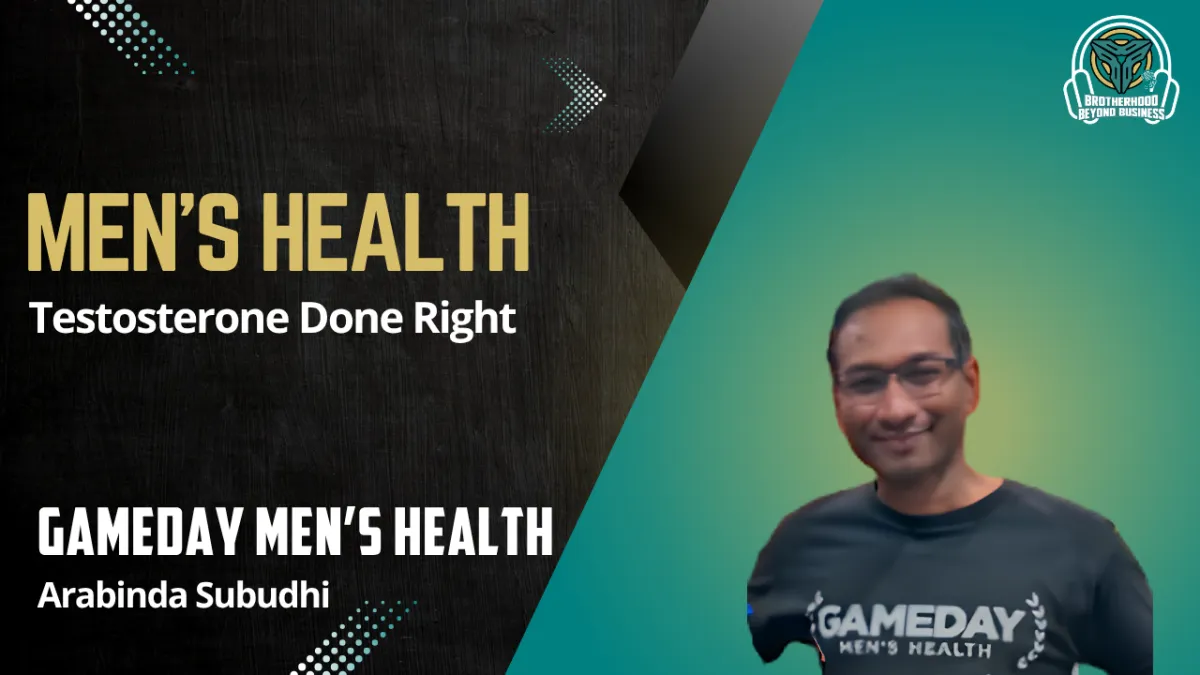
Ep 40 | Men’s Health, Testosterone, and Doing TRT the Right Way with Arabinda Subudhi
Episode 40 | Host: Nathan Johnson | Guest: Arabinda Subudhi
🔥 Why This Episode Matters
A lot of men are trying to lead their families, build businesses, and perform at a high level while quietly running on empty.
Low energy, poor sleep, brain fog, depression, lack of drive, and declining confidence can all get brushed off as “just getting older.” But for many men, there may be deeper health issues underneath that deserve real attention.
In this episode, Nathan Johnson sits down with Arabinda Subudhi, owner of Gameday Men’s Health in Libertyville, IL, to talk about testosterone therapy, hormone optimization, and why men need better education before jumping into medication.
This conversation matters because men do not need more shortcuts. They need better information, better testing, and better leadership over their own health.
🎧 Listen to the Episode
👤 Meet the Host & Guest
Nathan Johnson — Instagram | Facebook | LinkedIn | Profile
Nathan Johnson is a leader within the Brotherhood Beyond Business and the owner of Game Changing Performance. He helps entrepreneurs pursue excellence across business, health, and life through structured accountability and high-performance standards.
Arabinda Subudhi — Profile | LinkedIn
Arabinda Subudhi is the owner of Gameday Men’s Health in Libertyville, IL. After his own personal experience with depression, low energy, fibromyalgia symptoms, and low testosterone, Binda became passionate about helping men get educated, tested, and guided toward better health decisions.
About Gameday Men’s Health — Website | Instagram | Facebook
Gameday Men’s Health in Libertyville, IL is a men’s health clinic focused on testosterone therapy, hormone optimization, weight loss, peptides, IV therapy, and sexual health. The clinic helps men better understand the root causes behind low energy, poor sleep, low drive, and declining quality of life.
📌 What You’ll Learn in This Episode
Why low testosterone and poor sleep are affecting more men than people realize
How Binda’s own health journey led him into men’s health
Why responsible TRT starts with education and blood work
The difference between hormone optimization and social media shortcuts
Why online clinics can create problems when therapy is not managed correctly
How sleep, stress, caffeine, lifestyle, and modern habits affect testosterone
Why Gameday Men’s Health focuses on education before medication
How better health can impact marriage, parenting, work, and leadership
🧩 Episode Summary
Nathan and Arabinda break down the real issue many men face: they are tired, low-energy, unmotivated, struggling with poor sleep, and often told it is just part of getting older.
Arabinda shares his own story of spending years dealing with depression, low energy, fibromyalgia symptoms, and low testosterone before finding hormone optimization.
That personal experience became the foundation for why he opened Gameday Men’s Health in Libertyville.
The conversation dives into the difference between responsible TRT and the shortcut culture around testosterone.
Arabinda explains why testing, education, symptoms, prostate health, hemoglobin levels, and lifestyle all matter before a man starts therapy.
At its core, this episode is about ownership.
Men cannot outsource their health, ignore their symptoms, or chase quick fixes from social media. Better leadership starts with better information and the willingness to take the first step.
🕒 Episode Timestamps
[00:00] Intro and Arabinda Subudhi’s background
[01:25] Arabinda’s personal health journey and low testosterone
[03:26] How Gameday Men’s Health became a national franchise
[05:34] Why hormonal imbalance is becoming a bigger issue for men
[06:09] Sleep, stress, lifestyle, and testosterone
[11:22] Who Gameday Men’s Health is built to help
[13:22] What makes Gameday different from other TRT clinics
[19:37] Common fears and misunderstandings around testosterone therapy
[25:11] The danger of social media shortcuts and TRT abuse
[29:32] Education, trust, and doing what is right for the patient
[33:29] Balancing business, family, and personal health
[41:07] Final thoughts on taking the first step
💡 Quote Highlight
“Everybody needs the right advice. You can never go wrong with the right advice."
🚀 Next Steps
👉 Download our Your Circle is Your Ceiling eBook
👉 Learn more about Our Method
📚 Resources & Links
Follow BBB on: Website | Instagram | YouTube | X | Facebook | Buzzsprout
Watch the full episode on YouTube
Listen to the full episode: Spotify | Apple Podcasts | Buzzsprout
🚀Full Transcript
Nathan Johnson (00:28)
All right, I'm Nathan with Brotherhood Beyond Business. I'm here with Binda Subadi with Game Day Men's Health. And we just want to learn a bit about you today. So if you wouldn't mind, tell us who you are.
Arabinda Subudhi (00:39)
Thank you for having me Nathan. Of course. So my name is Binda. My actual name is actually Arabinda but everybody calls me Binda because I found that it's easier for people to pronounce and remember. So I'm the owner of Game Day Men's Health Clinic.
we are a specialty healthcare clinic that focuses on men's health and we deal with the issues that the traditional medicine ignores most of the time. But what we found is when we treat let's say hormones or the root cause behind sexual health problems, it actually does amazing for a man's mental health. So that was the idea behind why we started Game Day Men's Health. And the name suggests that it's a clinic specifically focusing on men's health. So which is a safe
space for men. We are a clinic located in Advocate Condel Medical Centre in Liberty Health.
Nathan Johnson (01:25)
Okay. What made you want to get into mental health? Was it someone in your family, you yourself that experienced something with the normal healthcare industry? What happened there to kinda promote this or p spice things up and get you moving in the right direction?
Arabinda Subudhi (01:37)
Great
question. So I'm sure some of the other people who are listening they would relate. So I was in the corporate world. ⁓ I have an MBA in finance. I worked with many, many pharmaceutical companies enhancing their business processes, helping them adopt software, artificial intelligence, data, and all of that. After twenty-two years in the field of software, I started getting depressed. My depression
It was a journey of seven years of feeling low and even more low and lack of energy and all of that. And when I brought in these symptoms to my primary care physician, he was very ⁓ dismissive of it. He just said, You work too much. It's probably your eyes. And that happened for five years. Then I heard about hormone optimization and testosterone therapy on radio through a competitor clinic of ours.
So I actually went there and find that my testosterone is in fact on the lower side. I brought back the results. And but by that time it's been five years already, and I was already deep on depression. lost 15 pounds, I had fibromyalgia. So I was put on depression medication. And the medications are as such that you start out at a lower dose and then you increase the dose because they stop working at a lower dose and you go higher and higher.
At that point, I decided to go against my primary care physician's advice and actually get started on testosterone therapy. Once I did that, it was a life-changing experience for me. The way I felt it was probably took me back 20 years. My wife was happy, my kids were happy because I could play with them. Right? So so I strongly believed in the therapy and then I made a decision to start.
Looking into probably maybe getting associated with a business that does something like this. And the opportunity of game team and self came up in the Libertyville area.
Nathan Johnson (03:26)
Okay. Is Game Day Men's Health part of like a franchise that you bought into? Okay, talk to about that process and how that works.
Arabinda Subudhi (03:32)
Yeah,
absolutely. So Game Day Mansell started in 2018 and it was one clinic in California. They became extremely successful. ⁓ then they opened three clinics. It was still a family-owned business. But Dr. Evan Miller, who started Game Day, he saw a potential of expanding this care across the nation. So he then decided to franchise just two years ago actually in 2024 and after that
Believe it or not, we have become the fastest Coron franchise in the world ever. So that says something about the business, but also about the epidemic. I call it an epidemic of hormonal imbalance and depression that's plaguing the men in our society. There's a lot of things that's going on. So yeah, and I I wanted to get involved.
I had to of course interview for the process with Dr. Miller multiple times because I did not have any prior business experience. So I had to win his trust over a six to nine month period and then I was they they did see the passion that I bring into the business and then said, Okay, fine, here is your opportunity to own a business, but we will handhold you and see how you do. And we are now the number one clinic in the whole of Lake County. So I that speaks something about our business.
Nathan Johnson (04:46)
yeah. I mean I can feel the passion of your business side. I mean the fact that you went through it personally is huge. Do you get a chance to share that a lot with like potential clients, talk to them about how you went through the same thing?
Arabinda Subudhi (04:56)
Yes, we see a lot of young men now, unfortunately, in their late twenties, early thirties experiencing the same thing that I experienced in my late thirties and early forties. And many times that happens because of lifestyle choices, either by choice or by societal pressure. For example, excessive cell phone uses. I say that a lot because that's one of the primary reasons of why men feel this way. So they are depressed.
on ADSD medication and things like that. So we go through what changes can they make in their lifestyle and how can hormone optimization truly help them if they are really at that point that they they need the care.
Nathan Johnson (05:34)
Okay. So you mentioned you thought it was like an epidemic it's an academic of hormonal imbalances among men, mostly I'm assuming, right? And you said you contribute that to behavior at like behavioral choices, right? Most of those being cell phone uses. Is there any other major things you're seeing contribute to potential hormone imbalance from men? 'Cause you said even younger men are experiencing hormonal imbalance. So what is it just is you think it's mostly cellphone? Do you think it's
Now we tradition to sitting behind a desk all day as well. What do you feel like is they're not exercised, maybe they drink alcohol. What do you feel like are the main behavior choices that lead down this path?
Arabinda Subudhi (06:09)
Great question in finding the root cause of why this is happening. What we have seen across the 600 GMD clinics by exchanging notes between the doctors is the single most important factor for
Quality of life impact and hormonal imbalance is bad sleep. The one thing, if you ask me, the one thing that would improve a lot naturally is good quality sleep. And there is a lot that goes behind why a person is not able to sleep, especially a man. The reasons range from something like divorce or you know multiple.
Relationships like the breakups and and relationship the relationships are no longer as steady as they used to be. That plays a big role. And of course the social media pressure that's there. But the other regions that are kind of we consider easy to manage but there is lack of knowledge is microplastics. Too much coffee, too much caffeinated drinks, sedentary lifestyle.
So these are things we consider. If somebody has a strong willpower or the right guidance, they can easily take care of themselves and get rid of the bad things. So these are all the reasons that help create imbalance between dopamine and serotonin. One is a pleasure hormone, one is a happiness hormone. And when you have imbalance in some of these hormones, they impact your sleep. When the sleep is impacted, then you produce less testosterone, less growth hormone.
And when your testosterone and growth hormone are low, you can't sleep well. So it becomes a vicious cycle, like a recession in the economy.
Nathan Johnson (07:43)
I mean, you sound s extremely knowledgeable about this. You said you've been in business for two years. Two years, right? Yeah. When did you start studying all this? Before you even thought about game day? Or like when you started game day, you just started diving into this, studies after studies after studies? Cause it surprises me the sedentary lifestyle thing is still so popular. Right? 'Cause everybody knows they need to exercise but they're not. Do you think you have if you were to guess like a certain percentage of your male population?
that actually exercises when they walk on different sealed or do feel like it's almost non existent?
Arabinda Subudhi (08:13)
No, no, there is a certain percentage. We we get I would say almost equal, like fifty percent of our patients who walk in through the door, they have been trying to exercise, they put in the effort but they don't see the results because the hormonal imbalance is making sure that they do not have the motivation to go and work out or do the extra thing for the family or at work. And the other fifty percent just wants to get the medicine so they look and feel good on social media.
Nathan Johnson (08:40)
⁓
cool.
Arabinda Subudhi (08:41)
It's definitely and 50% is a big number. If you look at if you go a few years back, I know men were like work, work, work, family, right? They they wanted to do the right thing and do the right way. Like, okay, I'm going to hard work and I'm there for the family. But now it's how do I look good without maybe putting the effort that I am, you know, truly supposed to put. So people come in like, hey, I follow this influencer and
The person looks good, and he said that peptide or that particular medication made me look like this, and I want to get on that and be like this in two months or three months. Or when they start on testosterone therapy, can you give me a higher dose? like I don't I want to be 200 or milligram or above, which is a very high dose when it comes to testosterone. But they want to be there because they want to feel good. But they think that being high on medication will actually make them feel and look good.
without putting in the work, which is unfortunate.
Nathan Johnson (09:34)
To say the least. Yeah, not putting any habits in place and then they stop the therapy.
Arabinda Subudhi (09:40)
I
have ⁓ I believe like social media and short term memory has a role to play. We start very young with kids getting cell phones at at a very young age and all they see is the outcome which is I want to look like this, I want to go there. They do not get to see the effort that somebody has put in to actually be successful and it's not advertised, right? There is no true money to be made in the effort.
but actually in the outcome, right? And people stick to I want to look like this. I I follow him and I I I'll just do this, whatever he's saying, rather than what the person is actually doing. And it's it's a societal I mean we we as parents have to guide our children also to do the right things.
Nathan Johnson (10:24)
So it's like instead of seeing the five work of effort that went behind, all they see is the finished product and they're like, I wanna look like a finished product from a pill or a shot. And they're like, Well they may have taken a pill or a shot, but they did it with five years of effort, maybe and like the minimal work or whatever type.
Arabinda Subudhi (10:39)
You
know, they may have hired a personal trainer or a nutritionist to do get to where they are, but they don't talk about that, right? They don't talk about the journey. They talk about, yeah, you know, I took this medication for six months. Look at me now. So unfortunately there is also money to be made by selling whatever products they are trying to sell. So it's a culmination of capitalism and it's a culmination of social media and easy access to misinformation. Mm-hmm. All of that combined is how we operate nowadays, I guess.
Nathan Johnson (10:58)
Yeah.
So it doesn't sound like the young man that's been influenced by a social media influencer is your ideal client, not necessarily. But like who would you say like, man, this type of person walks through my door, I want that I you get super excited to help them. Who is that?
Arabinda Subudhi (11:22)
So we get excited about anybody who walks in. ⁓ if if somebody looks at our Google reviews, they'll find we are the number one in terms of people leaving us reviews after they leave us. We don't even sometimes ask for it. The reason that is most people that walk in through our door, they do not actually sign up on anything because they feel like they learned so much more, they can try and do those positive changes in their life and health outside of medication. And we take pride in that.
We don't force anyone to get started on medication if they don't absolutely truly need it. So the answer to your question is we love everybody who walks through the door because we think of it as an opportunity to educate them. But who is our ideal patient who must actually start on the therapy or who we would like to start on the therapy is a middle aged man. Let's say we call it midlife crisis. Right? So there is a word called midlife crisis. ⁓
Most men and women at some age they go through that. Earlier it was considered it's just age. I'm losing my spark. But many times what happens is it's the stress in our life and the lack of sleep in our health ⁓ and sleep in our life that's causing all these issues and they think that it's just age and we would like to help them truly experience what it means to optimize their hormone and feel amazing. Being
Twenty years again.
Nathan Johnson (12:44)
Feeling like Superman again, right? Superman again. Absolutely. So like they feel like to have the midlife crisis, they just could be doing a lot of the wrong habits. And their testosterone is plumbing. The testosterone to plummet. Wow. Okay. So then you mentioned a few things that obviously will set you apart about most businesses, like maybe an average CRT place wants to just be like you walk in the door, boom, here's your here's your medicines, like let's get you started. You're like, no, not every person does that with us. Some people will leave just with
an education and a hopefully a habit based, you know, program that will help fix them. So like what else sets you apart from those other T R T places? What are your main differentiators?
Arabinda Subudhi (13:22)
Absolutely. So let me talk about a few things. Sixty to seventy percent of the people who walk in through our door.
We tell them that this may not be the right thing for them. Either maybe they are too young, or they could try other options before they try something with us because we want them to get a long-term result. So that's the statistics behind it. We have seen thousands of people, but we only have probably between 300 and 400 patients, right? So the math speaks for itself and we take pride in that. The other thing is when somebody walks in, we do a free blood work to check their hormone level.
Check the hemoglobin levels and check the prostate. Why do we do that? Because many times an enlarged prostate may give a man ED symptoms, which has nothing to do with the testosterone or lack of it. So we want to make sure that the prostate is healthy actually. And if it is not, guess what? You can go to a urologist, figure out if it's a prostate cancer or it's a brandine prostate, fix it, see if that works. If it still doesn't help fix your problem, then we are there for you.
We do that and we give that do do that for free. I have probably twenty-five different patients from my church. Mind it, I'm not a Christian, but I do go to a church and these like people who are like 70 years old, they come to my clinic because it's so easy for them to get their prostate check with us rather than going to their urologist and waiting for months and then f fearing about is my prostate healthy? We help them right away in twenty minutes. We also look at hemoglobin levels.
And again, that's a free of cost blood work. The reason we look at hemoglobin levels is if your hemoglobin production is low, that means your body is not producing as much red blood cell. Of course, you'll not have the energy. That will give you all the symptoms of low testosterone. So we want to make sure that we can pinpoint the root cause to hormones and nothing else. If there is anything wrong, you better fix that. Then see if you are still experiencing the issues, and we are here to help. So that is the number one differentiator across all game day clinics.
The other clin other major differentiator is we do not have commissioned staff or employees in our clinic. They don't get commissions, they do get some bonuses but no commissions. The general manager, which is in my clinic, it's myself in most of the game day clinics. It's usually owner who works as a general manager. That's the motto behind the Game Day Clinics because we want to build relationships but not try to push unnecessary medication.
Like many other clinics do. I'll give an example. Most TRT places that you walk in, they would say along with testosterone, you need to do this peptide, you need to include vitamin. My our point is why do you need a vitamin B12 or B complex if you're not deficient with it? Right? Why do you need an estrogen blocker? Why do you need a very high level of testosterone? Most of the online clinics they lure people with advertised low prices, but they start everybody on the same dose.
And an estrogen blocker. I know I'm getting into technicality, but we see a lot of people who go to online clinics and eventually five months or six months down the line they come see us because their hormones level have been meshed up because of a bunch of medications. And then it tells takes us between three and six months to fix them. So this these are the basic differences between any KMD clinic and other clinics. We don't push free blood work initially, so you get to know your root cause.
And you do only what is absolutely necessary and we will tell you if some medication is not right for you, then leave you with education.
Nathan Johnson (16:47)
Okay, awesome. So you do would you say you do most of the education then? Yeah. Then absolutely. You hired a doctor or so yeah. Okay.
Arabinda Subudhi (16:55)
Is owned by a doctor who
has set the processes and protocols and all of that, and all the staff in the like they're all medically licensed except myself because I'm the business owner, but I'm not the clinic owner. That's the difference, right? So the MD owns the clinic, and all the clinical staff, like the medical assistant, the nurse, and the nurse practitioner, they report to the MD, and we try to keep the
Business aspect kind of separate from the medical aspect. For example, if somebody comes in or you come in and say, Hey, should I be doing this? I would probably refer you or definitely refer you to the person or the team who is medically licensed, right? For a medication dispensing and ⁓ prescription standpoint, I will not be giving you the prescription, right? But I handle the business like should I order a refill for you? Should I what's the payment and
When should we do the blood draw? So I handle the administrative task, maintain the relationship, but the medical ⁓ the clinical staff is what who handles the medicine and all of
Nathan Johnson (17:58)
Okay. How so you said like the D h owns the clinic, right? How does that person get then with you? How do you create that team between you and them? Okay.
Arabinda Subudhi (18:07)
Think of it like a partnership
between an MD and somebody like me who is not an MD. So so that person or our MD, Dr. Kang, he controls the like the entire protocol. Like how do we run the labs? when do we certify the labs? ⁓ when do we prescribe a certain medication? When do we not prescribe a certain medication? What happens if the blood pressure goes up? Right? So those are all the protocols that you need medically licensed individuals.
So he decides all of that and all our staff follows it, right, to the letter.
Nathan Johnson (18:38)
Did Game Day partner you with him? Game Day found him. Game Day ho Game Day found him and you and put you guys Okay, okay, I get it now. Yeah.
Arabinda Subudhi (18:46)
Game day does the ⁓ for all the game day clinics they find an D for a particular location and they partner them with us. Okay. Because they need to make sure that the person is right also.
Nathan Johnson (18:55)
Right. And they're also passionate about what game day stands for. Right. Yeah.
Arabinda Subudhi (18:58)
RMD is amazing. He's forty-two years old, my age and our age, and he does he he does adventure sports all the time. If you look at him, he's he's jacked. He's no longer started in himself yet. But he has ⁓ he has a long history of knowledge of pain management, surgeries and hormones. So so we we feel like we are in good hands.
Nathan Johnson (19:10)
Yeah.
Cool.
Alright, so I have a butter s I feel like I have a better understanding of how that side of things work. Okay, very cool. what do people misunderstand a lot? What do you feel like people always get confused or they you know, they come in with a certain way of looking at a business like yours? Yes. What do you think is that number one thing people get?
Arabinda Subudhi (19:37)
So
number one thing is the misinformation or the fear of testosterone therapy or clinics like ours. And and there is a strong reason behind it. The fear is not unfounded. For a long time, our clinic or our practice, like the testosterone therapy in general, was not officially a therapy, so as to speak. It was provided underground, it was provided in black market. Many times people used it for the wrong reasons, which is
To build better muscles or be sexually more active. Right? So what happened was when it was happening for for so long, when it happened for years, in in a wrong way, people never really checked their levels to make sure that they are doing it the right way or their levels are fine. And usually in the long term, they ended up damaging their ⁓ certain things, like for example, either estrogen being too high or having a cardiac arrest and all of that.
Which is a possibility when you are on very high level of testosterone therapy. So that is the reason we do it the right way. But because of the stigma that is associated with testosterone therapy, people come in with the same mindset that mm, I don't think this therapy is right for me, but I'm just here to find out. But once they speak with us, they realize that okay, this is a difference, this is a completely different type of therapy. the reason for why that happened is
Our business or our therapy did not have the pharmaceutical backing. The reason being it's not a branded medication, it's a generic bio-identical hormone and there was no pharmaceutical backing. That means there was no investment in studies and doing it the right way. And pharmaceutical companies and insurance companies made it very hard for people to get it the right way. When you make access difficult, there will be a black market. When there is black market, there will be side effects.
Unfortunately we are dealing with the reality of that. But I'm glad that social media and information online is helping people do the right thing nowadays.
Nathan Johnson (21:35)
For sure. So you mentioned gosh, I lost my train of thought. But I was gonna say like I can't remember. This is a misunder ⁓ so for example, like when I remember now. When someone comes in and they're they're afraid, right? You pr you probably have someone who's got that fear side of things, like, my gosh, this makes me nervous. You probably have the next person who walks in and they're like, Well, you have two maybe two like, just help me. Yeah. Right? Yeah, absolutely. So how much is it
Arabinda Subudhi (21:39)
Pharmaceutical.
Nathan Johnson (21:59)
the fear side of things you have to overcome versus how much is it, man, this person just needs help. Is it fifty fifty or is it like there's a lot more peop lot more people I have to educate to yeah deal with the fear? Yeah. Is it that side?
Arabinda Subudhi (22:11)
It's
it's it's I would say seventy-five to twenty-five. Yes, a lot of people are afraid. The lot of people have had bad ex or heard about bad experiences with online clinics. So unfortunately, now the other side. Everybody knows somebody who is on testosterone therapy. Of course. And everybody knows somebody who has done it the wrong way and experienced the negative side effects, especially either with online companies or maybe a urologist or somebody who didn't have the right experience.
Nathan Johnson (22:13)
Really? Yeah.
Arabinda Subudhi (22:38)
to handle the testosterone therapy the right way. So now people come in with fear, but the fear is two sided. I don't know if it's right and I've heard things on Reddit and things like that, bad things, but I also get people who are like, you know, my friend takes it and he had this issue, he had this side effect. testosterone therapy worked out well initially, but then he got E D symptoms and a lot of acne and all of that. How do I deal with it? So it's a lot of education and talking and we start out
By saying that hey, we don't even know if this is right for you. Let's do a free evaluation. Let's look at your symptoms. Look at your age and your life goals. And if this is right for you based on the blood test and your symptoms, then we'll talk about the options. You leave your credit card at home. We say that loud and clear: you leave your credit card at home.
So that you can come with an open mind and listen to what you have to say. And then you decide if this is right for you. And most often than not, they they usually come back and sign when it's right for them.
Nathan Johnson (23:36)
So you would say the average when the average man comes into you, they're not actually signing up the that day. The average male signs up later.
Arabinda Subudhi (23:43)
Yeah, in
specifically in our clinic we have completely made it a no pressure environment in a way that they feel comfortable even living. Sometimes what happens is they go out, talk to their friend, talk to the wife, and come back in a few days to few months. The folks who usually come back in few months is we found is they kind of try to shop around, right? They get the education from us and
And then they try to have the same conversation with other clinics in the area. I'm proud to say that not a single person who went out ever really signed up with somebody else locally. There may some young guys may have signed up online for cheaper prices. They come back much later. But the the guys who are middle aged they always come back to us because they never have the same type of experience and conversation with any other provider.
And they never have and we are very competitively priced, so nobody can match our price too. So they usually come back to us.
Nathan Johnson (24:41)
Very cool. I love the fact that you're always so willing just to help these men out so much. Like especially ones that like come in they have so much fear that you have to overcome. That's that's tough to do. But it's so cool probably when you're having those conversations and you probably know each moment. When each conversation when you see the fear just like slip away, right? And you're like you're like like they know now, right? They you mentioned like obviously social media, like things are
Would you say they're more trendy now than they've ever been for testosterone? Or do you feel like it it was started maybe a few years ago?
Arabinda Subudhi (25:11)
Yeah, it
started a few years ago. It's definitely ⁓ not that much of a taboo nowadays, but that's also causing a other problem of not doing it the right way. Right? If a bodybuilder is on a high dose of testosterone therapy for a short while for a competition or something, that's very different from a middle-aged man or or an older man being on a high dose of therapy in a long term, it could cause a lot more side effects. So people look at they they like to follow
personalities right on social media and try try to follow everything to the letter but they forget that everybody's belt different their activities are different their genetics is different what we can put in is the 100% effort like going to the gym, watching your diet. But the medication is something should be adjusted based on their own lifestyle and genetics, not necessarily who they follow up.
Nathan Johnson (26:05)
But Yeah. So it's it's more trendy than it's ever been. Yeah. But it's also more ab maybe maybe more abused than it's ever been as well. So it's good thing game day is there to help fix that problem.
Arabinda Subudhi (26:17)
Well, not
for everybody though unfortunately lot of the young guys who follow these personalities, like when I say young, I've seen seventeen year olds being on this controlled substance without telling their parents to all the guys who are in their twenties and they go to the gym and they see the next guy who is bigger than them and he's on TRT and they get the medication in the black. They come and see us when they're having issues like heart palpitations or
They can't sleep or they're having severe ED issues. Only then they come see us. I wish they had come see seen us like much before so we can advise them against it. But you know, we can only do this much. And that's why I guess you and I are talking today to maybe educate some more people.
Nathan Johnson (27:01)
It's being reactive is so much harder. I mean, fixing things is so much harder. It takes so much longer than doing it right the right
Arabinda Subudhi (27:09)
Very
well said. So online clinics nowadays there is just so many. What they do is they start everybody, it doesn't matter what your background, if you had had cancer, if you have a kidney function, anybody can get on any medication nowadays, right? So they start everybody on a very high dose of testosterone, they start everybody on estrogen blockers. Estrogen blockers are required when testosterone excess testosterone in the body converts over to estrogen and causes all kinds of issues like bloating.
Mood swings, ED problems, because it's the female hormone. Women need estrogen much more. Men need estrogen very little. But if you are on very high testosterone, you'll have more estrogen. Estrogen blockers are extremely powerful medications. One person should not be on it for more than like eight to ten weeks. But we see a lot of patients who are on it on a long term basis because the online clinic said so. And the reason they do that is they do not want to actively manage your therapy.
They want everybody to be high on testosterone so that they feel good, but they also want everybody to be on estrogen blocker so that they do not have to worry about your estrogenic effects and symptoms. But in the long run, it's actually a negative for your longevity to be on estrogen blocker. Unfortunately, we see that a lot. The second problem that we see is hemoglobin being too high. When somebody is on testosterone therapy, their blood will thicken too much, but when they are with online clinics,
There is no proactive treatment to measure if you are feeling good. yeah, your next blood drives three months to six months down the line. We will check it then. You don't want to carry very high or thick blood with you for three months, it could cause cardiac issues. So that's where we come in to do it the right way. I know it sounds scary, but it's better for people to know what could be right the negative side effects.
versus not knowing and doing the wrong things. It's much more expensive to do the wrong thing.
Nathan Johnson (29:02)
Right. It's really important to get that information out there. Right. They need to know the right way. Yeah. Because like, I mean, having the knowledge is extremely important. Then we can then hopefully they apply it by like going and going to like something like this, not going to like an online clinic or something like that. So woof. So yeah, I like all this stuff you say about like how game day and like obviously the way you go about it is so much different. What would you hope though people say about you? You know, they come in, they meet you, right? Every single person that walks to the door meets Binda.
What do you hope people will say about you when when they're all done?
Arabinda Subudhi (29:32)
I think they always say that they learned something really, really valuable information and our goal is for people to kind of know more when they leave versus when they came in, right? We try to exclude all or remove all the misinformation. But not just that.
We also try them to be holistically good. And I guess that's where businesses like yours come in handy. Because we want people to feel and do the right things outside of our clinic. And that's where a nutritionist, somebody who has knowledge about human body, right, the right exercise techniques and all of that comes in handy. So
Yes, people say good things about us, they always say good things about us. There's not a single bad review. But I wish more people did the right things or implemented what we told them or spoken to some of our partners. So one thing that we do differently at our Game Day Libertyville Clinic is partner with local businesses like yours so that they can holistically feel good. It could be a fitness center, it could be a nutrition, it could be a food prep, right? Like doing the right food prep. Because
everybody needs the right advice. It's you can never go wrong with the right advice. That's what we feel. And we do not have like our clinic does not have all the ability or the knowledge to help guide the men in terms of nutrition and diet and all of that. And that's why we try to compensate that by forming partnership with businesses like yours to help them feel good holistically.
Nathan Johnson (31:00)
Okay. So like we want people to leave your business knowing that Binda gives the right advice. That's very, very cool. So if you were to like step away from your business, right, what would you hope still existed? Like say you weren't the GM, you weren't doing consultations and stuff anymore, is like what is that what you would say like you'd want to continue like you'd still want that personal touch to main to stay if you had to like step away?
Arabinda Subudhi (31:27)
Right? Yeah.
So I take pride in the fact that we have built a very good team and I think you have met some of our ⁓ staff members as well. They're the way they are trained and experienced is no pushing, only listening and then educating. So everybody in the team does a good thing. So if I was to step away, I would still feel very, very comfortable that the business is going to run in itself. But it's just that there'll be more workload on the existing team members, right?
It will take the medical staff away from some of these conversations that I can have. For example, setting up an appointment, gathering some details, and all of that. So I would still, yeah, that's a good thought. I still want the business to run. But this is what I'll say when I went through my
Experience with depression and excessive weight loss and all of that and fibromyalgia with multiple joints hurting. I made a decision that since this therapy helped me, I wanted to help the men in our community. Since it's a franchisee, I cannot go outside of the territory of the franchisee, you know that's how the businesses work. But I anybody who walks in, anybody we interact with, I really want to help them with knowledge, with medication, short-term or long term, doesn't matter.
We really want them to do the right thing and we take pride and feel very happy that somebody was able to transform their life and health with our with our health.
Nathan Johnson (32:50)
That right there every single person needs to hear. Right? If they heard that come out of w the way you just told me, I don't see how anyone would not completely trust and understand that like what you want most out of them is the best thing for them. Even if it means no medicine. That is so cool to hear. So y I mean, obviously we talk about stepping away from business as business owners sometimes, like i we hope it still runs, but like we are passionate about the business why we we do it. So how do you make sure that you balance
business like doing all the things that you want to do with you mentioned having kids, so you got kids and a wife. How do you how do you do both? What do you what do you find? What is hard? Is it harder than you thought it was gonna be or do you feel like so
Arabinda Subudhi (33:29)
So it's definitely harder than anyone thinks running a business is going to be it's not that fancy dream. It's like you have to put in a lot of work. But opening up this business has actually given me more time to spend with the family because you must remember I was suffering from depression. When I was doing that I was working from home in a corporate world,
But for two years I was as if non-existent in the house. I was not able to do anything because I was severely depressed. So when I compare myself to that particular situation, it's a much better situation because I have the energy to be with my kid. I have the energy to be with my wife, help her with the dishes or go on the weekends. Now, timing is a different thing. So I do have the energy, but timing comes down to like
How do I run the business? So the way I have structured my timing with the clinic is there are two days in a week that I do not go to the clinic out of a weekday. So that's Mondays and Wednesdays. And we give Mondays holiday to ⁓ Mondays are off for everybody in the team so that they get a little bit longer weekend and they feel fresh and they're itching to come back to the clinic. Because happy employees are the primary reason why your patients will be happy. Right? So
Mondays and Wednesdays are off. I stay at home, talk to people who have reached out, follow up with ⁓ existing patients and try to spend some time with the family. And weekends kind of do the same thing, but many times weekends I have events to attend to that are to promote our business. So it's the Mondays and the Wednesdays that compensate for the weekends not being.
Nathan Johnson (35:03)
Do you feel like it's almost like if you had to block off time to be with family or does it like just kinda grab it
Arabinda Subudhi (35:09)
Initially that was the case, but now that we are more mature and the community knows us, it has kind of we have kind of built a trust that that it's become a little bit easier now in convincing people. Right. And then everybody has known everybody knows somebody who has come to a gone to a game day clinic. And also the fact that there is six hundred clinics of game day men's health across the country and we are the number one in whole of North America in a very short span, like in two years.
Right, so that speaks for the way we do our clinic and business. So it has definitely made our life ⁓ my life easier to run this.
Nathan Johnson (35:45)
How many kids? One kid. One? And how old? Thirteen. Well, that's gonna be a tough age. So
Arabinda Subudhi (35:47)
thirteen.
It's nobody teaches us how to handle it.
Nathan Johnson (35:54)
No.
Well it's just like everyone's got a different teenager. What happened?
Arabinda Subudhi (35:59)
Why is she mad all the time?
Nathan Johnson (36:02)
So
So you have yeah, that that's I mean it can be really tough to like balance obviously owning a business and then trying to be there as a husband, as a father and then like the family man that you dream about. But there's also a lot of tough decisions you have to make as a business owner for the business. How do you go about that process? Who do you lean on in those tough moments?
Arabinda Subudhi (36:22)
Absolutely. So so far it's been ⁓ my wife at home who has been a big supporter because you know, I still don't get a salary from the business. I'm still trying to establish the business. That means she's the breadwinner of the family. So I I do consult with her and ⁓ my team has been with me for since the beginning. All the team members are MD and everybody, so I talk take professional help from them. But I'd say this any decision we make, we make with the best
interest of our patients. If we were to let's say prescribe a new medication, the only thing is is it good for our patients in our community? If we find that in a certain area there's a lot of people with high blood pressure will not prescribe the medication even if it's very profitable therapy for us. So there's a lot of peptides available in the market. We only prescribe very limited peptides the ones for example that are that have a strong proven record
Of improving somebody's health. So we wouldn't prescribe any peptide willinly and experiment with our patients' life. We could, but we will not. So that's the the primary decision maker for any tough decision is is it going to benefit our business, our patients, or not? For example, if I was to hire one more staff, I would think twice because adding one more staff comes with more expenses, and then I may have to increase some of the prices for our patients.
Is there more value in having that staff and increasing the pricing for our patients? If not, I wouldn't hire. I would rather do two jobs in my same business. So every decision is based on our patients. Value.
Nathan Johnson (37:53)
Okay.
And then you mentioned ⁓ not taking a salary yet, but like is so you've had you've been on existed for about two years. Is there anything you think so like does I don't know if you get business coaching from game day. Do they yeah, they do that? Okay. Like, is there anything that you're like, ⁓ man, two years ago, if I'd have done this, we would be even faster where then we're at? Yeah.
Arabinda Subudhi (38:14)
Yeah, so this ⁓ probably spending a little bit more on social media marketing would have been better. But hey, you always learn on a daily basis, on a monthly basis. So yeah, d spending a little bit more would have been better, but I also wanted to be careful that we are able to handle the large volume of patients that come in and we provide a good care to every single person. So because it's a balance. Right? If you grow too fast
And your quality of care suffers, then it's a you you know, once you have a bad experience, we don't usually go back to the same place, right? So thankfully nobody has had a bad experience at our clinic out of the four hundred patients that we have. So that speaks volume, it's a fine balance. But yes, I sometimes think maybe I should have grown a little bit more aggressively to increase the revenue a little bit faster. You know, we're human beings, we always have
Nathan Johnson (39:06)
Yeah, it's like you say though, like you you are growing pretty good, you get four patients, like what would happen if you had had forward patients? Bam Yeah, you're like, ⁓ man, because like you you I mean you guys get a you do a good job getting good reviews, right? But the one thing people will always leave
It's a bad review. Right? Right. And it it's like you have to like work to get a good review feels like, right? You have to put effort into getting a good review. They do nothing to get a bad review. Just just just do a poor service and people will leave you a bad review.
Arabinda Subudhi (39:34)
Have a single
even a four star review, I guess. So it's all five star reviews. So let's speak something about how
Nathan Johnson (39:41)
For sure. I mean I love that part where you say like the mum one thing is that you want to care either the best you want to make the best possible decision for that person right in that moment so that they have the best advice they can make the best decision for their health right for the long term. Because you don't want to be a quick fix facility 'cause then they're gonna be coming back to you like, well, game day only cared about taking my money and then then like I'm back to where I was. Exactly. So Exactly. So that is
Phenomenal. I love that story about what game day is and like who you are and your passion and how you got into this with your own experience through having low testosterone. Do you still have yourself? Do you no therapy? So
Arabinda Subudhi (40:21)
I'm thankfully
I do not have it. And that's what keeps me going. So
Nathan Johnson (40:26)
Awesome, it gives that all that all that energy. So you are a testament to this thing. That is so cool. All right. Well, I just think you've been such a great, great story for people to hear out there. I hope every man in the local area will hear it and get a little more educated on what testosterone therapy is and what game day is for the local area. I'd say like Lake County for sure, like benefits from having you guys here. So that's so cool to see as long as you know, with more and more people getting educated on TRT, I think more and more men will finally start to understand that hey.
This is what I actually need to do, right? To actually get back to my old self, to feel like Superman again. Right. Because they had all these bad habits, lowered the testosterone, fixed their habits, maybe a little bit of testosterone therapy and before you know it, they're back to their old
Arabinda Subudhi (41:07)
Absolutely. Not just that, we do weight loss medications, we do peptide prescriptions, we do ⁓ IV therapy, so there's a lot or there's something for everybody, but it's the first step that you must take, which is the hardest, right? And then coming and speaking to somebody who knows what they're doing, versus just relying on information that's ⁓ by AI, because you must understand AI gets the information from sources.
Which is not really medically validated. So something to keep in mind.
Nathan Johnson (41:38)
All right, man. Thank you so much for your story. I loved hearing it. I'm sure everyone else will