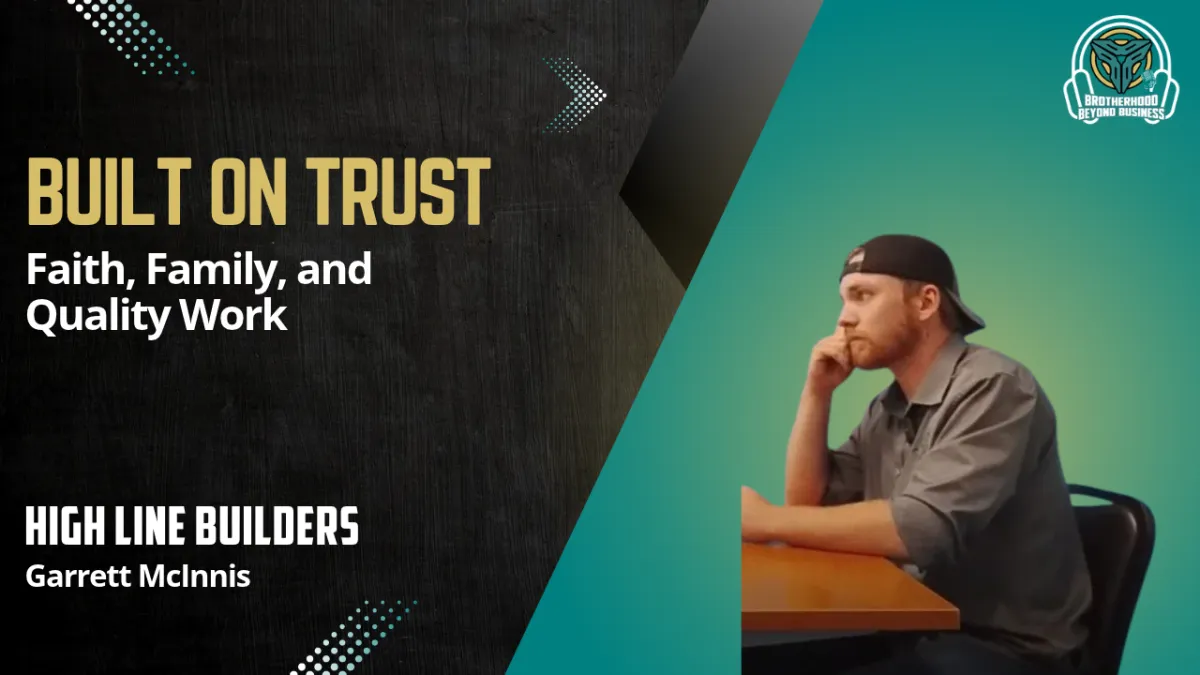
Ep 49 | Building with Integrity, Faith, and Trust with Garrett McInnis
Episode 49 | Hosts: Nathan Johnson | Guest: Garrett McInnis
🔥 Why This Episode Matters
Most business owners know how to work hard. Fewer know how to work hard without losing their family, their integrity, or their peace in the process.
In this episode, Nathan Johnson sits down with Garrett McInnis, owner and founder of High Line Builders in Lake County, Illinois. Garrett is a carpenter who became a contractor. He still picks up the tools, still frames the decks, and still runs a company built on scripture, even when it costs him a job.
If you're a business owner who has ever taken the work home with you, talked yourself into a job you didn't believe in, or wondered how to switch from "strict boss" to "present husband and dad" in the time it takes to walk through your front door, this conversation is for you.
Garrett is honest about where he gets it right and where he's still working on it. That's what makes it worth your time.
🎧 Listen to the Episode
👤 Meet the Hosts & Guest
Nathan Johnson - Instagram | Facebook | LinkedIn | Profile
Nathan is a co-host of the Brotherhood Beyond Business Podcast and a business owner who coaches clients every day through health and fitness. He leads with faith in his business and his home, and he brings that same perspective to every conversation on the show.
In this episode, Nathan draws on his own experience as a gym owner, husband, and father to dig into how Garrett balances a demanding business with a family that comes first.
Garrett McInnis - Profile
Garrett is the owner and founder of High Line Builders, a contracting, carpentry, and building company serving Lake County, Illinois. He started as a professional carpenter and grew into contracting, and he still works on the job site alongside his crew.
Garrett is a husband and a father of two. He runs his business by scripture and believes the quality of the work is a result of taking care of the people doing it.
About High Line Builders - Website | Facebook
High Line Builders is a contractor, carpenter, and builder based in Lake County, Illinois. The company handles remodels, decks, trim work, and full home builds, supplying skilled carpenter labor and managing projects from planning through finish.
The team is built on honest communication, quality work, and doing right by the client, even when that means telling them what they don't want to hear. Garrett's long-term vision includes building spec homes and launching a natural disaster response team.
📌 What You'll Learn in This Episode
Why carpenters so often grow into contractors, and why hands-on knowledge sets a contractor apart
What the "GC fee" really covers and why good contracting is far more work than most people realize
Why turning down a job you don't believe in can protect your integrity and your client
How the traits that make you a strong business owner can work against you as a husband
Why the shift from "fix it" mode to "just listen" mode matters when you walk in the door
A simple family strategy: set a 24-hour goal, protect Sundays, and get the phone put away early
Why hiring your first employees sooner moves you from working in the business to working on it
How to build a business around trust, and why the people come before the product
🧩 Episode Summary
Garrett starts with how he got here. He came up doing the physical work, framing houses and building decks, and rolled into contracting from there. That background shapes everything about how High Line Builders operates. He knows how the work is supposed to look, and he's on site as much as he's in meetings.
From there the conversation gets personal. Garrett talks about how his dad pulled him into projects as a kid and how he wants to do the same for his own children. He's also honest about the hard part of business ownership. Twelve hours of being strict and solution-focused doesn't translate well when you walk in and your wife just needs you to listen. His fixes are simple: prayer before he opens the door, a 24-hour focus on what his family needs, Sundays locked down, and phones put away.
The middle of the episode is where integrity gets tested. Garrett shares stories about telling clients no, including a basement finish on a home with a cracked foundation, and why he'd rather lose the job than do someone a disservice. He also talks about his wife, whom he calls the reason High Line is still open, and the natural disaster response team he hopes to build over the next five to ten years.
It's a grounded look at what Brotherhood is about: faith, family, and building a business you can be proud of. Garrett's answer to what he wants people to say about him is simple: "We trust him."
🕒 Episode Timestamps
[00:19] Intro and meet Garrett McInnis of High Line Builders
[00:57] From carpenter to contractor
[04:57] What sets High Line apart
[07:21] Running a business by scripture
[08:13] Fatherhood and lessons from Garrett's dad
[11:10] What people misunderstand about contracting
[13:15] Business owner vs. husband: switching gears at home
[18:43] Phones, Sundays, and showing up for family
[21:40] Telling clients no and protecting your integrity
[27:30] Marriage, big decisions, and the natural disaster response dream
[35:50] Legacy and what people say about High Line
💡 Quote Highlight
"If I fail as a business owner, but I build my faith, it was all worth it."
🚀 Next Steps
👉 Get our weekly Build the Business, Build the Man., Build the Edge, playbook to get one actionable task to implement into your business and life each week --> Sign Up
👉 Download our Your Circle is Your Ceiling eBook
👉 Learn more about Our Method
📚 Resources & Links
Follow BBB on: Website | Instagram | YouTube | X | Facebook | Buzzsprout
Watch the full episode on YouTube
Listen to the full episode: Spotify | Apple Podcasts | Buzzsprout
🚀Full Transcript
Nathan Johnson (00:19)
All right, this is Nathan with the Brotherhood Beyond Business. I have Garrett McGuinness with me here today with Highline Builders. We're gonna talk a little bit about what he does. So if you wouldn't mind telling us a little bit about who you are and what do you do.
Garrett McInnis (00:31)
I'm Garrett McGuinness, as you said. I am the owner and founder of Highline Builders and we are contractors, carpenters, builders is what I tell people. We'll as contractors we'll sub out remodels and things like that. We're just basically a one-stop shop for that. carpenters, we physically p supply carpenter labor like decks and trim work. And builders, we'll build you a whole house. And so we kinda cover cover it all. And so contractors is probably mainly what we
Nathan Johnson (00:57)
So you're a contractor, but you ru said you mentioned you also do the wordworking. Why then do you become a contractor from the word working? Why evolve?
Garrett McInnis (01:06)
the reason that I involved is that if you look at the trades a lot, carpenters just tend to become the contractor. That's just kind of what happens. I think the reason is that we are very flexible in what we do as opposed to a plumber that's very in their like they do plumbing stuff, HRAC guys do their stuff, we do electricians do their stuff. Plumbers can evolve a little bit more. It would it it would be really weird if you told like my electrician is hanging a sheet of drywall.
If you say that your carpenter's hanging a sheet of drywall, that's not as out of the ordinary. And so they're also there for most of the process compared to everyone else. We're there for the framing, and then we're also there for the trim work. And so it makes the most sense for carpenters to usually become contractors. I don't know if there's an exact reason to do it, that's just something that I've always seen and makes the most sense.
Nathan Johnson (01:53)
Yeah, it makes sense the way you explain it because you're there for the beginning and the end, whereas like an electrician is always needed for the specific wiring portion, then goodbye. You're not needed anymore. So right. So once that once the framing part is done and the electrician comes through, they're not needed. But now sure a carpenter could probably do small portions of that.
Garrett McInnis (02:11)
Well
yeah, the carpenters kind of they're they're probably and I think sure everyone can they're probably pretty much the biggest filler. Like if there's something that is really random and out of ordinary that needs to get done, nine times out of ten it's just the carpenter doing it. and so they are there a lot. And so what's different, a little bit different about us, is that
Me being the contractor, I own the company, and then I not only am I also a carpenter personally, but we also have carpenters in the company as well. And so yes, I am a carpenter and also a contractor, but then below me are other just carpenters, and so we can tackle really big projects. Which that's a little more uncommon for contractors. so it's not super crazy to have me sit down with a client.
and go over the exact order of operation for how this house is gonna go together and then the next morning you're seeing me out there physically laying the trusses. That's pretty uncommon for some contractors that we do that do projects of the scale that we do.
Nathan Johnson (03:09)
Okay. And then so obviously master of carpentry work and then almost like a jack of all trades as well of the other things.
Garrett McInnis (03:16)
I would do very hair on Jack of all trays. Very I that's very light. We're not very much I'm not gonna have my I'm not even gonna have my carpenter go put in an outlet. And so but I will have him he my carpenter will frame the house and I'll also trim the house. We can do both of them as well. That kinda makes sense.
Nathan Johnson (03:34)
So So you mentioned houses a few times now. Is that your ideal job? Building a house?
Garrett McInnis (03:38)
Well we do have one house going on right now and we are subbed out for a bunch of other builders as well. A coup not a bunch of a couple builders sub us out for the just the carpentry side of thing, with the end goal again, I know there's the whole don't tell people's your dreams until it happens, but the end goal is for us to just strictly build houses or more specifically, I contract out the house, but then also supply the carpenters to actually work on the house.
Nathan Johnson (04:04)
Right. So the best thing for the business is homes. Like in your eyes.
Garrett McInnis (04:10)
It's probably not the best moneymaker. I'm sure people are gonna come out with bigger crazy moneymakers, but it's what I enjoy the most. Okay, for me is more important if I enjoy doing what I'm doing.
Nathan Johnson (04:19)
So your greatest passion is obviously contracting, but then the greatest passion part.
Garrett McInnis (04:22)
Specifically homes. Homes.
If you want to talk about straight up fun, I really enjoy building a good deck. But that's a light hearted kind of fun thing. But the end goal would be to build particularly spec homes. But any home will take right now.
Nathan Johnson (04:35)
And so a dream I'd like to be get the house bid that has a deck on it. So that you can build the deck so that you can build the deck when it's all set up. A
Garrett McInnis (04:44)
Around.
Nathan Johnson (04:45)
surround deck. Bigger the deck, bigger the grill, man. So yeah what we what
Garrett McInnis (04:51)
that's kinda
Nathan Johnson (04:51)
we do. That's very cool. So then what makes you different from I don't know how many contracts are out there, but I'm sure there's a lot.
Garrett McInnis (04:57)
Man, I really I was thinking about I knew you were gonna ask that question when we were gonna go in there. If you want to talk about a a physical side of thing, to to have a contractor that is in depth of the work as I am is not that common, at least at the scale that we're operating. And so like for example, this Monday morning I spent twelve hours framing out a deck with my crew. I was physically there, I was physically doing layout and stuff like that.
Then next morning I had meetings all day for layouts for homes and how to sub out things like that. And then this morning I had to stop on by, do some problem solving when it came to the physical aspect, and then just came from a big meeting with some subs. And so there it's definitely which can be a little messy on my part, but business wise, I definitely we definitely take a lot of pride in the physical knowledge on how to do it and not just the organization. And so
we know how things are supposed to look, which is not as common for contractors as you may think. and so that would be probably the more the more physical thing that we do. And then another thing, which I don't want to make this sound like a selling point, because I think every company should do this. But we do follow a rule book which is the scriptures. And that's the rule book that we follow in everywhere that we go. And to every s every screw that you see dro driven.
all kinda falls back to how we operate our business based on what we are commanded to. So I don't like saying that as like a selling point because that sounds like I'm using that to like market myself, but that's just what we do. Whether it sells or we lose money, that's how we're gonna operate over
Nathan Johnson (06:33)
Is there like a mission statement almost for your company that stems from that as well?
Garrett McInnis (06:36)
N
honestly no. which the only reason there was I I wanna do one, but you don't really see mission statements from for profit contractors. but I almost feel like I should do one because everywhere every everyone kinda knows on where we stand with our faith. and we're not a non-for-profit. Right. So we have some great non-for-profit ideas, hopefully not too far down the pipeline. but no, no mission statement, but we just
We just wanna make sure that we're doing what we're commanded to doing, which is doing honorable work, being honest with the client, providing good quality work, keeping even simple things, like keeping the job side clean when it comes to like your the language and what you're talking about. And so which I am very blessed on the employees that I have that I don't even need to worry about that a little bit. But if you know in the traits, that's hard to come by. So
Nathan Johnson (07:21)
So for you, would you s it sounds like you're more physically present than the average contract.
Garrett McInnis (07:26)
I would definitely think so. Personally, again, I don't like bragging about that, but that's just kind of the background that I came from. I came from physically doing the work. And so I came from being the one that's building the deck and framing the houses and stuff like that. And that got me into the contracting scene. But I also can say I did that part on a professional level before I started doing what I'm doing now. I know I'm young, but I was I swear I did it professionally and then rolled into the contractor scene as opposed to
I don't wanna say a lot of people, but I'd say a large portion of contractors kind of jump straight into the contracting. And so their knowledge backwards is not always there as much. and then on top of that, they kind of go out of their way to try and not do the work. And me on the other hand I get burned out being like, you're friendly the deck without me? Come on. And so
Nathan Johnson (08:13)
Did you have a role model? Like a lot of I know a lot of carpenters and contractors, like their dads are really handy too and they did a lot of work. Is there anyone in your life that kind of helped you guide you down this path?
Garrett McInnis (08:22)
I think when it comes to the physicalness and kind of the the way that we we think, I would put a lot of it on I would put a lot of it on my dad. And so he was really, really good at when I was growing up. He would come down to my world as a kid. Like, for example, he would come downstairs and build build Legos with me and
Which as an adult, now being that, I'm like, I'd build something like those right now. But a lot of things that he also did is he reached down to my world and pulled me up into his. And so when we were doing our when we were finishing our basement or building our our shed or building a chicken coop or something like that, no matter how young I was, he was always pulling me into there. Even even cutting grass. Now that is a story completely in itself on how strict he was in cutting grass. But
And then on top of that, my dad was very much a perfectionist in what we were doing. Like you either do it with your whole heart and a hundred and ten percent, or you don't do it at all. Or you do it again until you do it with your whole heart and a hundred and ten percent. And so I think when it comes to the strict side of things, I definitely think he kinda helped push me towards the way that we run things now.
Nathan Johnson (09:29)
Okay, that's very cool. And then so your dad helping you there. Had you taken anything from hi you know, your dad parenting you that way to like are you your father, right? Mm-hmm. How old are your kids?
Garrett McInnis (09:40)
I have a two year old and s seven month old.
Nathan Johnson (09:42)
A seven month okay, not too much with the seven month old yet, but like how do you think like you're gonna steal some of that into like your parenting method?
Garrett McInnis (09:49)
I think the reaching down and bringing my kids into my life and having them be involved as well as that, I think is definitely something that I'm definitely gonna want to take through. and then also the the discipline, right? And the the how like you teach your kids off of discipline and stuff like that. and I think my dad had made sure that when growing up that we weren't completely in under liabilities all the time. And so I think
having that in our kids as well. I definitely wanna make sure that that that carries on that legacy, you know. So
Nathan Johnson (10:20)
Do you have you have a son? Mm-hmm. Is it two or seven? He's a seven month old. He's a seven month. well. I can guarantee you that one that that seven your seven month old's gonna be a shadow of you. Like was gonna be wanna have the little tool belt with dad and like follow you around, do all the work with ya.
Garrett McInnis (10:36)
funny 'cause my daughter actually does that a lot now. We have her we have a little plastic drill, right? And she'll she'll sleep with that. And she has a plastic hammer that her neighbors found in their yard. We have all the stuffed animals you can imagine.
But she sleeps with that plastic hammer. Daddy's little girl. And then when I was working on my trailer, and I was of course frustrated because just something wasn't working. And so I'm sitting in the trailer like, and I look over and there's little Phillips head screws on the side of the trailer and she found my screwdriver and she's determined to take out that screw of that screwdriver. And she sat there for like ten minutes trying to
Nathan Johnson (11:10)
yeah, it's rubbing off already. So so when it comes to contractors, like obviously I had to learn a lot through a conversation with you previously. What would you say people maybe misunderstand about you know what it means to be a contractor, what contracting really is?
Garrett McInnis (11:26)
Contracting is a lot of work. There's a lot of work. So for example, the house that we're building right now, I probably dedicate every bit of three to four hours a day on that home. And so people always, always freak out is that you have the line items. At least what we do is we'll basically be like, this is how much supply, this is how much the bottom
Nathan Johnson (11:45)
This is this, this is
Garrett McInnis (11:47)
there's always a GC fee. That is the number one argument that everyone likes to have. That GC fee.
A good contractor, which there are bad contractors that do not justify that G C fee. a good contractor will spend hours a day on that project just making sure it's organized, making sure you're getting exactly what you want and all that stuff, and that's a lot of work. That's a lot of work. But I will say, finding good contractors, it is tough. So I've heard more horror stories about contractors, which are very valid of what people say about contractors, than
This contract I hired was great. And so but that's the biggest misconception. Contract work, just the organizing part, outside of the physical part that we always provide, it is a lot of work. It's a ton of work.
Nathan Johnson (12:31)
So why the com so you do contracting you like it, obviously you're you say it's a lot more work than you think people's ideal image is. Like the contractor shows up the first day and then they're again there for collecting the collecting the money. That's about it, right? why why would you choose Lake County area or McHenry County or any of this type of stuff?
Garrett McInnis (12:50)
That's where I live.
Nathan Johnson (12:51)
That's where you live. That's where I live. Simple answer.
Garrett McInnis (12:54)
that's honestly we can go a l if you wanna go a layer and deeper in the future, there is a h more of a housing shortage in Illinois, but that doesn't really matter for what I'm doing right now. but that's honestly this is where God put me and this is where I'm gonna work.
Nathan Johnson (13:06)
Beautiful. And that's where you met your wife too, right?
Garrett McInnis (13:09)
I met her, we've gone to church for forever and more we've met technically in Spring Grove is where our church is located.
Nathan Johnson (13:15)
But So when it comes to like we talk a lot about in the brotherhood like business, we talk about being a man, father, right, husband. So let's talk a little bit about the the man side of things. How is running a business you feel like changed you as a man? Is and from the day you started it to who you are now?
Garrett McInnis (13:32)
To be really frank, I'm gonna be as frank as I can. There are things that make you a good business owner that would make you a bad husband. And one of those things is that sometimes in business you're called to be like kind of not cutthroat, I don't want to say that 'cause that sounds stupid, but you're called to be strict. You're called to keep everything in line. You're called to make sure that you're organized, you're called to be like to the point and stuff like that. And I'll do that for twelve hours a day.
When you come home and you come with your wife that's been watching kids for twelve hours a day, you can see how well that that really really bounces. And so when it comes to that, it is balancing that personality for sure. And there is a switch that kind of has to come home. that after kind of being strict all day and stuff like that, balancing that out with, you know, the person that has your back and everything else, it can be tru it can be tough.
And so I I I believe that that's ki probably why you see a lot of really, really successful businessmen that you everyone's thinking about all of them, not married. Right. And that is kind of why I think that is that it does the the qualities clash. But in that same, there's a lot of qualities that do really pass over. I think my faith has exploded exponentially. If I fail as a business owner and but I build my faith, it was all worth it.
And so and then obviously that transfers over to family as well. so there's a lot of positive I think the biggest one would be would be that as a business owner there definitely can be some positives and negatives when it comes to writing a business versus being the head of your household.
Nathan Johnson (15:05)
Do you feel like like so you said like something specifically is like organized, right? Everything's in order. Well when you have kids, it's chaos. So like going home from like you might have the workplace organized, you go home is like, my gosh, it's a mess. That's not even
Garrett McInnis (15:19)
Mm-hmm. That's not
even the biggest one. I think the biggest one is that when someone presents to you at work, especially w as a contractor, I am the I am the second on the food chain after the own homeowner. When people come to a problem with you, your goal is to find a solution as fast as you can and resolve the problem. When your wife comes at you with problem, she sometimes just wants you to listen. You know that. Every male that's watching this that's married absolutely knows that.
And so then when she presents to you a problem and then your response is, here's the solution, why didn't you just do this? Why don't we do this? That doesn't vote very well. And so it's things like that. Well, I'm used to coming home if it's a mess. It's one of those things I'm like, I don't care about the mess. I'm excited to see my wife and my kids. And so
Nathan Johnson (16:02)
That's so true 'cause as business owner of game change performance as well, like coaching coaching people all day long. I my wife's like, I don't wanna be coached. That's exactly it. You know exactly what I'm talking about. Right. So and it's just like one of those things like I just want like when you come home it's like so I heard this great this wonderful line. It's like when when men come home from work, P should be going through the door with him. Right? And I was like, that's so that's so true. Like I can't be bringing hectic, you know, li my my hectic day with me.
when I when I get home. I always gotta I gotta bring peace 'cause like it's you know, it could be like a whirlwind, a storm going on inside the house and I need to bring the peace to help calm it down. You know, first start with the with the wife and then move down to the Exactly move down to the children.
Garrett McInnis (16:43)
I think as business owner, in my personal opinion, that's my number one struggle, is making sure that you 'cause you really you really want to take everything home with you, but then bringing that peace in the door, that's hard. That's really hard. And that's where the the discipline of prayer comes in at that point, because at some point you only can do so much w under your own willpower.
Nathan Johnson (17:00)
yeah. It's like almost like you stop when you get home. Mm-hmm. Pray for what's about to happen the moment we open that door, right? Lord be with me, because it's a challenge the moment that door opens, because you know that it's you know the wife's gonna be like, you have no idea. You're gonna be like, I'm sure it was rough. So right. So how do you then make sure you show so you got twelve hour days, you're contracting, how do you make sure you show up at home? What is your strategy?
Garrett McInnis (17:23)
Make sure I show up at home. Period or show up?
Nathan Johnson (17:25)
Like
show up like when you're to be there for the kids, be there for her. Like what do you do to make sure that you're not just a workaholic?
Garrett McInnis (17:31)
the time. you have to be with listening to I biggest thing I listen to my wife's feedback, which can be hard sometimes because as your provider you're like, I need to provide, I need to provide, I need to provide, I need to hustle, I need to hustle, I need to hustle, because you're thinking about the big picture. You're thinking about the house that you want to put your family in. You're thinking about the car you want your wife to have that's reliable. You're thinking about all that stuff. Stopping and thinking about what your family needs for the next twenty-four hours.
would be is is the biggest thing. And so, which is tough because you that's as a business owner, you're not thinking that. And so like I said, another characteristic that kinda come back is that you gotta like, all right, in the next twenty four hours, you need to have a conversation with your wife to see how her day's going. In the next twenty-four hours, you need to pick up dog food. In the next twenty-four hours, you need to wrestle the kids. And so
That is the biggest thing is when I start every morning is kind of being like, all right, what needs to happen? Not like happen like chore-wise. Happen like emotionally and relationship-wise, what needs to happen. And I f and I fail, just like everybody else. We all fail. And so that's my biggest thing. Set a 24-hour goal, stop the long-term thinking, and see what you can accomplish in in that.
Nathan Johnson (18:43)
And so with the Brotherhood stuff we like to like teach people how to block off like calendars and stuff and like really dedicate time. Like, hey, this time if you've put it with family, nothing's allowed to intervene with it. Have you started to do anything like that you think yet or is it still kinda Sundays?
Garrett McInnis (18:58)
Sundays. I
have Sundays locked down and there's obviously exceptions, but every time there's an exception is when my wife and I sit down in our office and we talk like business stuff. But we both enjoy that. That is for us to kind of be like, how do we want this to look? Those kind of conversation. And maybe the occasional annoying invoice that we have to send out. but Sundays is our biggest blockout.
is where we're kinda like Sundays after that and then my wife will usually yell me if it's like seven thirty, seven o'clock at night and you're like, I swear if you're on your phone right now I'm gonna hit you the face She'll do that as well. Rightfully so. And so
Nathan Johnson (19:30)
Are you like so what what's time what you you said twelve hours, so was it like seven to seven?
Garrett McInnis (19:35)
I l I usually I've been trying I've been trying better. I've been doing slowly and surely but better. But I try to have the phone put away by at the latest six. So the only people that would ever text usually at that point is my employees to know what the next day looks like. And that's usually a a fifteen second text. and again, obviously there's exceptions. but I that is one thing I do have to do better on.
Like to I'm gonna admit my fault. I gotta do I can do better on that. Definitely with hiring the new employee, I'm having to completely change in how I I run my brain and so I think once I get in the hang of that I'll definitely be like, phone's going up at five thirty, five o'clock, gonna wrestle the kids before they go to bed, help make dinner and stuff like that, and then have more time.
Nathan Johnson (20:14)
And it the employees know the phone is up, no big deal, right? Exactly. It's like my big thing is like on the weekends, I keep the phone in the bedroom. Right? It stays in there. I'm not it's not on my body, right, unless I go out to run an errand or something, right? But otherwise it just stays at its location and that's the strategy that I've used to like kinda like make sure that I'm there present as well. So I like your strategy too. It's like, hey, there's no phone after six PM. We get home, they put it down, and I'm focused on
You people that are in front of me, it's like putting out a fire real quick, like or w whether you know but it's like cherishing that time with your family.
Garrett McInnis (20:47)
My wife and I we actually do we do at night phone stays outside the bedroom at all times. Like just because that for us is our our important time because we used to ha bring the phone in the bedroom, shoot text, scroll, doom scroll for a little bit, but now we do like no phones in the bedroom 'cause that helps us like talk about our day and just catch up and things like that. And so especially cause she knows that.
She'll try and call me throughout the day and be like, Hey, how are you doing? I'm on the phone all the time and I'm like, I love you. I hate phone calls with you because I wanna see your beautiful face. So let me come home and then we can talk that. I'm fine. Are the kids fine? Yes. Cool, touch base tonight.
Nathan Johnson (21:26)
Touch face when I get home. So you we mentioned like the hardest part about like being a business owner and a man and husband, what it was distinguishing between like business owner Garrett and husband Garrett. But what's the hardest thing you've had to face like running a business?
Garrett McInnis (21:40)
Run a business? Are you talking about like an exact moment?
Nathan Johnson (21:44)
No, no, I'm saying but like what's the what's the hardest what was way harder than expected maybe? When you're like, I'm gonna be a contract like people So like when I started the gym, it's like it's gonna be wonderful, like I'm gonna have two hundred clients right away. Well n that unrealistic dream, right? It doesn't happen that way. It's it takes a it takes a long time to grow. So what for you, like what was your harder than expected moments maybe?
Garrett McInnis (22:05)
Again, I think
I'm actually funny enough, I've I would call myself a pretty I can be a bad businessman sometimes by saying that if there might be an idea that the client wants that could make me a couple extra thousand dollars on that project, but I think it's dumb, I'll tell them that it's dumb. And so or I'm like the client is wanting to to do something, and there's a a lot of times where like
We need we need this job or something like that or whatever. And I'd be nah, I don't want to do that because that client seems kind of annoying and I'm just gonna do something else. there's been opposites. There's been opposites where I've worked for people that I should have. And that is probably the biggest struggle is the balancing act of I didn't realize how much I would have to sell myself. I thought just saying that I'm a good carpenter, I know how to do work, I know how to organize was enough.
And now I'm like, holy cow, like you need a you need formal estimates? What's this whole thing about? so I think that's the biggest one. The biggest if I had to do a hurdle like that. And then it all circles back, you practice your faith a lot more when running a business for sure.
Nathan Johnson (23:09)
I'm sure you have very different people. So you you lay out the plan, you got the whole estimate, you explain it all to them, and you got some people who want every little detail from A to Z. And you got some people who say, It looks great, let's do it.
Garrett McInnis (23:20)
The A to Z, that never bothered me actually. The A to Z never bothered me because in my mind, again, this might be the bad business side of me coming out, but I'm like, okay, if you're gonna spend if you're gonna spend $120,000 on this project, you need to know exactly what's going in there. There's a lines that I draw. There's lines that I draw, like the biggest one I I'll draw is like splitting material from labor. I don't draw that line mostly to protect my subs and to protect my employees.
For when I'm not there, I'm not getting the client bullying them for them taking a 30-minute lunch break. That I don't do. But they should know this is how much the plumbing's gonna cost, this is exactly what they're gonna do, this is how much this is gonna cost, this is exactly what they're gonna do. It's more so the fact of like I just had somebody that wanted to do a super fancy aluminum like super thin roof, right, on one of their on one of their barns. And I'm like, the roof was probably four hundred thousand dollars.
Nathan Johnson (24:16)
yeah it would be
Garrett McInnis (24:17)
crazy amount of money and I'm like don't don't do that like yeah my GC fee would be double of what it would normally be but I'm like don't don't do that because those roofs don't last long they have this problem they have this problem they have this problem this problem here is a much more budget friendly option four times as durable and it looks just as beautiful let's do that option right
And it's the clients that are like, I don't care, I wanna do this and then in my mind I'm like, Okay, I don't feel good doing this for you because I don't believe in this product. Sometimes it's really helped me out because I'll hear from a contract that did it later, I'm like, Yeah, I put it on and they had nothing but problems and so whatever and so I'm like, Whatever, I have a clear conscience. So, that is the ones that annoy me more so.
Nathan Johnson (25:00)
'Cause you feel like that would almost come back to you then, right? If you already said it's a bad product and then then later they're like, Hey, this product that is not working out They're like, You did a bad job, like no, I told you the product was faulty, whatever.
Garrett McInnis (25:13)
Yeah. My thing is that what we did highlight is that we always want to provide a service. Right? What we're doing here is we are providing a service for people. And that comes down to everything. And if I feel like that we are doing something for you that's not providing you a service, even if you think that it is providing you a service, I'm really good at being like, I'll tell them straight up, I'm like, I think this is a bad idea, I don't agree with this, or whatever. I'll give you another good example.
Somebody wanted to do a basement in a house. The house was not in great shape, right? And they want a full finished basement, foundations cracking, things like that. And I walked in there and I'm like, I would fix this, I would fix this, I would fix this before doing this basement. And they're kind of like, well, I want this basement to be finished, I want it to be beautiful, and stuff like that. I'm like, I really think that this is a bad idea. It is not a good time for me to come in and build you a basement because it's going to get ruined. If I put a basement in there and the basement got ruined and it's not my fault.
Doesn't no liability falls on me. But in my brain, I did them a disservice because they just pulled out they pulled out a HELOC to pay for this basement and now this basement's ruined and now they're stuck with a second mortgage. Right. And that is a disservice. so those are when I'm like I'm sure those some business people that'll be like, just do what the client says, the client's always right kind of thing. And I'm like, I'd I'd probably have lost a lot of money over conversations like this of being like, I don't agree with this. I'm just I'm gonna back away because I'm doing you a disservice.
made people angry for it too. Really?
Nathan Johnson (26:39)
Really?
Garrett McInnis (26:40)
yeah, 100%.
Nathan Johnson (26:42)
But they just they want it their way, huh?
Garrett McInnis (26:44)
their way and they'll be like, Well, you're they they said some pretty nasty things in the past. but then there was one time someone said that and then the contractor that did it, he did it the way that they wanted, and then I heard later on that he they kind got mad at him because the problem that I told the client that was gonna happen happened.
And it ruined their entire project. It was very similar to the basement story I just told. so if you want a statement of faith, we're here to provide a service.
Nathan Johnson (27:09)
Well not only that, but your integrity like stays intact. You know, like, hey, this is not a good idea. You should not do this, right? And whether or not they're angry or grateful for what you've said, it's like, Well, I can sleep at night Yeah So right
Garrett McInnis (27:23)
Yeah, it's not it's this I can sleep at night but then also knowing that like in all that we do we provide a service. Right? A non disservice and
Nathan Johnson (27:30)
So perfect. so obviously being a business owner s sounds like you you did mention your wife when you said we, like you sent out invoice all of it. How does she help out then and talk about in terms of like the business what is her does she have actual r responsibility or title or what's her thing?
Garrett McInnis (27:43)
The most important decision a business owner can make is the person that they marry. One hundred percent I stand by that fact. If she's not doing the physical things, she is keeping me in check and not me completely demoralized. she is the one if if it wasn't for my wife, Highline would have been shut down three years ago. A hundred percent.
And there's all the times that I've come to her with like, I have this problem. And her, if you know my wife, she's a massive spitfire, and she's very blunt, which is exactly what I need. And her being in her blunt self, being like, there's no way that you're quitting. It's never the soft, like, you're doing great, honey. It's more of a you're an idiot if you quit, which is if you know me, that's exactly what I need. So she is so involved in
the the spirit and the camaraderie and the character of what you see highlight now. If it's not her direct feedback, it is her feeding me to make it look like this. there's a sermon that I or a a podcast I heard Josh Howerton and say, the big pastor in Texas that says you're either gonna marry a launch pad or a lid.
Nathan Johnson (28:52)
Yeah.
Garrett McInnis (28:53)
for a husband and I definitely married a launch pad.
a launch pad with a thing of dynamite at the bottom of it to launch me even higher. That's what I'm married. and so no, she helps feed life into this business, even if it's through herself or even just being it to me to feed the business. And so
Nathan Johnson (29:10)
That's very cool. That she's it's like the jet pack.
Garrett McInnis (29:14)
A hundred percent.
Nathan Johnson (29:15)
That when you're getting low she fills up the cups that you can
Garrett McInnis (29:18)
Or
she is the jet pack itself. I'd be staying on the ground looking up, being like, I don't know how to get up and then she'll be the jet pack to get me up is the best way to put it.
Nathan Johnson (29:26)
So a lot of times business owners have to make really big decisions, right? Whether or not the business is gonna go this way or that way. You had mentioned even charity bits, we can get into that a little bit. how do you like make those big decisions? Do you feel like it ever gets lonely? Who does your main source of lien on? Is it your wife? My wife. Yeah.
Garrett McInnis (29:43)
100% my wife. Well, how about this? Scripture. Then my wife.
Nathan Johnson (29:47)
What move?
Garrett McInnis (29:48)
Funny enough, well, my wife and I even convenient. She'll point to scripture before I even go look there sometimes. definitely those are the number, the two number things there. And I have a few people that I very rarely reach out and talk to that are also entrepreneurs as well. And I'll kind of run things by them, but nine times out of ten they'll look at me and be like you're a little crazy, which I'm like, I know. but definitely my wife and for sure.
is the first person that I consult.
Nathan Johnson (30:13)
How how long have you been contracting? A couple of years?
Garrett McInnis (30:16)
my business is gonna be three years old in Nova. Well three
years old from when we formed the L L C. I was doing it obviously I was even doing side stuff f since high school.
Nathan Johnson (30:25)
You're not infant anymore, you're officially a toddler. The business is a toddler. If you could go back in time three years, mm hmm, would you do anything differently?
Garrett McInnis (30:34)
The only reason I'm gonna say no is that I I think that everything has happened for a reason going forward. there's a few jobs I probably wouldn't have taken, and a few opportunities that I wouldn't have chased, but then in the same breath, praise the fleas in that case, because you still even learn stuff out of out of the bat. so I don't think so. I really don't think there would be. I would hire an employee sooner.
Nathan Johnson (30:57)
Yes. Probably
number one.
Garrett McInnis (30:59)
Really? I don't think so because we do everything with cash. We don't use we don't use loans or anything like that. So the business is gonna be slow no matter what. And so I just kinda have to accept that. I've already I actually do feel like that we have grown really quick. We've quadrupled our profit this not profit our sales this year as opposed to last year. And so I'd call that pretty darn quick. Yeah. And so I think any quicker would probably give me even more of a panic attack than I already get sometimes now.
So yeah, maybe if if I had to change one thing, maybe hire employees sooner, but I think that'd be right.
Nathan Johnson (31:30)
'Cause that's probably the one thing from even owning the gym we would have done sooner. Really? Right? It's cause like that and maybe realizing that marketing was more important than like we probably e thought, right? It's like putting more investments into marketing in the beginning. Right? Marketing and sales. Like marketing and sell like you mentioned, you gotta sell yourself, right? It's like no one like going off to like learn about the body and how the muscles move, how the skeletons move. Like no one told me that I had to learn on to sell.
Garrett McInnis (31:57)
How many employees?
Nathan Johnson (31:58)
Do you have? I have three employees. So
Garrett McInnis (32:02)
Yeah, so you would agree higher employees sooner.
Nathan Johnson (32:04)
Yeah,
because like you think about listening. Right, 'cause then you think about the freedom it gives you to so like for example, if you're building a deck, are you being able to get more jobs? Mm-hmm.
Garrett McInnis (32:15)
Right now, no. But because I'm learning. That's why. We're
Nathan Johnson (32:19)
You're
Garrett McInnis (32:19)
also booked out already. So but if anything, it's pulled I have to balance right now is because if all suddenly I had a 12-hour day or 16-hour day in some cases, also suddenly I had people there. I'm really good at wanting to fill it back up to the 16-hour day. The main reason that it does free me up to go do other things, maybe if it's not directly selling, but it's making money in other ways, like be more contracting services and things like that.
Nathan Johnson (32:42)
Yeah, exactly. Right. It takes you from working t directly in the business to working on the business. That's such a huge step that people like boy, if we could have bought speed years ago, we would have bought that speed to be able to go on the business rather than in the business all the time. It was nice like coaching and people would come in and be like, I work out with the owner or something like that. But like I think having an employee sooner would have been way more beneficial. People would have been used to like the fact that like Nathan's not always gonna be around coaching, right?
Garrett McInnis (33:07)
Mm-hmm. I
agree with that. I definitely agree with that.
Nathan Johnson (33:11)
Right, where's like you know, they don't always have to have Garrett building the building the decks. Like I trust Garrett to trust and he knows who's gonna be like his guys, he trusts his guys to do a good job. So talk to me a little bit about you mentioned a like a charity house thing. Talk to me about that.
Garrett McInnis (33:26)
I'll share I'll I'll share very little. but we want to basically at some point we want to start small, but we want to create down the road some sort of natural disaster response team. That was actually one of the leading motivations. Highline NDRT is what we what we call it. The financial flexibility and the equipment to actually go cause change for some of these places that had big disasters.
Nathan Johnson (33:53)
So a natural disaster employed by you guys. So
Garrett McInnis (33:54)
So N D R T is what we call it. Would
be the I don't know the the physical like I said, I won't get too deep into the legality of it, but basically it would be originally I was gonna have it strictly under Highline, but the more I'm talking about it, the more other contractors wanna get involved. So if anything it'd probably be headed by Highline with other contractors also involved
And then it would basically be like we would partner with other large things. I've had some conversations about some people. I won't name you probably know who it is, but I won't name them just for privacy. about working with them to use us to send them us to certain locations. But a lot of things have to happen because I do believe if I send skilled workers in a place, which first of all would be huge, if you can send a crew and equipment to some of these places, you gotta pay the skilled workers. And I can't ask
the only way to make this profitable is that the business has to be able to pay those workers. Correct. Right? And then also the business has to be able to fund to get vehicles down there and get equipment down there, have good equipment to be reliable. So there's a lot of steps that have to happen. that's probably the five to ten year plan to try and get something really set in stone. But that doesn't mean that we can't start doing small things now. so that is
Probably the the biggest dream when it comes to our business. It's that and spec homes right underneath it. It's the two things that we want to do.
Nathan Johnson (35:15)
what's
have Highline as a as a business so that it we can help others. Right? That's such a cool that's such a cool dream to have for your business. So knowing that that you want to like be such a huge component to helping, you know, cities, towns, you know, individuals bounce back from natural disasters. What would you say knowing you guys in your heart for service and like you know helping people, what would you say you hope people remember
or what people say about you after they meet you, get a job by you, if they could say just one thing about you, what would it be?
Garrett McInnis (35:50)
We trust him.
Is the biggest thing. We trust the people. if you
The two things that I've heard people comment about when it comes to contractors are whether they did a good job or the two the two biggest things, the praise that they did a good job, and then the other one is they did a bad job. And those two of those things don't really matter on price. If you do a good job and they're happy with your product, they usually forget about how much it costs them. Not forget, but it's not the big thing. If they did a bad job, they're gonna talk about he did a horrible job and it cost this much money.
So I want people to be able to be like, hey, well, we trust Garrett. And we trust the fact that we hand him over this project. The little details that we will never see are getting done right. And then it also accessible the fact that when we trust Garrett, we feel safe. One of the comments that we had, we had it from a neighbor of a deck that we were putting up. And she walked up to us on the side. And me my younger my my laborman, which is my only employee ahead of the time, we were talking out about Star Wars and Marvel all day long.
And if you've ever been to a job site, you know that that is not the normal conversation that happened. And so she came out and she's like, I appreciate the fact that I can trust that my kids will be outside and not hear anything. And
Nathan Johnson (37:01)
Mm-hmm.
Garrett McInnis (37:02)
so that was probably the biggest compliment I ever got. And so it's the trust in little things like like that is what we strive for most. We want to focus the entire business on the people that are working for it as opposed to the product that we're breaking. If you focus on the people that were working for it, the product that you are creating will be
or just a result of that.
Nathan Johnson (37:22)
That's that's pretty amazing. Like not only does it mean like they just obviously trust you to do a good job, but it means that they know that you cared. Exactly.
Garrett McInnis (37:28)
Exactly.
Nathan Johnson (37:29)
Right? Because like if because otherwise you'd be like, I cut corners, I mean, I'll try to say a little bit, say a little bit here, but they know that Garrett's not gonna do that, they try them to a T. What would you say, like this is if I was to just step away tomorrow, I was to just disappear, God you know, call me home. What would you hope would remain from Highline? What do you think would hope?
Garrett McInnis (37:51)
The remaining from Highline.
Nathan Johnson (37:53)
That's tough. Think about legacy a little bit now, right?
Garrett McInnis (37:56)
Hmm. If if if I were to vanish tomorrow, right, if all of suddenly I'm I some I'm I'm just gone off the off the world, Highline would probably no longer exist to be legitic because I'm right now I am such the the middle of Highline. But I hope the legacy would stand if anything from the two guys that I have hired right now. I hope that they would be able to go out and create
something different as well. And so if that is all that I get out of Highline is those two guys going off and creating something awesome and amazing and running the trades as they should be, I would call that a
Nathan Johnson (38:35)
Right.
Garrett McInnis (38:39)
They
go work for somebody else, but they show the same honor, integrity, and quality of work that we have always done, even if it's for somebody else, and that's all they do for the rest of their life, I would I would call that a win.
Nathan Johnson (38:51)
That's pretty amazing. I think like listening to you tell the stories about the contract and how you got started, why you do what you do and everything. It's a tremendous story. I hope a lot of people take some stuff out of it. Guys, this is Garrett McGuinness with Highline Builders, and that is your podcast for today.