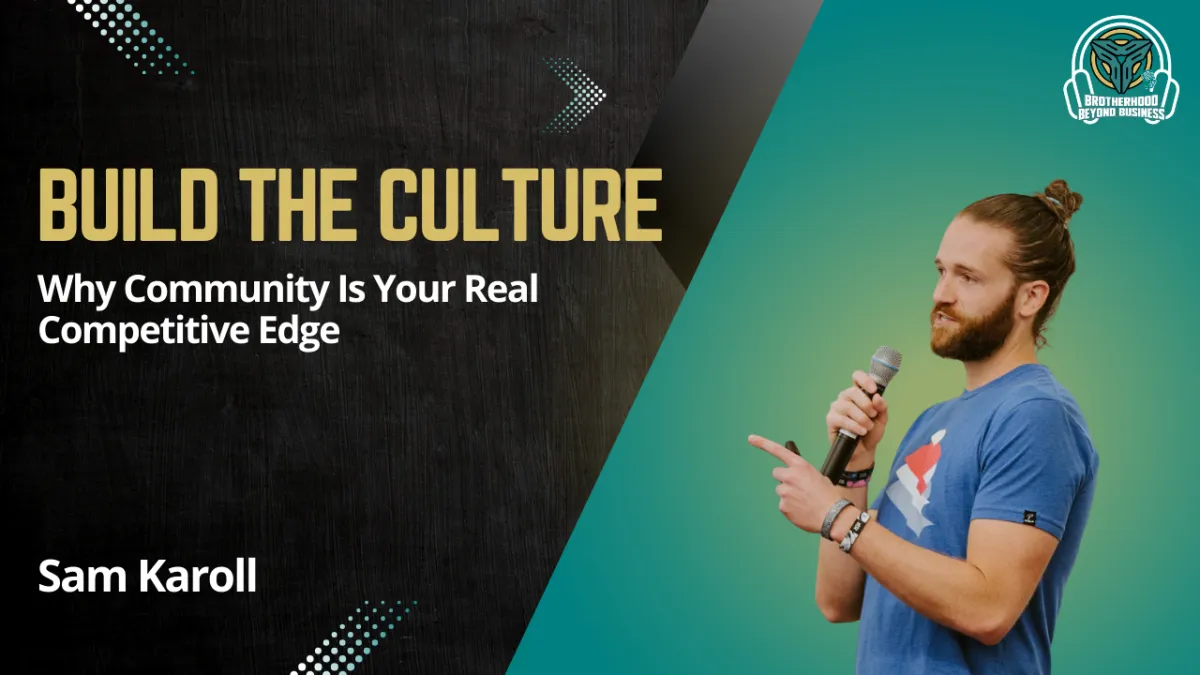
Ep 24 | Building Community and Culture with Sam Karoll
Episode 24 | Host: Joe Rouse | Guest: Sam Karoll
🔥 Why This Episode Matters
Every entrepreneur says they want a strong culture. Few are willing to build it on purpose.
In this conversation, Joe Rouse sits down with Sam Karoll to unpack what community and culture actually require from a leader. Not slogans. Not perks. Not team-building events. Real leadership.
Many business owners feel the tension of growth without alignment. Revenue increases, responsibilities stack up, but the team starts to drift. Trust weakens. Standards blur. Culture becomes accidental instead of intentional.
This episode is timely because culture is the difference between a business that scales with strength and one that fractures under pressure. If you’re leading men, building a team, or trying to create something that lasts, this conversation will challenge you.
🎧 Listen to the Episode
👤 Meet the Host & Guest
Joe Rouse — Instagram | Facebook | LinkedIn | Profile
Joe Rouse is a Brotherhood Beyond Business leader and host known for direct, practical conversations around entrepreneurship, accountability, and personal responsibility. As owner of Breakaway Fitness & Performance, Joe challenges men to build strong companies without sacrificing faith, family, and integrity.
Sam Karoll — Instagram | Profile
Sam Karoll is a leader focused on building authentic community and intentional culture inside growing organizations. Through his work nationally, he helps teams strengthen alignment, improve trust, and create standards that drive long-term performance.
📌 What You’ll Learn in This Episode
Why culture must be built deliberately — not left to chance
The difference between surface-level morale and real community
How leaders earn buy-in instead of demanding it
The role personal discipline plays in company standards
Why hard conversations protect culture, not damage it
How identity and leadership are directly connected
The long-term cost of neglecting alignment
Practical ways to strengthen culture this week
🧩 Episode Summary
Joe and Sam begin by unpacking what “community” actually means inside a business. It’s not about popularity. It’s about shared standards, mutual accountability, and clarity of mission. Leaders who ignore this eventually feel the cracks.
As the conversation unfolds, Sam shares how culture is either shaped intentionally or shaped by default. There is no neutral ground. Leaders who avoid hard conversations, lower standards, or fail to model discipline create confusion — and confusion spreads fast.
They also explore the connection between personal responsibility and organizational strength. The way a man leads himself directly impacts how he leads his team. Identity, values, and consistency matter more than motivational speeches.
The episode reinforces a core Brotherhood principle: strong businesses are built by strong men who take ownership. Community isn’t accidental. Culture isn’t decorative. It’s built by leaders willing to do the work.
🕒 Episode Timestamps
[00:00] Why culture can’t be ignored
[06:15] Sam’s leadership journey
[14:40] What real community means inside a business
[24:05] Earning trust and buy-in
[33:30] Hard conversations and protecting standards
[44:50] Identity, discipline, and leadership
[55:20] Long-term thinking and legacy
💡 Quote Highlight
“Culture doesn’t happen by accident. You either build it intentionally, or you live with what forms without you.”
🚀 Next Steps
👉 Download our Your Circle is Your Ceiling eBook
👉 Learn more about Our Method
📚 Resources & Links
Follow BBB on: Website | Instagram | YouTube | X | Facebook | Buzzsprout Podcasts
Watch the full episode on YouTube
Want to listen to future episodes: Spotify | Apple Podcasts | Buzzsprout
🚀Full Transcript
Joe Rouse (00:02.075)
All right, welcome back to the Brotherhood Beyond Business podcast. I am the host today, I'm Joe Rouse, and I'm here today with Sam Carroll. Sam, I am really excited to interview because I know Sam in mostly professionally, but I would say Sam sort of left a personal touch on me through an action that he took when he worked for a company called Push Press. So we'll dive into that and we'll talk about it, because I think...
that when we talk about that, that's going to reveal at least as far as I know, like Sam's nature and how I think Sam tends to probably operate in his regular life, I would assume. But Sam is a former gym owner and he has also worked for Pushpress, which is a software company for gym owners in Jiu Jitsu gyms for the last several years.
Now Sam's got new stuff cooking, he's working on other things. So once I found that out, was really, I immediately, mean like literally, as soon as I saw your social media post, I was like, my gosh, I want to talk to Sam. So I reached out, but the first time I met you, it had to be at the Healthy Steps Nutrition Conference, because that was the first place that you would have been. And I feel like you were the first person to come up and talk to me about,
push press and stuff that you were working on. But one thing about you that made an impression on me was, and I'm not great at articulating this, but it was your tone, your body language. I think you were a good active listener and asked good questions. And I think that it goes a long way in making somebody feel like they want to talk to you more.
Sam Karoll (01:44.824)
you
Joe Rouse (01:50.959)
And to be clear for anybody watching, Sam and I have had interactions for maybe a couple of hours at a dinner one time, but other than that, it's been like 30 seconds here, two minutes here, and that's how strong of an impression you left on me. So I think you were doing a really good job, and I'm excited to talk to you today.
Sam Karoll (02:06.894)
Well, I appreciate that, man. And it was, it was back in, what did that have been? 2022, probably?
Joe Rouse (02:11.451)
like right after COVID. It was like the first conference that happened after COVID, I feel like.
Sam Karoll (02:16.226)
Yeah, because we were out at the Healthing Steps Nutrition Summit that year. And that was when we had like the little like multi-course dinner for Push Press. And we invited like whoever could make it out to a place called Cinema, which is like in a part of Nashville, which is really fun. And yeah, you and your wife came out and we had a good time and good dinner and we got to talk. But it's always like...
Joe Rouse (02:35.315)
Mm-hmm.
Sam Karoll (02:40.468)
I joined Push Press because they reached out as a long-term client to build out like a sense of community for them. So it's always been like part of my nature was like reaching out to people having like authentic discussions and actual questions and paying attention and not just being this like person who's like, I got to like sell this persona of a human being that I am. It's more of like, if I'm my authentic self and I'm vulnerable, then that makes other people feel like they can be
Joe Rouse (02:47.099)
Mm-hmm.
Joe Rouse (02:55.507)
That's a good word, yeah.
Sam Karoll (03:10.592)
and vulnerable and that makes having any kind of conversation whether it's about life or business like that much easier so that was always like a key component of like anytime you talk to somebody it's just be you like that's it care
Joe Rouse (03:17.768)
Yeah.
Joe Rouse (03:24.349)
Did care, yes. Did you, originally did you read that? Did you figure that out through just conversations? mean, sometimes stuff like that can be natural, but we can also learn it, right? Like, mean, how did you come about that information?
Sam Karoll (03:40.128)
I think it was probably always watching like a...
My parents growing up would probably be the big influence on that, especially like my dad. Both of them though, both my mom and my dad were really big on just like being engaging with the community or helping whenever they could. If there was a crisis or a friend needed like a shoulder, like they always provided that. So growing up like under that culture, it just kind of naturally clicks. So as I got older, especially after maybe like high school and college and I opened my gym,
you really start to learn the importance of community. And then as that continues to happen, especially as certain life events occur, that was when I'm very ingrained in culture, community, the connections that we create are extremely important for the success of my business, how I feel about my day-to-day life when I wake up or I go to sleep, and investing in that community and in people became extremely important to me, and that's something that I hold.
like close to my chest to this day.
Joe Rouse (04:45.873)
I can tell, I can tell. I think it pays off. So let's backtrack. let's go, where'd you go to school or college? Where'd you go to college?
Sam Karoll (04:56.098)
I went to Monmouth College. Little tiny... Yeah.
Joe Rouse (04:58.095)
Was that, I know that name, was that like for exercise science type stuff or would you go to, what was it?
Sam Karoll (05:05.408)
No, so I went there, I played football for a year, and then I studied business instead of exercise science. Always knew I wanted to own something, didn't know what it would be, and it wasn't until I actually dropped out of college in my junior year. And one day at a gym, I was like, why don't I just open a gym? Like, I've always talked to friends about like performance, I've always cared about my nutrition, like, this just makes sense. I just decided to do it and opened my gym at 22. 22.
Joe Rouse (05:30.515)
At 22. Awesome. Awesome. So at 22, open a gym. What was your gym called?
Sam Karoll (05:38.936)
Shadow CrossFit.
Joe Rouse (05:41.329)
Where was, where'd you open?
Sam Karoll (05:43.628)
Quincy, Illinois, is where I grew up. Figured if I was going to take a big financial risk, being in a place where can sleep on my parents' couch indefinitely was the right play. Yeah.
Joe Rouse (05:52.455)
That might have been the best business decision you made to start with, right?
Sam Karoll (05:57.366)
Yep, yep. It definitely helped me save some money and not have to worry about like cutting myself a big check right away, which is nice.
Joe Rouse (06:03.633)
Yeah, so I wanna learn more about that, but a question that comes to mind if you've got some other 22 year olds you're talking to and they tell you they wanna open a gym, are you, with the knowledge you have, immediately gonna say, great idea, are you gonna say, or you should look out for this, this, and this, just be ready for it, don't expect this, or are you gonna be like, bad idea, don't do it?
Sam Karoll (06:29.725)
I would say like, especially being around so many small business owners from like any industry at this point in life, you kind of, when you talk to people, you can kind of tell like, does that person have like that, that it, that drive to like open up a business, to give it the grind that it needs, especially in the first year to make sure that it's successful instead of just like tossing it out there. So like, if I, if I
sense that I'd be like yeah like do it but watch out for like
these couple big mistakes that I made, like expect this to happen in your life, especially at 22, you know, most of your friends are either still in college or they're just about to graduate. So you're talking about a culture where like, you know, your fun time is going out to bars late nights on Fridays and Saturdays and like waking up at 10 a.m. instead of getting up at like 3.30 a.m. Yeah, I was, I was getting up at for my gym. So it's like,
Joe Rouse (07:13.139)
Mm-hmm.
Joe Rouse (07:25.085)
Yeah.
Sam Karoll (07:30.069)
you have to be ready to kind of like quote-unquote grow up and like really dive into what work life culture is at a very high level and if you're okay with that then have at it but if you think that that is going to be a problem then it's going to be very difficult from the jump for somebody to like jump in at that age I would say.
Joe Rouse (07:50.161)
Yeah, yeah. So how long was your gym open? Well first, push press was your next thing after the gym, right?
Sam Karoll (08:02.19)
No, so I actually opened up a nutrition company in between.
Joe Rouse (08:05.455)
in between, so before push press entirely. Did you do that with the gym or was the nutrition company separate?
Sam Karoll (08:08.482)
Yep.
Sam Karoll (08:12.717)
So we always did nutrition at the gym. And then I kind of knew that at some point I'd want to get out. So that's when I started opening my nutrition company. And I had my gym from March of 2013 through like February of 2020. So we sold out right before the pandemic hit. And then I opened my nutrition company in...
Joe Rouse (08:31.687)
You sold.
Sam Karoll (08:43.117)
2016 I think and I had that from 2016 to 2023.
Joe Rouse (08:47.963)
Okay, okay, so man, so you, and you said you sold your gym.
Sam Karoll (08:54.635)
Yeah, it was more of like a, by sell I would say it was more of a liquidation just because at that point I had some like health stuff where I just was ready to get out and be done rather than like have to grind and do it. Which in hindsight is probably good because if I would have sold it to somebody right before everything hit in 2020, I would have felt terrible.
Joe Rouse (09:13.213)
Dude, that's where my head was going. Yeah, that was my next thing was like, dude, what in the world? You got out right before we were all flipped upside down and we were, you know, enemies of the state. You know, we just had to close. So it was just.
Sam Karoll (09:29.185)
So it was a weird transition though, because part of opening up this nutrition company is like, I can be remote. I can get out of town. I can go travel if I want to. But to go from being around people for 10 hours a day and being super energetic and caffeinated to being at home and quiet and not doing fitness for that long was a real weird transition for a while.
Joe Rouse (09:29.363)
That's wild timing.
Joe Rouse (09:39.378)
Yeah.
Joe Rouse (09:54.794)
yeah, tell me about that. So, because that's something that I can understand on like a short term basis on a day where I might, like I just told you before we started, right? Like I'm doing this at the gym because I wanted to be here to put in FaceTime with people, because otherwise it would have put me here too late. But I have days where I work from home and you start there and it's quiet and I'm like, you know, this is great. This is peaceful. This is nice. And a few hours in, I'm like, I want to talk to somebody. Like, cause that's what I'm used to. So you did that.
permanently. mean, what was, did you, was that challenging right away or did that come up later? Like, how was that?
Sam Karoll (10:32.589)
I think a part of it like initially was like really like
kind of refreshing because you're so used to just go, go, go all the time. Like your energy when you own a gym or your coach, like it can't dip. You always have to be like higher than everybody else in the building. So to be able to like just kind of sit and relax and like watch some TV and go for a walk outside and like not have to worry about things is really nice. And then probably like everyone that year, it gets really isolating where you're like, man, I need like people and energy and like my community and yeah. So
Joe Rouse (10:44.818)
always.
Joe Rouse (10:48.467)
Mm-hmm.
Joe Rouse (11:04.946)
Yeah.
Sam Karoll (11:07.375)
Great for a little while, not so great towards a few months afterwards where it starts to click that you're kind of hanging out and rotting watching Tiger King on rerun.
Joe Rouse (11:17.487)
Did you have enough business built through the nutrition business? did starting, I mean you started that in 16, so you had the gym a long time while you were still doing the nutrition company. Did having that nutrition business weigh into you closing the gym or did stuff just get really tough? Did something happen? Like what was the main driver behind closing, whatever you're willing to share, what was the main driver behind closing the gym?
Sam Karoll (11:40.013)
Yeah. So, always loved my gym. My dad, we opened MySpace in a 17,000 square foot warehouse. It was huge. Like I was...
Joe Rouse (11:53.043)
Like as in your business took all 17,000 square feet? Lord.
Sam Karoll (11:56.691)
Yep, we had 14,000 of it for the gym floor. We had 118 foot rig, know, 10 rowers, five GHDs. Like we had enough room that you could do a hundred meter run in a circle around everything on the inside and a 40 meter sprint down on like a turf, like non-terfed spot, but just like open flooring. Yeah, I would have banked on that at this point. But then one winter.
Joe Rouse (12:04.838)
you
Joe Rouse (12:16.765)
Great would that have been for high rocks, huh?
Sam Karoll (12:27.116)
we got like a $5,000 heating bill because it was real cold. And I was like, I don't want to do that anymore. Yeah. And for a little while we were working.
Joe Rouse (12:31.475)
Illinois.
Sam Karoll (12:37.716)
or I was working with our local hospital and we were actually going to like take over their health and wellness program. And they did some things that caused that to not happen very last second. So we decided, all right, I'm going to go ahead and like move to a smaller facility. set a date, date comes around, it's in March and the day before the move, my dad unexpectedly passes away. So we go through that. At that point, you're like, whatever happens, happens. Like I have to be out of this, but I can't.
Joe Rouse (12:43.144)
Mm-hmm.
Joe Rouse (13:02.76)
Yeah.
Sam Karoll (13:07.63)
can't deal with it right now. Some health things came up. So I have what's called Euler Danlos syndrome. So it's like a, connective tissue in your body doesn't like build quite correctly. So I've had two surgeries on both my hips. So I've had a labrum repaired on my right and my left and a major injury from football on my left shoulder. And it got to the point where I couldn't do what I wanted to do in the gym. It made like demonstrating movements harder. And when you're in that environment,
Joe Rouse (13:09.199)
huh.
Joe Rouse (13:28.403)
Okay.
Sam Karoll (13:37.503)
I can't show up in the way I want to show up. I can't train in the way I want to train. And because I'm here and I can't get away, it's a constant reminder of like what you can't do anymore. So it's like, I might want to do that again someday, but in order for me to like mentally get to a place where I'm okay with that, I need to step away. So that's where like starting to plan in advance of like, all right, I think I've got another maybe year, two years in me, and then I'm going to jump and then nutrition was
Joe Rouse (13:49.895)
Yeah.
Sam Karoll (14:07.406)
part of that of being like, if I start this, I can stay in this culture and I can still do things. I can still work with clients and even expand into new areas. But I don't have to be like in the environment so much that it's like constantly weighing on me. So that's where that came from. So we span that out, open that up. And then once that felt like it was in a good place, I was like, all right, now it's time.
Joe Rouse (14:32.338)
That's a story, man. That's wild. That's tough. Why, so you moved to nutrition. What was the name of your nutrition company?
Sam Karoll (14:43.266)
explore nutrition.
Joe Rouse (14:44.668)
Okay, so was it, and it was primarily like one-on-one coaching?
Sam Karoll (14:49.376)
We did one-on-one coaching. We would work with like gyms as like affiliates of ours essentially. So like you would get like a kickback for referring us members. We, right before COVID hit, we actually struck a deal to work with every clinic that was part of a medical group in our area. So we would basically, we had flyers in every patient office across like 10 different locations, which was pretty cool.
And yeah, we just kind of worked with everything. And then we had a web application that other coaches could use as well if they wanted to.
Joe Rouse (15:17.779)
Okay.
Joe Rouse (15:23.444)
So where do we, how long, when did you, where does this move into you going back to no longer working for yourself?
Sam Karoll (15:32.14)
in 2021 is when Push Press reached out and they're like...
We have a role. We don't have a job description yet for it. Like we just know that you're the person that we want for it. We need to build out our community and we know that community is important to you. Like it's something that I talk about pretty openly a lot. So Dan and Nick both sent me a DM and then it's like, all right, let's do it. Five days later or not even, I think I was onboarding and starting to build out that program for them. And then that would have been around.
probably the tail end of 2022. was like, you know what? It's kind of nice, like not having to worry about a bunch of other things and just being able to like work. So it's like, I think I'm going take a little break from this whole entrepreneur thing and like just kind of do the thing. So I stepped away from nutrition and just started working for somebody else officially at the beginning of 2023. Cause I would have wrapped up the business entirely by the end of 2022.
Joe Rouse (16:25.204)
Mm-hmm.
Joe Rouse (16:30.864)
Okay. So when you wrapped up the nutrition business, you just, did you sell the clientele or did you hand them off or just, just stop working with everybody?
Sam Karoll (16:40.064)
slowly dwindled it down. So like as clients would like taper off or if people wanted to stay, we'd basically be like, hey, we're not taking anyone new on right now. We're just gonna stick with what we have. And then as like those clients naturally tapered off, you're like, all right, cool. We'll just call it it stops. And also learned that building a web application is very expensive and decided not to put any more money into that anymore.
Joe Rouse (17:03.718)
Okay, okay, so you were building out your own, or you were using, probably continuing to build out based on feedback and all that stuff.
Sam Karoll (17:09.546)
Yep, yep. That was when I learned that like an email not sending might cost me like five grand to fix, or we used a chat API, so like a system that you use from somebody else to build into your software. And that company got acquired and to rebuild because they canned that entire application once they bought it, to build in a new one was gonna be like.
Joe Rouse (17:30.194)
Mm-hmm.
Sam Karoll (17:33.036)
30, 40 grand or something like that. we're like, well, like at this stage, I don't think we can do that. So I don't think we're gonna have chat in our thing anymore. So everyone's gonna go back to texting.
Joe Rouse (17:43.838)
Man, you've got some good experience, Very interesting experience.
Sam Karoll (17:46.986)
Yeah, it's I have done a few things. I've definitely put my feet in the fire a couple times.
Joe Rouse (17:51.058)
Yeah.
Yeah, 17,000 square feet. God bless, dude. What a way to start out.
Sam Karoll (17:59.308)
It was awesome. went and that was from 17,000. We shifted down to 4,000 total and only 3000 of that was usable gym floor space. So it was a huge change. Yep.
Joe Rouse (18:09.012)
That's pretty much what we have. We have 3,000 total and probably 2,500 of it's usable. Because we just kept knocking everything down to make more space to have people in here is what we ended up doing in the past.
Sam Karoll (18:23.349)
Like we had enough space in that first facility where I literally taped off how the new building was laid out. And then we would tape out like, is where everything's going to go. And we just walk around and just leave it there on the gym floor because we had enough room that it didn't bother anybody.
Joe Rouse (18:33.777)
Uh-huh.
Joe Rouse (18:39.632)
Yeah, dude, 17,000 square feet is larger than the entire building that I like rent from. I think it's like 10,000 or so. So if you were, now you are on your own again.
Joe Rouse (18:56.316)
What's, what's, are you considering starting something at all?
Sam Karoll (19:03.861)
I don't think I'd start anything. If I started anything, it'd be more like...
freelance like consulting type stuff or like maybe shoot some media for, you know, brands for events. Like that's something that we always did with PushCrest. if like CrossFit was like, hey, we have an event coming up or TFX or whatever type of competition and we need somebody to come in and like shoot some photography, stuff like that is something that I'd like freelance out. But I haven't had any like hard business idea that just like comes to mind where I'm like, yeah, I'm ready for that 80 hour a week grind to like get this off in the first
Joe Rouse (19:26.387)
Mm-hmm.
Sam Karoll (19:40.07)
again at this point.
Joe Rouse (19:42.12)
think that's such an interesting perspective to have to go from understanding that ground, I mean you still do, but from having that and then going to not having exactly that or having it a different way or maybe I'm assuming to, you were a community manager so that probably involves some weird hours, but you could essentially turn it off when you left work.
Sam Karoll (20:03.744)
Yeah, for the most part. think there's...
Joe Rouse (20:04.786)
I mean, outside of some of the social media part probably.
Sam Karoll (20:08.959)
That and like, I think between being a community person and just having that business ownership thing, like you kind of like working hard and like being available and like being on. So being able to turn it off is probably something I'm still like fully mastering. I'm much better at it now than I used to be, but you know, it'd be like, I don't have anything going on. I'll go ahead and work for, you know, three hours from.
Joe Rouse (20:25.757)
Okay.
Sam Karoll (20:35.339)
8 p.m. to 11 p.m. because I'm just watching Netflix like I'll get some stuff done. So you just jump on and you start doing more. So there's always that.
Joe Rouse (20:43.978)
there's definitely times where I'd message you privately on Facebook a few times about whatever is it related to Push Press or something like, hey man, I just saw this in this other private group over here, just wanted you to know about it or whatever. But I can relate there heavily because if you enjoy your work, it's work but it's almost like the word work has a different definition.
Sam Karoll (21:09.417)
Yep. It's like, you're working, but it never feels like exhausting in the way where you're like, I don't want to do this anymore. Or like you're working and it's like enjoyable enough. Cause you know, you're like building something special or you get to do something that you love. Right. And that feeling of building something always feels pretty cool, especially when it's being successful. So it's hard to like,
Joe Rouse (21:20.937)
Mm-hmm.
Joe Rouse (21:34.408)
Yeah, it's back.
Sam Karoll (21:36.873)
turn that off when you're home and you're like, I could fit in an hour of doing this while we watch a show or, yeah, it's gonna be difficult.
Joe Rouse (21:45.106)
Yeah, it's because it brings you joy. It's also, I it could be specific to different types of personalities, but it's like a creative outlet, which can lead to a lot of waste time or not focused on the right priorities when it comes to business. But I mean, every now and then it can be therapeutic for me just to design a new flyer or something. You know, shut your brain off and.
Sam Karoll (21:53.439)
Yep, exactly.
Sam Karoll (22:05.836)
Yeah, it's like a...
like the things in business that don't require so much bandwidth and you're just like, all right, I got some time. I'm going to turn on some jams or hang out at a coffee shop and just get this thing out and get it done and relax for a little while and not have to worry about balancing my checkbook or making sure that all the bills are paid. So it's like those little things that aren't quite as draining are nice.
Joe Rouse (22:32.36)
Yeah, they're the best. mean, they can be what gets you through some of those tough times too. mean, what do you remember? Let's go back to your nutrition company in gym. I when you closed, obviously that was a very challenging time. But before that, do you have any like specific memories or like lessons you learned that you can recall that are worth sharing or like a mistake that you made early on?
or even just a really challenging stretch that maybe you didn't think you were gonna make it through or you were concerned and you did get through it.
Sam Karoll (23:09.781)
I mean, the biggest one that I always told, and I actually would have told this, this would have been part of our like presentation the year that you were at gas or healthy steps event was when we were ready to move. Cause it was very much like a needed to get out of this warehouse space. Like our move date was basically passed the end of our lease periods at this point, you know, landlords, like we need you to get out so we can get a new tenant in.
Joe Rouse (23:16.777)
Mm-hmm.
Sam Karoll (23:36.693)
But then when you have this major family crisis, you're like, whatever. At this point, yeah, I don't care. Whatever happens, happens. I can't be at the gym tomorrow morning to open it up and help set up the new space. So he passes away. I text my coaches and our clients. like, hey, this just happened.
Joe Rouse (23:40.308)
I don't care.
Sam Karoll (23:59.135)
Tomorrow's move is probably gonna be off. We'll figure it out. I hope that the gym is gonna be alive, but I can't really guarantee it's not my priority right now. So the next morning, I woke up.
Joe Rouse (24:06.836)
Mm-hmm.
Sam Karoll (24:10.666)
and there was something at my gym that I wanted to take to my dad's funeral. So I was like, all right, I'm going to go swing by my office really quick. Like, I know where it is. It's on my desk. I'm going to go pick it up. I drive out to my gym and I get there and the entire parking lot is full of cars. There's trailers out by like the big overhead doors that we have. Like everything's flung open. I can hear music.
Joe Rouse (24:28.692)
Mm-hmm.
Sam Karoll (24:31.562)
I'm like, man, what's going on? And I walk in, grab my stuff, and then I walk into the gym space, because we had a bunch of offices and you can't see into the actual gym floor from where my office is. So I can't actually see what's happening in it. I can just hear people moving around. This is at like, I don't know, maybe 10 in the morning. It's pretty early. And I get out there. There's maybe 15 clients there.
Joe Rouse (24:53.108)
Mm-hmm.
Sam Karoll (25:00.106)
and they had taken up all 10,000 square feet of flooring off the ground. They took all
Joe Rouse (25:05.73)
gosh, that's heavy.
Sam Karoll (25:07.646)
They took apart the entire rig and every piece of equipment. They had those like separated out on the floor. One of my coaches divvied up some stuff that we were selling since we obviously couldn't fit all of it in the same space. So they had that in piles and labeled for the person who was supposed to come and pick it up that day. We had another crew of like seven members at the new space that were installing all the things that were getting loaded up onto the trailers. They're painting the walls, like they made extra keys. Like a friend was literally coming to that gym.
Joe Rouse (25:19.07)
Mm-hmm.
Sam Karoll (25:37.58)
late at night to paint the walls while everyone wasn't there and I just remember like walking out there
Joe Rouse (25:41.129)
Jeez.
Sam Karoll (25:46.315)
standing for like two seconds and like I was okay until like one of my friends came over and like put a hand on my shoulder and then I just started balling my eyes out and like every one of those members like came over and just gave me a big group hug and that was one of those moments is where it's like Man investing and like like your community's kind of kind of everything in a lot of different ways. It's like it's your lifeline. It's your support It's what keeps a member coming around from year one to year seven So that was like one of those like really touching up
Joe Rouse (25:52.141)
yeah.
Joe Rouse (26:05.79)
Mm-hmm.
Sam Karoll (26:16.278)
my business could literally be dead by the end of the week to, my community literally kept my business alive for me while I was dealing with like a life crisis. And I was able to like three days later, just walked into my gym and everything from my office to the floor, to the rig, to the, all of it was completely set up, ready to go, done. And I didn't have to pick a finger.
Joe Rouse (26:25.672)
Yeah.
Joe Rouse (26:39.814)
It's like somebody gifted you a new facility.
Sam Karoll (26:44.574)
Yeah, after that, I always used to say, yeah, this is Shadow CrossFit. It's the gym that our community built. At this location, I did not build this. This is completely on our members, and they put this together for us. And to this day, every once in while, I'll post about this story and be like, if you're one of my members and you were there, that still sits, and I will never forget that moment. It was super hard, touched my heart in a lot of ways. So that would be a really big thing.
Joe Rouse (26:52.873)
Yeah.
Joe Rouse (27:13.712)
Mm-hmm. Yeah, absolutely. It's hard to surpass something like that. I that's impactful.
Sam Karoll (27:16.542)
Yeah.
Joe Rouse (27:20.574)
People can be amazing sometimes.
Sam Karoll (27:23.272)
You know, and it's like the typical stuff. It's like, we didn't have systems initially where we needed systems. Like take the time to build out systems. If you're going to open a business or if you have one, like take a backseat for a little while and try to figure out where do we not have processes where if I did, it would be that much easier for me to operate. It's taking like a slower amount of time to hire the right people and being quick when somebody does not feel right. Right. So like, don't be like,
Joe Rouse (27:47.826)
Yes.
Joe Rouse (27:51.612)
Like that feeling actually, that pays off. If you feel it and you have a conversation and it goes poorly or you're not settled, just cut them. It's hard to do. It's hard to do in a small business too.
Sam Karoll (27:55.07)
Yep.
Sam Karoll (28:07.221)
So it's like a, what is it? It's like a higher slow fire fast or something like that. That's a good phrase to go for it.
Joe Rouse (28:11.976)
Yep, I was literally just quoting that to somebody earlier.
Sam Karoll (28:15.71)
Yeah, so it's like take the time to like really vet out and feel out like who's going to join your team because that is, especially in our industry, you're relying heavily on that person to make sure that your business is successful. It's not just a, that person's going to like flip a burger for me or wait the table. It's like, no, that person is literally the figurehead of your culture for an hour at a time for 20, 30, hundreds of people. Like you need that to be a great fit.
Joe Rouse (28:25.256)
Mm-hmm.
Joe Rouse (28:40.148)
That's a great way to phrase it.
Sam Karoll (28:43.986)
So doing that and then just like you said, like if it doesn't feel right at any point, whether it's interview process or they've been around for a year or two and something just feels off, you've got to be, yeah, you've just got to cut it. Like it can't be something you can let fester for a long period of time.
Joe Rouse (28:54.516)
It usually is.
Joe Rouse (29:01.224)
I would say, I mean, of course I agree on the systems. That could probably be interesting for you as such a strong community driven person because it can be very easy to things slide because of how strong a community can be and relationships and to not stick to your own policies that you might've created, like, because you just wanna help people.
But there's this really fine line, I mean really fine, really small between helping and.
I guess self-sabotaging or somebody taking advantage of you, I guess. And it just surprised you, it can be, that's an interesting lesson I've learned in business is, I mean, I've experienced some pretty amazing things from a community perspective, nothing quite to the level of what you just discussed, but.
Sam Karoll (29:42.672)
Yeah. There.
Joe Rouse (30:02.64)
where at another time with maybe like let's say I had something that really left an impact on me when my daughter was born with a bunch of guys that got together and got me a gift because it was a girl. But later one of those guys I ended up having to ask to leave our facility and it was my gosh that was a terrible time it was at that point it's hard like you don't you don't that's
Sam Karoll (30:27.059)
Hard man.
Joe Rouse (30:32.628)
That shouldn't happen, but like as a business owner you it's hard not to be cynical sometimes When you've been through that kind of you've been here and then the same person it's like now we're wait What are we talking about here like at least? From a client to owner perspective Anytime money becomes involved or culture sometimes
Sam Karoll (30:50.921)
It's like a...
money, culture, it can kind of be that, you know, like when you're in a bad relationship and you're like, I can fix it or like, this will get better if I just like let it roll out. So you're like, I mean, if this person hasn't been a problem for the past X number of years or months, like now they are, you know, maybe they're going through like a little life thing themselves. Like we'll just, we'll let it roll for a little while. Give them a leash, not even a short leash necessarily, but a leash.
Joe Rouse (31:01.501)
Uh-huh.
Joe Rouse (31:09.817)
my gosh,
Sam Karoll (31:22.633)
And let's see if it just like self resolves itself. And then you realize, it's not, but you've just let this behavior go on for however long. And you're like, now I'm starting to deal with like other clients, like pointing this behavior out or other things are like starting to happen. And that's when you're like, yep. And that's when you're like, all right, I've, I've got to make a call here and like, just get that out.
Joe Rouse (31:25.961)
Mm-hmm.
Joe Rouse (31:39.092)
because they always notice. Everybody else feels it.
Joe Rouse (31:47.186)
Yeah, it's hard. It's hard to do. But it does lead to you potentially putting safeguards in place to make sure that doesn't happen very often again. you don't have to write like that's where the policies come in. And a lot of people don't understand that. Like you really have to be a business owner, you have to been through some stuff to understand why policies and sticking to them matter so much because it will save you a mountain of stress and problems in the future.
Sam Karoll (31:58.738)
or policies.
Sam Karoll (32:10.568)
Yep. So it's very much like a, if there's anything I would have to tell like a brand new business owner, it's like, Hey, if you have a friend that starts coming to your business or God forbid you have a friend that like works for you, like part of being a business owner is you've got to be able to separate the relationship of like, I like this person versus this is how this person impacts my business. And you need to be able to like cut that and separate them entirely. Like, cause when push comes to shove, no matter how good of a friend that person has been.
Joe Rouse (32:30.312)
Mm-hmm.
Sam Karoll (32:38.991)
if they're a negative impact on your business, you have to be able to be stern and be like, sorry, like this can't, can't keep happening. Like love you as a human being. Like we can still hang out, grab a beer, do whatever. But for the sake of my business, I cannot, can it keep you around? Like it's just not a good thing.
Joe Rouse (32:50.347)
huh.
Joe Rouse (32:56.68)
Yeah, I don't think you anticipate when you open a business that you're gonna essentially or potentially have what feels like breaking up with somebody several times over however long you have your business. Because that's how it affects you like physically, psychologically, it's like a breakup. Depending on the person.
Sam Karoll (33:06.685)
Yep.
Sam Karoll (33:13.383)
Yeah, even if it's a great client, right? Like somebody you know is like a good part of your culture or a coach that you absolutely love. when that person has to leave, maybe they move, they get a new job, whatever, it's like, you're breaking up with me? Like, why's that gotta happen? We've been together for three years. you just, that's part of life. It's part of owning a business.
Joe Rouse (33:20.274)
Okay.
Joe Rouse (33:28.756)
Yeah,
Joe Rouse (33:37.652)
That's it, right? And you work on, the thing I work on now, us being open, we opened probably two months after you did, by the way, same, 2013, which is kind of wild.
Sam Karoll (33:45.749)
nice.
Joe Rouse (33:49.172)
Walking the line or learning to operate within a space where you can have those conversations, go through those situations, but not take them so personally, but also not be so cold and hardened that you somehow create it where nothing matters. Like that was a place I had to learn how to operate and it took
at least 10 years to figure it out for me.
Sam Karoll (34:21.395)
Dude, it's really hard. It's like you said, you have to get to a point where you don't take those things like personally and they don't sit and fester or like own space in your thoughts for an indefinite period of time. It has to be something where a client acts up, you have to fire a coach, you have to let go of a member, or something doesn't go as planned. You just have to be like...
as business, like, and just move on from it and take it in stride and realize that like, that is a period and moment and time, but that period and moment doesn't have to like continue forward and it probably shouldn't. It should be, this didn't work? Cool. That sucks. What's next? And you have to go on to that next thing. Yeah.
Joe Rouse (34:45.193)
Yeah.
Joe Rouse (35:00.02)
Mm-hmm. That's it. You have to. That's it. And that's the approach. This will resolve. there's always, there's going to be tomorrow, no matter what. It's amazing how much time it took me to figure that out. And same thing with when you talk about higher, slow, fire, fast. I read that, I think it was good to great is where that's from, I think. And I read it a long time ago. And I would say it, tell it to other people.
Sam Karoll (35:21.982)
Mm-hmm.
Joe Rouse (35:29.16)
but I didn't really follow the fire fast part because I was just being, I was still learning that stuff, figuring that out. And through owning a second location, there's lots of lessons I learned in the second, through having that and what it required and what I wasn't willing to do because I have three kids and my wife and other priorities. So the fire fasting didn't happen when it should have happened, but that whole gut feeling, so higher slow,
That's what we did with our last round of couple of coaches that we hired here at this location. And it could not have worked out any better. It was really, we'd been open almost 13 years in May. And I just, over the last year, I've caught myself or found myself even telling my staff or just saying it to myself about how thankful I am for the current team we have.
and how well we operate. It's a small team, we're like seven-ish. But how well we operate together, how well we communicate, how bought in everybody is to the mission of what we're trying to do. And that lesson of hire slow, fire fast is 100 % responsible for it. Because we really went slow hiring. Really, really slow. And now, we're about to, at almost the same time, the two people I'm talking about that came in to part of what we already had that was great,
they're both going to be leaving because one one's going to be a Navy SEAL and the other one her husband is in the military and he's going to be leaving for like six months so we'll see her sporadically but I'm willing to step in do what I need to do for as long as I need to to just find the right person again
Sam Karoll (37:11.485)
Yeah, it's way back in the day, CrossFit used to have this thing called the CrossFit Journal and they'd interview affiliate owners and stuff. And they actually interviewed me for an article on how we hire our coaches and our staff. And something that I've always believed in is you can hire the most technical person in the world.
But you cannot teach a super technical person like how to have a great personality, how to be able to connect with people, how to be able to run a great class. Like, it's hard skills versus soft skills. Like I can teach somebody with world-class soft skills the hard skills to be very, very good at a job. It is very hard, very hard to teach somebody great soft skills even if they have great hard skills. So we always would be like, hey, this person is a great culture fit. They have a great personality. They have an eagerness to learn. They're coachable.
Joe Rouse (37:51.486)
Mm-hmm.
Sam Karoll (38:05.672)
They take and give me good feedback, which is really important. And it's like, all right, I can hire you.
Joe Rouse (38:09.411)
yeah. Yeah.
Sam Karoll (38:14.821)
You may not know like this, this and this, but that's all stuff that I can like, I can teach you that that's easy, but I can't teach you how to be like, to know right from wrong. And what's how do you actually interact with a client in a way that helps me build a flourishing business? So that's how we always did it. We're always like, all right, we're gonna, we're gonna take our time and we're gonna hire people who are big culture fits that know enough and I can teach them the rest of the hard stuff. But if they don't have that soft skills part, it's like,
Joe Rouse (38:20.318)
Mm-hmm.
Sam Karoll (38:44.714)
I can't bring that person onto my team because that's something that like could take me years and that's assuming that it's even teachable like that person just maybe so far gone that it's like yeah that's never never ever gonna happen but they teach a mean squat but it just won't the rest of it just not gonna click yeah yeah
Joe Rouse (38:51.315)
Yeah.
Joe Rouse (38:59.23)
problem is it's mean all the time, right? It's always mean. Yeah, dude, I had that mindset shift a little while back. There's somebody named Lindsay Vastola who's in the industry and she talks a lot about emotional intelligence and how Chick-fil-A uses that a lot in their hiring process, or at least they did at one point. But that became something that I started talking about using in our hiring process exactly like you're saying, but I probably still didn't put it into practice very well until those last few hires.
I think it naturally slows down your hiring process.
Sam Karoll (39:32.743)
Yep, it does.
Joe Rouse (39:36.24)
And it's, I would say it accelerates the onboarding process more than hiring that technical. Like we used to require all of our coaches to have a bachelor's degree in exercise science because I had that my general manager has that and all, you know, all that. And, you know, we both also know how to deal with people because we've been working for a long time and all that stuff too. So, it's no longer now it just says
you know, it's nice to have that, but we have a great onboarding system. We'll teach you everything you're going to learn in an exercise science degree for at least the stuff you need to know right away on our onboarding process. So if we can get somebody who can come in and like we have a good example is we have a coach now. She's good. She's the one who's getting ready to take a step back, but she came in and I noticed that every time she got nervous, she just smiled. And I was like, who smiles when they're nervous?
I feel like this is gonna be a good thing. So when she gets up in front of the room and she's not exactly sure to say whatever's up there on the TV screen, she still looks happy and confident and says whatever happens to be said gets said, but she's doing it in a way that people will still follow or they like her enough to allow her to earn their trust. And that led to our clientele trusting her.
faster than probably any other coach we've hired previously. Like really, really fast.
Sam Karoll (41:06.792)
Yeah. It's all about the body language and demeanor that you put off.
And there's also something to be said about, especially for like new coaches or somebody you're just onboarding. It's also okay if like you're doing it and you're up there and you're like, man, like I forgot how to like do this, this thing. But if you're up there you're like, you're confident, you're smiling through it, you know, maybe crack like a little joke of like, sorry guys. Like I kind of forgot like this part of the process. Like that's something that humility is something that your clients connect with. And like you just naturally gravitate towards people that carry that.
Joe Rouse (41:18.931)
Mm-hmm.
Joe Rouse (41:25.041)
Yeah. Yeah.
Joe Rouse (41:31.795)
Yeah.
Joe Rouse (41:38.694)
yeah.
Sam Karoll (41:43.018)
point of like during the hiring process.
In my nutrition company, we used to have something during like an interview process that we called the ice cream question, because I love ice cream. So it was like the food of choice for it. And it was a really simple question, but it was designed to like weed out who like how people thought about food and how that attaches to life. And it was just, would you ever recommend a client like enjoys a bowl of ice cream or a slice of cake or some M &Ms? And the entire purpose of that was we always
wanted to take this aspect of culture of like food doesn't have a morality to it like it's not this is evil this is good this is bad like it was always just like food food is food it's just you know some things you eat a lot of and other things that you enjoy on more of an occasion and
Joe Rouse (42:32.084)
100%.
Sam Karoll (42:34.024)
The people that would answer the question would like, yeah, absolutely. Because everyone would always dive into the answer. It'd be like, explain it. So they'd be like, yeah, you can't expect a client to never, ever eat ice cream again. So we just want to teach them how to enjoy it in a way that's healthy to their life. So of course I would recommend it. And then other people would be like, no, ice cream's bad. I would never tell a client to go out and eat sugar. You're like, all right, great. The rest of your interview is fantastic, but you're not a fit for our culture because that is a soft-scale mindset that is very
hard for me to help you unlearn versus the other people where it's like they get the the psychology and the human nature of this thing which is harder to teach. Cool I can teach you the technical stuff like let's let's keep the conversation going.
Joe Rouse (43:04.456)
Yeah.
Joe Rouse (43:19.124)
That's a great question. I might add that to my interview questions as we work through it, even though we're not specifically interviewing nutrition coaches. I think that's a good question to ask. I mean, that could be phrased in a lot of different ways, right? Like it could be for fitness. mean, it could be, hey, you see somebody barbell back squatting, right? Like theoretically high risk movement and they, but they're lightweight. They round their back coming out of the bottom. Like, do you immediately run over there and jump on them? Do you watch a couple more reps? you, what do you, you know what I mean?
Sam Karoll (43:25.052)
Yeah.
Joe Rouse (43:49.896)
That's a good way to phrase it. mean, that could work in just about any job, For sure.
Sam Karoll (43:53.884)
Yep, think it's good to have those little seated questions that actually carry more meaning than a person might think, because then you're also approaching it less like, you know, somebody asks, what are your qualifications? Very clearly, are you qualified for this job? When you ask somebody something that's more soft skill based and cultural, it's...
Joe Rouse (44:01.652)
Mm-hmm.
Sam Karoll (44:16.056)
more likely to get an authentic answer because they aren't really fully sure how to approach it. So it's a nice way to weed out, is this person truly a culture fit for the identity that I want to carry forward for my business or my coaching or whatever? Or is this person somebody who is so deeply ingrained in not thinking how I want my team to think that that is not worth my time to try to recondition and figure back out?
Joe Rouse (44:41.652)
Sounds like some great content for Sam Carroll to write a blog about and share with the world and get your list of 10 questions for gym owners here or something like that.
Sam Karoll (44:44.871)
Ha!
Sam Karoll (44:52.743)
Maybe a social post or two. I don't even have a personal website, so it would take me a minute to get a blog up. to create something.
Joe Rouse (44:59.88)
Yeah. So jumping off of that was a great conversation, but jump moving to something else. Like, so what's, where is your head at now? So, I mean, we went through past history and right now you've, you've stopped working with push press. So where, what's next? What's your, is there an industry you're interested in more than any other industry? Like what, what are you thinking?
Sam Karoll (45:28.209)
So, as somebody who really likes a challenge, there's always like this slight pull or like itch to be like...
Maybe I jump out of the industry a little bit as far as full-time work goes, just to get a little uncomfortable, learn something new, see new skills, get out of something I know like the back of my hand at this point. So that is part of what the consideration is. All right, let's give it a year outside of the industry, at least, just to see what it's like to learn some new stuff. Then the rest of it is, because it's so deeply ingrained and you're so passionate, it's like, all right, let's see what other companies we can find.
Joe Rouse (45:40.755)
Mm-hmm.
Joe Rouse (45:48.393)
Mm-hmm.
Sam Karoll (46:05.914)
that's another software provider, if it's you know somebody like CrossFit once they open up their hiring portal, is it working for brands that are out there like HWPO, Proven, like reaching out to those types of spaces. If I ever got out of the fitness space the outdoor industry is also somewhere where I like being in like those brands have good cultures so like working for an out an outdoory brand too would be really cool and you're also still within the like active
Joe Rouse (46:17.704)
Mm-hmm.
Joe Rouse (46:28.839)
Yeah, they did, yeah.
Sam Karoll (46:35.817)
mindset, healthy lifestyle type of living. So it is kind of a, the world's open for what those possibilities might be and whether that's in the industry that we're all in now or somewhere else, it's kind of kind of exciting to be able to like get out there and just like check things out for the first time in 13 plus years.
Joe Rouse (46:58.356)
That's an interesting way to think about it, like to get out there for the first time in 13 plus years, right? Because we've been so focused, even with hobbies and all that.
Sam Karoll (47:04.667)
Yeah, it's like.
It's like, you know, when you leave, it's like, you know what? I'm not gonna rush back into employment right away, because at first I was like, all right, let's go. Let's do this thing. And then I was like, man, I don't know if I've ever had more than like a week off.
since I opened my gym at 22 and I'm 35 now. Like, I think I'm going to take some time and like breathe and work out more and like focus on health and like get outside. So it's like, I'm going to, I'm going to like sit low and just take, take the rest of the year off and relax and like kind of.
Joe Rouse (47:27.71)
Since you're opening. Yeah.
Sam Karoll (47:44.801)
reset my brain from going, going and going for over a decade. And that was actually like very like revitalizing. Like it was helped like put things in a perspective of like what I want in the next step of a career and like where my head is at, what kind of challenges do I like want to take on and just feel like re-energized after truly going nonstop for since, you know, you're basically fresh out of college.
Joe Rouse (48:10.174)
man, I think you literally would have to reset your brain. Like you are probably there's some training involved like in how you talk to yourself and to, but I also wonder based on this conversation, is this going to be you doing nutrition? Not actually, but like analogy wise, like are you, is it going to turn into man, I need to be around people. Like I need that energy. Like it did when you left your gym and you started doing it. Like maybe not, maybe it doesn't. This is a different situation. You're a different point of life, but
Sam Karoll (48:35.495)
Yeah.
Joe Rouse (48:39.75)
It's just a thought that popped into my head as you're saying that. Because I know you as the guy that goes to all the events and manages the community. mean, and you can do that on your own level, but it's just something I was thinking about.
Sam Karoll (48:46.351)
Yeah, yeah,
Sam Karoll (48:52.984)
It's something where...
Having that time off kind of like taught me like I love traveling and I love being on the road and I love getting out there and like meeting people face to face at the level in the amount that I was doing it at was probably too much just because there would be like...
There was at least one period last summer, I think across almost 40 days, I think it was home for maybe seven or eight days. And you're like, truly going, you'd be gone, come back, drive home from the airport, do your laundry the next day, eat a good meal the day after that, back on the road the next morning. And you would just do that week to week to week to week to week. And that really makes it hard to have like an actual like life at home to like build relationships, to have time with friends, to like train and work out and focus.
on your own health. So the time away really taught me like I want to travel but maybe like 20 to 30 days out of the year instead of 100 to more. So you kind of take that like that new perspective has traveled in and like whenever I talk to people about new opportunities like all right what's the uh like what are you thinking about travel here like are we talking 30 days are we talking 60 days because 30 days
Joe Rouse (49:56.015)
Yeah.
Sam Karoll (50:09.413)
Great, 60 days not as great anymore.
But I think there will always be a component of like whatever I do, I want to interact with people, whether that's, you know, virtually building a community. it, you know, training people? Is it helping them? Is it opportunities to be on the road? I don't think I could ever be in something where it's like, Hey, you just do this thing and you work on a team of five. And that, that's, that's it. Cause I don't think that would like fulfill me like purposefully enough. I would need to be able to engage with like more people than that since there will always be that.
that desire to reach out and connect.
Joe Rouse (50:47.156)
think I'd be right there with you. I've never traveled that much though, I don't have that perspective yet.
Sam Karoll (50:49.007)
Yeah, it's.
It's a lot. You live out of a suitcase. And it's like, at the time, it's a lot of fun. Like, you have a blast. But then once you actually get to sit back, you're like, man, that was a lot. Like, I didn't have... Most weekends were not my own. And when you get back, because you're traveling on a weekend, it's straight back into work. There's no real time off. And it's just like, again, it's like owning a business, right? It's like grind, grind, grind, grind, grind.
Joe Rouse (51:05.577)
Mm-hmm.
Joe Rouse (51:19.09)
Yeah, yeah.
Sam Karoll (51:20.593)
I got a three day weekend this week. Like, cool, I'm gonna go sit outside and do absolutely nothing.
Joe Rouse (51:25.97)
Yep. Right on. Well, Sam, I appreciate your time, man. It's been a great conversation. It great learning about you. Thank you for coming on the podcast. And hopefully we get to do something like this again.
Sam Karoll (51:38.78)
Yeah, I appreciate it Joe, thanks for having me on.
Joe Rouse (51:41.108)
Yeah, man.