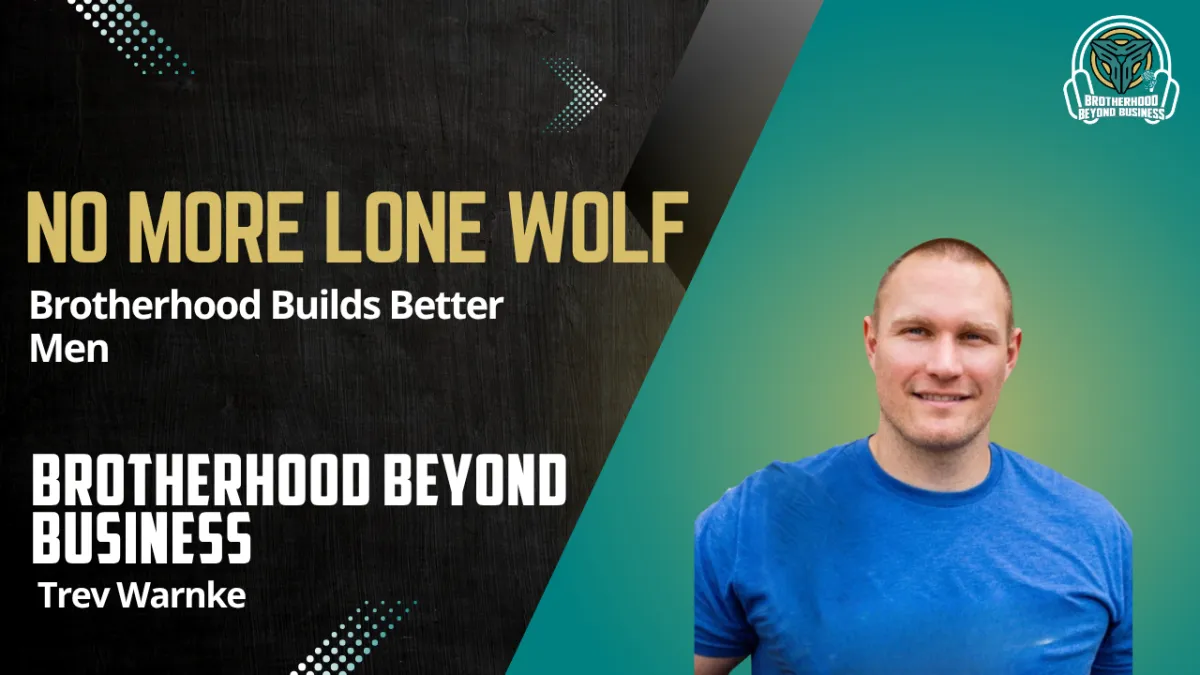
Ep 34 | Building Brotherhood, Accountability, and Real Growth for Entrepreneurs with Trev Warnke
Episode 34 | Host: Joe Rouse | Guest: Trev Warnke
🔥 Why This Episode Matters
Most entrepreneurs don’t fail because they lack information. They fail because they lack accountability and the right people around them.
You can read the books, listen to podcasts, and build a solid plan—but if you’re executing alone, it’s easy to drift. Standards slip. Focus fades. And over time, you start settling without even realizing it.
This conversation gets to the root of that problem. It’s about why isolation is one of the biggest threats to growth—and how surrounding yourself with the right men changes everything.
If you’ve ever felt like you’re doing this alone, this episode is going to hit.
🎧 Listen to the Episode
👤 Meet the Host & Guest
Joe Rouse — Instagram | Facebook | LinkedIn | Profile
Joe Rouse is a Brotherhood Beyond Business leader and host known for direct, practical conversations around entrepreneurship, accountability, and personal responsibility. As owner of Breakaway Fitness & Performance, Joe challenges men to build strong companies without sacrificing faith, family, and integrity.
Trev Warnke — Instagram | Facebook | LinkedIn | Profile
Trev Warnke is an entrepreneur, coach, and co-founder of Brotherhood Beyond Business. Through the Brotherhood community, Trev works with male entrepreneurs who want to build strong businesses without sacrificing their health, faith, or family.
📌 What You’ll Learn in This Episode
Why doing business alone leads to slower growth and burnout
The difference between consuming information and actually executing
How accountability raises your standards without you realizing it
Why your circle directly impacts your results in business and life
The role of brotherhood in building consistency and discipline
How to stop drifting and start leading with intention
What real accountability actually looks like in practice
🧩 Episode Summary
This conversation between Joe Rouse and Trev Warnke centers around a core truth most entrepreneurs avoid: you can’t build something great alone.
They break down how many business owners get stuck in a cycle of learning without executing. It’s not because they’re lazy—it’s because they don’t have anyone around them holding the line. Without that pressure, it’s easy to justify staying the same.
Trev explains how brotherhood creates a different standard. When you’re surrounded by men who are honest, driven, and willing to call you out, your level of execution naturally rises. You stop negotiating with yourself and start doing what you said you would do.
The conversation also ties this back to life outside of business. Leadership at home, consistency in health, and showing up with intention all improve when you’re not operating in isolation. It’s not just about business growth—it’s about becoming a better man across the board.
🕒 Episode Timestamps
[00:00] Intro & topic overview
[04:20] The problem with building alone
[11:45] Why information isn’t the issue
[20:10] Accountability vs motivation
[29:30] How your circle raises your standards
[38:15] Impact on family and leadership
[47:00] Building consistency through brotherhood
💡 Quote Highlight
“You don’t need more information—you need the right people around you to execute.”
🚀 Next Steps
👉 Download our Your Circle is Your Ceiling eBook
👉 Learn more about Our Method
📚 Resources & Links
Follow BBB on: Website | Instagram | YouTube | X | Facebook | Buzzsprout Podcasts
Watch the full episode on YouTube
Want to listen to this episode: Spotify | Apple Podcasts | Buzzsprout
🚀Full Transcript
Joe Rouse (00:28)
All right, everybody, welcome back to the Brotherhood Beyond Business podcast. I'm excited today because today I'm gonna be interviewing Trevor because I don't know that everybody knows as much as they should know about Trevor and he's a pretty interesting guy to know about. So I'm gonna do my best to ask the right questions so you all know how interesting he actually is. So Trevor, let's start from the beginning, man. Like, what is...
I think we should start with your story as an adult professionally. Like you didn't just open a business straight out of college. You went to college, right? What did you go to school for?
Trev (01:00)
School for Extra Science.
Joe Rouse (01:02)
Okay, so exercise science, what was your, when you first went to college, what was your thought process? Did you think you were going to open a business, like as a trainer, as a coach?
Trev (01:11)
Yeah, I actually did. So I was blessed to grow up in an entrepreneur family. And so I kind of always was going to do my own thing. I don't know if I knew the exact path I was going to be on the path is way different now than I initially thought out. but the initial path that I, when I went to college, I wanted to train athletes. wanted to build like, for, for people that are familiar with fitness, like a Mike Boyle facility, right? Athlete training facility focused on youth athletes, specifically getting to high school and possibly professional athletes.
That was my initial dream. started probably thinking about that at like maybe 18 or 19.
Joe Rouse (01:43)
Right on man. So you said you were part of an entrepreneurial family. What's that based in? What does that mean?
Trev (01:49)
Um, so my dad invented a patent in geothermal, um, which is if you guys aren't familiar with this heating and cooling your house using ground temperatures, invented a patent in geothermal that made it so the house ran more efficient and the pump, the heat pumps work more efficiently. So from there in that patent, then he built an entire factory, um, where it employs most of the town that I grew up in, which I grew up in a town of 600, so very, very small town in Western Iowa. Um, and both the time, uh,
building their facility there and they, sell these products all throughout the world. So, so I was really part of that from day one. So he originally started as a plumber, had his own plumbing business. And my dad had the entrepreneur journey where he'd done everything along the way. And every single time the business just kept upgrading, meaning like he would make the, he would, you know, be working as a, they first opened a hardware store and after the hardware store, then he got into plumbing. Cause that was the need in the area. So he got more into plumbing. And then after plumbing,
he went and worked for carrier corporation, which is a huge, like, air conditioning corporation and became, you know, a top in sales there and started really learning that. And then he invented his patent, went out and built his own business. So we just kept on moving the scale where it's like, we talked about an entrepreneurship. like, it's not about where you start. It's where you keep building towards. And so I just got to see that journey and watch him like moot, just keep leveling up throughout my life. and I just kept on seeing her head. This is so cool because every single stage, you could just see the level up to him.
Joe Rouse (02:49)
Mm-hmm.
Trev (03:11)
as a person who just kept on doing, because he just kept on doing these cool things. And when I look back on his journey, I'm like, man, that was a really cool journey to be part of.
Joe Rouse (03:19)
Do you remember roughly what age he had the idea to come up with this part and got it patented?
Trev (03:25)
⁓
yeah, I want to say early fifties.
Joe Rouse (03:29)
early 50s. That's why I was hoping you, I would hope you, because I actually didn't know that. I knew the story, but I didn't know the age. And it's really interesting to think about the fact that he struck gold, but he didn't do it until he was in his early 50s.
Trev (03:43)
So I saw something a couple, probably a couple of years ago that inspired me as well. Cause I've always been inspired by the fact that it took him so long to like strike rich, right? Or to hit that big, big thing, right? But it's because of all the skills he built. He would never been able to do that. If it wasn't for all the skills he had built along the way, because all those skills allowed him to be able to build this huge manufacturing corporation that employs all these people now. But he couldn't have done that from day one. He had to go through all these during to get there. But I saw something that, I want to say it's like 90.
Joe Rouse (03:51)
Mm-hmm.
Yeah.
Trev (04:09)
90 or 92 % of all millionaires don't really get started until 42. And so like that's when they first get that idea that 42 is when they first get their million dollar idea, right? And so that's always inspired me being 39. like, I'm like still a few ways away from even have to worry about my million dollar idea yet.
Joe Rouse (04:21)
Thanks.
Hurry up, hurry up.
Yeah, he would have done that. Do you know what you went when that roughly was like decade 90s 2000s one was Yeah, so no internet right like
Trev (04:31)
1992.
Oh yeah.
He had to learn all of that. So here's like, um, and for me, the way I've always been inspired by things is like, kind of look back to my dad's journey because it, when I looked, when I really looked back on and think about what he had to do, I was like, man, he did way more than I'm willing to do in many ways. He drove the whole United States. He drove the United States and did all sales just by driving and going into the most random places and seeing if he could sell his product there. Right.
And so like, I mean, we, talk about just doing networking and having to get in these network groups of people we don't know. Yeah. Yeah. Or calling somebody, right. Nowadays, like calling is like, and he would just go step by step. And that was just the way they did it back then. It was just like, you grind. And my dad came from a family of 15. And so he's one of 15. And so because of that, he learned you have to earn everything you get. don't, just, you just, there's not enough to go around. And so you have to make your own. And so it was one of those things where I just take a lot from his journey because.
Joe Rouse (05:05)
We're having to call somebody. Call a lead that reached out to us.
Trev (05:29)
I look back on it a lot to be like, whenever I have these moments of like feeling inadequate or where I'm like, I'm like, man, like dad went through all this and did all these things. And I can't like do this little bit. Like, come on, man. I can't go to this meeting tonight. That's at six 30 at night when he was gone for a week from us because he had to do what he had to do, you know? And it was just like, nah, I can't take one night away from my family to build my business a little bit farther. Cause sometimes I want to be done at five and be with my wife and, and stuff like that. But same time, sometimes just got to go out and do so.
Joe Rouse (05:46)
Mm-hmm.
Yeah, so let's continuing down that journey. mean, so let's say you graduate from school, you know you want to open a fitness business. What year did you open? It wasn't called GCP originally. was it? was athletic revolution? What was it?
Trev (06:12)
So, so it
was called a lot of athletic revolution. was a franchise. let's take a few years to step back. so in 2008, I graduated with a degree in exercise science. And, at that time, two, the 2008 crash had happened, housing crash, and a lot of people were struggling with disposable income. And so I had kind of like, I was going to go into do personal training originally and kind of grow from there. And I decided to take a step back. My dad offered me to become.
part of his business. I was okay. I'm going to go in and do that and, uh, you know, run his corporation. And so out of school. Yep. So when I was 22, I took over as the vice president of manufacturing for his corporation and that like, talk about buying speed and having to learn on the fly. Cause my dad is amazing in many ways, but he did not, he was not the person that was going to be like, here's how you do it. It was like, there you are now in charge of 60 some employees go.
Joe Rouse (06:42)
So you did that, that was out of school. You didn't open the business right away, okay.
you're 22, you're in charge of 60 people and all those 60 people are like how'd this guy get this job?
Trev (07:07)
Exactly.
Well, luckily when I growing up, I worked there every single summer also, you know, so I had done every dirt job you could think of. now my dad never let us just do fun stuff. It was always like, what's the worst thing you can think of? Like you're, my son's going to be the person that does that. And that's just how he was like, you know, I'm not going to make my employees do that. My son can go do that, which, which for me, like I didn't mind it because I didn't know it was a dirt job. I just, you know, it's just a job. It's just, we were kind of raised that way. You just do work and whatever the work is, you just do it.
Joe Rouse (07:14)
Yeah, okay.
Yep.
Trev (07:36)
And so it never bothered me. and it physically built me, there was stuff we had to carry. So being a former football player, I was hadn't had to carry pipe and stuff all around our property there, because the forklifts and stuff couldn't go where you need to go. And so it just built physically built me into a bigger human being because this pipe was hundreds of pounds that you're carrying overhead walking places. So I loved it as a football player because I got stronger than everybody without having even, I mean, I lifted weights, but not, I didn't have to do as much because I had so much of that. but in terms of entrepreneurship, had
everything that that business had ever thought anybody in the business thought of. when I took over as vice president of manufacturing, I knew how to manufacture everything in there. And so it allowed me to have what we expect with all these other, um, employees that were there, you know, they watched me grow up. So they knew who my personality was and I'm, a very focused individual always have been. And so they knew I wasn't there to play around. I was there to like help them grow. Um, and so it was a cool four year experience because for me, the biggest thing that I learned is I learned a lot about business and stuff, but I learned how to develop culture.
Joe Rouse (08:25)
Yeah.
Trev (08:33)
The culture there was not the best culture, in my opinion. it was a lot of like infighting and stuff. And so I spent, I, one thing I really focused on is reducing swearing there, like simple things like that. Let's just reduce this, this swear, the place from swearing all the time. Let's start to get people to be in groups of leadership groups. And I started to build up the culture there. And that was really my main focus was building up the employee base and making them the best version of themselves. and that got me in that first stage of knowing that, I could lead.
by changing the environment, could change the business more than, you I understood finances and I understood how to make products more efficient and that kind of stuff and how to make more money by reducing the cost of products. But the thing I think that was the most important impact that I had on the business was a cultural component. Cause I realized once I could affect the employee and show them the path to become better, it completely transformed the way people thought there. And that was my first understanding of that community and culture was one of the biggest movers that I could move personally.
Joe Rouse (09:29)
What, what, see I didn't even know this and I've known you for, I don't know, like eight or nine years now with the culture part of it. So what was, what's a good, not a good story. What was, you talk about like, you had to ask people not to cuss and that wasn't a part of the culture before, right? Like I built that into the culture from the beginning at my place and I still cuss sometimes, right? but when you were implementing changes like that as a 22 year old out of college, even though you come up there like,
Do you have, did anybody really push back? Was there any like major situations that took place while you were going through that where you had to fire somebody because they didn't buy into the culture or was there anybody who you knew growing up that turned out not to be a good fit for the culture once you got there?
Trev (10:11)
I don't think there was anybody on that specific side of the culture that wasn't. So it wasn't like all of a sudden it was like, all of a sudden we're not, we're not swearing anymore. It was just, I think it was my influence of every time we go around, I was like, Hey guys, like we don't really need to use the F-bomb every single time. let's we've, so that if you're not familiar with factory life, factory life is like, you just, people talk any way they want, you know, it's just, just, you don't think of like, people that worry too much about how other people feel and think. But I realized like, okay.
Joe Rouse (10:18)
Yeah.
Mm-hmm.
Trev (10:37)
how everybody feels about each other, you're working together all time. So if we can just make this a more friendly environment, we'll have a better long-term result from this. And so like using swearing as an example of one of the few things, we had other things we focused on, but swearing was like, it wasn't like I wasn't all of sudden like, hey guys, we're not swearing. It was just more going back and like, hey, let's use different language. It's like, don't need to be using that all the time. We got better language. I would say the hardest one was my brother. My brother swore a ton.
Joe Rouse (10:58)
Hmph.
Trev (11:00)
And he was the vice president
of sales or is still the vice president of sales. And so like, that's one of those things like he saw a ton. So getting him to bring that down naturally was hard, but I could see that improving too. and so, but it was one those things that like you were just in, in, in, the time I left four years later, I do remember like swearing was like pretty much obsolete in our facility. it was one those things where it's like people just didn't like naturally, they just use better language around each other. I think the big thing that I,
Implemented that I thought was the biggest culture change was leadership groups And so putting them giving them a chance to be in charge of certain components So having heads in different departments and bringing them together and meeting in small groups I don't even know if they do that anymore But during my time they did that and that was big because it gave each person there it communicated the different heads together you would think that's natural but in a business in small-town, Iowa They just didn't worry about that because like well, we're already doing well So these are just things that I'd seen that I thought could make
Joe Rouse (11:41)
Mm-hmm.
Trev (11:54)
improvements from all the books and stuff that I'd read. But like being in those groups, those leadership groups, then I could have employee them to go out and explain to their group of people the mission that we're trying to achieve.
Joe Rouse (12:05)
Right on, So four years, why four years change direction?
Trev (12:10)
Yeah. ⁓ it,
I am a hard charger. You know that, like I'm a person that just like, I put my head down and I go to work and at that age, I had nothing else in my life, but business. So I didn't have family distractions, meaning like white, white for kids or anything of that nature. So you put me on a single minded task of making this business. Like, I mean, we, we were at the time probably between six to 8 million. And then when I left about 24 million. and so it was one of those.
Joe Rouse (12:33)
through
a recession, essentially.
Trev (12:35)
Yeah, yeah, exactly.
And so it was one of those things where if you put me on a single minded task, it's not fun for everybody else. And for my siblings, it wasn't the most fun for them. we butted heads a lot because they did have family and they wanted the family life more than I wanted at the time. Now I want it, but at the time I didn't really, really care that much about it. So my idea was let's just push until push, push, push and become the biggest corporation we possibly could. And like,
grow into these different markets and stuff. And that just wasn't the journey they were on. And so after probably about three and a half years, I realized like, I can keep pushing and destroy my personal family life or I could step away and my family will do just fine. And I knew that I could go do my own thing. I had other passions. I really enjoyed fitness. I want to build my own thing. I want my own legacy as well. Like I love my dad's legacy. He built something incredible that hopefully I can achieve even what he's ever achieved. But the idea is like, I knew my legacy, I could build my own legacy and I didn't want to just stand on
You know, his legacy, like it's his legacy, not mine. want my own. And so it was that point where I was like, okay, I knew that me and my family were butting heads enough and I knew I would drive them crazy and possibly destroy our family because that's sometimes I can be so single-mindedly focused, which is a great trait in certain ways, but negative in other ways. And so I hadn't really developed into who I am at that point, right? I'm in my early twenties and all I saw was like former athlete just focused on goals and just charging.
And so it took me to wake up one day and realize I need to step away from this because my family life is way more important. Like my relationship with my siblings and my, and my parents is so much more important to me than this business ever will be. And so, and I can do my own thing. So I went out and decided, so what I did is I told them, Hey, I'm moving to Australia for a year. And they're like, what Australia for a year. Um, who does that? And it's like, well, because I knew if I didn't move far enough away, I would just jump back in the business. And so I needed to move far enough away, get myself separated far enough.
Joe Rouse (14:12)
You
Trev (14:23)
And the cool part is my business partner in GCP, future GCP was, Nathan, me and Nathan went to college together. We were personal training stuff and we'd always talk about building our business. so Nathan had been in New Zealand for a year and came back and he's like, Hey, I'm thinking about going to Australia for a year before I start to like, he was just adventuring more and I was already business focused and he was, he was in the adventure stage. And so he's like, Hey, come adventure with me for a year, get your separation.
Joe Rouse (14:33)
Mm-hmm.
Trev (14:47)
from the business and then we can figure out maybe because we talked about building our own facility together and like, we can build that facility when we come back from there. So moved to Australia for a year and worked for a personal training studio while I was there and just like got away, let myself kind of relax a little bit, come down from that intense energy that I had at B and D, which is named my dad's corporation B and D. Um, and so that bring myself back down and also allowed me to start building the plans for what I wanted my future facility to look like. And so I built those plans over that year. So that way, when I came back,
we opened at the time was athletic revolution.
Joe Rouse (15:18)
Okay, I mean, I could, I've seen your evolution over the last few years in terms of priorities. Like you just thought about being, being so able to be so single minded focused, but understanding the difference of finding harmony between the home life and the business life. Like remember when I think I brought this up several times to you before, but like when we were in that meeting with the business advice and career at the time and
Dean Carlson came in and just talking about business and life or business being your passion, being happy coming from business and how there's two different things, Like life is different from your business. And me and you were talking and you were like, I don't have a difference, my business is my life. There is no difference for me.
You know, we knew everything. We were in agreeance on that and then immediately he's like, one day you're gonna lose that passion and you're gonna care about other things. I remember that had such a big impact on me, but I think it took longer to come true for you than it did for me, maybe. And you're closer to there now, right? Now that you have a home, you have your wife and all that stuff.
Trev (16:29)
Well, for me, was
the way I had always thought about it was there's an endpoint I'm trying to get to and the faster I can get to that endpoint, then I can start that next stage. I had always been really good about kind of like they think of like Kobe Bryant, like he was willing to sacrifice parts of his life to get the benefit of the current focus he was on. Right. And I'd always thought that way is like, I wanted to, if I sacrifice all the family, I don't have family, I don't have kids. I don't do any of that stuff right now.
Joe Rouse (16:48)
Mm-hmm.
Trev (16:55)
I can get my business to this part here and then I can start that part of life. But that was like the worst mindset I could have because I didn't want to be, I didn't want to be the biggest gym in history. really didn't want that. Money means absolutely nothing to me personally. Legacy is probably more important, but realistically harmony is probably the most important thing. just took me this long to realize it. But realistically, I had just had this thing, like if I sacrifice until 35, I can start this part because everything will be ready at this.
Joe Rouse (17:16)
Mm-hmm.
Trev (17:23)
But the thing that took me until 35 to realize like, man, I always want more or this could always be bigger. This could be always better. Maybe I'm not as far along as I thought it was going to be at this point. So do I keep putting family apart to the side? And, yeah, that was probably what was different for me than you guys. had kids, younger age, other people in the group were wanting to have kids. So they all had, you know, most of our group had kids.
And so they understood that little bit of balance they had to have without me having kids and me not even worry about finding a wife at the time. And so that was never part of the equation. So I just didn't have to think about those. could like compartmentalize that to the side and just like, Oh, I'll figure that out at a certain point. And I've always been a planner and I'm like, okay, at 35, I will figure, find this out. You know, even me and my wife, I'm like now like 45 is when we'll start thinking about kids. Right? So say ideas like I've always been this way in my mind is like, okay, I'm setting up my line, my life with this timeline. Um, and I, it's funny thing is, you know, life.
Joe Rouse (17:59)
Mm-hmm.
Yeah
Trev (18:14)
Life is what happens when, or the plan, I'm trying to remember what the exact quote was, but like, life is what happens when you make a plan and God says no or whatever. So it's like, you know, it's like the idea is I'm trying to make this plan and God might have his own plan. I'm trying to direct this whole purpose. And so part of me thinks like. Along this journey was I had this plan. had to be this huge corporation. If I would've hit that huge corporation by the time I wanted to, I don't think it would've, it wasn't the path God had me on. And I was trying to force myself down this, this, this timeline, because this is the path I wanted to.
Joe Rouse (18:20)
Mm-hmm.
Trev (18:42)
And so I really started diving into my faith that I realized like, this isn't God's plan. This is my plan. And it's funny. Like it's the idea is like, don't, can't make this plan without God being part of this plan. And that will kind of help open me up to, okay, now I need to start finding a relationship, finding my wife and figuring out that next stage.
Joe Rouse (18:59)
So lived in Australia for a year, started planning Athletic Revolution. Why Athletic Revolution was a, either, was it a franchise or a licensee program? Okay, so franchise. So why, you know, Trevor comes up in an entrepreneurial family. Why does Trevor decide to buy into a franchise?
Trev (19:07)
franchise at the time.
A philosophy I still buy into today is I, I have always believed in buying speed. I've always thought the fastest way to the end result is to find somebody that's doing an amazing thing. Get surrounded by people that can help you go forward fast and do that. And for me, I had been reading, camera, I think it was called fitness consulting group at the time. I'd been reading their articles, Nick Barry's Pat Riggs piece, articles for years. And so I locate if I was to buy speed, these are the guys I want to buy speed through. Well, they had.
Joe Rouse (19:23)
Mm-hmm.
Trev (19:46)
I was like, okay, I'm going to go buy speed instantly through these guys. And so that was my, that's why I went there instead of building my own thing and figuring it all out. I'm like, I will always buy speed. will, I will look for the people that can help me get to the end result of fastest because I can figure it out myself, but it's going to take me a lot longer. So I've always been in the philosophy. can buy speed.
Joe Rouse (20:08)
I think that's super interesting because the conversation I was just having with the guy before this podcast, we were both, his saying that he thinks he's taught his kids is like, well, if they can do it, then I can probably do it. He said like, you can literally ask his kids, like if you go to his kids and you say, hey, if they can do it and you do this, they'll go, you're talking to my dad, haven't you? And you do this again and they'll go, I can probably do it. And I would say I've always been more that way. don't know, buying speed was not a concept to me. So it was more like, I'm gonna bootstrap this.
It's and I didn't speed wasn't a concept. I didn't know how long it would take or how fast it would happen So it's really interesting that you were aware of that concept earlier on in your life I mean I would argue earlier on early 20s mid 20s because in my mid 20s, I knew everything so that's why I wasn't thinking about buying speed even having a discussion earlier of you maybe maybe I didn't heed advice from mentors in my life They got any realized there were mentors in my life or I wasn't listening to my father
and my stepfather what they were trying to teach me earlier in life. And I wish that I would have listened earlier on, but I've learned a lot. But it's very interesting, like why do you, where did that come from? How did you know that you could buy a Speed? And why did you choose that? Why didn't you think, I'm Trevor, I know how to focus, I can do this, I'm just gonna go do it?
Trev (21:23)
again, probably comes from my dad is mentorship. had a mentor from a very young age and I just, I took every word that he ever said about business and I was just like, you know, just hanging on it. You know, when we'd get done with the workday, I'd go into his office and just like pick his brain about questions. You know, like I was just like always inquisitive because like he, he's where I want to be. And how do I get to where I want to be? Find the person that's already there and learn everything they know. And if I can do that at 20 years old and he's, know, in his fifties,
Well, how fast I can get there so much faster. And so for me, it was just, I'd always thought that way. mean, in sports, growing up in sports is like when I wanted to become a better football player, I went out and worked hard, but I also read books and I researched like, how do I become a better tight end? And so was like, here's my blocking technique. I go read a book about blocking. It's always like, I just always thought like, okay, there is a way to get better and I can get there faster than other people. Cause I'm willing to study and then go do the work. And so that was always just in my mindset. I was like, there's somebody else that's done already. I'm just going to go find that person.
and then go build exactly what they did and then put my twist on.
Joe Rouse (22:25)
How long did you have athletic revolution before you started realizing you wanted to do something different or what changed? made? Well, you changed the game. Yeah, let's start with that. Yeah.
Trev (22:31)
to like gain future performance or?
So the reason we switched to GameChange Performance from Athletic Revolution strictly was we built a second location. And on the second location, I didn't want to pay two licensing fees because we weren't using the information on both. ⁓ I was just using my own information for the new one to build. And so I didn't want to pay for two licensing fee with a small facility. And so I was like, OK, we'll just change our name to GameChange Performance. And then I don't have to pay the licensing fee for the second location.
Joe Rouse (22:48)
Mm-hmm.
Trev (23:00)
Um, and so we switched it over that, which it fit more of our model. made me like, now I could build my own branding. I could do my own things. I didn't have to follow their branding guidelines. Um, and even though Nick and Kelly that run, um, athletic revolution, they gave a lot of like, you know, freedom to do what you want kind of stuff. I still wanted my own legacy. And I, that, at that point is okay. I can still have this license. Once they moved to the licensee program, I didn't have to the franchise rules anymore. And so that helped out a lot too, allowed me to, okay, I'm still getting their business coaching. Cause they really became a business coaching platform after that. And so I.
Joe Rouse (23:29)
Mm-hmm.
Trev (23:29)
use their business coaching and then be able to put it under my own brand. So then we moved over to my own brand, our own branding, um, stuff and built our second location. And I did my second location at 28 years old, think. Um, and that was an experience. Um, but at the same time, it was one of those things where it's like, you've been through it too. You know, you've closed your second location. We've closed our second location. Um, and the idea was it is just, I was moving too fast without
really knowing the, I thought the end result was by building multiple locations, I would build a bigger business. All I was doing is spreading myself thin, not building. And so I was spending more time trying to like make both these businesses function versus being able to like take my, my time and duplicate it. Okay. Now I have this experience, I can duplicate it, but that wasn't, we've learned that that doesn't happen on two locations, maybe on five locations, possibly if you have the right managers in place, but like,
Joe Rouse (24:04)
Mm.
Yeah.
Trev (24:22)
You have to have a team that can help you do that. And that was a part I didn't realize is it's not really about having multiple locations. It's about having a team to work through.
Joe Rouse (24:30)
I it's also about having, I agree, it's also about having the right expectations for the location and how it's going to be. Thinking that we can, alluding to what you said, replicate ourselves into another location and get the same feelings or culture that we have at the first place is really hard to do if you're not there. Or if you don't have the right person at the first place for you to go build it.
similarly to how you did at the first place. That was a hard lesson for me to learn. That like, I couldn't just pick the people, teach them the systems, and they would run it just like I wanted to run it without me being there. It was a very expensive lesson for me to learn with that second location. Mm-hmm.
Trev (25:09)
Agreed. It was a lot of time lost, know, trying to do both locations
was a lot of time lost. And that was, so we built that in when I was 28 and then, um, so got rid of that, like pay 31. So like three years later, like I pretty much put it all in charge of my, yeah, put my, it put it in charge of my business partner, um, Simeon at the time. Um, and then, um, we eventually, we actually just technically sold everything about a year and a half ago, but Sim took over and pretty much took a full charge of that at that point.
Joe Rouse (25:25)
Gosh, it was three years.
Mm-hmm.
Trev (25:39)
I was still technically like business partners with them, but I just wasn't taking anything from the business because I wasn't doing anything with the business. just wanted to send to be able to take care of it. and so what you like from that point on, like what really honestly changed my opinion on what my next stage of life was was cause so at that point I had wanted to build multiple locations. We're going to build like five GCPs. and that lesson taught me, Hey, I really don't want to run five GCPs, but I want to build a bigger business. I just don't want to run GCP or I don't want to do that long term.
And so what really changed for me was when we were, I guess we were probably maybe 28, maybe maybe 30 is I was 30 when we first joined the mastermind group. And so when we all joined the mastermind group, that very first meeting with Vaughn, you, me, Marshall. Yep. That like, man, that lit a fire under me. I'd never had lit before just like the conversations with like-minded people doing like-minded things and like trying to like do great greatness. And it was just like, man, that lit.
Joe Rouse (26:19)
Greenville, South Carolina.
Trev (26:33)
from that day on, literally from that day on, I had always had in the back of my head, I am going to build mastermind groups. I just didn't know when it was going to be, but from that day on, I never stopped that thought in the back of my head. And I knew Nick who had run the mastermind group there. I had even talked to him on the side, like, Hey, you know, like you can make this bigger or whatever. It just didn't seem like something he wanted to do. So when they actually sold fitness revolution, that was kind of when I thought, Hey, now I can go ahead and go into mastermind group. don't feel like I'm stepping on Nick's toes at all.
And that's when we want to wait. Like that's when the path had moved for me be able to run the brotherhood or do the brotherhood.
Joe Rouse (27:04)
That's in the past. So, but between there, there's level up.
Trev (27:09)
Yeah. So, so let everybody know. So I was living, we built game change and performance in, Chicago, Illinois in the suburbs, Munderline, Illinois is where it's at. And during COVID 2020, that was like the final straw for me to run gyms because Illinois just made it extremely hard to run a gym during that time. And we had to like pretty much, we had built our business up. was so proud of where our business was at, at that time. And COVID just.
Joe Rouse (27:27)
Yeah.
Trev (27:34)
Completely tanked the heck out of it. And it was like, man, we're starting literally right back over. Like this just sucks. You've spent so many years getting to that point right back over. And so me and Nate, my business partner, he's also a business partner and the brotherhood as well and level up. We at that point just said, Hey, we've got to find a business. We got to find another direction. We've got to find that next step. So we started rebuilding game change performance. But at that point I already had started thinking about what's the next step because I knew that gyms couldn't be the next step because I was never going to let the government do this to me again.
And so was like one of those things like this is, got to find my next direction. so the other part was, is during that time I met my wife, which was awesome. And that started to give me some clarity on like what I wanted out of life and how to build the life that I wanted to build. And so we had both realized that that life wasn't in Illinois because we are very active people that enjoy adventures and Illinois, pretty much have to pay for every adventure you want to do. we're like, Hey, I want to not have to pay for doing
to go out and like, just go for a walk with my wife pretty much. That's so crazy in Illinois. Like there's just nothing to do if you're not driving. And so we like, we got to get out of here. So we went throughout the United States, kind of figure out where we wanted to live. And we moved out to Prescott, Arizona. We got married in 2022 and a week later, we've moved out to Prescott, Arizona. and that's when it, had to figure out what's the next business I'm going to run because I can't take a full salary from GCP because I'm not working there anymore.
Joe Rouse (28:51)
Okay. And what gave you the idea to do software? mean, it fits your lifestyle and where you're currently at life season. But did something happen? Did you notice something? Did you research something?
Trev (29:04)
Well, if I'm being completely honest, it was just, the time it was a quick money grab that could allow me to be a solution for what I needed at the time. I knew it wasn't going to be the end business for me because I didn't have any passion in it. And I'm a very passionate person about business, but I knew I could, I was good enough at the software. I was good enough at building websites.
Joe Rouse (29:13)
the solution.
Mm-hmm.
Trev (29:28)
that I could find some path inside of Level Up to make a business out of it to get to the point everything all this plan had always been to eventually build masterminds. But I needed to get a steady income in the software to allow me to then build masterminds out of the software.
Joe Rouse (29:44)
Got it, got it. I think that's an entrepreneurial step. You weren't like, I'm gonna go get a job. You were like, what business am I going to start next?
Trev (29:51)
Exactly.
Yeah. I could have went and done real estate or whatever. You could have done so many other things that could have done, but my idea was like, I can do this on my own. I can figure out how to do it. And the cool part is with level up, we do have things I've become special at. Like we are an amazing SEO. We really are. And our SEO platform that we use for, for all businesses now, but we started with plumbers and trades, our SEO crushes. And so we were really good at SEO and I would never imagine, cause I knew no idea. had no idea what SEO was before I started in 2022, like really knew what it was.
And now I would say I'm not an expert, but I'm very, very good at SEO and understand all the paths with it. So I did, we do still have level up and lovely level up. It's now an SEO company, not even a software company, it's an SEO company. and so it's something we're going to keep doing for the future because we do a really good job at it, but it also has built me a daily income so that I can put all my time and effort because that business has become pretty hands off for me already. And so now my daily effort is like, I just got to spend all my time networking and building the brotherhood.
Joe Rouse (30:43)
Was there anything you did with Level Up to buy speed similarly to how you did with fitness to start with?
Trev (30:50)
I would say hiring a team of virtual assistants was probably the biggest speed I got because. Yeah. And so like that was the fastest speed I got. Cause one, they could do the work for me, which helped too. They had X I got a group of VA's. luckily stumbled onto a company called carp IDM and they had their VA's, but they do very specific things. They're not like a VA that's going to check your emails and do like little tasks for you. They have a very specific focus and their focus is focused luckily had to be in, it was in different categories, but one of those is SEO.
Joe Rouse (30:54)
That was where my head was, I knew that's what you were gonna say.
Mm-hmm.
Trev (31:20)
And so they actually taught me a lot about SEO and they're able to work my SEO plan that I had learned. I had learned through them, but then I also went out and did a lot of research and kind of put these different components together to make us really good. And I knew what I could sell and now they run the SEO component for me. So yeah, they bought me in credit. And they pretty much run level up for me, honestly, except for the software side where I have to like help people figure out some of the nuances. Cause we use the go high level software, which is an awesome software, but it has so many nuances to it. It can get very confusing. And so I have to kind of help.
Joe Rouse (31:30)
Mm-hmm.
complex. Yeah.
Trev (31:48)
with that kind of component, but outside of that, the SEO part, they, they helped me kind of design the initial part. went out and made it robust and made it sellable. And then we brought it back and then they run all the components that I created.
Joe Rouse (32:00)
Right on. All right, so level up. You're working towards starting a mastermind group. You've been working on it, working on it, working on it. When did you know it was the right time to start the Brotherhood?
Trev (32:15)
had no clue. I just, I honestly had no idea when it was the right time to do it. I knew it was in my heart. And so I had my, my, former, my former fitness franchise, owner, Nick Barry ended up selling fitness revolution and ended up becoming a business coach. I mean, he'd always been a business coach, but he became more of like a personal business coach. And so I had reached out to him about just getting some advice and he became my business coach. And so.
You know, he helped me kind of develop level up and get level up to the right position. But then one day we were talking and he was kind of like, you know, Trevor, I don't think you want anything to do with level up. Honestly, you don't want, you know, we don't talk about it. We really don't want anything to do with it. He's like, it seems like he's in a good position. He's like, you know, but we talk about, we talk about masterminds a lot and you pick my brain about masterminds a lot. And he's like, you know, if you want to do it, why don't you just do it? You know, and he's like, why don't you, instead of chasing this national level concept, take it locally.
Like, why don't you build this in local markets? Cause he originally had the idea that he was going to do that years ago and just never either never went forward with it and never really wanted to do. I don't know really why he didn't go forward with it, but he said that and instantly once he changed my mindset from being a national level mastermind, which was pretty scary because he had to build so much content and build so much trust to instantly making it local. And all I gotta do is just go out and talk to other men in business. I'm like, wow, that instantly changes the scale for me and instantly takes a
Joe Rouse (33:09)
Mm-hmm.
Trev (33:37)
a humongous level of nerves out and didn't come, it wasn't about how good a content I could make. It's about how good a human being I am. And I knew I was a good human being. You know, that was the thing that like really helped me was like the fact that like, I knew if I had a one-on-one conversation with you, I could add value to you in seconds. I knew that. And that was the thing that helped me take the mastermind level to a real idea was if you and me have a conversation, I guarantee within minutes, I will add value to your life.
And so when I could do that, that gave me this value proposition that when I go out and talk to other men, I can give them value. And that's when the, when the mastermind was like, okay, this is real. I can do this. I can take this to the next stage. And since August of 2025, it's been all mastermind.
Joe Rouse (34:03)
Mm-hmm.
How's that affected your life?
Trev (34:19)
Well, it's added stress because it's another new business, right? So there's always stress with creating new businesses, because you have to build systems and stuff. How it's changed it is it brought passion back to business again for me. So level up had been just about growing profits. And I told you early on this, this thing, I care nothing about money, literally nothing about money. like growing a business to more and more money just does not make me excited to wake up in the morning. But when it
Joe Rouse (34:21)
Thank
Mm-hmm.
Trev (34:43)
came about building a mastermind group where I get together other local men and talk business that just fired me up inside. And that's what's woke me up every single day to be like, Hey, I've got to do the work. I've got to do the beat in the path, reaching out to people because that's like what in many ways that's what God's calling me to do. think God continues to put me down this path. There's a reason I keep coming back to masterminds is because God keeps on telling me every single time I take a step away from it. He does something in my life that pushes me back on this path.
Joe Rouse (35:09)
Right on, man. I could barely hear any of that. I don't know what happened. I lost you there for a second. Maybe the internet hears.
Trev (35:13)
No worries. Hopefully
it picked up on the audio here.
Joe Rouse (35:17)
Like I could hear it, but I couldn't hear all of it. Hopefully it might be the internet here where I'm at, I'm not sure. ⁓
Trev (35:24)
Your internet connection
looks good from my side, so.
Joe Rouse (35:27)
Okay. All right, dude. So we're at the Brotherhood now. I would say I tend to share that vision with you or I'm on board with that vision. And I haven't been on board with somebody else's vision in a long time. And maybe shifting locally is what did it for me because you know, I've kind of been involved in listening kind of from the outside a little bit for a while now with the Brotherhood.
But I know...
I know that I've always enjoyed listening to people and learning about them. And I think it helps me ask valuable questions to help them figure out the stuff that they're working through. And I think that was something that I always learned from someone like Nick or when you have a mentor, like they listen well and they ask the right questions. that's because I know I can listen well and ask the right questions, I know I can help people.
develop their business or at least give them an angle that they haven't been thinking about. And when we started focusing more on the local groups, it got me excited because I knew there was other men locally that would be, they're lonely, right? Like they need other men to not network with, but to talk with and to get things off their chest. And they also need somebody to hold them accountable to getting the business stuff done, but don't neglect your life in the process.
Like I just had a conversation with another business owner an hour ago and eventually it got to the point where it was, you know, I want my staff to know that I care. And I think that's part of the culture that we build here. He was, this is him, I'm paraphrasing, but him talking about that. And then he said, you know, do something for them unexpected. It really helps for the culture of your business. And, and he said, you know, it's, like, uh, he's, he, he immediately reminded himself. said, I may not do a great job of this, but it's like,
Trev (37:04)
you
Joe Rouse (37:14)
surprising your wife with flowers, assuming if your wife likes flowers. I was like, you know, it's interesting to think how as a man who owns a business, as an entrepreneurial mindset, when there's something financial tied to it or like legacy or something that affects your life as a provider that you seem to, I do at least, seem to remember to reinvest in my staff, take care of my staff, show, you know, surprise them every now and then, whatever it might be.
but I might not always remember that as much for my wife, even though that's the most important thing to me. I think that's a common conversation. I think I can help people in that area of their life, but back to, I kind of went off on a tangent there, back to you. So Brotherhood Beyond Business, we're doing local groups now and your fire's lit.
Trev (38:02)
Well, so my fire is lit from building the local masterminds, but I think that was like that next stage for me to get lit. But I think the thing that has continued to keep that fire stoked was one thing that I've always done great in my business. Well, I think I've done great in my business. Relationships is I've always had business partners. So Nathan is my best friend. We've known each other since we're 18 years old. best friend built this, built mobile businesses with him now.
Joe Rouse (38:21)
Mm-hmm.
Trev (38:28)
We are different mindsets. I am extremely business focused needs very relationship focused And so it's one of those things where it's like, okay I knew that was a smart idea to bring Nathan on because he holds me accountable to things that I'm not great at and I do the opposite I know I hold him the things he's not great at and we carry each other in different ways and then when I built level up I talked to Danny because Danny has always been interested in the Danny Mullen and he wanted to be part of that as well because I wanted like I want these cool I Want to be business partners with people that I really call close friends
And so one of the coolest things that happened to me in April this year was after our live mastermind meeting, you sent me a text that, whatever you're doing with this mastermind thing, I'd love to be a part if it makes sense. And so that was like a good part of it under me too was like, there are a few people in my life. I've always wanted to be business partners with. just didn't know how to make it possible. And you were one of those, you know, I've always we've known each other. What? I don't know, even nine, 10 years now. Um, and so it's like, we.
Joe Rouse (39:15)
Mm-hmm.
Trev (39:21)
have always been so close in many ways and we challenge each other in so many different ways too. Like me and Joe, when we have conversations, it's not just like patty cake. me and Joe will like have real legit intense conversations, by the end of the conversation, we do it not in like a like upset way. It's just like, am like really, whatever you're saying here, I'm going to combat it, but I also am listening at the same time, you know? And so we have these intense conversations. Yeah, it is.
Joe Rouse (39:43)
It's unique. I think
it's unique and I think we've gotten better at it over time.
Trev (39:49)
Yeah. And so I always love that about you and me. And I knew someday, you know, like your personality and my personality go so well. was like, I want to build something. And I always wanted you be part of this mastermind thing. I just knew sometimes you like to be single minded focused. So I didn't want to distract you from BFP, but I knew somewhere along the way that you BFP is just a part of your journey. mean, like it's still going to be always part of it, but you need the next stage. And you'd been looking at coffee shops, different ideas to do stuff.
And when you finally had, but I needed you to come to the revelation that you want to be part of this mastermind. And when you did, was like, yes, because I knew you and me, Danny and Nate could blow this thing up and make it so amazing. because of the personalities we have, the relationship builders we are. So I think that's also the thing that's lit a fire under me is I am. I played, I always played team sports growing up. I'm a great team player. I am an horrible individual player. I like I'm not that good about like,
I am not the most accountable to myself. I'm extremely accountable to other people. And so when other people have, when I have to lead other people that helps keep me like when I don't want to go to a networking meeting on a certain night, I'm like, but if I expect Nate or Joe or Danny to go to this, like I gotta go, you know, I'm building something for us as a legacy for all of us, not just for myself. And so that's really what's kept the fire lit. It makes me super excited for the future because I have, building it with
my favorite people in my world, like literally you four, you three are probably my best friends. And so like I'm building it with you guys, along with working with men that need us, like you said, the men that really need these conversations. And we're doing it in a fun environment where we're just locally, we can help them build their business. We can build these awesome relationships, have a group of men to hang out with and spend time with. Everything about the Brotherhood just speaks to my heart of who I am.
Joe Rouse (41:30)
So fast forward three, five, 10 years, maybe it's just three. Where do you see the brotherhood going? What's your vision?
Trev (41:40)
Yeah. So I think it's, I think it's obviously going to grow. I would say, you know, our goal is to have roughly five groups per town, right? So it's like roughly 50 members per location, because you can build good community, 50 people is a good community. But looking long-term, what I see it being is I see this being more of a movement over time where we find other leaders that lead.
brotherhoods in their local communities, right? And I have a couple of people already on hand. I know our good friend, Mark Greenwood, I think he would be an amazing brotherhood lead. ⁓ There's other people that have been marking notes down. It's going to take time to find the right person to lead these groups. By to see it being able to move throughout the United States, that's one thing. Two, I see the next level of it being retreats where we have these local brotherhoods, but then we have these retreats where we bring people from all different brotherhoods in the United States together and meet at these cool retreats. So
Joe Rouse (42:09)
I agree.
Trev (42:30)
I, you know, that's in the three year plan, that's a three year plan, a 10 year plan. have no clue. I was just hoping to make it through three years. and so I've, I've definitely changed my, my philosophy on growth to being like, three years is all I can really predict or even work towards. but that's what I see right now is us growing to multiple each location, the four locations that we currently have growing to capacity and then taking that and adding different look. Once we kind of show here's the strat, here's how you build them.
then we can bring other people on to say, hey, here we have the path on how to build these groups and then bring them on to run their own local masterminds. And then eventually having a retreat component to that, that we can bring different people in masterminds together and meet other people throughout the United States and just continue to have conversations that are higher level.
Joe Rouse (43:11)
I'm excited about it. think we can do that. I don't think there's a lot of people doing that, especially with local stuff. think masterminds are probably more common than they used to be years ago. And anybody and everybody might be trying to start it, but I cannot communicate enough to anybody who listens to this, especially if you're local to my area, local to Trevor's area, that like, that's not who we are. We've done this because we love doing it. We're not trying to just be like the guys that know everything, or we don't feel like we're experts when we're not.
We know there's a specific problem that entrepreneurs have. We decided to focus on men because we're men and because we want to protect and provide. And we know how lonely it gets owning a business or maybe even being like a top level executive. It could go there too or manager. But we know how lonely it gets. And we've seen over the last 10 years how massively important it is to have the support
of other people going through it or the support and mentorship of people who've been through it and maybe are still actively going through it. And then on top of that, this is what I think gives us a unique advantage because we didn't just start this. And it's not like you just had a dream and you started it. We and mostly you, but we have been running, we've been a part of, all of us have been a part of multiple mastermind groups, but we've been running our own group.
Like Trevor is the glue that organizes it, holds it together and leads it. But we've all stayed together as our own group and then testing and tweaking and experimenting. And we figured out what works really well from an accountability perspective for most men. And we've also learned a lot of lessons together along the way and learned that, you know, business might be the thing that gives us a lot of, that gives us the most fulfillment in our lives.
outside of the legacy that we create for our family, but when you're in a room with other like-minded men, right, and we're trying to work on dealing with that lonely at the top feeling, you cannot, and maybe this is how we were exposed early on, but you cannot subtract the family part of it from the business part of it. Like there can be some separateness there.
But if you're going to have a mentor, you can't have a mentor that only cares about how much money you're making and how many leads you get and how many sales you make and how many people you convert. They have to also care, hey, have you had a date night in the last two weeks with your wife? What have you done with your oldest, now that they're kind of pulled away because they're getting older and they can kind of do their own thing, but what have you done to pour back into them lately?
And that's what we've done. We've done this over probably the last six years alone, I guess I would say, without somebody else guiding our group to where we've tested, we've tweaked, we've experimented. And we, from literal experience, have a winning formula that can help people succeed and not just in business, but in life. And a lot of that's just going to come from us carrying. But we've got data to prove it. And I think everybody could benefit.
not everybody. think if you're the right fit for the brotherhood, if you align with our values and the culture that we're trying to put out, then it's something worth considering. And if you're not inspired by listening to Trevor's story, then you're probably not a good fit. Because that's a pretty cool story that he's had a Trevor's a unique mind and that he grew up appreciating the things that he was being taught by somebody who knew more than him.
I know a lot of men, myself included, who when I was coming up, I didn't care what anybody else had to say. Like I was going to figure it out. I was going to do it on my own. took me, took me years after a mentor I had passing away to realize that he was a mentor and all the things that he had taught me once that guy passed away. And then that made me value all the time. I get with people who've done more than me, know more than me and willing to spend their time teaching me something. Trevor had that, you, you had that unique capability from a young age and that I think that's different. It's different from anybody else I've interviewed for a podcast.
And think that's unique and it makes me excited to be a part of this with you.
Trev (47:25)
Yeah, I appreciate that. it, do, I, had, I didn't realize that a certain age that it was unique. My desire to build relationships and hold relationships has always been unique in my opinion, because everybody that I've ever met that has added any value to my life, I have always stayed in touch in some way. I mean, the most random people are like, man, I haven't heard from you in years, but I get texts from you every once in a I've always been really good at that because my philosophy has like, relationships are so important.
Joe Rouse (47:44)
Mm-hmm.
Trev (47:54)
absolutely so important. And I think that's what makes the brotherhood special. What I found, at least in our brotherhood is the relationships we have between each other are 10 times more important than the information I get business wise. I learn a lot of things business wise, but our relationships are so strong. And that's what I'm hoping to build with these local masterminds or local men having strong relationships like they used to have back in the day. My dad talked about in like the 60s and 70s that have a lot of local men group places for local social clubs for men to go to. They don't have those anymore.
Joe Rouse (48:08)
Mm-hmm.
Trev (48:22)
And we're building that little social club component to this as well because you have other like-minded men to spend time with. You're just going to build the world together and that's going to make a better world because entrepreneurs shift the world in the right direction. And like we're both Christian men, we're Christian entrepreneurs. And I think those kinds of men are the type that move this world forward in the best of ways because we can lead others.
Joe Rouse (48:43)
And we care, and we care, and we're not trying to build a place for men to socialize that are going to be doing things that go against our values. We're not going to cater to the world. We're going to separate from the world as far as what we're called to do as Christian men. And then we can hopefully make the world a better place or help others separate from the ways of the world as we're called to do.
Trev (48:50)
Exactly.
Yeah. And I think that that's an important part of personal growth is the fact that like, are, we are, there's so many things about our mastermind that's not, that's unique. Cause we have the personal growth perspective where we're trying to look at more than just business, but we do focus on business first in terms of like bringing people in there are business owners because we know entrepreneurs can move the world forward. And we, that's a mission we can help them move. They can help us move this mission forward. And I think God has called me down this path. I grew up in entrepreneur family. I've built my life around entrepreneurs. My best friends are all entrepreneurs.
Joe Rouse (49:22)
Mm-hmm.
Trev (49:32)
So I knew like me going out to another path of building a personal growth mastermind would do me no good. I've got, this is my lane. This is what God called me to do. And now to lead other entrepreneurs down his path and saying, Hey, entrepreneurs can shift the perspective of the world and shift it forward. And I truly believe that more than the average person can because we get to make our own decisions. And so by making our own decisions, we can move our businesses in whatever direction we want to take them. And that's a powerful thing to do. Very few.
people in their career get to move things in their own direction and be in their own values. We get to do all that stuff. We get to set the values for our team. I just think that's such a powerful thing we can do. And this is the path that God's put me on. Every single time I kind of go away from that path, they're like, I could coach football or do something else like that. He's like, that's cool. You were good at that, but this is the lane I'm keeping you in. Get back to that lane.
Joe Rouse (50:18)
Yeah, dude, I'm with you 100%. I'm excited that we actually have this going on. So for everybody watching, thank you for tuning in. That's all the time we got today. But make sure you can see in the show notes, you can check out our website, you can check out the resources that we have created. Definitely check out the book that Trevor has written because that just dropped hard copy recently. What's title of the book?
Trev (50:39)
Brotherhood Beyond Business, journey of becoming the CEO of your own life.
Joe Rouse (50:43)
And it's like a fable, right? Like it's told in a story perspective. So it's actually interesting to listen to. Parable, there you go, there you go. But you got, yeah, I it was a bull at the end of it.
Trev (50:46)
Technically a parable. A fable is about animals, a parable is about humans.
All right, guys. Thanks for joining us today on the podcast. Really appreciate it. Have a great day.
Joe Rouse (50:54)
All right.